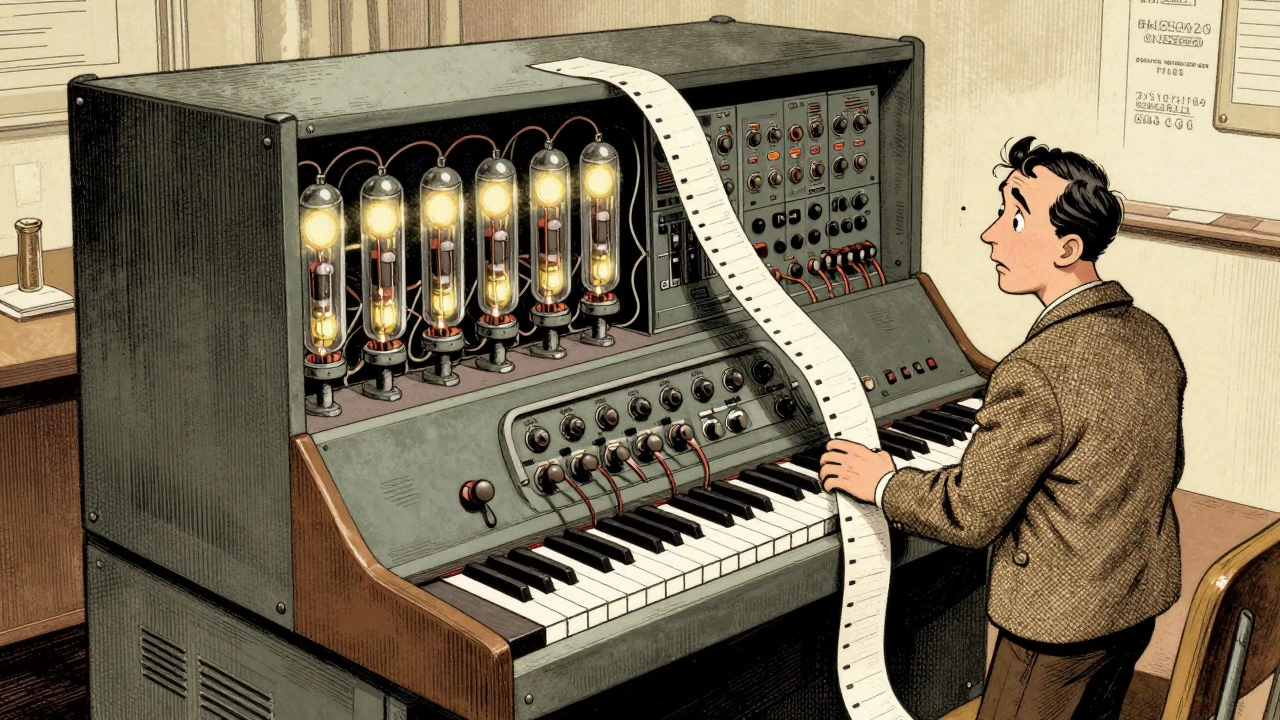

Imagine trying to play a song on an instrument that looks more like a server rack than a piano. That was the reality for musicians in the 1950s when Synthesizers were room-sized laboratory machines requiring punched tape and vacuum tubes. Today, those same tools fit in your pocket or run as software on a laptop. The journey from engineering nightmare to everyday creative tool is one of the most fascinating stories in music history. It wasn't just about making new sounds; it was about how human beings adapted their brains and hands to control electricity.
The story isn't linear. It’s a series of jumps where each new generation of technology lowered the barrier to entry while raising the ceiling for creativity. From Bob Moog’s modular cables to the digital menus of modern workstations, every shift changed what it meant to be a "synth player." If you’ve ever felt overwhelmed by a patch cable or a confusing menu system, you’re standing on the shoulders of giants who figured out exactly how to make this complex tech feel musical.
From Lab Equipment to Stage Instruments
In the early 1950s, synthesizers didn’t belong in bands. They belonged in universities. The RCA Electronic Music Synthesizers, developed by Harry Olson and Herbert Belar, were massive, expensive, and difficult to operate. You didn’t "play" them in real-time; you programmed them offline using paper tape. The learning curve here was steep because the user had to be part engineer, part programmer, and part composer. There was no feedback loop between hand and ear. You made a choice, waited for the tape to process, and hoped it sounded right.
This changed in the mid-1960s with Bob Moog. Moog introduced modular systems that used voltage control. This was a game-changer because it allowed musicians to hear changes instantly. Instead of programming a sequence, you could twist a knob and hear the pitch change immediately. However, these systems still required understanding signal flow. You had to know which cable went into which jack to get a sound at all. For many rock and psychedelic artists of the era, mastering this physical patching was the primary hurdle. It took weeks or months to learn the logic of oscillators, filters, and envelopes, but once understood, the concepts stuck because they were tangible.
The Minimoog Revolution and Tactile Control
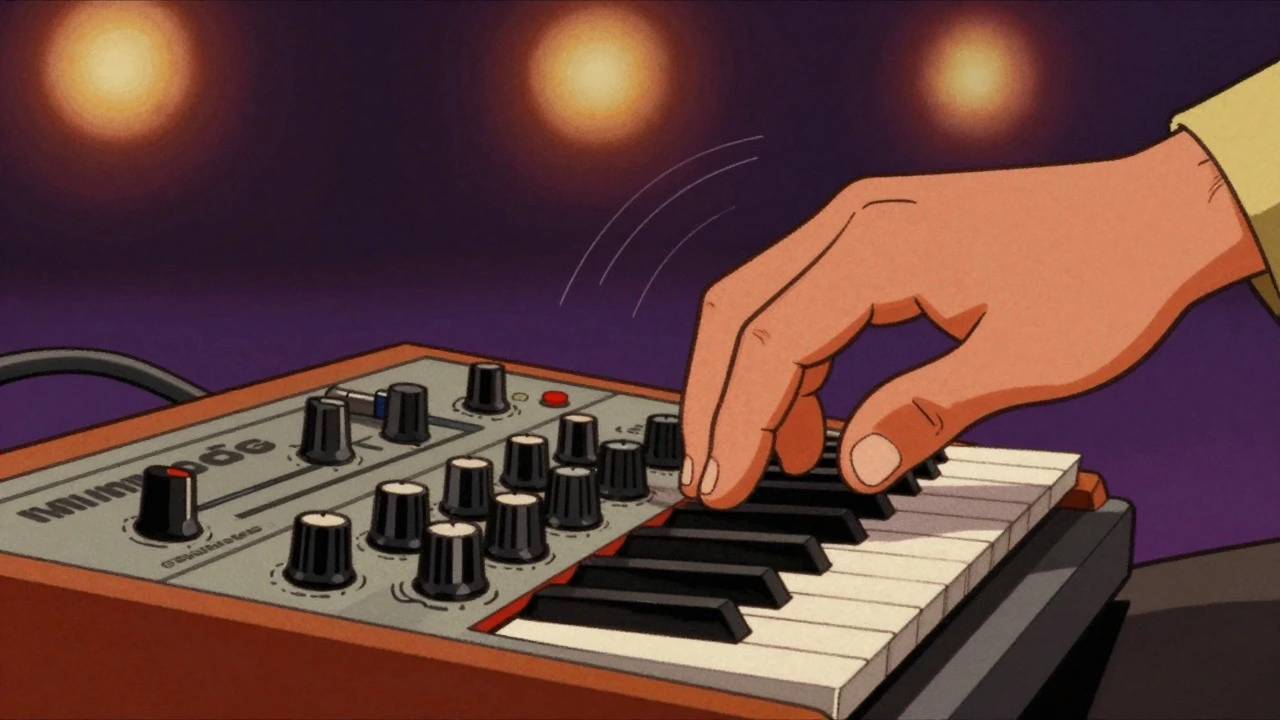
The biggest drop in the learning curve happened in 1970 with the release of the Minimoog. Before this, synthesizers were often static studio monsters. The Minimoog put a keyboard on top and fixed the internal wiring. You no longer needed cables to connect basic components. You just played. This standardized the subtractive synthesis architecture: three oscillators, a filter, and envelope generators. Because the controls were large, tactile knobs, musicians could learn by feel rather than theory. Rock and funk players in the early 1970s incorporated the Minimoog into their setups within weeks. They treated it like a lead guitar, using pitch bends and filter sweeps to express emotion directly through their fingers. The technology became secondary to the performance.
Memory, MIDI, and the Digital Shift
By the late 1970s, the challenge shifted from playing the instrument to managing it. The Sequential Circuits Prophet-5, released in 1978, introduced patch memory. Suddenly, you could program a complex sound during rehearsal and recall it instantly on stage. This reduced the cognitive load during live performance but added a new layer of complexity: data entry. Musicians now had to learn how to save, store, and organize sounds.
Then came MIDI (Musical Instrument Digital Interface) in 1982. This protocol allowed different instruments to talk to each other. For a working musician, this meant controlling multiple synths from one keyboard. But it also meant learning device addressing, channels, and clock synchronization. While it simplified some workflows, it added a technical layer that required study. By the mid-1980s, however, the ecosystem had matured. Synthesizers were on nearly every mainstream album. The learning curve had flattened enough that tens of thousands of studio and touring musicians could operate factory presets and simple edits without being engineers. The social adaptation caught up with the technical feasibility, largely driven by iconic recordings that proved synthetic timbres could carry emotional weight.
Modern Interfaces: Menus vs. Knobs
Today, the landscape is split. On one side, we have hardware synths with clearly labeled front panels, designed to shorten the time to productivity. On the other, we have complex digital workstations and virtual instruments (VSTs) that offer limitless possibilities but come with deep menu systems. Community feedback from forums like r/synthesizers highlights a recurring theme: the steepest part of the modern learning curve is often interface design, not synthesis theory. Users report that starting with a simple analog or virtual analog synth helps reduce confusion. Understanding the basic signal path-oscillator to filter to amplifier-provides quick "aha" moments. But navigating nested parameters on a screen can overwhelm beginners. Many musicians now spend more time listening and experimenting with simple tools before diving into advanced modulation matrices or wavetable synthesis. The trend suggests that manufacturers are responding by designing more intuitive interfaces, recognizing that clarity drives adoption.
Market Growth and Continued Adoption
The numbers back up the idea that this technology has become mainstream. Global consumption of electrical musical and keyboard instruments reached 15 million units in 2024, valued at $2.7 billion. Analysts project growth to 25 million units and $4.5 billion by 2035. This consistent expansion indicates that millions of users worldwide are investing in electronic instruments. Hardware keyboards and synthesizers remain central, accounting for around 62.7% of the market in recent reports. This isn't just a niche hobby; it's a core part of modern music production. As new models and software instruments continue to release, each generation requires musicians to adapt to evolving features, ensuring the learning curve remains dynamic but accessible.
| Era | Key Technology | Primary Learning Hurdle | User Adaptation Strategy |
|---|---|---|---|
| 1950s | RCA Punched Tape Machines | Engineering & Offline Programming | Specialized training in labs |
| 1960s | Moog Modular Systems | Voltage Control & Patching Logic | Hands-on experimentation with cables |
| 1970s | Minimoog (Fixed Architecture) | Tactile Performance Controls | Treating synth as a lead instrument |
| 1980s | Prophet-5 & MIDI | Patch Memory & Device Synchronization | Programming sets & relying on recall |
| 2020s | Digital Workstations & VSTs | Menu Navigation & Complex Modulation | Starting simple & incremental skill building |
Practical Tips for Modern Learners
If you’re picking up a synth today, don’t try to master everything at once. Start with the signal path. Understand how an oscillator generates a wave, how a filter shapes its tone, and how an envelope controls its volume over time. These four concepts cover 80% of what you need to know to make interesting sounds. Ignore the modulation matrix until you’re comfortable with the basics. Use hardware with physical knobs if possible; the immediate feedback loop accelerates learning significantly. And remember, even the pros use presets. Knowing how to tweak a factory sound is a valid skill. The goal isn’t to build a sound from scratch every time; it’s to have the confidence to shape the sound to fit your musical vision.
Is the synthesizer learning curve harder than traditional instruments?
It depends on what you mean by "harder." Traditional instruments require years of physical technique and muscle memory. Synthesizers require conceptual understanding of electronics and signal flow. For many, the initial barrier is lower because you can make a sound immediately, but the depth of customization is much greater. Mastering advanced synthesis takes years, similar to mastering jazz improvisation on a piano.
Should I start with hardware or software synths?
Hardware is generally recommended for beginners due to tactile feedback. Physical knobs allow you to hear changes instantly, which reinforces learning. Software synths offer more flexibility and cost less, but navigating menus can slow down the creative process. If you already use a DAW, a simple virtual analog plugin is a great low-cost entry point.
How long does it take to become proficient with a synthesizer?
Most users report becoming comfortable with core subtractive synthesis within a few months of regular practice. Basic operation can be grasped in days. However, mastering advanced techniques like FM synthesis, wavetables, or complex modulation routing can take years. The timeline varies based on prior musical experience and the specific instrument chosen.
Why did it take so long for synthesizers to become popular?
Initially, synthesizers were viewed as avant-garde tools with limited commercial potential. They were expensive, bulky, and required specialized knowledge. It wasn't until the 1970s, with the introduction of affordable, portable instruments like the Minimoog and iconic albums like Wendy Carlos's 'Switched-On Bach,' that mainstream acceptance grew. Social and aesthetic adaptation lagged behind technical feasibility by roughly a decade.
What is the role of MIDI in modern synth usage?
MIDI allows different electronic instruments to communicate. It enables a single keyboard to control multiple synthesizers, simplifies studio workflows, and standardizes communication between hardware and software. While it adds a layer of technical complexity regarding channels and addressing, it is essential for any serious electronic music setup and remains the industry standard decades after its introduction.