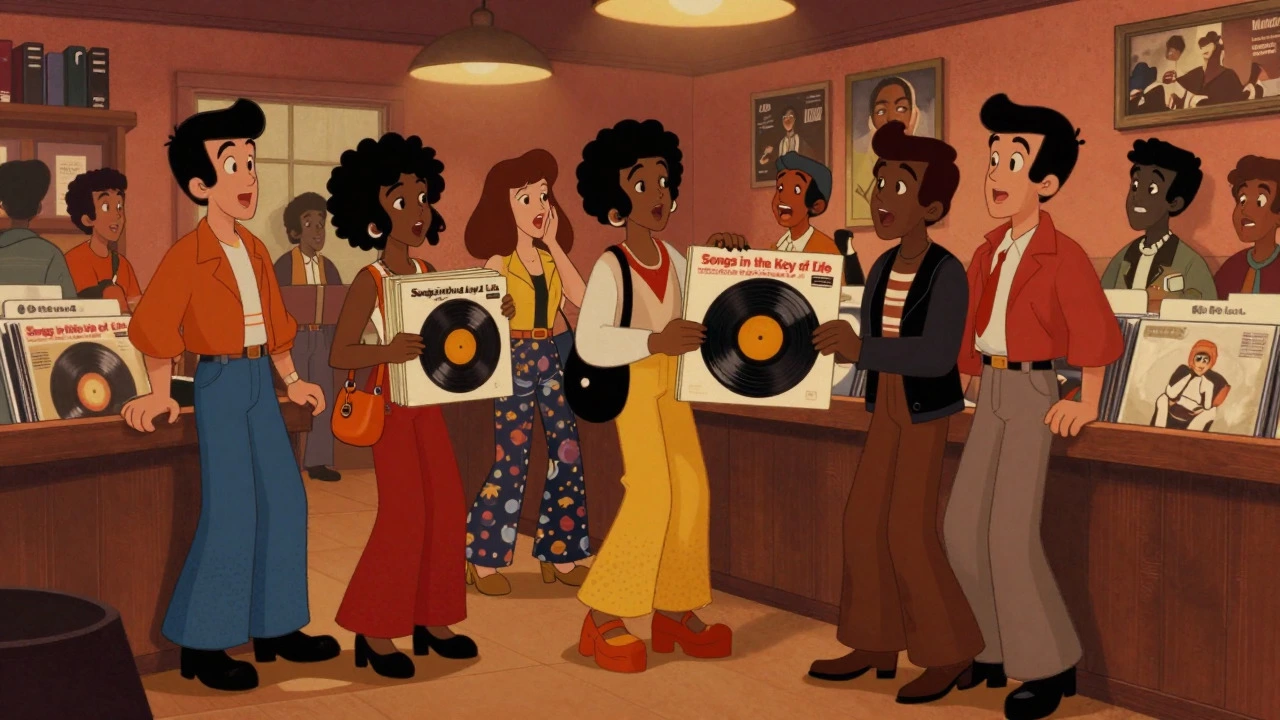

Imagine buying an album in 1976 and paying nearly $14 for it. That was a lot of money back then-roughly equivalent to $60 today. You weren’t just getting one record; you were getting two LPs plus a bonus EP. Most people would have walked away. But for Songs in the Key of Life, the landmark double album by Stevie Wonder released in September 1976, fans didn’t hesitate. They bought it because they knew they were witnessing something historic.
This isn’t just another entry in the discography of Stevie Wonder, American singer, songwriter, and multi-instrumentalist born Stevland Hardaway Morris. It is widely considered his magnum opus. It is also one of the most significant achievements in the history of soul music, a genre blending rhythm and blues, gospel, and pop influences. Released by Motown Records, the iconic Detroit-based record label founded by Berry Gordy' Tamla imprint, this project changed how artists approached creative control, studio production, and thematic depth in popular music.
The Unprecedented Creative Freedom
To understand why this album sounds so different from what came before, you have to look at the business side. By the mid-1970s, Wonder had already released a string of critically acclaimed albums like Talking Book (1972) and Innervisions (1973). He wasn't just a performer anymore; he was a producer who wanted total say over his art.
In 1975, Wonder renegotiated his contract with Motown. The deal was reportedly worth $13 million-an astronomical figure for a Black recording artist at that time. This financial leverage gave him something rare: independence. He could spend as much time in the studio as he wanted. He could hire whoever he wanted. He could write about whatever he wanted.
That freedom resulted in a recording process that stretched across roughly two years, from 1974 to 1976. Sessions took place in high-end studios across the country, including Crystal Sound, a famous recording studio in Hollywood, California, the Record Plant, a renowned recording studio with locations in Los Angeles and Sausalito, and The Hit Factory, a prominent recording studio in New York City. Wonder produced, arranged, and wrote or co-wrote every single song on the album. He played most of the instruments himself. This level of personal involvement created a cohesive sonic identity that felt intimate despite its massive scale.
A Panoramic View of Life and Love
The title says it all. This isn’t a collection of random hits. It’s a narrative arc exploring love, spirituality, social justice, and family. The album opens with "Love’s in Need of Love Today," a seven-minute gospel-soul ballad that sets a serious, urgent tone. It’s a plea for compassion in a world filled with hatred. From there, the journey gets deeper.
Wonder tackles heavy subjects with grace. In "Village Ghetto Land," co-written with poet Gary Byrd, he uses orchestral synthesizers to describe poverty and systemic neglect in urban Black communities. It’s socially conscious music in the vein of Marvin Gaye’s What’s Going On, but with a distinct futuristic sound thanks to Wonder’s mastery of electronic instruments. Then there’s "Black Man," an eight-minute funk track that celebrates the contributions of African Americans to US history through call-and-response vocals.
But it’s not all serious. The album swings wildly between the profound and the playful. "Sir Duke" is a joyous tribute to jazz legends like Duke Ellington, Louis Armstrong, and Ella Fitzgerald. It’s upbeat, horn-driven, and impossible not to dance to. "I Wish" looks back nostalgically at childhood with a syncopated bass line that became instantly iconic. These tracks show that soul music could be both intellectually stimulating and commercially catchy.
| Track Name | Duration | Primary Theme | Musical Style |
|---|---|---|---|
| Love’s in Need of Love Today | 7:06 | Compassion and Social Responsibility | Gospel-Soul Ballad |
| Village Ghetto Land | 3:25 | Urban Poverty and Neglect | Orchestral Synth-Funk |
| Sir Duke | 3:54 | Jazz History Tribute | Upbeat Funk-Soul |
| I Wish | 4:12 | Nostalgia for Childhood | Syncopated Bass Funk |
| Isn’t She Lovely | 6:34 | Celebration of Daughter Aisha | Mid-Tempo Soul with Harmonica |
| As | 7:08 | Unconditional Love | Extended Groove-Based Soul |

The Bonus EP and Extended Cuts
Here’s where things get interesting. When the album first dropped, it came as a double LP with 17 core tracks. But wait-there was more. Motown included a separate seven-inch EP called "A Something’s Extra" with four additional songs: "Saturn," "Ebony Eyes," "All Day Sucker," and "Easy Goin' Evening (My Mama’s Call)." This made the complete package a triple album experience, totaling 21 songs and running over 104 minutes.
Why include these? Because they offered different textures. "Ebony Eyes" is a haunting, slow-burning ballad that showcases Wonder’s vocal vulnerability. "Saturn" is a psychedelic instrumental that feels almost otherworldly. Later CD reissues integrated these tracks into the main sequence, which helps modern listeners appreciate the full scope of the work without having to hunt down rare vinyl discs.
One standout from the second half of the album is "Isn’t She Lovely." Written for Wonder’s daughter Aisha, it features baby sounds, a memorable harmonica melody, and a gentle rhythm. It became one of his most recognizable songs, proving that deeply personal moments could resonate universally. Similarly, "Pastime Paradise" uses a repetitive minor-key keyboard ostinato to contrast materialism with spiritual fulfillment. Its influence extended far beyond the 1970s, eventually inspiring Coolio’s "Gangsta’s Paradise" in the 1990s.
Commercial Dominance and Critical Reception
You might think an album this long and complex would struggle commercially. You’d be wrong. Songs in the Key of Life debuted at number one on the Billboard 200 chart and stayed there for 14 weeks-the longest run at the top for any Motown album before or since. It also topped the R&B albums chart for 20 weeks. Singles like "I Wish" and "Sir Duke" dominated radio airwaves, bringing the album’s deeper cuts into mainstream homes.
Critically, the reception was mixed at first. Some reviewers, like Robert Christgau of the Village Voice, called it a "flawed masterpiece," citing convoluted lyrics and occasional lack of focus. Others praised its ambition. Over time, however, consensus shifted. Today, it is consistently ranked among the greatest albums of all time. BBC Music highlights its "sheer musicality" and diversity, while platforms like Genius frame it as the pinnacle of Wonder’s career at age 26.
In 2005, the Recording Industry Association of America (RIAA) certified the album diamond, recognizing sales of 10 million units in the United States. That’s a rare feat for a soul/R&B album from the 1970s. It places Songs in the Key of Life in the top tier of best-selling Motown releases, alongside classics by The Supremes and The Temptations.
Legacy and Lasting Influence
Fifty years later, does this album still matter? Absolutely. It remains fully integrated into modern music catalogs, available on streaming services like Spotify and Apple Music. Audiophile editions on SACD and high-resolution digital formats preserve the dynamic range and multi-layered arrangements that defined its original production.
Its influence extends beyond soul and R&B. Hip-hop producers have sampled its grooves for decades. Pop musicians cite it as a blueprint for artistic integrity. And new generations of listeners continue to discover its emotional depth. Whether you’re drawn to the funk of "Contusion," the romance of "Another Star," or the spiritual reflection of "Have a Talk with God," there’s something here for everyone.
For those new to Stevie Wonder, start with the singles: "Sir Duke," "I Wish," and "Isn’t She Lovely." Let them pull you in. Then sit down and listen to the whole thing. Don’t rush it. Take your time. Let the themes unfold. You’ll see why this album isn’t just a product of the 1970s-it’s a timeless statement on what music can achieve when given the space to breathe.
When was Songs in the Key of Life released?
The album was officially released on September 28, 1976, by Motown’s Tamla imprint. Some sources cite October 8, 1976, due to variations in street dates across different regions.
How many songs are on the complete version of the album?
The complete configuration includes 21 songs: 17 on the main double LP and 4 on the bonus EP titled "A Something’s Extra." Later CD editions combine all tracks onto two discs.
Did Stevie Wonder produce the entire album himself?
Yes. Wonder served as the sole producer and arranger for the entire project. He also wrote or co-wrote every song and performed most of the instrumentation, relying only on a small circle of guest musicians.
Is Songs in the Key of Life considered a best-selling album?
Yes. It was certified diamond by the RIAA in 2005 for selling 10 million units in the United States, making it one of the best-selling Motown albums of all time.
What makes this album different from other 1970s soul records?
Its scale, thematic depth, and creative control set it apart. With 21 tracks spanning over 100 minutes, it explores spirituality, social justice, and personal relationships with unprecedented detail. Wonder’s use of synthesizers and studio layering also pushed the boundaries of soul music production.
Which studios were used to record the album?
Recording sessions took place at Crystal Sound in Hollywood, Record Plant in Los Angeles and Sausalito, and The Hit Factory in New York City between 1974 and 1976.
Are there any controversial aspects of the album’s reception?
Initially, some critics found the lyrics overly complex or the structure too sprawling. Robert Christgau famously called it a "flawed masterpiece." However, retrospective reviews have overwhelmingly elevated it to canonical status.
Can I listen to the full album on streaming platforms?
Yes. The complete 21-track version is available on major streaming services like Spotify, Apple Music, and Amazon Music, often with remastered audio quality.


