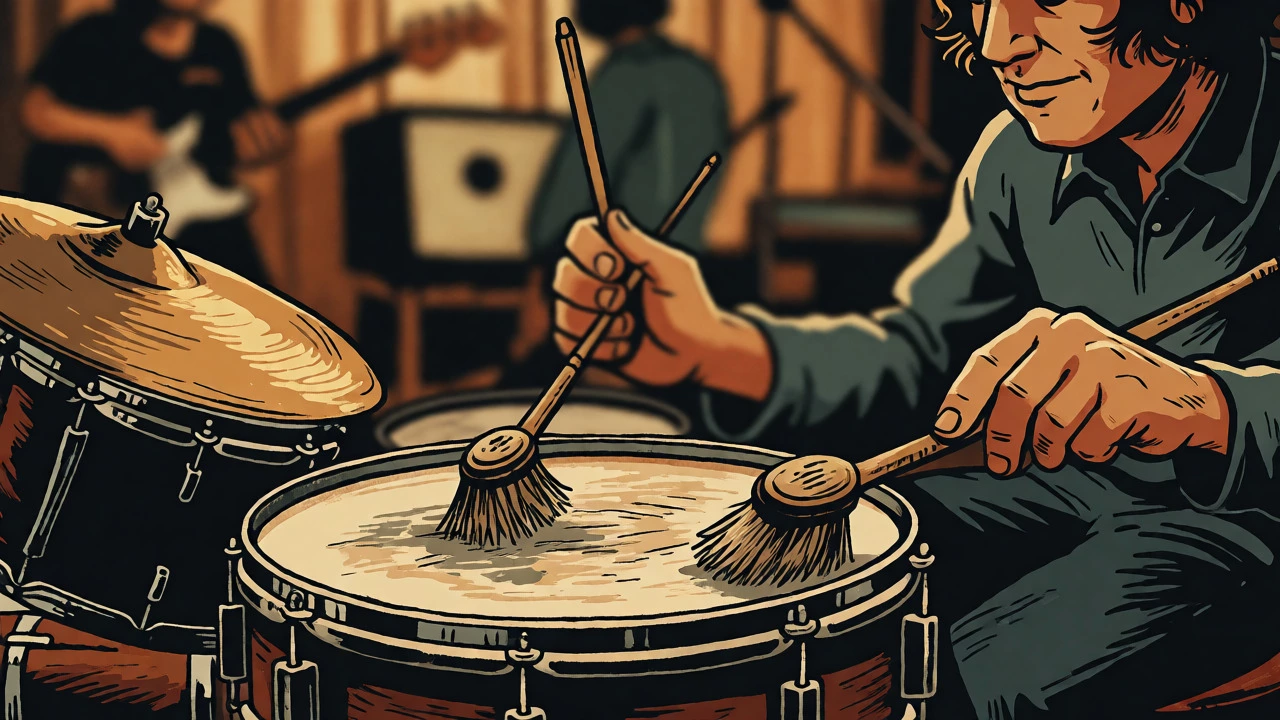

Think about the last time you heard a soft rock ballad that felt incredibly smooth yet powerful. You probably didn’t notice the drummer. That’s the point. In genres like soft rock, a style of popular music that emerged in the late 1960s and dominated the 1970s, characterized by smooth timbres and polished production, the drum part isn’t about showing off chops or filling every silence with noise. It’s about serving the song. If you’re trying to nail that vibe, you need to master three specific tools: brushes, rimshots, and the art of restraint within the pocket.
Defining the Pocket in Soft Rock
Before you pick up a stick or a brush, you have to understand what "the pocket" actually is. It’s not just playing on time. Playing on time means hitting the beat when the metronome clicks. Playing in the pocket means locking in with the bass player so tightly that the rhythm feels inevitable. In soft rock, this often involves a slight "lay back," where the snare hits a fraction of a second after the strict grid. This creates a relaxed, human feel that supports vocal phrasing rather than competing with it.
Drummer Dennis Chambers describes this as retaining a clear time position while slightly delaying the attack. For a beginner, this can be tricky. If you lay back too much, the song drags and loses energy. If you rush, the arrangement sounds anxious. The goal is consistency. Your kick drum should align perfectly with the bass notes, creating a solid foundation, while your snare floats just behind that foundation. This micro-placement allows the singer to breathe and the guitarist to strum without fighting for sonic space.
The Art of Brush Technique
Brushes are the signature sound of intimate soft rock verses. They provide a continuous, warm texture that sticks simply cannot replicate. However, many drummers struggle with them because they treat them as a weaker version of sticks. They aren’t. They require a completely different physical approach.
There are two main actions: sweeping and tapping. A sweep creates sustained noise and motion; a tap provides a discrete pulse. To get started, use a coated snare head. The rough surface gives the bristles something to grip, allowing for a controlled swish rather than a slippery slide. Start slow. Set your metronome to 50 beats per minute. Practice making one full clockwise circle with your left hand per beat. Use your arm, not just your wrist. Once that feels natural, add your right hand doing the same motion in the opposite direction. Then, introduce taps with your right hand on the downbeats while your left hand maintains the sweep.
| Implement | Primary Sound Characteristic | Best Application | Dynamic Range |
|---|---|---|---|
| Wire Brushes | Continuous sweep, adjustable articulation | Ballads, low-volume verses | Low to Medium |
| Cross-Stick (Rim Click) | Dry, high-pitched click, minimal resonance | Rhythmic definition without broadband energy | Low |
| Standard Sticks | Clear attack, wide tonal variety | Choruses, bridges, general groove | Wide |
| Rods (Hot Rods) | Softer attack than sticks, louder than brushes | Mid-dynamic sections, stage volume control | Medium |
Don’t make the mistake of treating every brush stroke equally. Vary your pressure. In a verse, keep the sweep light and airy. As the pre-chorus builds, increase the pressure and the size of your circles. When the chorus hits, you might switch to sticks or heavier taps. Remember, brushes aren’t automatically quiet. A forceful sweep can overpower a delicate vocal just as easily as a loud stick hit. Control comes from touch, not just equipment choice.
Rimshots vs. Cross-Sticks: Knowing the Difference
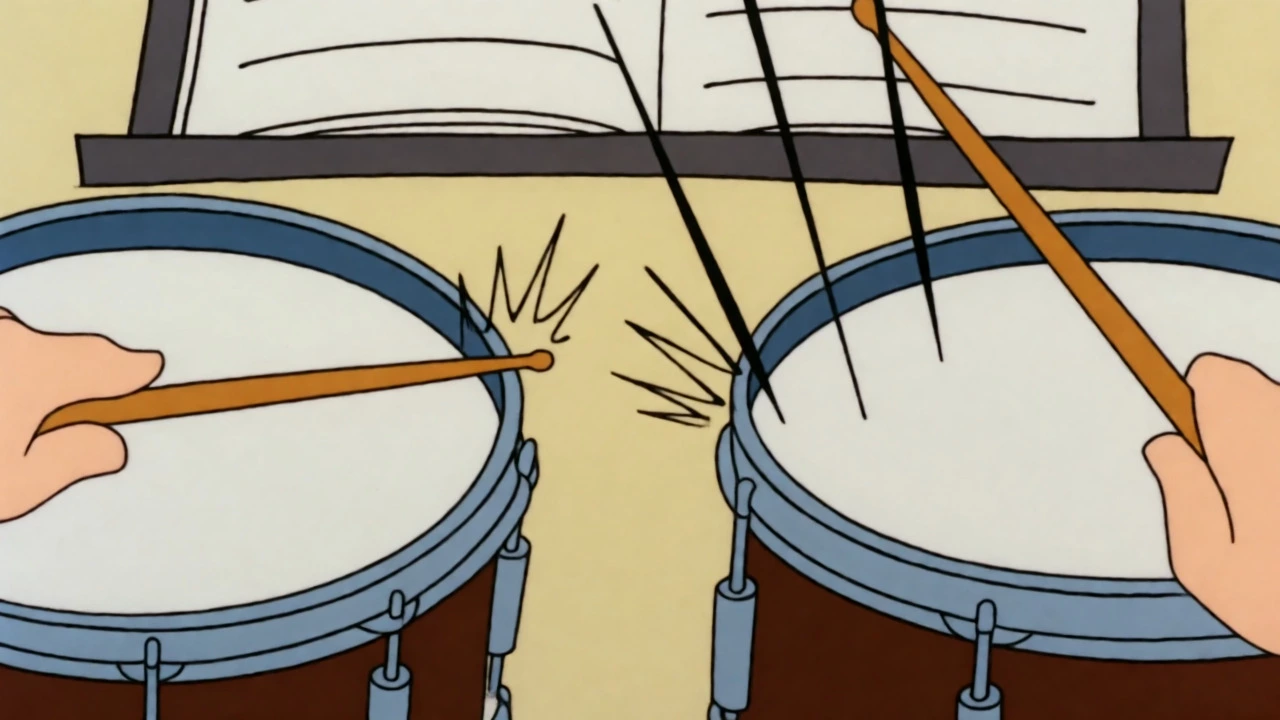
A common confusion among newer players is mixing up rimshots and cross-sticks. They sound similar but serve very different purposes. A rimshot is created by striking the snare head and the rim simultaneously with the tip of the stick. This produces a loud, cutting accent that cuts through the mix. It’s an exclamation point in your rhythm pattern.
In contrast, a cross-stick (also called a side-stick or rim click) involves laying the stick across the head and striking the butt end against the opposite rim. This produces a dry, high-pitched click with almost no head resonance. It’s a whisper, not a shout. In soft rock, the cross-stick is invaluable for verses where you need rhythmic clarity without adding volume or mud. It keeps the time ticking over without masking the acoustic guitar or piano.
Use the cross-stick when the arrangement is sparse. Think of the intro to Bread’s "Make It with You." The drums don’t crash in; they tick along, supporting the melody. Save the rimshot for structural peaks. Maybe you use it on the final snare of a four-bar phrase to signal a transition, or on the first beat of a chorus to lift the energy. If you use rimshots on every backbeat, you’ll lose their impact. Restraint means saving the big sounds for moments that truly deserve them.
Engineering Restraint: Tuning and Recording
Your performance doesn’t exist in a vacuum. It interacts with microphones, room acoustics, and mixing engineers. Soft rock recordings rely heavily on clean transients and controlled decay. If your snare rings out for three seconds after every hit, it will muddy the mix, especially when layered with strings or backing vocals.
Tuning plays a huge role here. Lower snare tunings produce a longer, deeper decay associated with classic rock, while higher tunings offer a tighter, more contemporary pop sound. For soft rock, you often want a middle ground: enough body to sound musical, but short enough decay to stay out of the way. Many pros use internal dampening or external gels to control overtones. The goal is a "dry" sound that sits nicely in a dense arrangement.
When recording, watch your levels carefully. Percussion has sharp transients, meaning peak meters can jump high even if the average volume is low. Engineers often aim for around -4 dB on VU meters for drums to leave headroom. Compression is another tool to handle with care. Too much compression flattens the dynamics, killing the emotional arc of your performance. A medium attack and short release can help thicken the sound without erasing the subtle nuances of your brush work or cross-sticks. Automation is your friend here; ride the fader up during choruses and pull it back during verses to enhance the natural ebb and flow.
Practical Practice Routine
You can’t just read about this stuff; you have to play it. Here is a simple 30-minute daily routine to build these skills:
- 5 Minutes: Low-Height Stick Strokes. Focus on consistent rebound and minimal stick height. Play quarter notes on the snare at 80 BPM. Listen for evenness.
- 5 Minutes: Cross-Stick Consistency. Find the sweet spot on your snare rim. Play eighth notes with a metronome. Ensure every click sounds identical in pitch and volume.
- 10 Minutes: Brush Circles. Set tempo to 50-60 BPM. Practice the left-hand circle, then the right-hand circle, then both together. Add simple right-hand taps on beats 2 and 4.
- 10 Minutes: The Dynamic Ladder. Play a 16-bar form. Bars 1-4: Brushes only. Bars 5-8: Cross-sticks. Bars 9-12: Light sticks (no rimshots). Bars 13-16: Sticks with selective rimshots on the "and" of beat 4. Record yourself and listen back. Does the transition feel musical, or like you’re just changing tools?
Listening for Inspiration
To really understand this style, you need to analyze the masters. Listen to The Carpenters. Their drummer, Hal Blaine, set the standard for studio precision. Notice how the drums support Karen Carpenter’s voice without ever getting in her way. Study Fleetwood Mac’s "Rumours." Mick Fleetwood’s parts are deceptively simple but incredibly deep in the pocket. Pay attention to how he uses space. He doesn’t fill every gap. He lets the song breathe.
Also, check out Toto’s "Rosanna." While Jeff Porcaro is known for his shuffle, his ability to dial back the intensity for softer passages is a masterclass in restraint. These examples show that soft rock drumming isn’t about being boring; it’s about being intentional. Every note has a job. If a note doesn’t help the vocalist or the harmony, drop it.
What is the difference between a rimshot and a cross-stick?
A rimshot strikes the snare head and rim simultaneously for a loud, cutting accent. A cross-stick lays the stick across the head and strikes the butt against the rim for a dry, quiet click. Rimshots are for emphasis; cross-sticks are for low-volume rhythmic definition.
Do I need special brushes for soft rock?
Not necessarily, but wire brushes generally offer better articulation control than nylon ones. Look for brushes with adjustable bristle lengths if you want to vary stiffness. A coated snare head is highly recommended to ensure the brushes grip properly for a smooth sweep.
How do I know if I'm playing in the pocket?
You know you're in the pocket when the bassist and vocalist feel locked in with you. If they can phrase freely over your beat without rushing or dragging, you've succeeded. It's less about technical perfection and more about ensemble cohesion and consistent timing.
Can I use rods instead of brushes?
Yes, rods (or hot rods) are a great intermediate option. They are louder than brushes but softer than sticks. They work well in live settings where brushes might get lost in the mix, providing a textured sound with more projection.
Why does my brush sweep sound uneven?
Uneven sweeps usually come from using only your wrist instead of your arm, or lifting the brushes too high between strokes. Keep the contact area constant and use large, circular arm motions. Slow down your practice tempo until the motion feels fluid.