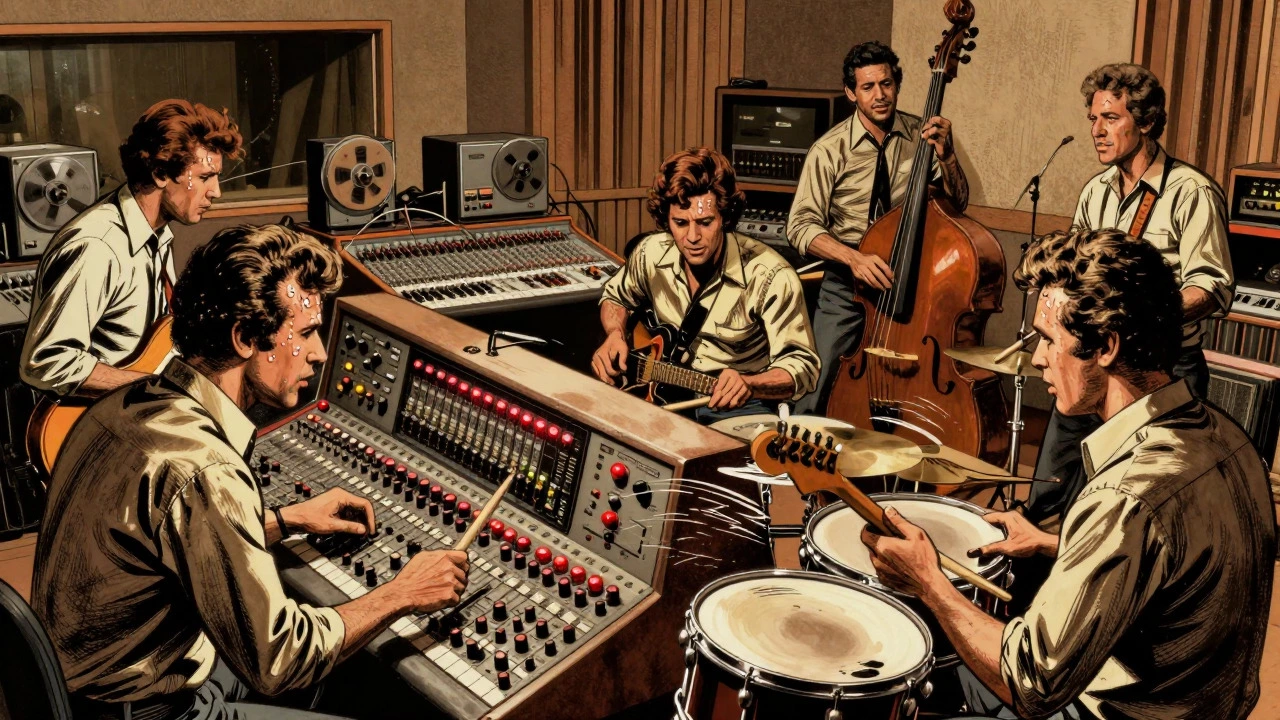

When you press play on a classic 1970s record, you hear the lead singer and maybe the main guitarist. But beneath that surface lies a complex architecture of rhythm, harmony, and texture that made the track feel "complete." This was the work of session musicians, highly skilled professional players hired to perform backing tracks in recording studios. These individuals were the unsung engines of the era, transforming raw ideas into gold-plated hits across pop, rock, soul, and country. Without their precision and speed, the polished sheen of 1970s radio would have been impossible.
The Definition of a Session Professional
In the 1970s recording industry, a session musician was not just a backup player; they were a specialized tool for production. Hired on a per-session basis, usually for 3 to 4-hour blocks, these professionals were valued for three specific traits: technical precision, rapid learning ability, and stylistic versatility. Unlike touring bands who developed a fixed identity over years, session players had to adapt instantly to the producer's vision. Whether it was a delicate ballad or a driving rock anthem, the job was to lock in with the artist and deliver a usable take in minimal passes. This efficiency was critical because studio time was billed hourly, and major labels scheduled sessions tightly to control costs.
The Los Angeles Powerhouse: The Wrecking Crew
No discussion of 1970s studio sound is complete without acknowledging The Wrecking Crew, a collective of elite session musicians based in Los Angeles who dominated the West Coast recording scene from the 1960s into the early 1970s. While their peak fame began in the 1960s, their influence defined the sonic landscape of early-1970s pop and rock. The group included drummers like Hal Blaine and Jim Gordon, bassists Carol Kaye and Lyle Ritz, and guitarists Glen Campbell and Tommy Tedesco. Their reputation rested on an almost supernatural ability to learn songs by ear in minutes and play them flawlessly. For producers like Phil Spector and Lou Adler, booking The Wrecking Crew meant guaranteeing a high-quality foundation for any project, from film scores to top-40 singles.
The Southern Groove: Muscle Shoals Rhythm Section
While Los Angeles offered polish, Alabama offered soul. In the small town of Muscle Shoals, a quartet known as the Muscle Shoals Rhythm Section (or "The Swampers") created a distinctively warm and deep pocket that attracted artists from all over the world. Consisting of Roger Hawkins (drums), Jimmy Johnson (guitar), Barry Beckett (keyboards), and David Hood (bass), this group evolved from being house employees at FAME Studios to owners of their own facility, Muscle Shoals Sound Studio, after 1969. Their style blended R&B, gospel, and country, creating a hybrid groove that felt both earthy and sophisticated. Artists like Aretha Franklin, Wilson Pickett, and even The Rolling Stones traveled to Sheffield, Alabama, specifically to capture this unique feel that couldn't be replicated in New York or California.
The Singer-Songwriter Cohort: Immediate Family
As the decade progressed, a new wave of session players emerged in Los Angeles, tailored to the rise of the singer-songwriter movement. By the early 1970s, a tight-knit group including Danny Kortchmar (guitar), Russ Kunkel (drums), Leland Sklar (bass), and Waddy Wachtel (guitar) became the go-to team for producer Peter Asher. They worked extensively with Carole King and James Taylor, crafting the mellow, high-fidelity sound that defined albums like Tapestry and Flowin' Sandy. Unlike the more anonymous pool of earlier LA players, this cohort developed a recognizable identity, often referred to as Immediate Family. Their strength lay in dynamic nuance; they knew exactly how to support a vulnerable vocal performance without overpowering it, balancing rock backbeats with intricate acoustic interplay.
Regional Styles Compared
The difference between these groups wasn't just geographic; it was sonic. The Wrecking Crew provided the dense, orchestrated layers required for big-budget pop productions, often working in complex multi-track environments. In contrast, the Muscle Shoals Rhythm Section focused on groove and feel, relying less on technical showmanship and more on rhythmic cohesion. The Immediate Family cohort sat somewhere in between, offering the technical skill of LA players but with the organic, live-band energy preferred by singer-songwriters. This diversity allowed producers to choose the right "flavor" for their project, ensuring that a soul record didn't sound like a pop hit, and vice versa.
| Collective | Location | Key Members | Sonic Signature | Notable Collaborators |
|---|---|---|---|---|
| The Wrecking Crew | Los Angeles, CA | Hal Blaine, Carol Kaye, Glen Campbell | Polished, precise, versatile pop/rock | Phil Spector, Lou Adler, The Mamas and the Papas |
| Muscle Shoals Rhythm Section | Sheffield, AL | Roger Hawkins, David Hood, Barry Beckett | Warm, deep pocket, soul/country blend | Aretha Franklin, The Rolling Stones, Paul Simon |
| Immediate Family Cohort | Los Angeles, CA | Danny Kortchmar, Russ Kunkel, Leland Sklar | High-fidelity, nuanced singer-songwriter | Carole King, James Taylor, Peter Asher |
Economics and Working Conditions
The life of a top-tier session musician in the 1970s was intense but lucrative compared to the average gigging musician. Top players could command premium fees due to their reliability and speed. In Los Angeles, union scales applied, but the demand for elite talent often pushed rates higher. In Muscle Shoals, the transition from employee to owner changed the economics entirely; the Swampers participated in production profits, giving them a stake in the success of every record they touched. However, the pressure was constant. Producers expected finished backing tracks within a single session block. If a player couldn't keep up with the pace or adapt to the arrangement quickly, they risked losing their spot in the rotation. This environment fostered a culture of extreme professionalism where musical literacy was as important as talent.
Legacy and Recognition
For decades, many of these musicians remained anonymous, their names buried in liner notes or omitted entirely. Listeners recognized the sounds but rarely the faces. Today, however, there is a significant push to correct this historical oversight. Documentaries, biographies, and music history articles have brought figures like Hal Blaine and David Hood into the spotlight, recognizing them as co-creators of the era's most iconic records. The Wrecking Crew has been dubbed "the most recorded band in history," while the Muscle Shoals Sound Studio is now a historic landmark. This re-evaluation acknowledges that the 1970s studio sound was not just the product of famous frontmen, but of a collaborative ecosystem of highly skilled professionals who built the foundation upon which popular music stood.
Who were the most famous session musicians of the 1970s?
Key figures include Hal Blaine and Carol Kaye from The Wrecking Crew in Los Angeles, and Roger Hawkins, David Hood, Jimmy Johnson, and Barry Beckett from the Muscle Shoals Rhythm Section in Alabama. Additionally, Danny Kortchmar, Russ Kunkel, Leland Sklar, and Waddy Wachtel were pivotal in the singer-songwriter scene.
What was the difference between The Wrecking Crew and the Muscle Shoals Rhythm Section?
The Wrecking Crew was a larger, more diverse collective in Los Angeles known for polished pop and rock recordings with high technical precision. The Muscle Shoals Rhythm Section was a tighter quartet in Alabama known for a warmer, groove-oriented sound that blended soul and country, attracting artists seeking a more organic feel.
How much did session musicians earn in the 1970s?
Top session musicians were highly paid for their time, often earning premium rates above standard union scales due to their reliability and speed. While exact figures varied, their earnings were significantly higher than those of typical gigging musicians, reflecting their status as essential specialists in the recording industry.
Why were session musicians so important in the 1970s?
They provided the rhythmic and harmonic foundation for thousands of records, allowing artists and producers to achieve a professional, consistent sound without needing a permanent touring band. Their ability to learn songs quickly and adapt to different styles was crucial for the fast-paced recording schedules of the era.
Did session musicians get credit on record sleeves?
Often, no. Many session musicians were uncredited or listed only in fine print in the liner notes. It wasn't until later decades that their contributions were widely acknowledged and celebrated through documentaries, books, and retrospective articles.


