

Imagine standing in Moscow in August 1989. The air is thick with humidity and the roar of nearly 300,000 people. You are part of a hard-rock band from West Germany, playing to a crowd that has been starved of Western rock for decades. This wasn't just a concert; it was a cultural breach. Klaus Meine, the frontman of Scorpions, felt something shift in the atmosphere. He didn't know it yet, but he was about to write a song that would become the unofficial soundtrack to the end of the Cold War.
The Scorpions are a German rock band formed in Hannover in 1965, known for their hard rock hits and emotionally resonant power ballads. While they were already giants of the glam metal and hard rock scene, it was their ability to craft vulnerable, melodic ballads that truly cemented their global legacy. By the late 1980s, they had perfected a formula that blended technical proficiency with raw emotion. But "Wind of Change" wasn't written in a vacuum. It was the culmination of a decade of balladry that prepared audiences worldwide to accept a political message wrapped in a pop-rock package.
The Blueprint: Crafting the Power Ballad
To understand why "Wind of Change" hit so hard, you have to look at what came before it. In the early 1980s, the Scorpions weren't just riff machines; they were architects of the modern power ballad. Their 1979 track "Holiday" set the stage, proving that heavy guitars could support gentle, nostalgic melodies. But it was "Still Loving You," released in 1984 on the album Love at First Sting, that defined their signature sound.
Written by guitarist Rudolf Schenker and singer Klaus Meine, "Still Loving You" was a masterclass in dynamics. It started quiet, almost fragile, before exploding into a chorus that demanded attention. The song wasn't about politics; it was about a relationship hanging by a thread. Yet, its structure-slow build, emotional climax, soaring guitar solo-became the template for everything that followed. It reached No. 14 in Germany and became a massive hit in France, where fans reportedly named children after the lyrics. This success gave the band a dual identity: they could shred like AC/DC and cry like Air Supply.
Moscow Calling: The Inspiration Behind the Whistle
Fast forward to 1988 and 1989. The Soviet Union was opening up under Mikhail Gorbachev's reforms. The Moscow Music Peace Festival invited Western acts like Ozzy Osbourne, Mötley Crüe, and the Scorpions to play behind the Iron Curtain. For Meine, walking through Gorky Park and seeing young Russians embrace Western culture was electric. He later recalled feeling that the world was changing right before his eyes.
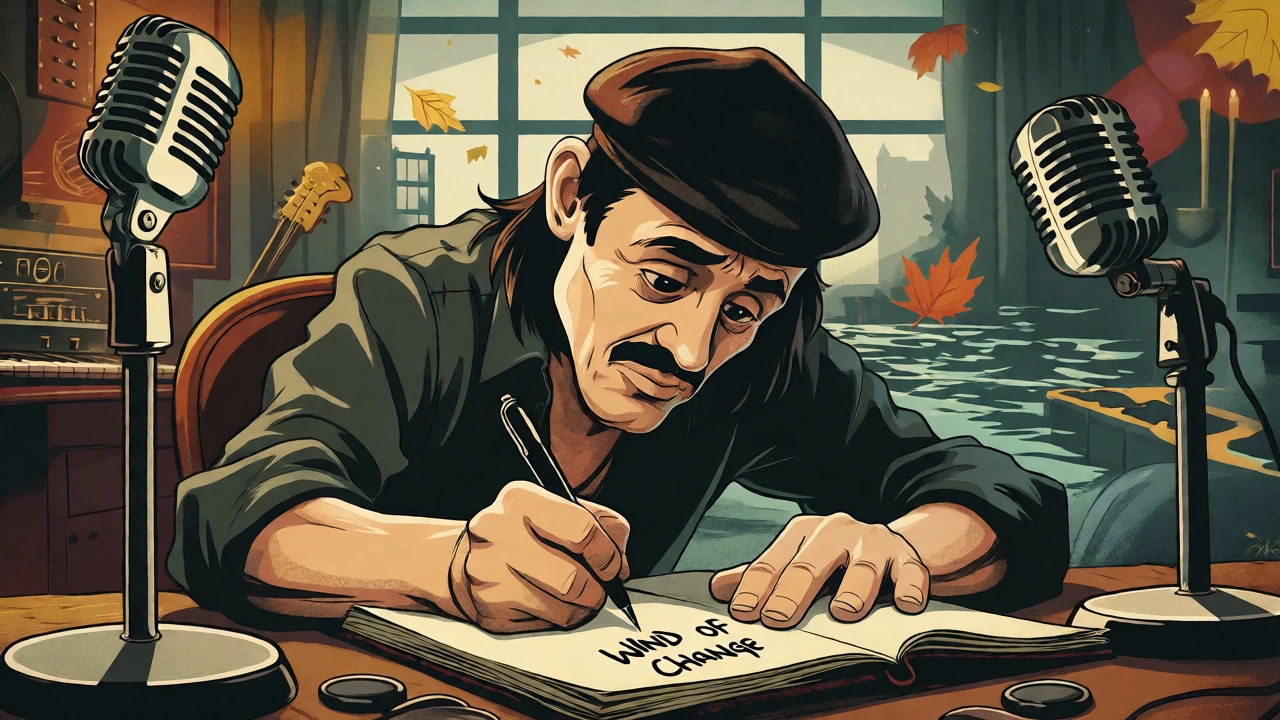
He wrote "Wind of Change" in September 1989, shortly after returning from this experience. Interestingly, the lyrics don't mention Berlin or the Wall. They reference the Moskva River and Gorky Park. The famous whistle intro? That was Meine trying to capture the mood of those open-air festivals, a universal language that needed no translation. The song was born not from a press release, but from the visceral experience of cultural thawing.
From Love Songs to Political Anthems
Why did a love song structure work for a political message? Because the audience already trusted the Scorpions with vulnerability. Tracks like "When the Smoke Is Going Down" (1982) and "Believe in Love" (1988) kept the romantic ballad tradition alive. These songs used metaphors of separation and reunion that listeners interpreted personally. When "Wind of Change" arrived, it simply expanded the scope. Instead of two lovers reuniting, it was East and West reuniting. The melody remained familiar, comforting even, which made the radical political content easier to digest.
This strategic continuity was crucial. If the band had suddenly switched to aggressive punk or complex prog-rock, the message might have been lost. By sticking to the ballad format, they ensured radio play across borders. The English lyrics helped too, allowing the song to travel from Paris to Los Angeles without needing localization.
The Myth vs. Reality: Did the CIA Write It?
No discussion of "Wind of Change" is complete without addressing the conspiracy theory that gained traction in recent years. A popular podcast investigation suggested that the CIA commissioned the song as a cultural weapon to soften Soviet attitudes toward the West. The idea was seductive: a secret agent writing a hit single to help win the Cold War.
Klaus Meine has repeatedly denied this. He insists he wrote the lyrics himself, drawing directly from his experiences in Russia. While the CIA angle makes for a great story, historical evidence supports Meine's account. The song was written before the Berlin Wall fell, not as a reaction to it. Its association with the Wall came later, when media outlets began pairing the song's video with footage of reunification. The song didn't cause the fall of the Wall, but it certainly provided the soundtrack for how we remember it.

Global Impact and Chart Domination
Released in late 1990, "Wind of Change" exploded globally. It hit No. 1 in Germany and six other countries, reaching No. 2 in the UK and No. 4 on the US Billboard Hot 100. Reports indicate it charted in 78 countries and sold over 14 million copies worldwide. This wasn't just commercial success; it was cultural penetration. In nations transitioning from communism, the song became an anthem of hope. In the West, it served as a comforting narrative that peace was possible.
| Song Title | Release Year | Primary Theme | Notable Feature |
|---|---|---|---|
| Holiday | 1979 | Nostalgia/Escapism | Early melodic foundation |
| Still Loving You | 1984 | Relationship Crisis | Dynamic guitar solos |
| Wind of Change | 1990 | Political Reconciliation | Famous whistle motif |
| Send Me an Angel | 1991 | Spiritual Guidance | Continued ballad success |
Legacy: Why It Still Matters
Today, "Wind of Change" remains one of the most recognizable songs in history. It transcends its origins as a German hard-rock track to become a universal symbol of peaceful transition. Critics sometimes dismiss it as overly sentimental, but that sentimentality was its superpower. It allowed millions of people to feel connected during a time of immense uncertainty.
The Scorpions proved that rock music could be more than rebellion; it could be reconciliation. Their 1980s ballads laid the groundwork for this achievement, turning personal heartbreak into collective healing. Whether you view it as a historical document or a manufactured memory, there's no denying its power. The whistle still cuts through the noise, reminding us of a moment when the world held its breath-and then exhaled.
Did the CIA actually write "Wind of Change"?
No, this is a popular myth. Klaus Meine, the lead singer of the Scorpions, has explicitly stated that he wrote the lyrics himself based on his experiences at the Moscow Music Peace Festival. While a podcast investigated the theory, there is no concrete evidence supporting CIA involvement.
Is "Wind of Change" about the Berlin Wall?
Technically, no. The lyrics specifically mention the Moskva River and Gorky Park in Moscow. However, because the song was released around the time the Berlin Wall fell and featured imagery of the Wall in its music video, it became culturally associated with German reunification and the end of the Cold War.
What is the most successful Scorpions ballad?
"Wind of Change" is their most commercially successful single globally, selling over 14 million copies and charting in 78 countries. However, "Still Loving You" is often cited by fans and critics as their artistic masterpiece and signature ballad within the rock genre.
How did the Scorpions' ballads influence other bands?
Their blend of heavy riffs and emotional vocals helped define the "power ballad" genre of the 1980s. Bands like Bon Jovi, Def Leppard, and Aerosmith adopted similar structures, using slow builds and high-register choruses to achieve mainstream radio crossover.
Are the Scorpions still active?
Yes, as of 2026, the Scorpions remain an active touring band. They have sold more than 110 million records worldwide and continue to perform classic hits alongside newer material.