
You hear it before you see it. That deep, undeniable pull that makes your head nod involuntarily while you’re driving or cooking dinner. It’s not just a beat; it’s a feeling. In the 1970s, R&B drumming evolved from simple timekeeping into an art form defined by three elusive concepts: the pocket, ghost notes, and shuffle grooves. These weren’t just technical terms for music nerds-they were the secret sauce behind hits by Al Green, The Meters, and Harold Melvin & the Blue Notes.
If you’ve ever tried to play along with those classic tracks and felt like something was missing, you weren’t imagining things. You were likely missing the nuance. This article breaks down how drummers shaped the sound of a decade, why "less is more" became the golden rule, and how you can actually hear-and feel-the difference between a stiff beat and a true groove.
The Elusive Concept of "The Pocket"
Ask ten drummers what "the pocket" is, and you’ll get ten different answers. Some say it’s playing slightly behind the beat. Others argue it’s about locking in perfectly with the bassist. The truth? It’s none of these exclusively, and all of them simultaneously. In 1970s R&B, the pocket wasn’t a fixed position on a timeline measured in milliseconds. It was a relationship.
Think of it like a conversation. If you interrupt every sentence, you’re annoying. If you wait too long to respond, the energy dies. Great R&B drummers like Al Jackson Jr. of Booker T. & the M.G.'s mastered this conversational flow. On Al Green’s "Let’s Stay Together," Jackson doesn’t just keep time; he breathes with the singer. He leaves space. He lets the bass line lead, then subtly nudges the groove forward when needed.
| Feature | In the Pocket | Out of Time |
|---|---|---|
| Relationship with Bass | Mutually supportive; drums reinforce bass syncopation. | Competitive; drums fight for rhythmic dominance. |
| Dynamics | Consistent; accents serve the song’s emotional arc. | Erratic; volume spikes distract from the groove. |
| Feel | Relaxed yet propulsive; feels inevitable. | Rigid or rushed; feels forced or anxious. |
Phil Gould, a respected drummer and educator, warns against confusing activity with groove. Many players think filling every silence with a note makes them sound better. In reality, 1970s R&B thrived on restraint. The pocket exists where the drums and bass lock together so tightly that the listener stops hearing individual instruments and starts hearing one unified pulse. If you’re trying to find the pocket, stop counting. Start listening to what the bass player isn’t playing.
Ghost Notes: The Secret Ingredient of Soul
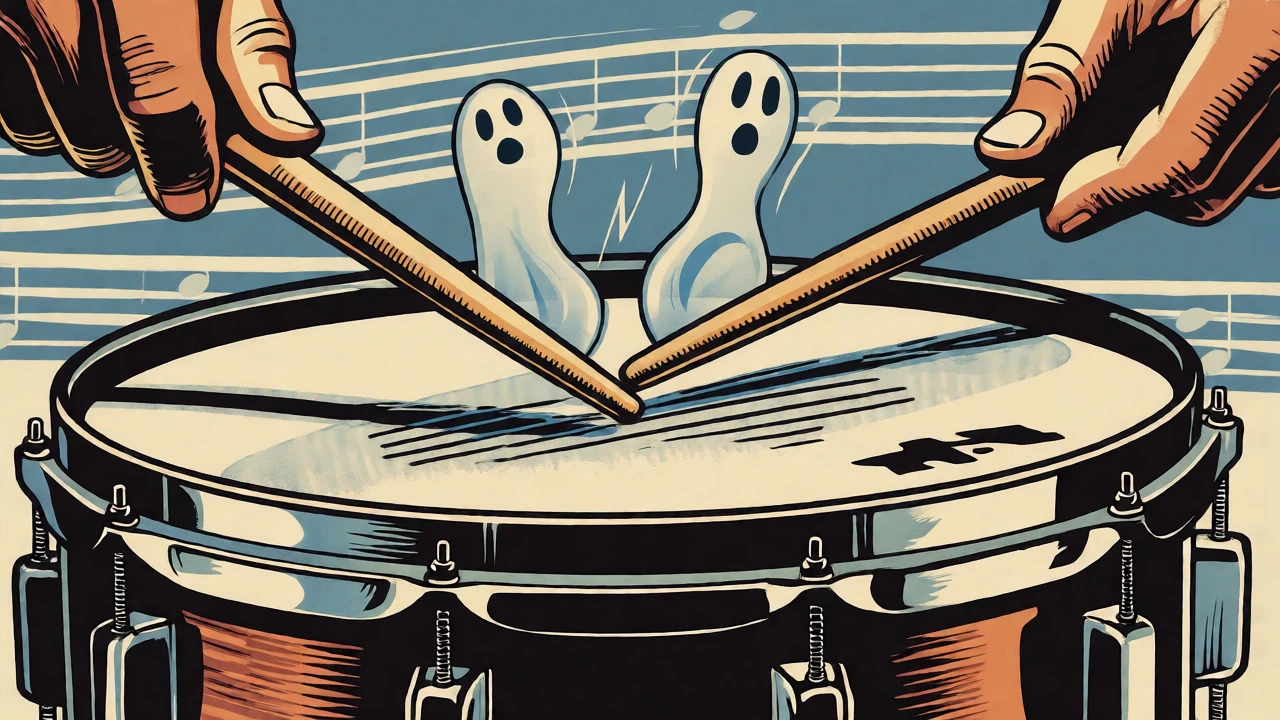
If the pocket is the foundation, ghost notes are the texture. These are the soft, barely-there snare strokes that sit between the loud backbeats. They’re called "ghosts" because they haunt the main rhythm without dominating it. Without them, a groove feels dry. With them, it swings.
In instructional contexts, modern educators like Jim Payne describe ghost notes as occurring on the "e" or "a" of a sixteenth-note count (think "1-e-and-a"). But don’t let the theory scare you off. Practically speaking, a ghost note is just a quiet tap. The trick is control. You need to strike the snare from just above the head-maybe an inch or two-to produce a low-volume sound that contrasts sharply with the rimshot crack on beats two and four.
Why did this matter so much in the 1970s? Because R&B vocals were getting more complex. Singers like Marvin Gaye and Stevie Wonder needed rhythmic support that didn’t compete with their phrasing. A heavy-handed snare would clash with the vocal melody. Ghost notes provided a subtle, double-time undercurrent that added drive without adding noise. It’s like seasoning food: too little, and it’s bland; too much, and you ruin the dish. The right amount of ghost notes makes the whole track taste richer.
Try this experiment. Listen to Clyde Stubblefield’s work on James Brown’s "Funky Drummer." Notice how the hi-hat keeps a steady eighth-note pulse, but the snare has these tiny, whisper-like hits scattered throughout. Those aren’t mistakes. They’re intentional design choices that create momentum. When you practice, start by playing only the backbeat. Then, add ghost notes only where you hear them in the recording. Resist the urge to overplay. If you can’t hear the ghost notes clearly in the mix, you’re probably hitting them too hard.
Shuffle Grooves and the Half-Time Feel
Not all R&B grooves march in straight lines. Some limp, swing, and swagger. Enter the shuffle. At its core, a shuffle divides the beat unevenly, creating a long-short triplet feel instead of even eighth notes. It’s the difference between walking and dancing. Walking is predictable; dancing has sway.
The most famous variant from this era is the half-time shuffle, often associated with Bernard "Pretty" Purdie. His signature style, heard on tracks like Steely Dan’s "Home at Last," combines a slow, heavy backbeat with rapid-fire triplet subdivisions on the hi-hat and snare. It sounds lazy, but it requires intense precision. The kick drum hits on beat one and sometimes the "and" of two, while the snare cracks on beat three. Everything else is filled with syncopated ghost notes that dance around the main pulse.
It’s crucial to distinguish this from the Philadelphia "four-on-the-floor" style. While Earl Young popularized the steady four-kick pattern that paved the way for disco, his approach was about continuous motion. A shuffle, by contrast, is spacious. It relies on tension and release. The half-time feel creates a sense of suspension, making the return to the downbeat feel satisfying and heavy. Questlove has famously credited Young with being "the whole reason for disco," highlighting how distinct regional styles coexisted in the same decade.
- Straight Eighth Notes: Even spacing; common in early funk and pop-soul.
- Triplet Shuffles: Long-short feel; creates a swinging, bluesy vibe.
- Half-Time Shuffle: Slow backbeat with fast subdivisions; adds complexity without clutter.
- Four-on-the-Floor: Kick on every quarter note; prioritizes danceability and steady pulse.
When studying shuffles, avoid the trap of thinking there’s one "correct" pattern. New Orleans legends like Joseph "Zigaboo" Modeliste of The Meters used loose, interlocking rhythms that defied strict categorization. His part on "Cissy Strut" isn’t a textbook shuffle; it’s a conversation with the bass guitar. The key takeaway? Listen to the subdivision. Are the spaces between beats equal, or do they stretch and compress? That variation is where the human element lives.
Regional Flavors: Memphis vs. Philadelphia vs. New Orleans
You can’t talk about 1970s R&B drumming without acknowledging geography. The sound varied wildly depending on which city you were in. This wasn’t just about personal preference; it was about studio culture and producer philosophy.
Memphis, home to Hi Records and Stax, favored economy. Producers like Willie Mitchell wanted drum parts that supported the voice. Al Jackson Jr. exemplified this. His fills were rare and purposeful. He didn’t show off. He served the song. If you listen to "Here I Am (Come and Take Me)," you’ll notice how sparse the arrangement is. The drums leave room for the strings and the vocals. This approach influenced countless ballads and mid-tempo soul tracks.
Philadelphia took a different path. Gamble and Huff’s Sound of Philadelphia leaned into orchestration and steady pulses. Earl Young’s four-on-the-floor beat provided a relentless engine for dancers. It was polished, consistent, and designed for the club. Unlike the gritty, syncopated New Orleans funk of The Meters, Philly soul was smooth and predictable in its tempo, allowing singers to glide over the top.
New Orleans brought chaos and joy. Zigaboo Modeliste and other local drummers played with a looseness that felt almost accidental but was deeply intentional. Their grooves relied on interlocking patterns rather than rigid quantization. This regional diversity means there’s no single "R&B drum sound." Instead, there’s a spectrum ranging from the tight, minimalism of Memphis to the driving pulse of Philly and the funky sprawl of NOLA.

How to Practice and Hear the Difference
Reading about grooves is fine, but feeling them is better. Here’s a practical way to internalize these concepts. First, pick a reference track. For pocket and restraint, choose an Al Green song. For ghost notes, go with James Brown. For shuffles, try Bernard Purdie’s work.
Start by isolating the kick and snare. Play along, matching the dynamics exactly. If the snare is loud, hit it hard. If the kick is soft, ease up. Next, add the hi-hat. Focus on consistency. Then, introduce ghost notes. Keep your stick height low. Finally, step back and listen to the whole band. Are you supporting the bass? Are you leaving space for the vocals?
A common mistake is rushing the recovery after a fill. In 1970s R&B, the beat after a fill should land solidly, not frantically. Think of the fill as a question and the next downbeat as the answer. Answer confidently. Don’t stumble. Use a metronome if you struggle with timing, but eventually, ditch it. Rely on your ears. If you feel good, you’re probably in the pocket.
Frequently Asked Questions
What exactly is "the pocket" in drumming?
The pocket refers to the cohesive rhythmic feel created when the drummer and bassist lock together seamlessly. It’s not about playing strictly on, ahead, or behind the beat, but rather maintaining a consistent, mutually supportive relationship that makes the groove feel natural and compelling.
Why are ghost notes important in R&B?
Ghost notes add texture and momentum without overwhelming the mix. They provide a subtle, double-time undercurrent that supports complex vocal melodies and keeps the groove moving forward, distinguishing soulful R&B from simpler, harder-hitting rock beats.
Who invented the half-time shuffle?
While no single person invented it, Bernard "Pretty" Purdie is widely credited with perfecting and popularizing the specific half-time shuffle style seen in 1970s recordings. His use of syncopated ghost notes over a laid-back backbeat became a defining characteristic of the genre.
How did Philadelphia soul drumming differ from Memphis soul?
Philadelphia soul, driven by drummers like Earl Young, emphasized a steady four-on-the-floor kick pattern suited for dancing. Memphis soul, exemplified by Al Jackson Jr., focused on restraint, space, and serving the vocalist, resulting in sparser, more dynamic arrangements.
Can I learn these grooves using a metronome?
Yes, but use it carefully. Start with a metronome to establish timing, but switch to playing along with original recordings to develop the human feel. R&B grooves often involve micro-timing variations that a rigid metronome cannot replicate.