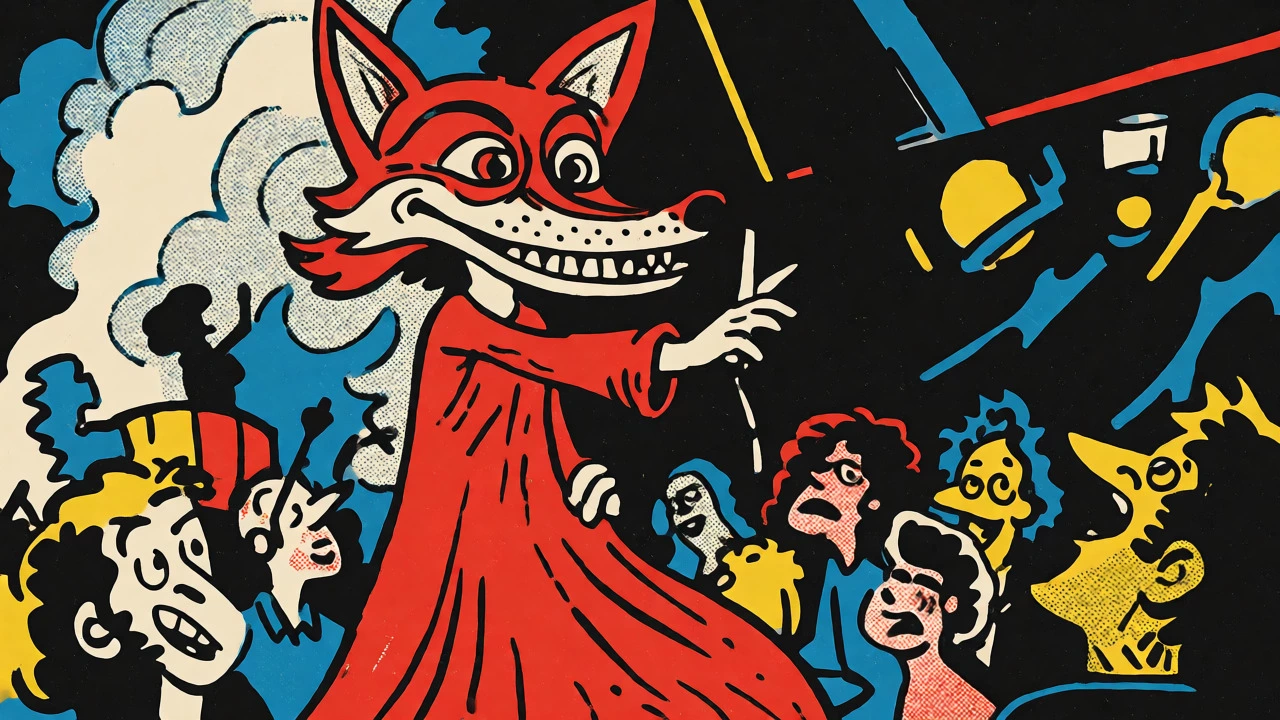

You’ve seen the videos. A wall of bricks rises from the floor. A fox head floats above a singer’s shoulders. Green beams slice through the smoke, turning an arena into a cathedral of light. This isn’t just background noise; it’s part of the music. Prog Rock Stagecraft is the art of turning long, complex songs into a multisensory event. It’s not about playing louder. It’s about making you feel the story. For decades, progressive rock bands realized that five-minute instrumental solos need more than good ears to hold an audience. They need eyes. From Genesis in the 1970s to Roger Waters’ modern tours, the goal has always been synchronization. The visuals don’t just decorate the song; they explain it. But how does this work? Is it safe? And why do some bands use lasers while others build literal walls?
| Element | Purpose | Risk Factor |
|---|---|---|
| Laser Shows | Aerial geometry, mood, spectacle | High (Eye/Skin safety) |
| Projection Mapping | Narrative imagery, transforming surfaces | Medium (Alignment/Brightness) |
| Theatrical Costumes | Character embodiment, intimacy | Low (Logistics only) |
| LED Walls | Brightness, reliability, video content | Medium (Weight/Power) |
The Birth of Theatrical Rock
Before digital screens, there was Peter Gabriel. In September 1972, at Dublin’s National Stadium, he stepped out wearing his wife’s red dress and a fox head. This wasn’t a gimmick for a photo op. It was essential to "The Musical Box." The costume transformed him from a singer into a character within the song’s narrative. Steve Hackett, Genesis’s guitarist, later explained that these changes helped hold attention during long songs with shifting moods. This approach had limits. Changing costumes takes time. It can block sightlines. But it offered something technology couldn’t: intimacy. A single performer could convey meaning without the cost of massive projectors. Today, we look back on these moments as the foundation of modern concert theater. The idea was simple: if the music tells a story, the stage must show it.Building The Wall: Architecture as Art
If Genesis used costumes, Pink Floyd used architecture. Their 1980 production of The Wall didn’t just play songs; it built a barrier. The set included 450 foldable cardboard bricks, creating a wall 33 feet high and 260 feet wide. As the performance progressed, the wall physically grew, hiding the musicians from the audience. This was a literal representation of alienation. The technical side was brutal. Lighting designer Marc Brickman managed 24 Telescan units, two full-color laser systems, and Vari-Lite fixtures. Three 35-millimeter projectors ran off eight-track tape recorders. A nine-meter circular screen served as both a backdrop and an animation surface. The result was iconic, but it came at a price. Transporting, constructing, and maintaining such a show required immense labor and specialized crews. It proved that prog rock could be an opera, but it also showed how fragile such spectacles are.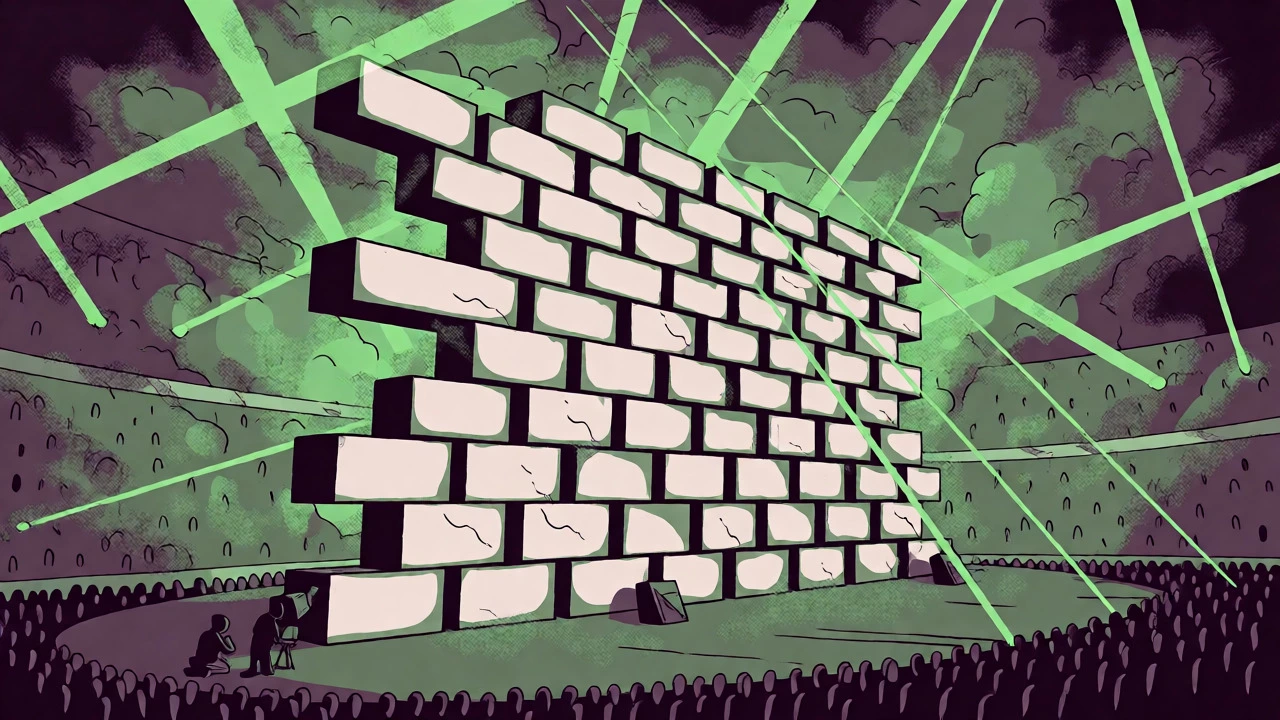
Lasers: Beauty and Danger
Laser shows became synonymous with prog rock in the 1970s. Unlike standard stage lights, lasers produce narrow, coherent beams. When combined with haze, these beams create visible lines, tunnels, and fans in the air. They add depth to a dark room. But they are not toys. The U.S. Food and Drug Administration (FDA) classifies most concert lasers as Class IIIb or Class IV products. Class IIIb lasers cause immediate eye hazards if viewed directly. Class IV lasers are even riskier; their reflected beams can injure skin and start fires. International standards like IEC TR 60825-3:2022 require strict planning. Operators must ensure beams stay above audience heads-typically higher than three meters vertically-and away from walkways. Why take the risk? Because lasers provide something unique: aerial geometry. They can turn empty space into structure. However, they require trained operators, emergency shutdown systems, and secure mounting. One misaligned beam can ruin a night or cause injury. Modern tours still use them, but now with rigorous safety protocols and automated scanning controls.Projection vs. LED: The Digital Shift
As technology advanced, so did the tools. Projection mapping allows designers to project images onto irregular surfaces. During Roger Waters’ 2010-2013 tour of The Wall, every brick was individually mapped. The stadium version used 36 Panasonic PT-DZ21K projectors, each producing 20,000 lumens. These were arranged across nine screen areas, with quad-stacking to maintain brightness. The canvas stretched 8,560 pixels wide. This level of detail allowed the wall itself to become a screen, showing animations and film clips seamlessly. But projection has weaknesses. It needs darkness. Ambient light washes out the image. Alignment is tricky; if one projector shifts, the image breaks. Enter LED walls. Bands like Genesis adopted large LED structures in later tours. For example, their 2007 tour featured a rear wall made of over 15,000 Barco O-Lite panels. LED offers higher brightness and better color consistency. It works even if the house lights aren’t fully dimmed. However, LED walls are heavy. They consume massive amounts of power. And unlike projection, they don’t make the scenery itself look magical-they just replace it with a screen.
Synchronization: The Invisible Conductor
How do all these elements work together? Timecode. In a modern prog rock show, audio and visuals are locked together using SMPTE linear or MIDI timecode. This data flows through networks using protocols like Art-Net or sACN. These protocols carry control signals for lighting fixtures and media servers. Imagine a cue stack. At exactly 4 minutes and 12 seconds into a song, the system triggers a laser scene, starts a video clip, changes the lighting state, and cues a pyrotechnic effect. All from one reference signal. If the band speeds up or slows down, the visuals might drift unless the operator adjusts manually. This rigidity is a trade-off. It ensures precision, but it restricts improvisation. A dedicated operator often monitors these cues, ready to abort unsafe effects if needed.Is Spectacle Worth the Cost?
Critics argue that spectacle can overwhelm musicianship. If the lasers are too bright, you miss the guitar solo. If the video is too loud, you lose the vocal nuance. There’s a valid point here. Some fans prefer the raw energy of a band interacting with the crowd, unburdened by complex tech. However, for concept albums, visuals are often necessary. Long instrumental passages can feel abstract without visual anchors. The best productions balance these elements. They use lasers for impact, projection for narrative, and conventional lighting for visibility. They don’t rely on one medium. They coordinate music, narrative, architecture, and timing into a single system. Today, prog rock stagecraft remains active. It’s not a museum piece. New tours combine legacy symbols with real-time rendering and camera-tracked content. The trend is toward brighter, more reliable tech, but the core principle hasn’t changed since 1972: the stage must serve the song.Are laser shows dangerous for audiences?
Yes, if not managed correctly. Most concert lasers are Class IIIb or Class IV, which can cause eye damage from direct viewing or skin burns from reflections. Safety regulations require beams to be scanned above audience heads (usually >3 meters high) and monitored by trained operators with emergency shutdown capabilities.
Why do prog rock bands use projection instead of just LED screens?
Projection mapping allows images to wrap around irregular surfaces, like the physical wall in Pink Floyd's 'The Wall' or scenic props. It creates a cinematic quality where the object itself seems to transform. LED screens are brighter and easier to manage but lack the ability to integrate visually with physical set pieces in the same way.
What is SMPTE timecode and why is it important in concerts?
SMPTE timecode is a standardized system for recording precise time positions. In concerts, it synchronizes audio playback with visual cues (lights, lasers, video). This ensures that a specific visual effect happens exactly when intended in the song, allowing for tight integration between music and stagecraft.
Did Peter Gabriel invent prog rock stagecraft?
Not alone, but he was pivotal. His use of costumes and characters, like the fox head in 'The Musical Box' (1972), set a precedent for theatricality in rock. Other bands like Pink Floyd and Hawkwind developed parallel approaches using lasers and projections, collectively defining the genre's visual language.
Can small venues support prog rock stagecraft?
Yes, but scaled down. Small clubs might use compact laser packages or simple projections on scrims. Large-scale productions with hundreds of projectors and automated sets are reserved for arenas and stadiums due to cost, weight, and space requirements.