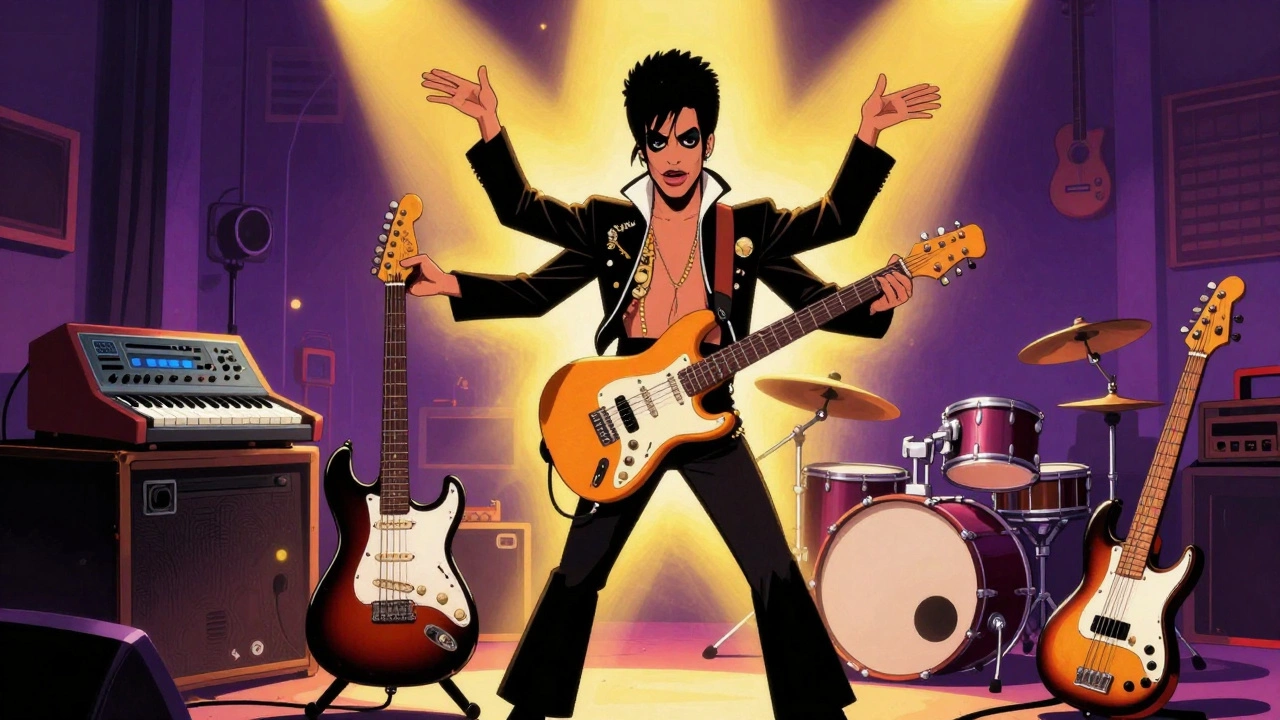

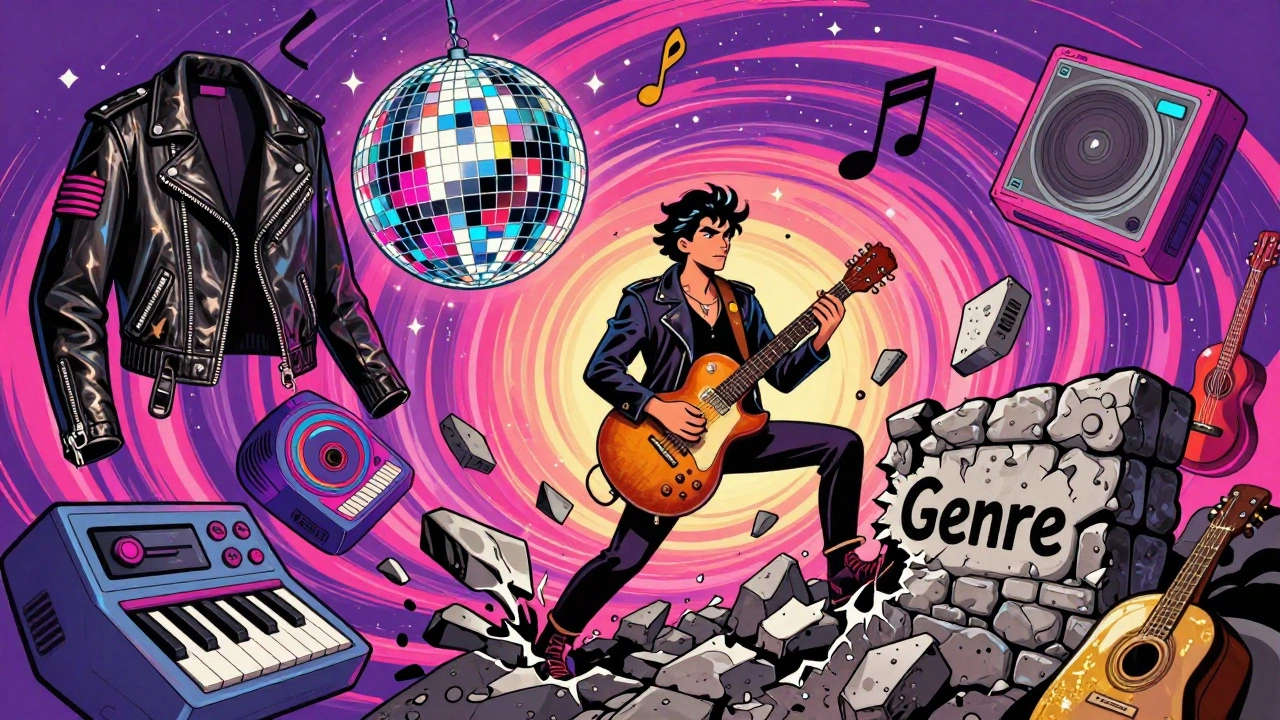
Imagine a world where the radio played only one type of music per station: rock for the leather-jacket crowd, funk for the dance floors, and pop for the masses. That was the rigid reality of the music industry before Prince is a virtuoso multi-instrumentalist and songwriter who dismantled the walls between musical genres during the 1980s. Also known as Prince Rogers Nelson, he didn't just bridge these gaps-he blew them up entirely, creating a sonic playground where a distorted Hendrix-style guitar riff could live perfectly alongside a lean, stripped-back funk groove.
The Architect of the Minneapolis Sound
To understand how Prince changed everything, you have to look at where he came from. Based in Minneapolis, he developed a specific aesthetic that combined the raw energy of rock with the rhythmic precision of R&B. While other artists were hiring teams of songwriters and session musicians, Prince was often a one-man army. He played the drums, bass, keyboards, and guitar, and sang every vocal layer. This total control allowed him to experiment without anyone telling him that a certain sound "didn't belong" in a specific genre.
His early 80s output, specifically the album Dirty Mind, served as a manifesto for this new approach. It wasn't just the explicit lyrics that shocked people; it was the sound. He blended New Wave synths with gritty funk, creating a hybrid that felt futuristic and dangerous at the same time. By the time he released Controversy and 1999, he had essentially mapped out a new territory in American pop music where the boundaries were irrelevant.
Breaking the Funk: Minimalism and Mastery
One of the most fascinating things about Prince's approach was his ability to be both maximalist and minimalist. He could layer twenty instruments on a track, but he also knew exactly when to take everything away. Take the 1986 hit "Kiss." Most funk songs of the era were heavy on the bass and horns, but Prince did the opposite. He stripped the track down to a lean, skeletal groove, leaving a massive amount of space for his falsetto to cut through the mix.
This minimalist strategy didn't just make the song catchy; it made it universal. Because it wasn't bogged down by the traditional tropes of a single genre, "Kiss" was able to top the Billboard Hot 100, the dance charts, and the R&B charts all in the same week. It proved that when you strip music down to its core essence of rhythm and melody, the labels we put on music-like "pop" or "funk"-stop mattering.
| Genre Element | Prince's Implementation | The Resulting Effect |
|---|---|---|
| Funk | Slap bass and syncopated rhythms | High-energy, danceable grooves |
| Rock | Distorted electric guitar solos | Aggression and raw emotional power |
| Pop | Polished hooks and catchy melodies | Mass commercial appeal across demographics |
| New Wave | Heavy use of synthesizers and drum machines | A futuristic, "electronic" sonic landscape |
The Competition: Prince vs. The Pop Titans
Prince didn't just want to be a star; he wanted to be the best. He viewed contemporaries like Michael Jackson, Madonna, and Bruce Springsteen as his primary rivals. However, his approach to competition was different. While Jackson perfected the art of the global pop spectacle, Prince focused on artistic autonomy and sonic versatility.
What separated Prince from these titans was his willingness to be "ugly" or provocative in his sound. He would throw a screeching guitar solo into a pop song or use a sexualy charged falsetto in a way that felt more like a rock performance than a polished pop track. He wasn't trying to fit into the Top 40 mold; he was reshaping the mold to fit himself. This flexibility gave him a distinct edge-he could play a rock stadium and an R&B club, and he'd be the most authentic person in both rooms.
The Invisible Influence
Something people often forget is that Prince's impact on the 80s wasn't just limited to his own albums. He was a ghost in the machine of the music industry, influencing the sound of other artists through production and songwriting. Even when his name wasn't on the cover, his fingerprints were everywhere. He taught the industry that you didn't have to choose between being a "credible" musician and a commercial success.
This "pop omnivorousness"-the ability to consume and blend every available style-predated the modern era of music. Today, we take it for granted that a pop star might collaborate with a rapper or a country singer, but in the early 80s, that was a radical move. Prince laid the groundwork for the dissolution of these boundaries. He proved that the most exciting music happens at the intersection of different cultures and styles.
Evolution Beyond the 80s
While the 80s were his most chart-dominant years, Prince's commitment to genre-blending never stopped. He continued to push back against the music business, fighting for ownership of his masters and challenging how artists are marketed. His later work, including his intimate "Piano & a Microphone" tours, showed a shift toward a more stripped-down, jazzy sophistication, but the core philosophy remained the same: the song dictates the genre, not the other way around.
By refusing to be boxed in, he created a blueprint for every independent artist who wants to blend styles without losing their identity. He showed us that the only real rule in music is that there are no rules, as long as you have the technical skill to back up your experiments.
What is the "Minneapolis Sound"?
The Minneapolis Sound is a blend of funk, rock, R&B, and synth-pop developed by Prince. It is characterized by a heavy use of synthesizers and drum machines, a lean approach to instrumentation (often removing traditional horn sections common in funk), and a strong emphasis on syncopated rhythms and pop hooks.
Why was Prince's approach to genre considered radical in the 1980s?
In the 1980s, music was strictly categorized by radio formats and record labels. Artists were usually pushed to stay within one genre to maximize their appeal to a specific demographic. Prince ignored these boundaries, mixing distorted rock guitars with dance-floor funk and pop melodies, which allowed him to appeal to multiple audiences simultaneously.
How did Prince's multi-instrumental skills help his genre-blending?
Because Prince could play almost every instrument (including guitars, drums, and keyboards) at a virtuoso level, he didn't have to rely on session musicians who might be limited by their own genre training. This gave him total creative control over the arrangements, allowing him to weave disparate styles together seamlessly in the studio.
Which 1980s albums best demonstrate his genre synthesis?
Dirty Mind is a key example of his early blending of New Wave and funk. Controversy and 1999 further refined this, mixing pop sensibility with social commentary and dance rhythms. Later, the track "Kiss" demonstrated his ability to use minimalist funk to achieve massive pop success.
How did he differ from other pop stars like Michael Jackson?
While Michael Jackson focused on creating a flawless, global pop product with high production value, Prince leaned into the raw, edgy, and often provocative elements of rock and funk. Prince acted as his own primary producer and instrumentalist, whereas Jackson worked with legendary producers like Quincy Jones to refine a specific pop sound.


