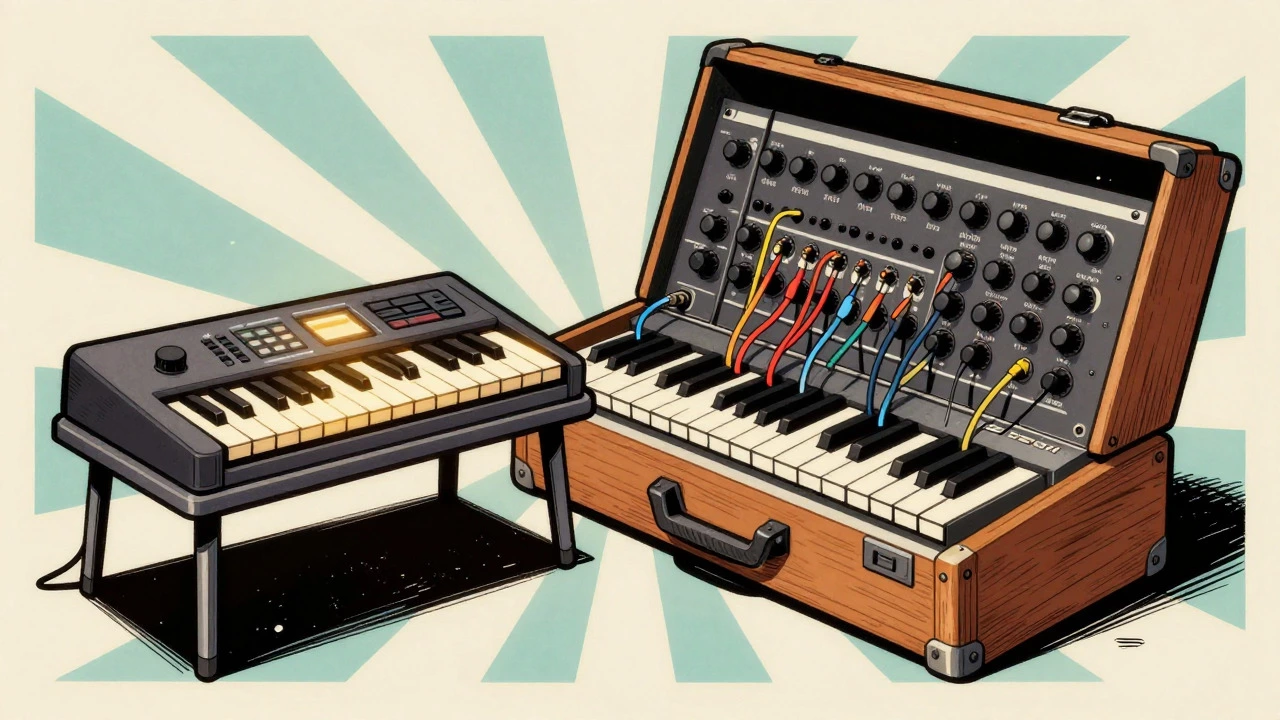

Imagine standing on stage with only ten minutes for soundcheck. Do you want to untangle a nest of patch cables into a heavy rack case, or do you just want to plug in your keyboard and hit play? This is the core tension between portable and modular synthesizers. One offers endless creative freedom; the other offers immediate reliability. Choosing between them isn't just about aesthetics-it’s about how you actually make music, where you perform, and how much time you have.
The Core Difference: Fixed Paths vs. Open Architecture
To understand why these two form factors feel so different, you have to look at how signals travel inside them. A portable synthesizer is a self-contained instrument with a hard-wired signal path, internal power supply, and integrated controls. When you turn the knob on a Minimoog-style device, the oscillator sends its signal directly to the filter, then to the volume control, and finally out the jack. You don't see this path; it's baked into the circuit board. This design prioritizes speed and simplicity. You pick up the unit, turn it on, and start playing within seconds.
In contrast, a modular synthesizer is a collection of separate modules-oscillators, filters, sequencers-that are interconnected by the user via patch cables. Here, there is no default path. You decide if the oscillator goes to the filter or straight to the output. You decide if the envelope generator affects the pitch or the volume. This "open architecture" means you are building the instrument every time you sit down. It is powerful, but it demands that you understand what each cable does before you can rely on it during a performance.
Historical Context: From Cabinets to Pockets
This divide didn't appear overnight. In the early 1960s, pioneers like Don Buchla and Robert Moog built massive cabinets filled with individual modules. These systems were studio-bound giants, requiring custom installation and professional maintenance. They were the original "high-end" tools, but they were far from portable.
The shift began in 1969 with the EMS VCS3, often cited as the first truly portable and affordable semi-modular synth. It used a matrix pinboard for routing, allowing users to change connections without physical cables, but it was still complex for most musicians. Then came the Minimoog in the early 1970s. Moog took the best parts of modular synthesis-the voltage-controlled oscillators and filters-and locked them into a single, sturdy chassis with a keyboard. This was a deliberate trade-off: less flexibility for greater reliability and ease of use on stage.
Decades later, in 1995, Dieter Döpfer introduced Eurorack. This format standardized modular synthesis into compact 3U-high modules (128.5 mm) measured in HP units (where 1 HP = 5.08 mm). Eurorack made modular smaller, cheaper, and more accessible. Today, we see a resurgence of interest in both extremes: ultra-compact pocket synths and sophisticated Eurorack racks, creating a market where musicians can choose their level of complexity.
Practicality in the Studio: Depth vs. Speed
If you work primarily in a home studio or a fixed location, the logistics of transport disappear. In this environment, the advantages of modular become clearer. Because you can add specific modules as needed, you can build a system that perfectly matches your workflow. Need a unique noise source? Add a dedicated noise module. Want complex rhythmic sequencing? Add a polyrhythmic sequencer. The learning curve is steep-you must understand control voltages, gate signals, and audio levels-but the reward is an instrument that evolves with you.
Portable synths, however, excel in iterative workflows. If you are writing songs quickly, you need instruments that respond instantly. A portable synth with presets allows you to capture ideas in real-time without stopping to re-patch. Many modern portable units also offer deep editing capabilities, letting you tweak parameters after the initial idea is recorded. For producers who value speed and consistency over infinite customization, the fixed architecture of a portable synth reduces decision fatigue.

Live Performance and Travel: The Logistics Reality
This is where the choice becomes critical. Live performance imposes strict constraints: limited setup time, stage space, and physical weight limits.
- Setup Time: A portable synth typically takes under a minute to set up. Plug in power, connect audio, and you're ready. A modular rig requires mounting cases, connecting power buses, and patching dozens of cables. Even experienced performers spend 15-30 minutes setting up a moderate Eurorack system.
- Reliability: Portable synths have fewer failure points. There are no loose patch cables to unplug accidentally. Modular systems are susceptible to mispatching, cold solder joints, and power issues. Performers often carry spare cables and test patches extensively before a show.
- Transport: A portable synth fits in a backpack. A modular case, even a small 60 HP unit, weighs several kilograms and requires careful padding. Airline baggage limits and hotel storage further complicate traveling with modular gear.
Many touring musicians adopt a hybrid approach: they keep a robust portable synth for reliable live backing tracks and use modular for experimental sets or studio work. Some even use semi-modular desktop units, which offer a middle ground with partial patching options in a compact form factor.
Market Trends and Future Directions
The synthesizer market reflects this dual demand. While portable keyboards and all-in-one synths dominate unit sales, the modular segment is growing rapidly. Market estimates place the global modular synthesizer market at approximately USD 253.9 million in 2025, projected to reach USD 476.2 million by 2034. This growth is driven by DIY culture, younger musicians seeking tactile control, and the availability of affordable Eurorack modules.
At the same time, portable synths are becoming more flexible. Manufacturers are incorporating more complex modulation matrices and digital effects into compact devices, blurring the line between fixed and modular architectures. Software-based semi-modular apps on tablets also offer modular-like routing in a highly portable package, adding another layer to the decision-making process.
| Feature | Portable Synthesizer | Modular Synthesizer (Eurorack) |
|---|---|---|
| Signal Path | Hard-wired, fixed | User-defined via patch cables |
| Setup Time | Seconds to minutes | 15-30+ minutes |
| Portability | High (fits in bag/backpack) | Low to Medium (requires case/padding) |
| Learning Curve | Low to Moderate | High (requires CV/Gate knowledge) |
| Flexibility | Limited to internal routing | Infinite (add/remove modules) |
| Best For | Live gigs, travel, quick composition | Studio experimentation, custom sound design |

How to Choose the Right Form Factor
Your choice should align with your primary workflow. Ask yourself these questions:
- Where do I make music most often? If it's always in one room, modular's complexity is manageable. If you move around frequently, prioritize portability.
- What is my experience level? Newcomers often find modular intimidating. Starting with a portable synth helps build foundational skills in synthesis without the overhead of patching.
- What is my budget? Modular systems can start cheap but grow expensive as you add modules. Portable synths have a fixed cost, making budgeting easier.
- Do I need specific features? If you require a specific type of sequencing or effect not available in standard portable synths, modular may be necessary.
For many musicians, the answer isn't one or the other. A common strategy is to own a reliable portable synth for daily use and live performances, while investing in a small modular system for creative exploration. This combination provides the best of both worlds: the immediacy of a fixed instrument and the depth of a customizable one.
Frequently Asked Questions
Is modular synthesis harder to learn than using a portable synth?
Yes, generally. Modular requires understanding control voltages, gate signals, and how different modules interact. Portable synths have pre-set relationships between components, allowing users to focus on musical expression rather than technical routing. However, the learning curve for modular leads to deeper insight into how synthesis works.
Can I use a modular synthesizer for live performances?
Yes, but it requires preparation. Successful live modular performers use compact cases, limit the number of modules, and rehearse patches extensively. They also carry spare cables and power supplies. It is more demanding than using a portable synth but feasible for dedicated setups.
What is the difference between semi-modular and fully modular?
Semi-modular synths have a default hard-wired signal path but expose patch points that allow users to override or modify the routing. Fully modular systems have no default path; all connections are made by the user via patch cables. Semi-modular offers a compromise between ease of use and flexibility.
Which form factor is better for beginners?
Portable synths are generally recommended for beginners. They provide immediate results and a clear interface, helping users develop musical intuition. Once comfortable with basic synthesis concepts, transitioning to modular becomes more meaningful and less overwhelming.
Are portable synths less capable than modular ones?
Not necessarily. Modern portable synths incorporate advanced DSP and digital effects that can rival or exceed the capabilities of older modular systems. However, modular offers unlimited expandability and custom signal paths that fixed-architecture instruments cannot replicate. Capability depends on the specific models compared.


