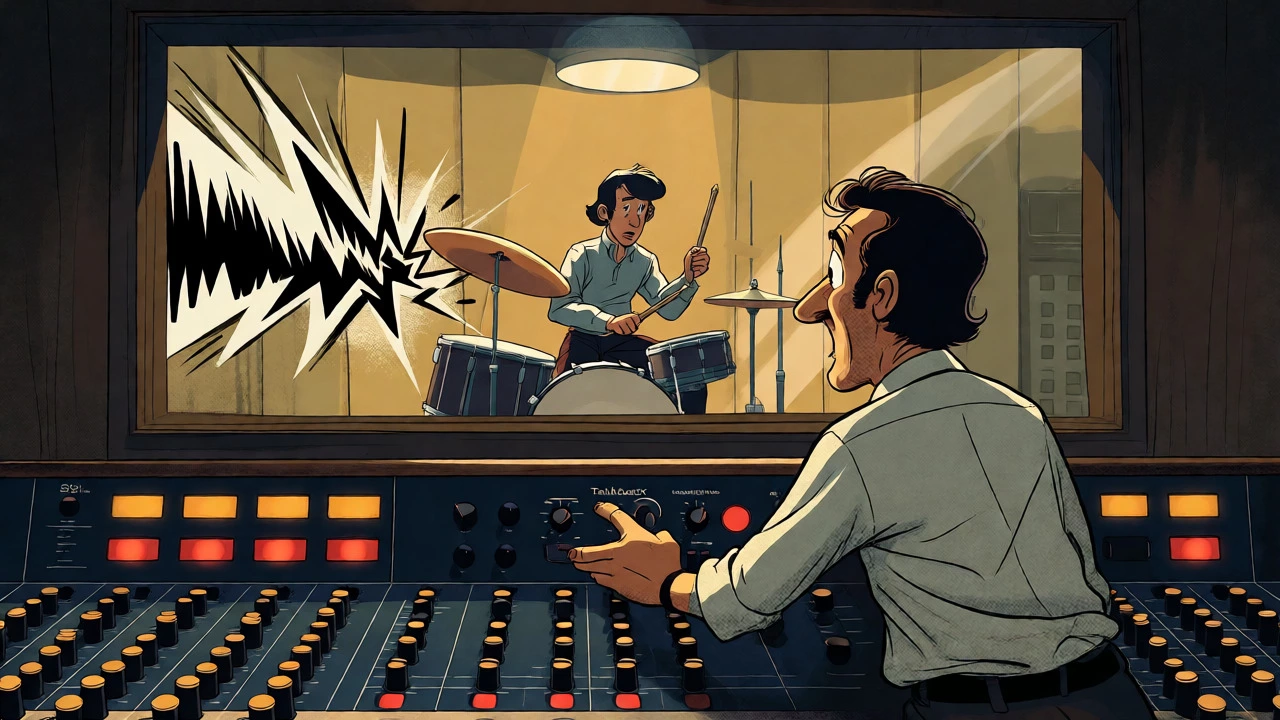

You hear it before you see it. That massive, explosive drum hit that sounds like a cannon blast in a cathedral, abruptly cut off as if by a knife. It’s the sound of Phil Collins in the 1980s. But here is the twist most people miss: that iconic "gated" sound wasn’t designed to be pretty. It was an accident born from divorce, bad weather, and a broken talkback microphone. If you’ve ever wondered why Phil Collins’s drums hit so hard yet feel so lonely, you’re looking at one of the most influential accidents in music history.
The Accidental Birth of Gated Reverb
To understand the sound, you have to go back to 1979, to Townhouse Studios in London. Phil Collins was playing drums for Peter Gabriel’s third solo album. The engineer, Hugh Padgham, was experimenting with a new Solid State Logic (SSL) 4000 console. During a session for the track "Intruder," Gabriel asked Collins to play without cymbals. Padgham accidentally left the talkback microphone open-a mic used for communication between the control room and the live room.
This talkback mic had heavy compression on it. When Collins hit the snare, the compressed mic picked up the huge, natural reverb of the studio room, but the compressor clamped down instantly when the sound stopped. The result? A drum hit that sounded enormous and then vanished into silence immediately. It wasn’t natural decay; it was a sonic cliff. Padgham realized this effect could be intentional. He spent an overnight session patching the SSL console to replicate this "barking" drum sound on purpose. This technique became known as gated reverb.
In the Air Tonight: The Perfect Storm
Collins took this accidental discovery home to his own sessions for his debut solo album, *Face Value* (1981). The song that defined the decade, "In the Air Tonight," is the ultimate showcase. For the first two minutes, there are no big drums. Just a sparse Roland CR-78 drum machine, eerie synthesizers, and Collins’s voice dripping with unresolved anger.
Then, the break hits. The full kit enters with that signature gated explosion. Why does it work so well? Because of contrast. By holding back the real drums, Collins made their arrival feel like a physical blow. The lyrics, often interpreted as dealing with the betrayal of his first marriage, match the production perfectly. The sudden, sharp end of the drum tail mirrors the abruptness of emotional rupture. It’s not just a beat; it’s a narrative device. Critics and producers alike cite this moment as the template for 1980s pop production, influencing everyone from David Bowie to New Order.

Deconstructing the Technical Recipe
How did they actually do it? It wasn’t magic; it was engineering. The setup required specific components working in harmony. You needed a large, reflective room to capture natural ambience. Then, you placed ambient microphones far away from the drum kit to catch that room tone. These distant mics were fed through aggressive compression and a noise gate.
| Component | Setting/Role | Purpose |
|---|---|---|
| Ambient Mics | Placed far from kit | Capture room reverb, not direct sound |
| Compressor | High ratio (4:1 or higher) | Lift quiet room reflections to loud levels |
| Noise Gate | Fast release (<200ms) | Cut reverb tail abruptly after hit |
| Cymbals | Avoided or minimized | Prevent continuous wash from keeping gate open |
The key was the timing. The gate had to close almost instantly after the drum hit. If the release time was too long, you’d get a normal reverb tail. Too short, and it would sound unnatural. Padgham fine-tuned these parameters on the SSL console, which allowed individual gating on every channel. This technical precision turned a studio error into a repeatable aesthetic choice.
Hooks That Stick, Lyrics That Hurt
While the drums grabbed headlines, Collins’s songwriting kept him on the radio. His 1980s hooks are deceptively simple. Think of "Sussudio" or "Take Me Home." They rely on rhythmic repetition and syncopation that lock tightly with the drum patterns. The structure is classic pop: immediate verse entry, a pre-chorus that builds tension, and a chorus repeated three to four times. This formula ensured maximum radio friendliness.
But beneath the glossy production lay raw emotion. Collins’s lyrics frequently dealt with heartbreak, divorce, and regret. Songs like "If Leaving Me Is Easy" and "I Don’t Care Anymore" use second-person address ("you") to create intimacy. The juxtaposition is stark: bright, major-key melodies paired with devastating lyrical content. This contrast defines his era. You’re dancing to the hook while listening to someone fall apart. It’s confessional pop, delivered with a punch.

The Legacy of the '80s Sound
By the mid-1980s, gated reverb was everywhere. It migrated from Collins’s solo work to Genesis albums like *Invisible Touch*, and influenced countless other artists. However, ubiquity led to backlash. By the early 1990s, the sound felt dated to some, associated with excess and artifice. Yet, its influence never truly faded.
Today, producers return to Collins’s techniques for their dramatic impact. Modern plugins offer "80s Drum" presets specifically modeled after the Townhouse sessions. The aesthetic has seen revivals in synthwave and retro-pop genres. More importantly, the core lesson remains relevant: production choices should serve the emotion. Collins didn’t use gated reverb because it was cool; he used it because it sounded like anger trapped in a box, waiting to explode.
Frequently Asked Questions
What exactly is gated reverb?
Gated reverb is a recording technique where a reverb effect is applied to a sound source, but a noise gate cuts off the reverb tail abruptly shortly after the original sound ends. This creates a large, expansive sound that disappears suddenly rather than fading out naturally.
Did Phil Collins invent gated reverb?
No, he didn't invent it alone. The effect was discovered accidentally by engineer Hugh Padgham during sessions for Peter Gabriel's album *Peter Gabriel III* (often called *Melt*) in 1979. Collins and Padgham then refined and popularized the technique on Collins's solo work, particularly "In the Air Tonight."
Why are there no cymbals in the famous drum break of "In the Air Tonight"?
Cymbals produce a continuous wash of high-frequency sound that sustains for a long time. If cymbals were present, the noise gate would remain open due to the sustained volume, preventing the abrupt cutoff that characterizes the gated sound. Removing them allowed the snare and toms to trigger the gate cleanly.
What equipment was used to create Phil Collins's 1980s drum sound?
The primary tool was the Solid State Logic (SSL) 4000 series mixing console at Townhouse Studios. Its built-in compressors and gates on each channel strip allowed engineers to apply the effect precisely to individual drum microphones. Ambient room microphones were also crucial for capturing the space.
Is the gated drum sound still used today?
Yes, though less universally than in the 1980s. It is frequently used in genres like synthwave, indie rock, and modern pop to evoke nostalgia or add dramatic impact. Many digital audio workstations include plugins specifically designed to emulate the classic gated reverb sound.