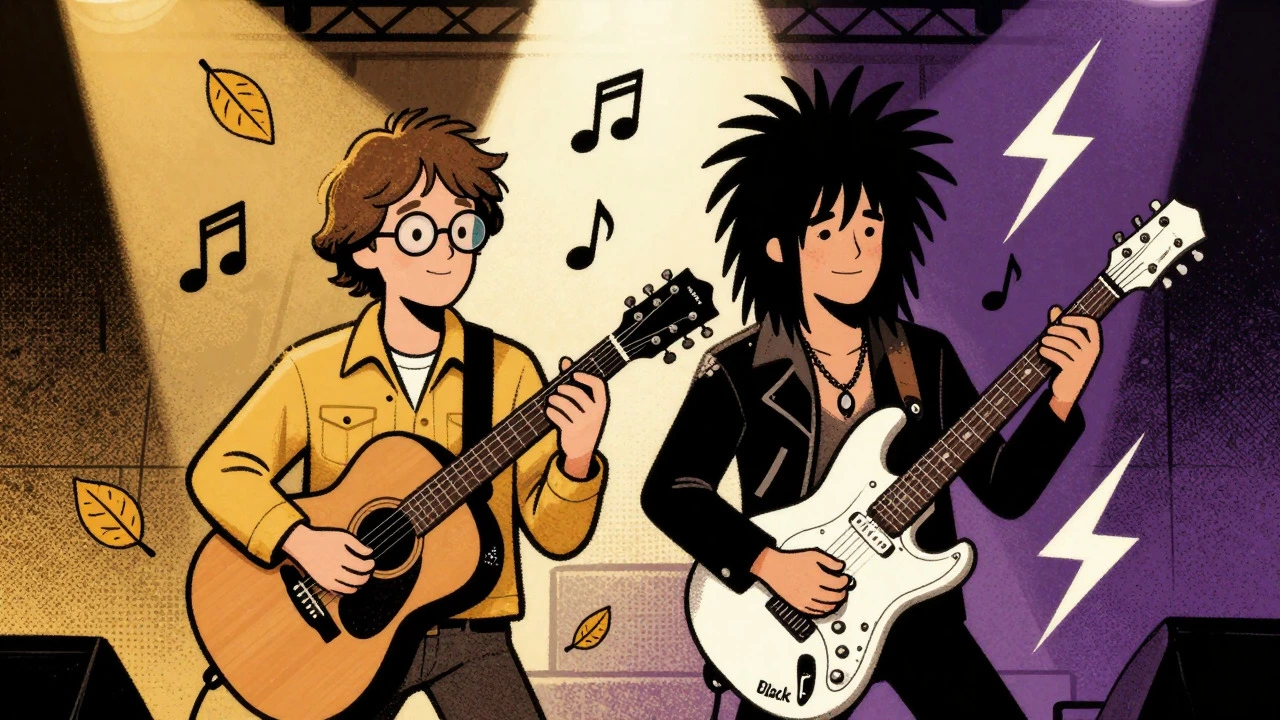

Most rock stars pick a lane. They are either the sensitive singer-songwriter with an acoustic guitar or the loud guitarist chasing distortion. Neil Young is a Canadian singer-songwriter who mastered both extremes simultaneously, creating a unique artistic identity defined by the tension between quiet intimacy and aggressive power. Born in Toronto in 1945, Young has spent over six decades proving that you don't have to choose between whispering secrets and screaming into the void. In fact, his greatest work happens when he does both in the same night.
This duality isn't just a gimmick; it is the structural backbone of his solo career. From his debut in 1968 through archival releases in the 2020s, Young’s discography oscillates between two distinct personas: the lone troubadour reflecting on life with sparse piano and steel-string guitars, and the ferocious bandleader leading Crazy Horse, a band known for its chaotic, feedback-drenched rock sound. Understanding this balance is key to appreciating why artists ranging from folk purists to grunge pioneers cite him as a primary influence.
The Blueprint of Duality: Rust Never Sleeps
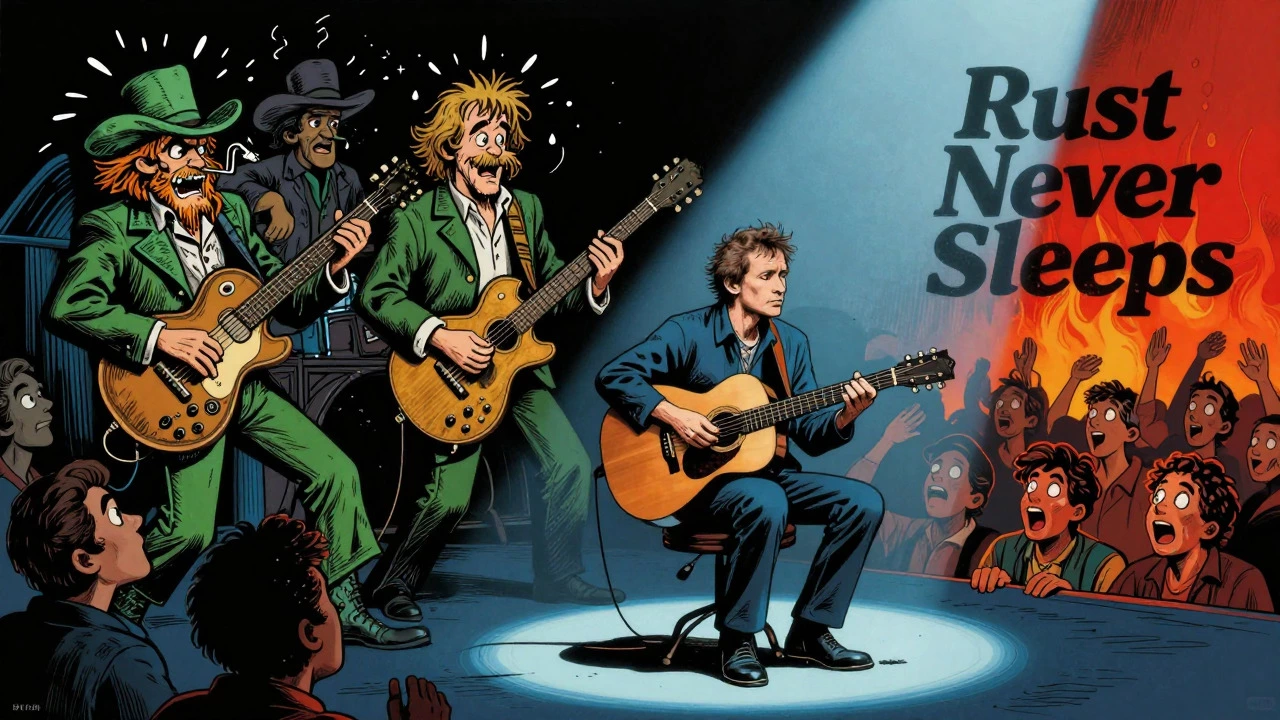
If you want to understand Neil Young’s solo artistry, you need to look at the 1979 album Rust Never Sleeps is a landmark double album that explicitly contrasts acoustic ballads with heavy electric rock tracks to demonstrate Young's range. This record was not an accident of studio experimentation; it was a deliberate statement. Side one features gentle, acoustic-driven songs like "My My, Hey Hey (Out of the Blue)"-wait, no, that’s side two. Let me correct that. Side one is pure, unadulterated acoustic intimacy. You hear songs like "A Man Needs a Maid" and "Comes a Time," where Young sits alone with his guitar, delivering lyrics with a fragile, nasal vulnerability.
Then, you flip the record. The needle drops, and suddenly you are hit with the sonic assault of "Cortez the Killer." This track, backed by Crazy Horse, is a ten-minute epic of distorted guitars and pounding drums. It sounds nothing like the previous side. Critics at the time were confused, but fans understood immediately: Young was showing us that these two sides of his personality coexist. He didn't leave the acoustic behind to play rock; he brought the rock to the acoustic world. This album established the template for his live shows for the next forty years: start quiet, end loud.
Acoustic Intimacy: The Massey Hall Standard
While many artists have released "unplugged" albums, few have made the solo acoustic format feel as dangerous and raw as Young. The definitive example is Live at Massey Hall 1971 is an archival live album recorded in Toronto showcasing Young performing entirely solo with acoustic guitar and piano, highlighting his storytelling ability. Recorded when Young was just 25 years old, this performance captures him mid-transition. He had already achieved massive success with Buffalo Springfield and Crosby, Stills, Nash & Young, but here, he strips everything away.
In this set, Young performs 17 songs without any backing musicians. He takes electric anthems like "Cowgirl in the Sand" and "Down by the River" and reimagines them as chilling narrative ballads. Without the wall of sound from a band, every lyric becomes crystal clear. The BBC noted in a 2007 review that this performance showed an evolution of his acoustic approach, tempered by his experience in supergroups but focused intensely on personal expression. Pitchfork highlighted that these aren't just softer versions of his hits; they are distinct identities. The absence of volume forces the listener to lean in, creating a sense of conspiracy between the artist and the audience.
Young’s acoustic technique is also specific. He doesn’t strum lightly. Guitar analyses note that he uses heavier-gauge strings, often 0.013-inch sets, and strikes them forcefully with a pick. This creates a percussive, almost aggressive attack even on soft songs like "Heart of Gold." He often employs alternate tunings, such as DADGAD, which allows simple chord shapes to produce droning, expansive harmonies. This technical choice means his acoustic playing retains a physical weight, preventing it from becoming too delicate or safe.
Electric Power: The Godfather of Grunge
On the other side of the coin lies the electric fury that earned Young the nickname "Godfather of Grunge." This title wasn't given lightly. In the late 1960s and 1970s, while most rock bands were polishing their sound, Young and Crazy Horse were exploring the limits of distortion and noise. Albums like Everybody Knows This Is Nowhere is Neil Young's second solo album featuring the first collaboration with Crazy Horse, known for its raw, distorted guitar solos and minimalist production (1969) introduced songs like "Cinnamon Girl," which featured some of the most heavily overdriven guitar tones heard on radio at the time.
The relationship with Crazy Horse is central to this electric power. Unlike typical backing bands that provide tight rhythm sections, Crazy Horse operates on instinct and chaos. Their performances are loose, often slightly out of sync, creating a jagged, primal energy. A 2023 feature in Vintage Guitar magazine described their combined sound as powerful enough to shame modern heavy metal bands. They don't rely on complex chord voicings or high-register shredding. Instead, Young focuses his rhythm parts on the lower three strings of his guitar, creating a thick, driving foundation that feels more like a heartbeat than a melody.
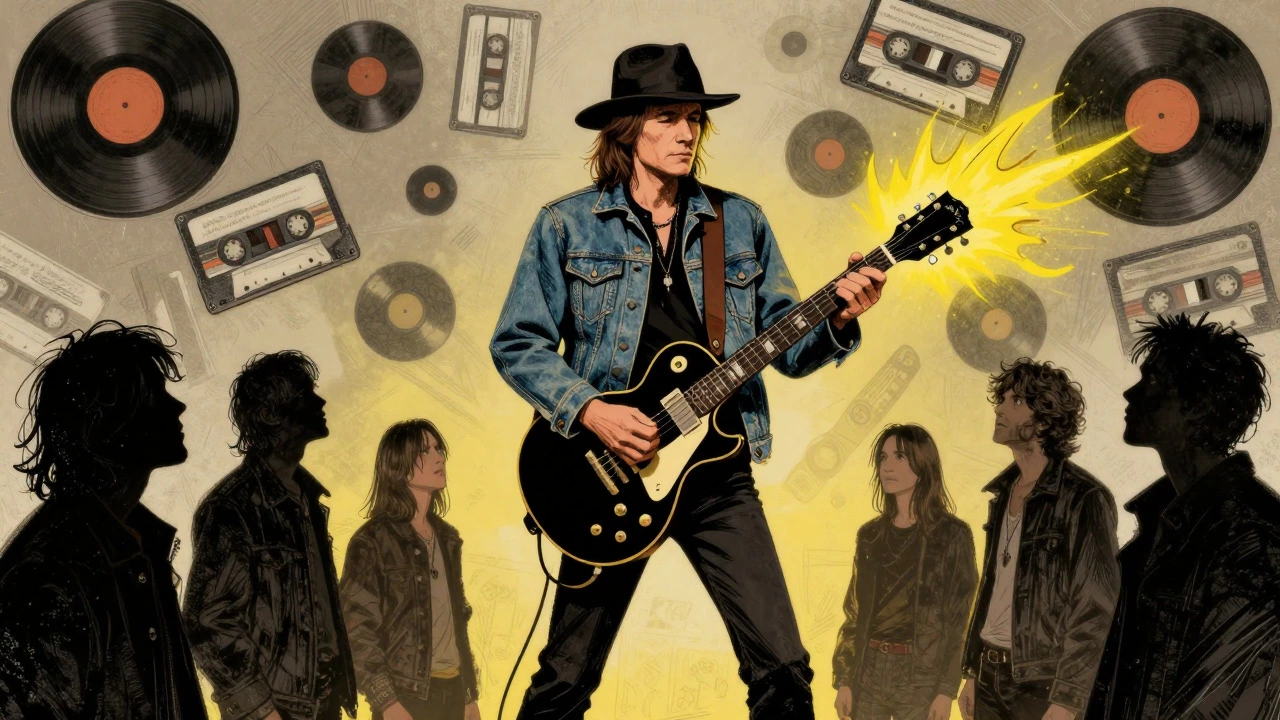
His gear choices reinforce this aesthetic. Young is famous for using a heavily modified Gibson Les Paul nicknamed "Old Black." He pairs this guitar with cranked amplifiers, pushing them to the point of breakup to achieve a ragged, unstable tone. This approach influenced a generation of alternative rock bands in the 1990s, including Pearl Jam, with whom Young collaborated on the 1995 album Mirror Ball is a collaborative album between Neil Young and Pearl Jam that blended Young's lyrical themes with the band's grunge-influenced sound. That collaboration served as a bridge, proving that Young’s 1970s electric experiments were not relics of the past but blueprints for the future of rock music.
Live Performance Strategy: Controlled Chaos
The true test of this dual artistry is how Young structures his live concerts. He rarely mixes the two styles randomly within a single song. Instead, he builds entire shows around the contrast. The 1978 tour documented on Live Rust is a live double album capturing Neil Young and Crazy Horse performing both solo acoustic sets and full-band electric numbers, exemplifying his dynamic range (1979) is the perfect case study. The show begins with Young alone on stage, performing tender acoustic numbers like "Sugar Mountain" and "The Needle and the Damage Done." The audience settles into a mood of reflection.
Then, the lights change. Crazy Horse storms the stage. The volume explodes. Tracks like "Sedan Delivery" and "Hey Hey, My My" tear through the venue with crushing intensity. Apple Music editors have noted that this sequencing turns the concert into a comprehensive portrait of the artist. It prevents listener fatigue by constantly resetting the emotional baseline. If the show stayed acoustic, it might become monotonous. If it stayed electric, it might become exhausting. By alternating, Young maintains maximum impact for both modes.
This structure persisted for decades. Even in later tours, such as the 2007 return to Massey Hall, Young maintained this split. The first set was purely acoustic, featuring banjo, upright piano, and organ, allowing for candid stage banter and intimate storytelling. The second set unleashed the full band. This consistency shows that the acoustic/electric divide is not just a musical preference but a core part of his performance philosophy. It respects the audience's attention span and emotional journey.
Key Albums for Understanding the Balance
| Album Title | Release Year | Primary Style Focus | Key Track Example |
|---|---|---|---|
| After the Gold Rush | 1970 | Acoustic/Country-Rock | "Only Love Can Break Your Heart" |
| Harvest | 1972 | Acoustic Folk-Pop | "Heart of Gold" |
| Rust Never Sleeps | 1979 | Split Acoustic/Electric | "Cortez the Killer" (Electric) |
| Live Rust | 1979 | Live Hybrid | "Powderfinger" (Electric) |
| Comes a Time | 1978 | Pure Acoustic | "Comes a Time" |
Fans and critics often debate which side of Young is "better," but the data suggests they serve different purposes. Reddit communities dedicated to Young frequently cite Harvest (1972) and Comes a Time (1978) as essential listening for their warm production and storytelling. These albums showcase his ability to craft melodies that resonate emotionally without relying on volume. Conversely, listeners seeking energy point to Live Rust and the electric halves of Rust Never Sleeps. Young himself has stated in interviews that he considers Comes a Time to be his finest acoustic work, noting its consistent use of stripped-back instrumentation.
Why This Duality Endures
In an era where artists often niche down to appeal to specific algorithms, Young’s refusal to simplify his sound remains radical. His career spans more than 60 years, yet he continues to release archival material that highlights this tension. Recent releases like Live at Carnegie Hall 1970 and Live at the Cellar Door prove that there is still untapped interest in his early solo acoustic performances. These records allow new generations to hear the roots of his artistry before the fame fully took hold.
The combination of acoustic intimacy and electric power ensures that Young’s catalog appeals to a wide range of listeners. You can listen to Harvest Moon (1992) on a quiet Sunday morning and then blast Mirror Ball on a Friday night. Both are authentic expressions of the same artist. This versatility has protected his legacy from becoming dated. While trends in rock music shift from glam to punk to grunge to indie, Young’s foundational approach-honesty in the quiet moments, passion in the loud ones-remains timeless.
For aspiring musicians, Young offers a lesson in authenticity. He doesn't hide his rough edges. His voice is nasal and strained; his guitar playing is sometimes sloppy. But because he commits fully to each mode, whether whispering or shouting, the result feels genuine. That emotional continuity is what binds his disparate works together. It is why a fan can cry during "After the Gold Rush" and headbang to "Rockin' in the Free World" without feeling betrayed by the artist's inconsistency. They are not inconsistent. They are complete.
What is the significance of Neil Young's album Rust Never Sleeps?
Rust Never Sleeps is significant because it explicitly showcases Neil Young's dual nature by splitting the album into two distinct halves: one featuring gentle acoustic songs and the other featuring heavy, distorted electric rock with Crazy Horse. This structure demonstrated that Young could master both intimate folk-rock and aggressive hard rock, influencing future genres like grunge.
Why is Neil Young called the Godfather of Grunge?
Neil Young earned the title "Godfather of Grunge" due to his use of heavily distorted, raw guitar tones and chaotic band dynamics with Crazy Horse in the late 1960s and 1970s. Bands like Pearl Jam cited his electric work, particularly albums like Everybody Knows This Is Nowhere and Live Rust, as a blueprint for the louder, less polished sound that defined 1990s alternative rock.
What makes Live at Massey Hall 1971 special?
Live at Massey Hall 1971 is considered a benchmark for Neil Young's solo acoustic performances. Recorded when he was 25, it features him performing entirely alone with acoustic guitar and piano. The album is praised for transforming his usual electric anthems into intimate, narrative-driven ballads, highlighting his songwriting skills without the distraction of a band.
How does Neil Young structure his live concerts?
Neil Young typically structures his live concerts by separating his acoustic and electric sets. He often begins with a solo acoustic performance featuring sparse arrangements and storytelling, followed by a high-energy electric set with Crazy Horse. This contrast keeps the audience engaged and highlights the full range of his musical abilities.
Which Neil Young albums are best for beginners?
For beginners, After the Gold Rush (1970) and Harvest (1972) are excellent starting points for understanding his acoustic side. To experience his electric power and the contrast between the two styles, Rust Never Sleeps (1979) and the live album Live Rust (1979) are highly recommended. These albums represent the peak of his 1970s output and clearly define his artistic duality.