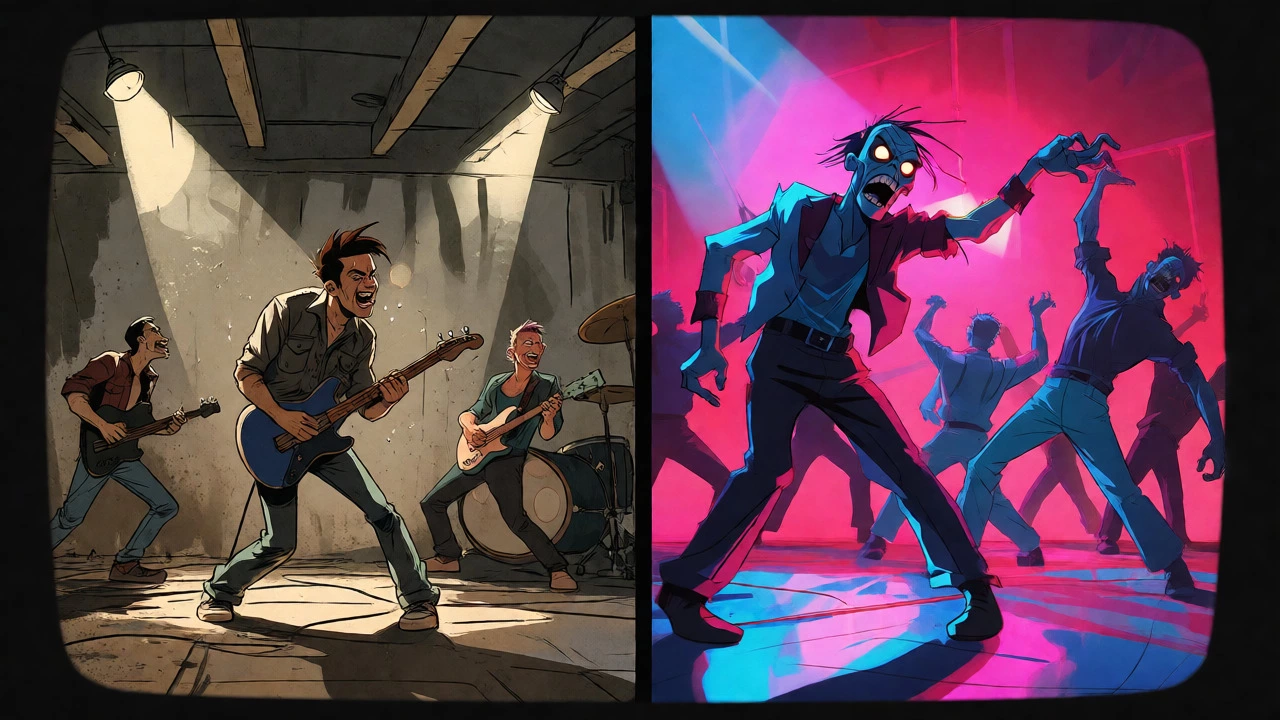

You turn on the TV in 1982 and see a band playing in a warehouse. You turn it on again in 1985, and you’re watching a mini-movie with zombies, plot twists, and cinematic lighting. What happened in between? The shift wasn’t just about better cameras or bigger budgets. It was a fundamental change in how we tell stories through moving images and sound. MTV, launched on August 1, 1981, didn't just play songs; it forced a battle between two competing styles of visual storytelling: narrative-driven shorts that told linear stories and performance-based clips that showcased musical talent. This tension defined the decade’s aesthetic, pushing directors to blend live energy with scripted drama in ways that still influence TikTok and YouTube today.
Key Takeaways
- The Three Modes: Scholar Marsha Kinder categorized early videos into performance, narrative, and dreamlike visuals, creating the framework we still use to analyze them.
- Economic Pressure: Early videos were cheap performance docs. As MTV rotation became essential for sales, labels invested in expensive narrative concepts to stand out.
- The Hybrid Solution: Hits like "Thriller" and "Take On Me" succeeded by mixing performance with story, proving you don't have to choose one over the other.
- Technical Constraints: Analog editing limits (fewer cuts per second) actually helped narrative clarity, whereas modern digital editing often fragments storylines.
- Legacy: The 1980s established the "music video as short film" genre, moving beyond simple lip-syncing to complex character development.
The Taxonomy of Visual Music
To understand the chaos of the 1980s, you need a map. Enter Marsha Kinder, a media scholar who, in the early 1980s, proposed a three-part typology for music videos that remains the standard academic lens today. She identified three distinct categories: performance videos, narrative videos, and dreamlike visuals. This wasn't just academic nitpicking; it reflected real production choices being made in studios from London to Los Angeles.
A performance video is exactly what it sounds like: the artist visibly performing the song, often in a studio or simulated concert setting. Think of the countless clips where a rock band stands in a circle, sweating under hot lights, miming to their track. These were cheap, fast to produce, and focused entirely on charisma and fashion. They prioritized the "star" over the "story."
In contrast, a narrative video functions like a traditional short film. It follows protagonists through a sequence of events with an inciting incident, complication, and resolution, all timed to the song's length. Here, the band might not even appear, or they appear only briefly. The focus shifts from the singer’s face to the protagonist’s journey.
Then there are dreamlike visuals. These are the outliers-non-linear, symbolic, and abstract sequences that prioritize mood over plot or direct performance. They reject both traditional cinema and straightforward documentation, leaning instead into surrealism. While less common than the other two, they pushed the boundaries of what video could be, influencing later experimental artists and high-fashion commercials.
From Warehouse to Cinema: The Economic Shift
Why did we move from warehouses to zombie movies? Money. In the late 1970s and very early 1980s, most music videos were essentially promotional tools. Record labels needed something to send to television shows like Solid Gold or The Old Grey Whistle Test. A band playing in a room was sufficient proof of existence. Costs were kept low because the primary goal was visibility, not artistic prestige.
But once MTV started broadcasting 24 hours a day, the economics changed overnight. Suddenly, a video wasn't just a promo; it was a product. With millions of teenage viewers tuning in daily, a generic performance clip risked getting lost in the shuffle. Directors like Russell Mulcahy (known for his work with Duran Duran and Queen) realized that distinctive visuals sold records. If everyone was playing in a warehouse, you had to do something else. You had to build a world.
This pressure created a feedback loop. Labels saw that narrative-heavy videos generated buzz and press coverage, which drove album sales. So, they poured more budget into these projects. By 1983-1984, the demand for "event" videos meant that hiring film directors became standard practice. The line between a music video and a movie trailer began to blur, setting the stage for the cinematic excesses of the mid-80s.
Case Studies: When Story Beats Song
Let’s look at how this played out in practice. One of the clearest examples of pure narrative dominance is Bronski Beat’s “Smalltown Boy” (1984). The video tells the story of a young gay man facing rejection and violence in his hometown, culminating in his departure. Notably, the band members themselves barely perform in the clip. There is no lip-syncing during the emotional scenes. The story carries the weight, using the song’s lyrics as a soundtrack to a specific social commentary. It proved that a video could tackle serious themes without relying on the band’s star power.
On the other end of the spectrum, Dire Straits’ “Money for Nothing” (1985) offers a fascinating hybrid. The core of the video is a performance shot-the band playing in a studio. But intercut with this are early computer-animated sequences depicting blue-collar workers watching MTV. The animation provides a narrative frame-a satire of consumer culture-while the live-action footage grounds the song in musical reality. It’s a perfect example of how performance and narrative can coexist, each serving a different function within the same four minutes.
Then there’s the gold standard of hybridization: A-ha’s “Take On Me” (1985). Using rotoscoping, the video blends live-action romance with pencil-sketch animation. Morten Harket performs, but he also acts as a character escaping into a comic book world. The choreography and visual effects create a narrative arc of pursuit and escape. It’s neither purely a concert film nor a silent movie; it’s a new form that leveraged technology to merge the two modes seamlessly.
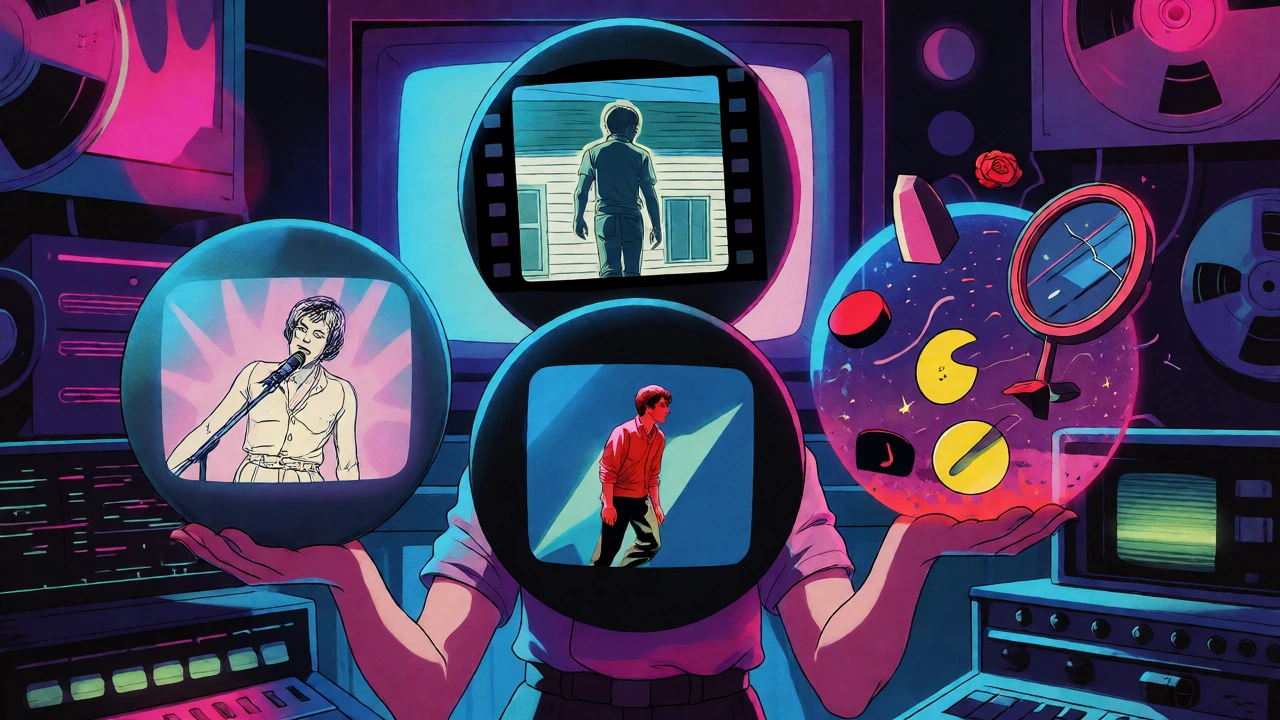
The Technical Grammar of the 80s
You can’t talk about style without talking about tech. The MTV aesthetic was defined by its constraints. Editing was analog. Cutting tape physically took time and skill. This limitation actually favored certain types of storytelling. Fast cuts were possible, but overdoing them was difficult and risky. As a result, many narrative videos relied on longer takes and clear spatial continuity to help viewers follow the plot.
Performance videos, however, exploited rapid editing to convey energy. A director could cut every two seconds to match the drum beat, creating a visceral sense of rhythm without needing a complex plot. This technical difference shaped the viewer’s experience. Narrative videos asked you to pay attention to characters; performance videos asked you to feel the beat.
Lighting also played a huge role. With limited budgets, directors couldn’t rely on massive sets or CGI. Instead, they used color palettes strategically. A scene might be lit entirely in neon pink or cold blue to signal emotion or location. This "more with less" approach forced creativity. Symbolic props-a red rose, a broken mirror, a leather jacket-had to do heavy lifting, embedding meaning directly into the performance gestures rather than relying on dialogue.
Beyond Pop: Video Art and Experimental Narratives
While MTV dominated living rooms, a parallel revolution was happening in galleries. Video art in the 1980s was explicitly critical of mainstream television’s naturalistic storytelling. Artists like Joan Jonas and Dan Reeves used video to deconstruct identity and memory.
Unlike pop stars, these artists weren’t trying to sell records. They were exploring the medium itself. For them, "narrative" didn’t mean a beginning, middle, and end. It meant layering voices, splitting personalities, and challenging the viewer’s perception of time. Dan Reeves’ “Smothering Dreams” (1981), for instance, uses a personal Vietnam War story across 20 minutes. It combines autobiographical testimony with experimental visuals, creating a dense, non-linear narrative that feels worlds away from a three-minute pop hit.
This distinction matters because it shows that the "narrative vs. performance" debate wasn’t just about marketing. It was about philosophy. Pop videos used narrative to humanize the star. Video art used performance to question the self. Both were reacting to the saturation of television images, but from opposite ends of the spectrum.
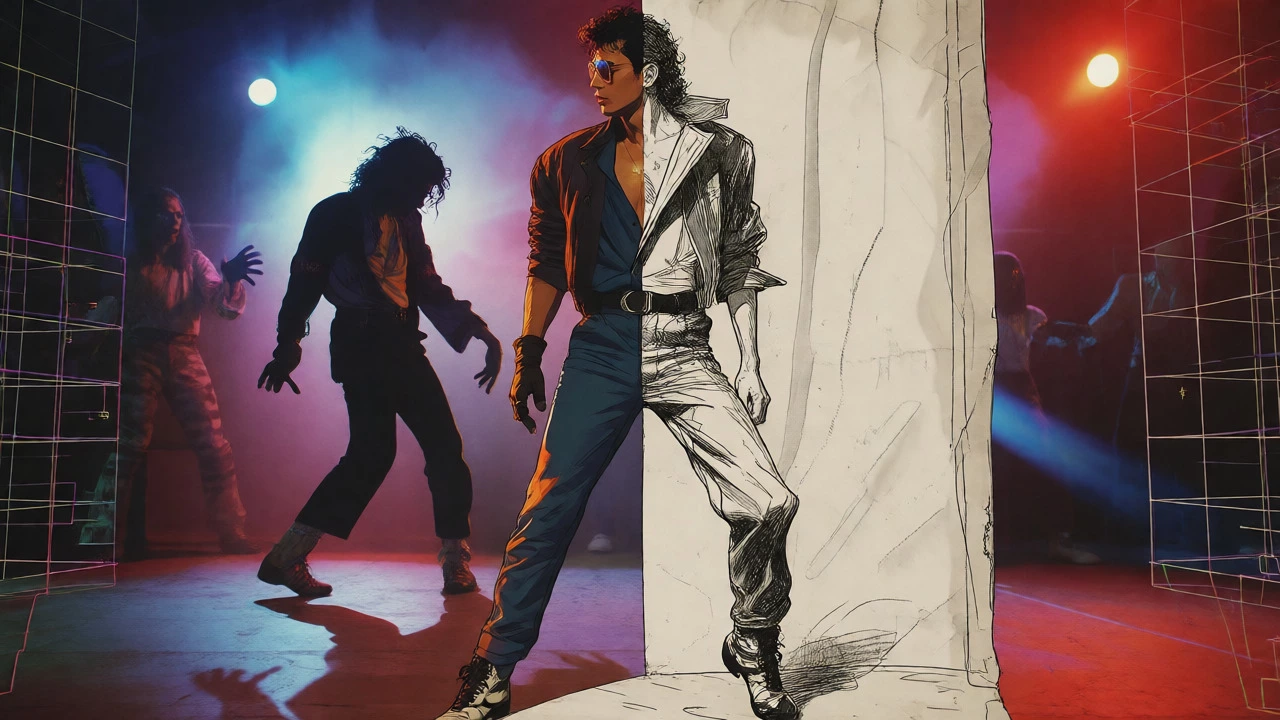
Comparing the Modes
How do you decide which mode works best? It depends on your goal. Below is a breakdown of the strengths and weaknesses of each approach during the 1980s.
| Feature | Performance Video | Narrative Video | Hybrid/Dreamlike |
|---|---|---|---|
| Primary Focus | Artist charisma, musical skill, fashion | Plot, character development, theme | Mood, symbolism, visual innovation |
| Production Cost | Low (studio setup, few locations) | High (actors, scripts, multiple locations) | Variable (depends on VFX/animation needs) |
| Viewer Engagement | Immediate, rhythmic, superficial | Emotional investment, repeated viewing | Intellectual curiosity, interpretive |
| Best For | New bands, upbeat tracks, showcasing talent | Ballads, concept albums, lyrical storytelling | Experimental genres, viral potential |
| Key Example | Early Def Leppard clips | Bronski Beat - "Smalltown Boy" | A-ha - "Take On Me" |
Why It Still Matters
Today, we consume music videos differently. We watch them on phones, often muted, with subtitles. Yet, the DNA of the 1980s remains. When a modern artist releases a short film for their single, they are following the path paved by Michael Jackson’s "Thriller." When a band posts raw rehearsal footage, they are echoing the early MTV performance clips.
The 1980s taught us that music isn’t just heard; it’s seen. The balance between showing the musician and telling a story is a delicate one. Too much narrative, and you lose the connection to the artist. Too much performance, and you risk boredom. The masters of the decade found the sweet spot, using the camera not just to record, but to imagine. Whether you prefer the raw energy of a garage band or the polished drama of a cinematic short, you’re engaging with a format that was forged in the fires of the MTV revolution.
What is the main difference between a narrative and a performance music video?
A performance video focuses on the artist playing or singing the song, often in a studio or stage setting, prioritizing musical presence and charisma. A narrative video tells a story with characters, plot, and scenes, similar to a short film, where the artist may not appear at all or serves only as a narrator.
Who was Marsha Kinder and why is she important to music video history?
Marsha Kinder is a media scholar who developed a foundational typology for music videos in the early 1980s. She categorized them into three types: performance, narrative, and dreamlike visuals. Her framework helps researchers and fans analyze how videos balance storytelling against musical presentation.
Did MTV cause the shift toward narrative music videos?
Yes, largely. Before MTV, videos were mostly cheap promotional tools featuring performances. After MTV launched in 1981, the need to stand out in constant rotation encouraged record labels to invest in higher-budget, story-driven videos that could capture and hold viewer attention longer.
What is a 'dreamlike' music video?
Dreamlike videos are a third category identified by scholars like Kinder. They avoid linear plots and direct performance, focusing instead on abstract, symbolic, or surreal imagery that evokes a mood or feeling rather than telling a clear story or showing a concert.
How did technology affect 1980s music video storytelling?
Analog editing constraints limited the speed of cuts, which actually helped narrative clarity by forcing longer takes. Conversely, the rise of early computer graphics (as seen in "Money for Nothing") and rotoscoping (in "Take On Me") allowed for new hybrid forms that blended live action with animation, expanding storytelling possibilities.