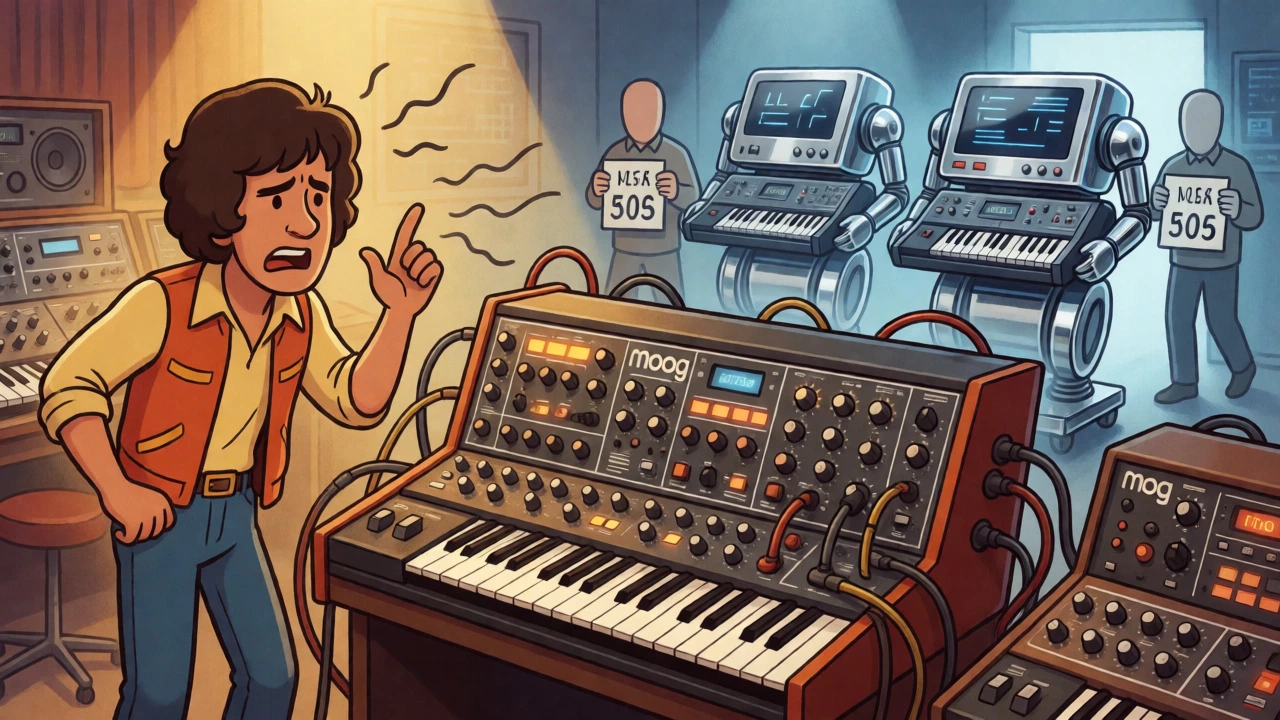

Imagine spending nearly $5,000 on a synthesizer that could play six notes at once, only to watch it go out of tune every time the studio lights turned on. That was the reality for professional musicians in the early 1980s who invested in Moog synthesizers. While Japanese manufacturers were flooding the market with cheap, stable digital instruments, Moog doubled down on complex analog engineering. This decade wasn't just about new gadgets; it was a high-stakes gamble where tradition collided with technology, leading to one of the most dramatic corporate collapses in music history.
The End of an Era: Norlin’s Mismanagement and Robert Moog’s Departure
To understand why the 1980s were so turbulent for Moog, you have to look at what happened before the decade started. By 1977, Robert Moog had left his own company, which had been absorbed by the conglomerate Norlin Musical Instruments. He moved to Asheville, North Carolina, and founded Big Briar, focusing on theremins and experimental controllers. Meanwhile, Norlin-owned Moog Music struggled under corporate bureaucracy. The iconic Minimoog, the workhorse of rock and electronic music since 1970, saw its production officially end in January 1981. The last unit rolled off the line with serial number 13,269. This marked a symbolic shift: the simple, knob-driven monosynth was being replaced by more complex, memory-equipped machines.
Norlin’s management style stifled innovation. Engineers wanted to push boundaries, but corporate accountants cared about margins. As a result, Moog entered the 1980s with a product lineup that felt increasingly outdated compared to agile competitors like Roland and Korg. The company needed a miracle, or at least a very good strategy, to survive the coming digital wave.
Bridging the Gap: Hybrid Designs Like the Source and Opus 3
Ahead of their flagship release, Moog attempted to modernize its image with smaller, more affordable instruments. These weren’t full-blown digital synths, but they used microprocessors to control analog circuits. This hybrid approach aimed to offer the convenience of patch recall without abandoning the warm analog tone Moog fans loved.
| Model | Release Year | Key Feature | Target Audience | Approx. Launch Price |
|---|---|---|---|---|
| Moog Source | 1981 | Membrane buttons, patch memory | Semi-pro / Studio | $1,000+ |
| Opus 3 | 1980 | Paraphonic string/brass sections | Stage Performers | N/A (Discontinued quickly) |
| Liberation | 1980 | Keytar form factor | Live Performers | N/A |
| Realistic MG-1 | 1981 | Mass-market entry level | Hobbyists | <$500 |
The Moog Source is a prime example of this transitional phase. It ditched the traditional knobs for a keypad and alphanumeric display, allowing users to store patches digitally while still generating sound through analog voltage-controlled oscillators. It was clever, but it lacked the raw power of the Minimoog. Similarly, the Opus 3 tried to compete with string machines by offering paraphonic textures, but it never gained significant traction. These instruments showed Moog was trying to adapt, but they didn’t solve the core problem: the market was moving toward fully digital FM synthesis.
The Monster in the Room: The Memorymoog (1982-1985)
If there was one instrument meant to save Moog, it was the Memorymoog. Released in 1982, this beast was a six-voice polyphonic synthesizer with three voltage-controlled oscillators per voice. That means 18 oscillators total, each feeding into a classic 24 dB/octave ladder filter. For sound designers, this offered unparalleled thickness and harmonic complexity. You could create chords that sounded massive, with rich detuning options that digital synths of the time couldn’t replicate.
The Memorymoog stored up to 100 patches in volatile memory, backed by a lithium battery. It featured a 61-key keyboard, pitch and modulation wheels, and a cassette interface for saving data. In 1984, the Memorymoog Plus added MIDI and a sequencer, bringing it closer to modern standards. However, the price tag was steep: around $4,795 in the US. For context, a Yamaha DX7, which was taking over the world, cost significantly less and offered hundreds of instantly playable presets.
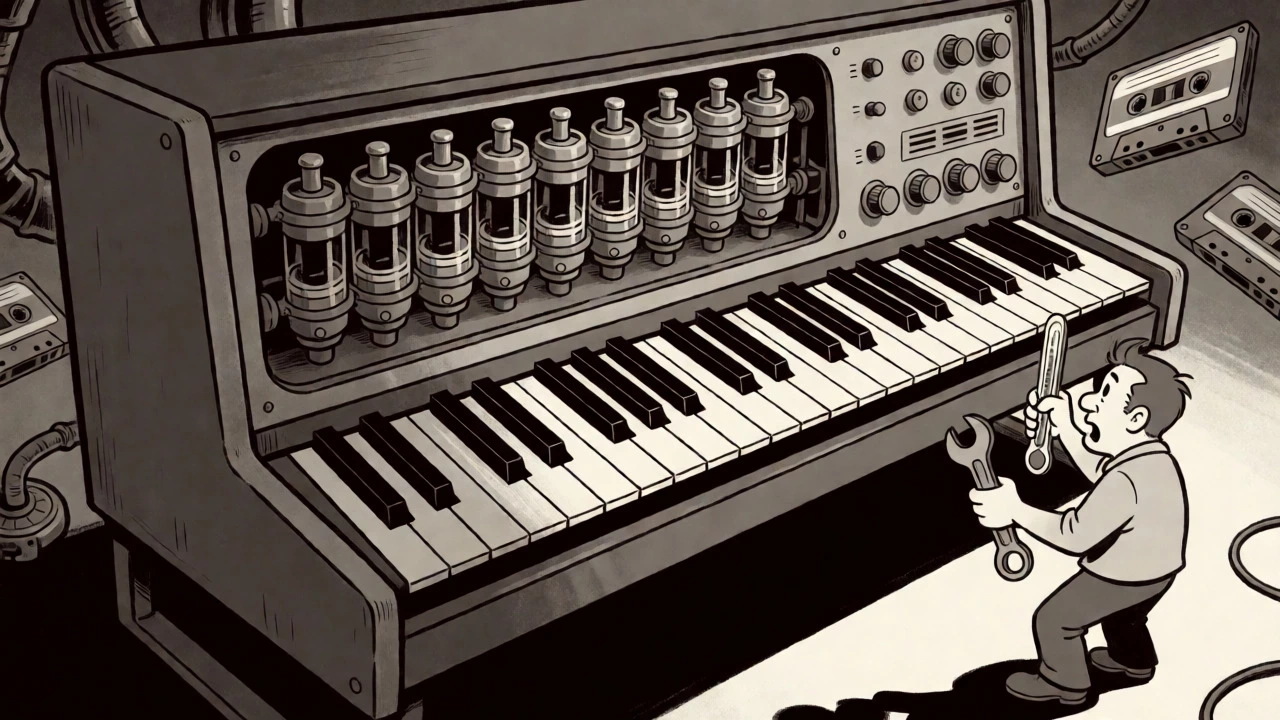
Technically, the Memorymoog used Curtis CEM3340 ICs for its oscillators, a move away from discrete transistors. This helped with manufacturing consistency but didn’t eliminate the tuning instability that plagued large analog polysynths. Users reported that the instrument required frequent calibration and was sensitive to temperature changes. Despite these issues, it remains a cult classic among collectors for its unique "triple VCO" sound.
The Digital Tsunami: Why Moog Couldn’t Compete
The real story of the 1980s isn’t just about Moog’s products; it’s about the competition. In 1983, Yamaha released the DX7. It used Frequency Modulation (FM) synthesis, which allowed for bright, metallic sounds and complex timbres that subtractive analog synthesis struggled to produce. More importantly, the DX7 was digital. It stayed in tune. It was reliable. And it was cheaper.
Japanese companies like Yamaha, Roland, and Korg dominated the market because they embraced mass production and digital efficiency. Moog, stuck in Buffalo, New York, continued to build hand-assembled analog units. The MIDI standard, introduced in 1983, further marginalized Moog. While other companies rushed to implement full MIDI support, Moog’s integration was late and limited. The Memorymoog Plus supported basic note-on/note-off messages, but lacked advanced features like velocity sensitivity or aftertouch, making it awkward in modern MIDI-centric studios.
Musicians began to view analog synths as temperamental relics. Why spend hours calibrating a $5,000 Memorymoog when a $1,200 DX7 gave you stable, futuristic sounds right out of the box? The shift in consumer preference was rapid and unforgiving.
Corporate Collapse: From Buyout to Bankruptcy
Norlin’s financial troubles spilled over onto Moog. In 1983, a group of Moog executives bought the company back from Norlin for $2.2 million, renaming it Moog Electronics. They hoped independence would allow them to pivot faster. But the damage was done. Sales plummeted as the DX7 and its successors took over pop, rock, and film scoring.
By 1986, Moog Music declared insolvency. Sources vary slightly on the exact timeline-some cite bankruptcy in 1986, others in 1987-but the outcome was the same. EJE Research Corporation acquired the assets and slowly liquidated the company. By 1993, all operations had ceased. The factory doors closed, ending an era of American analog dominance. Robert Moog, meanwhile, continued his work with Big Briar, keeping the spirit of experimentation alive even as the brand name went dormant.

Legacy and Revival
The 1980s were a dark age for Moog, but not a dead end. The instruments produced during this period, particularly the Memorymoog, became highly sought-after collectibles once the digital fatigue set in during the 1990s. Musicians realized that the "imperfections" of analog gear-the slight drift, the warmth, the unpredictability-were actually musical virtues.
In 2002, Robert Moog regained the rights to the Moog Music name. He revived the brand in Asheville, North Carolina, launching the Minimoog Voyager and later the Moog One. Today, Moog Music thrives by blending its heritage with modern technology, proving that the lessons of the 1980s-adapt or die-are still relevant. The evolution of Moog synthesizers in the 1980s serves as a cautionary tale about clinging to legacy technology in the face of disruptive innovation, but also a testament to the enduring appeal of analog sound.
Frequently Asked Questions
Why did Moog fail in the 1980s?
Moog failed primarily due to intense competition from Japanese manufacturers like Yamaha and Roland, who offered cheaper, more reliable digital synthesizers such as the Yamaha DX7. Additionally, internal mismanagement under Norlin and later Moog Electronics hindered the company's ability to pivot to digital technology quickly enough. The high cost and maintenance requirements of analog polysynths like the Memorymoog made them less attractive to mainstream buyers compared to stable digital alternatives.
What was the last major Moog synthesizer of the 1980s?
The Memorymoog, produced from 1982 to approximately 1985, was the last major synthesizer developed during the Norlin era. It was a six-voice polyphonic instrument known for its powerful triple-VCO architecture and distinctive analog sound. The Memorymoog Plus variant added MIDI and sequencing capabilities, representing Moog's final significant attempt to compete in the high-end synth market before the company's collapse.
Did Moog make any digital synthesizers in the 1980s?
No, Moog did not release a fully digital synthesizer during the 1980s. Their instruments remained based on analog subtractive synthesis, though they incorporated microprocessors for control functions like patch memory and parameter editing. Instruments like the Moog Source and Memorymoog Plus used digital logic for user interface tasks but generated sound using analog circuitry, distinguishing them from the true digital FM synths dominating the market at the time.
When did Moog Music declare bankruptcy?
Moog Music faced financial insolvency in 1986 and declared bankruptcy in 1987. Following this, the company was acquired by EJE Research Corporation, which gradually wound down operations. All remaining activities ceased by 1993, marking the complete end of the original Moog Music entity until the brand was revived by Robert Moog in 2002.
Is the Memorymoog still valuable today?
Yes, the Memorymoog has become a highly valuable collector's item. Due to its unique six-voice polyphony, rich analog tone, and historical significance as Moog's last major 1980s instrument, well-maintained units often sell for several thousand dollars on the secondary market. Its reputation for reliability issues adds to its allure for enthusiasts who appreciate vintage analog character and are willing to handle maintenance.