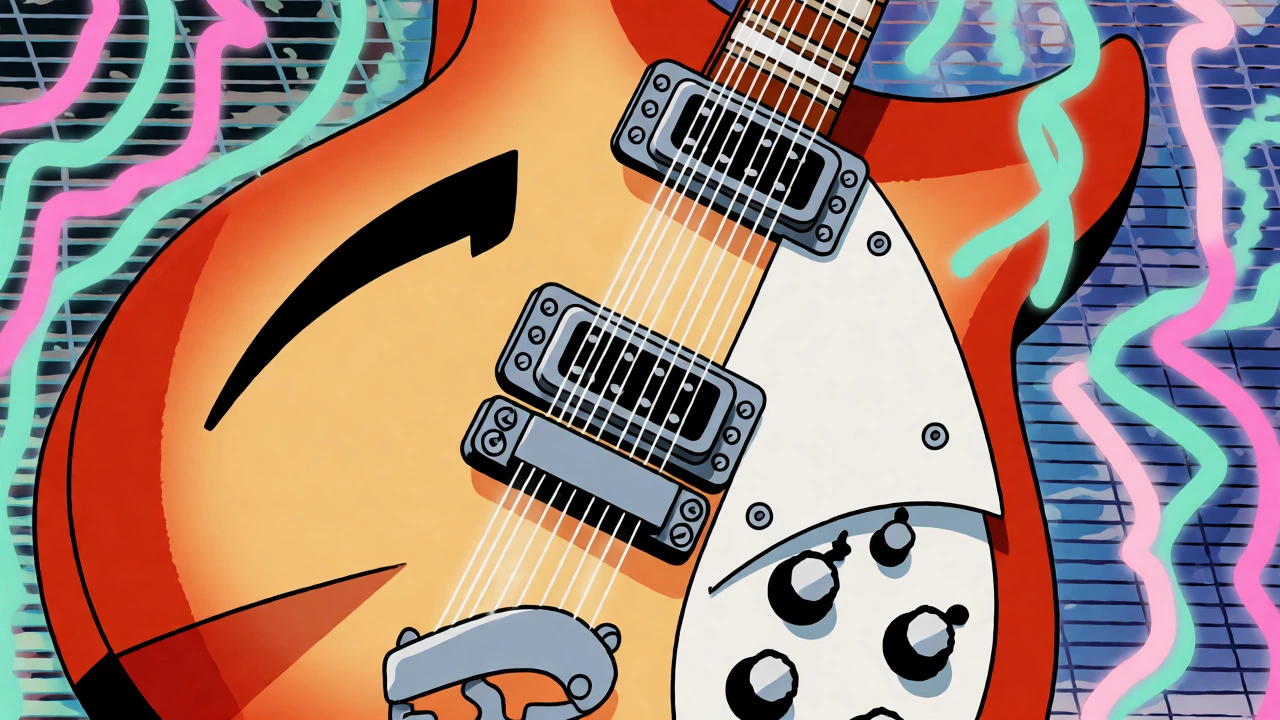

Why does a clean electric guitar suddenly feel like a memory? You hear it in the latest Alvvays track or a new Indie Rock single, and your brain instantly flags it as "retro." It isn't just a sound; it's a time machine. This sonic signature-bright, ringing, slightly wobbling-is what we call jangle pop. While its roots dig deep into the 1960s with The Byrds, its modern dominance comes from the mid-1980s college rock explosion. Today, bands aren't just copying old tapes; they are remixing the emotional texture of that era for a digital age. If you want to understand why this specific guitar tone dominates current playlists, you have to look at the instruments, the effects pedals, and the cultural longing that keeps them alive.
The Anatomy of the Jangle Sound
At its core, jangle is defined by clarity, not power. Unlike the distorted crunch of grunge or the wall-of-sound in shoegaze, jangle relies on treble-heavy, largely undistorted electric guitars. Think open chords, arpeggios, and ringing notes that sustain without muddying the mix. Historically, this sound is tied to R.E.M. and The Smiths, but the lineage stretches back further. AllMusic dates the peak of this movement to roughly 1984-1987, a period when college radio stations championed raw, amateurish recordings over polished mainstream pop. The lyrics were often cryptic, and the production was deliberately unpolished, creating an intimate vibe that felt accessible rather than distant.
But here is the catch: modern indie doesn't simply reproduce those old recordings. Today’s producers combine these audible signs of the past with modern editing tools, louder mastering standards, and digital effects. The value lies in recognizable historical color without needing a literal period reconstruction. It’s about evoking a feeling, not building a museum exhibit. When you listen to a contemporary track using this style, you are hearing a hybrid-a bridge between the DIY ethos of the 1980s underground and the high-fidelity expectations of streaming platforms.
Instruments That Define the Era
You cannot talk about jangle without talking about the Rickenbacker 12-string. This instrument is the holy grail for many guitarists chasing that chiming sound. Its current Model 360/12 specification features a semi-acoustic body, two Hi-Gain pickups, and a distinctive scale length. But why does it work so well? The octave-paired strings create rapid upper partials after every attack. This produces a natural sparkle and apparent chorus effect even before you plug into any electronic effects. It’s physics, not magic.
However, you don’t need a $2,000 Rickenbacker to get close. A standard six-string electric with bright single-coil pickups can deliver a related sound if played correctly. Bands like Flying Nun artists in New Zealand proved that attitude and technique matter more than gear. They used cheaper guitars, slower tempos, and denser walls of sound to create a darker, hypnotic variant of jangle. Johnny Marr of The Smiths famously rejected the idea that his sound was just one kind of "jingle jangle," citing Gibson ES-335s and various tuning experiments. The lesson? The instrument sets the potential, but the player unlocks it.
| Instrument | Sonic Characteristic | Historical Context |
|---|---|---|
| Rickenbacker 12-string | Bright, chiming, natural octave shimmer | The Byrds, R.E.M., The Smiths |
| Fender Jazzmaster | Warm, resonant, versatile tremolo | Dunedin Scene, Modern Indie |
| Gibson ES-335 | Hollow-body warmth, mid-range focus | Paisley Underground, Later Smiths |
| Telecaster | Cut-through twang, sharp attack | Country-rock influence, Twee Pop |
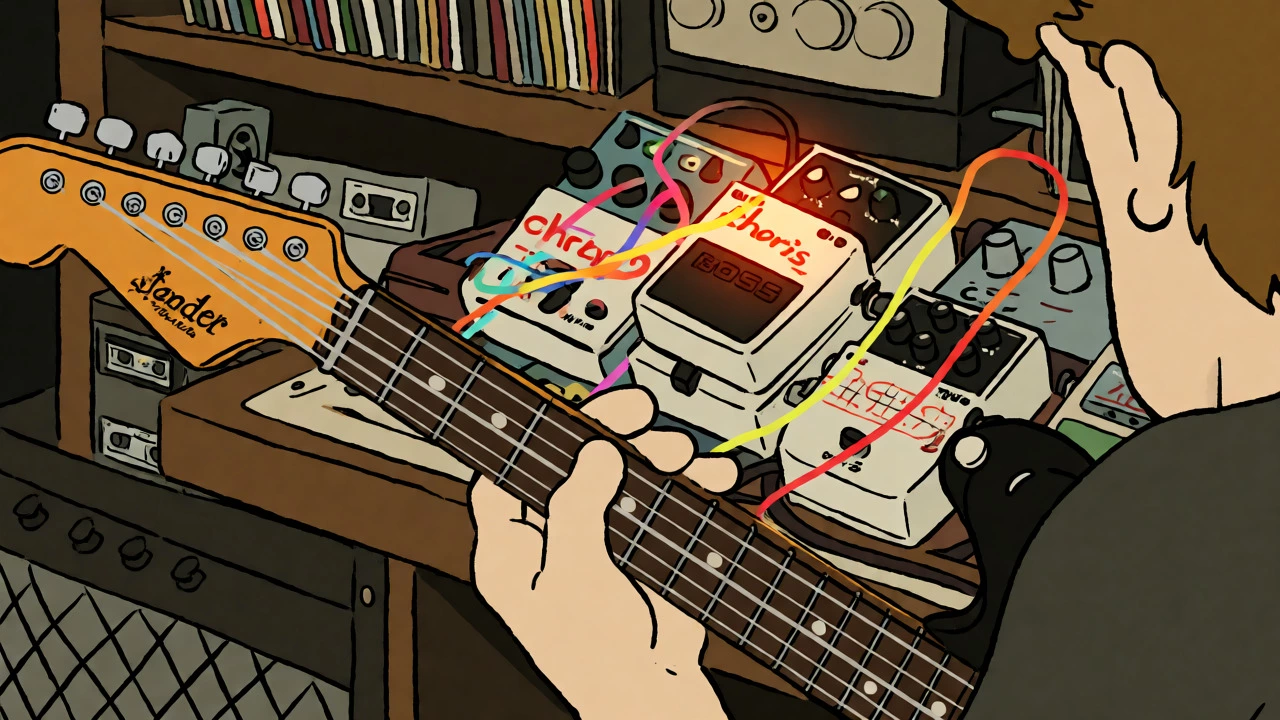
The Science Behind the Chorus Effect
If the guitar provides the skeleton, the Chorus Effect provides the skin. Technically, a chorus pedal splits your signal into dry (original) and wet (processed) paths. It delays the wet path by a few milliseconds and continuously varies that delay using a low-frequency oscillator (LFO). Your ear interprets these slight pitch variations as multiple performers playing the same part simultaneously. It creates width and movement out of thin air.
Analog units from the 1980s, like the BOSS CE-2, used bucket-brigade devices (BBD chips) to achieve this. These chips passed signals through charge-storage stages, adding a subtle, pleasing coloration that digital emulations still try to capture. Roland’s JC-120 Jazz Chorus amplifier, released in 1975, was another landmark. It used two independent amplifiers to send dry and modulated signals to separate speakers, creating a true stereo experience. For modern producers, understanding the controls is key: delay time, modulation speed, depth, and feedback. Too much depth sounds like a warble; too little sounds dry. The sweet spot for classic indie is often around 0.5-0.8 Hz rate and 30-45% depth.
Nostalgia as a Production Tool
Nostalgia in music isn't just about missing the past; it’s a functional tool. At the sonic level, elements like tape saturation, spring reverb, and imperfectly balanced mixes act as temporal markers. They tell the listener, "This is warm, human, and analog." Research on cassette culture shows that the reuse of cassettes today is both a nostalgic artifact and a statement of independence. It rejects the sterile perfection of modern digital production in favor of something that feels lived-in.
But be careful. Critics argue that these signals have become genre shorthand. Bright guitar plus breathy vocals might communicate "indie" before the song actually earns its identity. This is what scholars call "technostalgia"-a conflict between nostalgic rhetoric and modern commercial requirements. When a band uses a chorus pedal, they aren't just making a choice about tone; they are positioning themselves within a cultural narrative of college radio, fanzines, and small venues. It’s a pre-streaming model of discovery packaged for the Spotify algorithm.

How Modern Bands Reinterpret the Past
Look at Alvvays. Guitarist Alec O’Hanley cites late-1980s UK bands and Johnny Marr as major influences, yet their production is dense and contemporary. They don't hide the polish; they use it. Other groups like Black Country, New Road explore the British guitar tradition but push it into experimental territory. They show that the 1980s vocabulary is flexible. You can take the interlocking guitar parts of The Smiths and apply them to complex, odd-time signatures. You can take the chime of a Rickenbacker and bury it in modern distortion.
The strongest approach treats jangle as a toolkit, not a rulebook. Start with the musical function: do you need clarity? Interlocking parts? Emotional distance? Then choose the tech that supports it. A Jazzmaster with a simple delay might work better than a Rickenbacker with a heavy chorus. Preserve transients. Leave space between guitars. Automate modulation so the chorus swells during choruses and tightens up during verses. This dynamic control prevents the "blur" that plagues bad retro imitations.
Practical Tips for Achieving the Tone
If you are trying to capture this sound in your own recordings, start with a bright, clean amplifier. Keep the bass restrained and the treble moderate. Avoid excessive compression, which kills the pick attack. Here is a quick checklist for a modern-indie starting point:
- Guitar Choice: Single-coil pickups or a 12-string if available.
- Playing Style: Open voicings, suspended notes, and light picking dynamics.
- Chorus Settings: Delay 4-12ms, Rate 0.3-1.5Hz, Depth 30-45%, Mix 40-60%.
- Amp Settings: Clean channel, slight room reverb, no distortion.
- Arrangement: One guitar for rhythm bed, another for high-register counter-lines.
Remember, the 12-string’s natural beating is an arrangement feature, not a substitute for good playing. Don't drown everything in chorus. Sometimes, a dry, clean guitar cuts through a mix better than a washed-out one. Check your phase compatibility if recording in stereo; wide presets often collapse poorly on mono playback systems like phones.
Do I really need a 12-string guitar to play jangle pop?
No, while the Rickenbacker 12-string is iconic, a standard six-string with bright single-coil pickups can achieve a similar effect. The key is using open chord shapes, arpeggios, and proper pickup selection to maximize brightness and sustain.
What is the difference between chorus and flanger?
Both use delayed signals, but chorus typically has a shorter delay time (under 20ms) and no feedback, creating a doubling effect. Flangers use longer delays and feedback, resulting in a sweeping, jet-plane-like sound. Jangle pop usually favors chorus for its subtler, thicker texture.
Why does my chorus sound watery or muddy?
This often happens when the modulation depth is too high or the mix is too wet. Try reducing the depth to under 50% and ensuring your dry signal remains prominent. Also, check your EQ; excessive low-mids can clash with the chorus effect, causing mud.
Is jangle pop only associated with The Smiths?
While The Smiths are central figures, the genre includes R.E.M., The Byrds, The La’s, and the Dunedin scene bands like The Chills. Each group contributed unique elements, from psychedelic textures to twee minimalism, expanding the definition beyond just one band.
Can digital plugins replicate the 1980s chorus sound?
Yes, modern BBD emulations and convolution reverbs can closely mimic analog hardware. However, analog units add unique harmonic saturation that some purists prefer. Experiment with both to find the character that fits your track best.