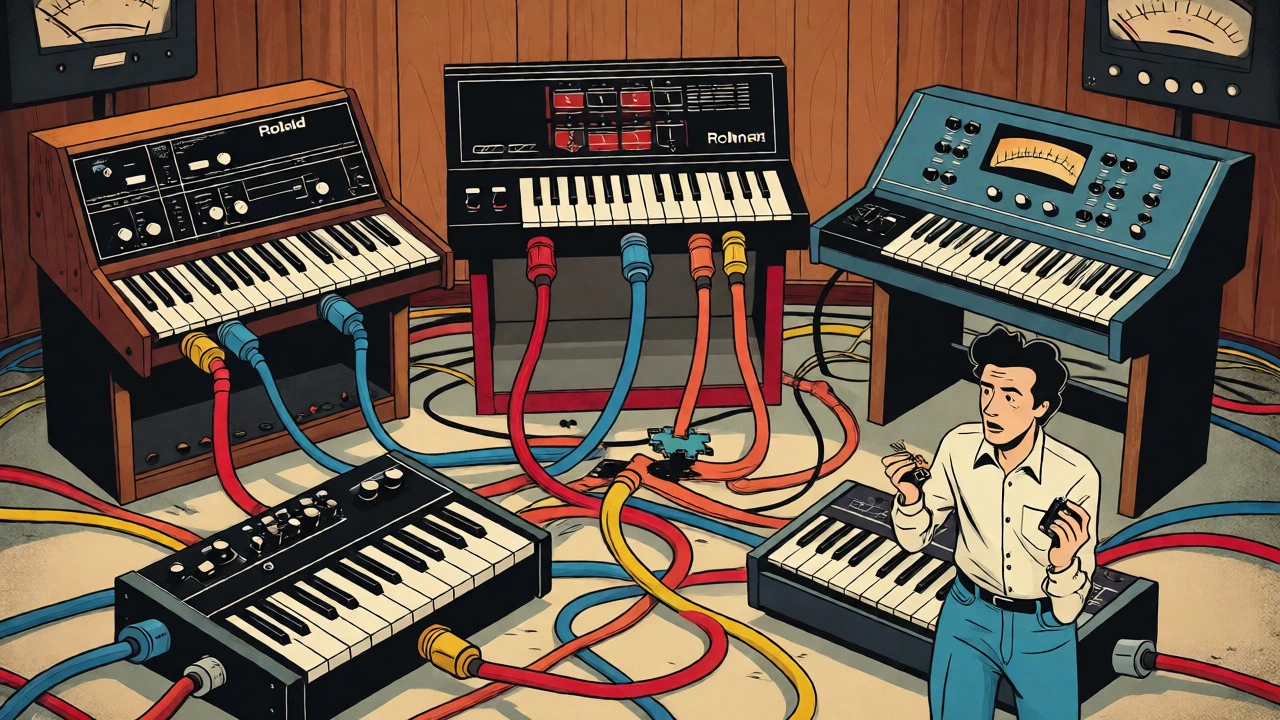

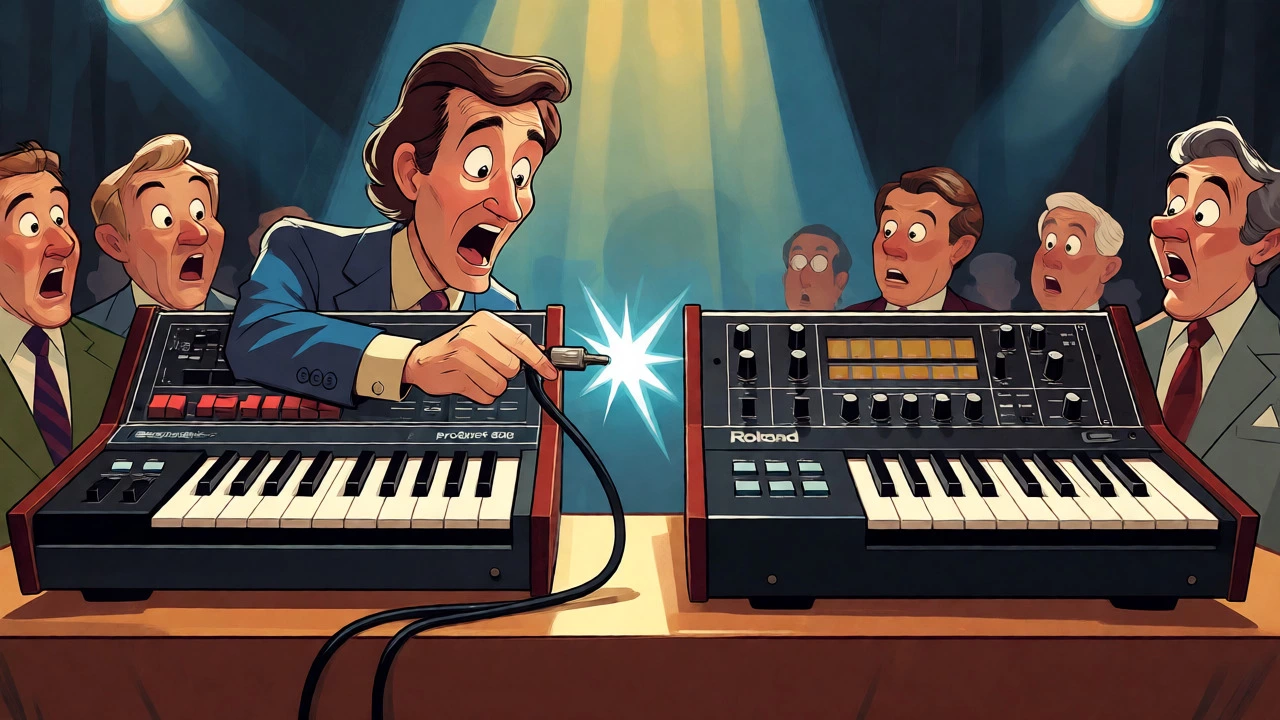
Imagine walking into a recording studio in 1982. You have three different synthesizers sitting on racks, each from a different brand. To play them all at once with one keyboard, you’d need a tangle of proprietary cables, specific adapters, and a technician who understood why Roland gear didn’t talk to Yamaha gear. It was a mess. Then, in January 1983, at the NAMM show in Anaheim, California, Dave Smith plugged a single cable between his Sequential Prophet-600 and a Roland Jupiter-6. He played a chord on the Prophet, and the Roland sang back. The room went quiet. That moment wasn't just a demo; it was the birth certificate of the MIDI controller, a device that sends performance data rather than generating sound itself.
This simple act of connection sparked a revolution. Before this, electronic instruments were islands. After this, they became a network. If you’re curious about how we got from isolated synths to the modern home studio setup where one keyboard controls your entire world, you need to look back at the early 1980s. This isn't just nostalgia; understanding this shift explains why your current DAW workflow works the way it does.
The Problem With Proprietary Cables
To appreciate what happened, you have to understand the chaos before the cure. In the late 1970s and early 1980s, major manufacturers like Roland, Oberheim, and Korg developed their own digital control buses. Roland had the DCB (Digital Control Bus), which worked great if you only owned Roland gear. Oberheim had its Parallel Bus. These systems used different voltage levels, different message formats, and different physical connectors. A Roland keyboard couldn't trigger an Oberheim synth without expensive, often unreliable interface boxes that converted signals on the fly.
For musicians, this meant locked ecosystems. If you bought a Yamaha DX7, you were effectively married to Yamaha’s ecosystem for sequencing and control. There was no universal language. Instruments could make sounds, but they couldn't easily share instructions. This lack of interoperability stifled creativity because artists spent more time troubleshooting connections than making music. The industry needed a handshake protocol-a standard way for machines to say "play note C4" regardless of who built the machine.
Dave Smith and the Birth of MIDI
The solution came from an unlikely alliance. Dave Smith, founder of Sequential Circuits, started talking to Ikutaro Kakehashi of Roland Corporation around June 1981. They weren't trying to save the world; they were trying to solve a practical engineering problem. Smith wanted his new synthesizer to communicate with other brands. Kakehashi agreed that a universal standard would benefit everyone. They brought in Tom Oberheim and engineers like Chet Wood to refine the idea.
They called it the Universal Synthesizer Interface (USI) initially. By October 1981, they presented a paper at the Audio Engineering Society convention in New York. The core concept was radical in its simplicity: use a serial data stream to send numbers. Instead of sending audio signals or complex analog voltages, the system would send binary messages representing notes, velocity, and control changes. It was cheap, fast, and easy to implement on the microprocessors of the day.
| Feature | Proprietary Buses (e.g., Roland DCB) | MIDI 1.0 Standard |
|---|---|---|
| Interoperability | Brand-specific only | Cross-manufacturer compatibility |
| Data Rate | Varied widely | Fixed 31.25 kbit/s |
| Channels | Limited or none | 16 logical channels |
| Connector Type | Various proprietary plugs | Standard 5-pin DIN |
| Adoption Speed | Slow, fragmented | Rapid industry-wide adoption |
The Technical Magic Behind the Controller
What made MIDI so successful wasn't just the idea; it was the technical execution. The specification defined a 31.25 kbit/s serial link using 8-bit words. It used 5-pin DIN connectors, which were already common in professional audio, making integration easier. But the real genius was in the separation of control and sound.
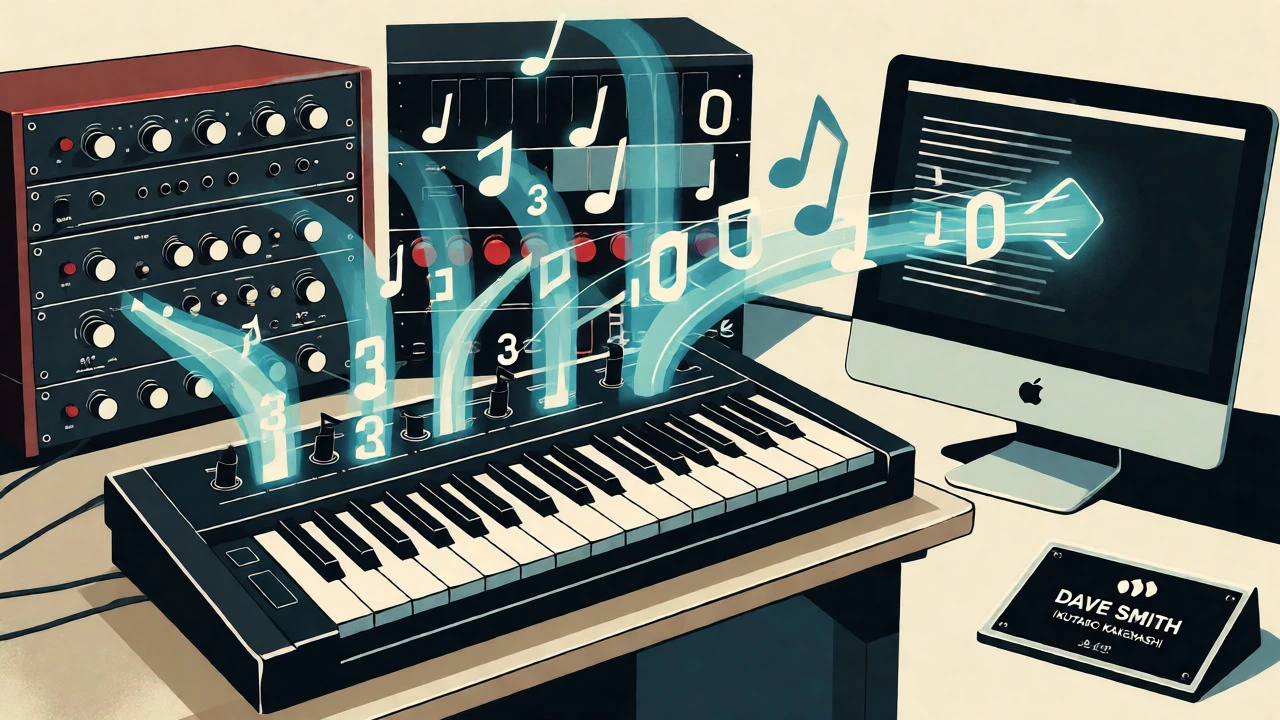
A MIDI controller is defined by what it does not do: it doesn't generate audio. It generates data. When you press a key, the controller sends a status byte indicating "Note On," followed by two data bytes specifying the note number (0-127) and the velocity (how hard you hit the key). This lightweight data structure meant you could chain multiple devices together. One keyboard could control five different sound modules simultaneously, each assigned to a different MIDI channel.
This architecture allowed for the creation of dedicated controllers-keyboards without oscillators or filters. Why pay for sound generation hardware twice? Musicians could buy a high-quality weighted-key controller and pair it with cheaper rack-mounted sound modules. This democratized access to high-end synthesis. You didn't need a $5,000 Prophet-5 to get professional sounds; you needed a controller and a module.
The First Wave of MIDI Devices
The market exploded almost immediately after the official publication of the MIDI 1.0 Specification in August 1983. Only five companies were actively involved in the initial development: Sequential Circuits, Roland, Yamaha, Korg, and Kawai. Yet, within two years, most major manufacturers had adopted MIDI as a standard feature.
The first mass-produced applications included the Yamaha DX7, released in May 1983. While primarily known for its FM synthesis engine, its MIDI port allowed it to be sequenced and controlled externally, setting a precedent for future workstations. The Roland JX-3P and the Sequential Prophet-600 also shipped with MIDI interfaces, blurring the line between instrument and controller.
By 1984 and 1985, dedicated controllers began appearing. These were keyboards stripped of their sound engines, designed solely to send MIDI data. They were cheaper, lighter, and often featured better key actions than the integrated synths they replaced. This era saw the rise of the "studio rig": a central computer or sequencer connected via MIDI to a bank of rack-mount modules, all played from a single master keyboard.
Beyond Keyboards: Alternative Controllers
MIDI’s numeric nature invited experimentation. If you can map a key press to a number, you can map anything to a number. This led to the emergence of alternative controllers in the mid-1980s. Devices like Palmtree Instruments’ Airdrums used motion sensors to translate physical gestures into MIDI messages. Drummers could wave their hands to trigger samples, bypassing traditional acoustic triggers.
Wind controllers appeared, allowing saxophone players to control synthesizers with breath pressure and finger position. Even early guitar-to-MIDI converters emerged, though latency issues plagued these early attempts. The common thread was the exploitation of MIDI’s low-latency, low-bandwidth data stream to capture human expression in ways that analog CV/Gate systems struggled to replicate reliably.
Why It Stuck: The Network Effect
You might wonder why MIDI survived when other standards died. The answer lies in the network effect. Because the spec was open and published by the International MIDI Association (IMA), any manufacturer could build a compatible device. As more devices joined the network, the value of having a MIDI port increased for everyone else. By the late 1980s, not having MIDI on a synthesizer was a significant competitive disadvantage.
This interoperability extended beyond instruments. Computers entered the picture. Early sequencers ran on Commodore 64s and Atari STs, turning personal computers into central command hubs for MIDI rigs. This laid the groundwork for the modern Digital Audio Workstation (DAW). Today, when you drag a MIDI clip into Ableton Live or Logic Pro, you are using the direct descendant of those 1983 protocols.
The impact was quantifiable. While exact sales figures for the 1980s are scarce, modern market research shows the global MIDI controller market valued at approximately USD 1.8 billion in 2025, projected to grow to USD 2.1 billion by 2034. This sustained growth over four decades proves that MIDI controllers aren't a fad; they are infrastructure.
Legacy and Modern Relevance
In 2013, Dave Smith and Ikutaro Kakehashi received joint Technical Grammy Awards for their role in creating MIDI. It was a belated recognition of a revolution that had already reshaped music production. Their collaboration proved that competition could coexist with cooperation when the goal was user empowerment.
Today, MIDI 2.0 is rolling out, offering higher resolution and bidirectional communication. But the core philosophy remains unchanged: separate control from sound generation. Whether you're using a $100 mini-keyboard or a $2,000 hybrid controller, you're participating in the digital music revolution that started with a single cable in Anaheim.
What is the difference between a MIDI controller and a synthesizer?
A synthesizer generates audio signals internally using oscillators and filters. A MIDI controller does not produce sound on its own; it sends digital data (note information, velocity, control changes) to another device that generates the sound. Many modern keyboards are hybrids, containing both a sound engine and a MIDI controller function.
Who invented MIDI?
MIDI was developed collaboratively by Dave Smith of Sequential Circuits and Ikutaro Kakehashi of Roland Corporation, with significant contributions from Tom Oberheim and engineers like Chet Wood. The standard was officially published in 1983.
How many MIDI channels can one controller handle?
The original MIDI 1.0 specification supports 16 logical channels per connection. This allows a single controller to address up to 16 different instruments or parts simultaneously, provided they are set to receive on different channels.
Did MIDI replace analog CV/Gate connections?
Not entirely. MIDI largely replaced CV/Gate in mainstream commercial synthesizers due to its ease of use and multi-channel capability. However, analog modular synthesizers still use CV/Gate for precise voltage control, and many modern hybrid setups use both systems to leverage the strengths of each.
Is MIDI still relevant today?
Yes, MIDI is fundamental to modern music production. It is the primary method for controlling software synthesizers, samplers, and effects plugins in DAWs. The introduction of MIDI 2.0 continues to expand its capabilities, ensuring its relevance for future technologies.

