
Imagine standing in a dark arena, watching a band play a song that has never been released on an album yet. Now imagine they do this for ninety minutes straight, every single night, across two continents. It sounds like madness, but it was the reality for fans of Progressive Rock, a genre defined by its ambition to merge rock music with classical complexity and literary themes. When bands decided to take their sprawling studio narratives-known as concept albums-to the stage, they didn't just plug in and play. They built empires of light, brick, and sound to make sure you understood the story.
The Challenge of Translating Studio Narratives
Concept albums are different from standard records. They are not collections of singles; they are long-form stories, often running forty to ninety minutes, designed to be heard from start to finish. In the studio, producers can layer dozens of tracks, use perfect editing, and create seamless transitions. Live, none of that exists. You have one chance to get it right, in front of thousands of people who might be drinking beer or talking to each other.
For progressive rock bands in the 1970s, the goal was total immersion. They wanted the concert to feel like a theater production, not just a gig. This meant adapting complex musical structures and surreal lyrics into visual experiences that could survive the chaos of a live venue. Three bands stand out as pioneers in this risky experiment: Genesis, Pink Floyd, and Jethro Tull. Each chose a completely different path to solve the same problem: how to keep the audience engaged while telling a difficult story.
Genesis: The Slide Show Spectacle
In November 1974, Genesis released The Lamb Lies Down on Broadway, a double album following the surreal journey of Rael, a young Puerto Rican man in New York City. The album was dense, weird, and over eighty minutes long. Instead of picking the best songs, the band decided to perform the entire album, in order, at every show. They did this even before the album was released in the United States.
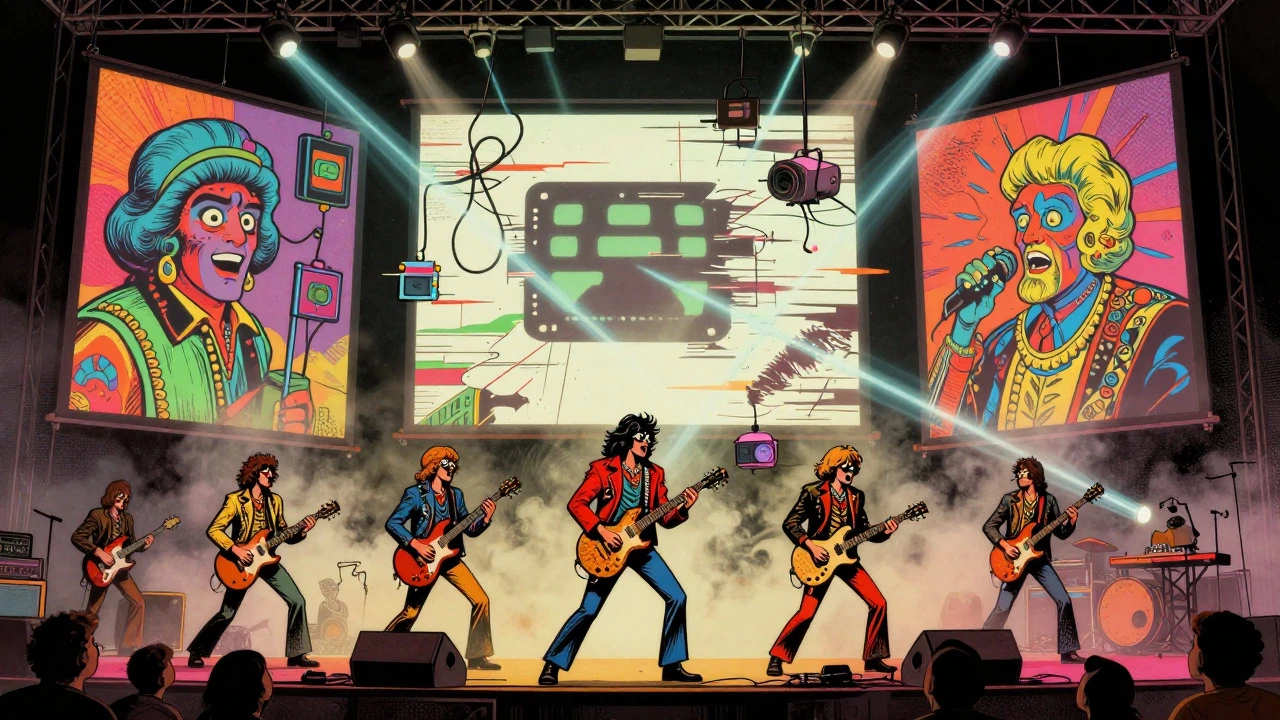
To help the audience follow the story, Genesis created one of the first large-scale multimedia tours in rock history. Behind the band, they set up three massive projection screens. These screens displayed Geoffrey Shaw's artwork, consisting of 1,450 individual slides. The setup required seven or eight slide projectors running simultaneously, plus a laser lighting system and elaborate costumes worn by lead singer Peter Gabriel.
| Band / Album | Primary Visual Method | Tour Scale (Dates) | Key Financial Impact |
|---|---|---|---|
| Genesis: The Lamb | Slide projections & lasers | 102 dates | £220,000 debt |
| Pink Floyd: The Wall | Physical wall structure | 31 dates | High per-show cost |
| Jethro Tull: Thick As A Brick | Minimal staging | Special revivals only | Low overhead |
The idea was brilliant, but the execution was a nightmare. Tony Banks, the band's keyboardist, later admitted that the slide show worked "almost perfectly" at only four or five shows out of the entire 102-date tour. That is a failure rate of over 95%. Mechanical projectors broke, slides got stuck, and the synchronization with the music failed constantly. Despite this, the band played on. To soften the blow of ninety minutes of unfamiliar material, they added encores featuring older hits like "The Musical Box" and "Watcher of the Skies." This gave fans something recognizable after the intense narrative experience.
The financial toll was severe. The tour left Genesis with a debt of approximately £220,000. At the time, this was a staggering amount, equivalent to several years of touring profits. It taught the band a harsh lesson: artistic ambition without technical reliability leads to bankruptcy. They never attempted such a heavy theatrical staging again.
Pink Floyd: Building the Barrier
If Genesis tried to tell their story through images, Pink Floyd decided to build their story physically. Released in 1979, The Wall is about a rock star named Pink who isolates himself from the world behind a metaphorical wall. For the 1980-1981 tour, bassist Roger Waters wanted the audience to see that isolation happen in real time.
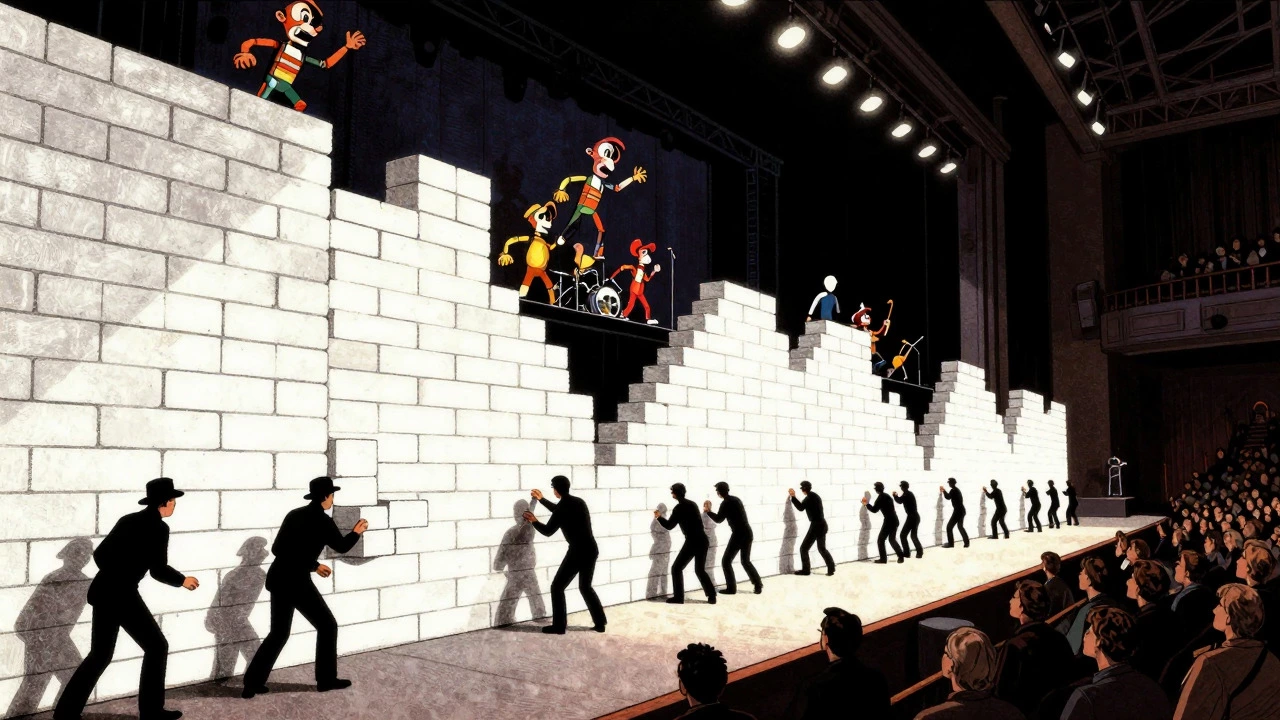
The centerpiece of the show was a literal wall. It stood 31 feet high and stretched 160 feet long across the stage. During the first half of the concert, crew members placed bricks onto the wall one by one, slowly separating the band from the crowd. By the end of the first act, the musicians were hidden behind a massive barrier, projecting their voices through speakers while animated puppets performed on the other side. Later in the show, the wall was demolished, symbolizing Pink's breakdown and reconnection with humanity.
This approach required a level of logistical precision that most tours couldn't handle. The stage itself had two levels, separated by a black curtain, allowing the wall to be constructed and destroyed without interrupting the flow of the music. Because the setup was so complex and expensive, Pink Floyd didn't tour the country. They picked only four cities: Los Angeles, New York, Dortmund, and London. In total, they performed just 31 times.
By limiting the number of shows, Pink Floyd managed the financial risk differently than Genesis. Instead of spreading costs over 100 nights, they charged premium prices for exclusive events in major markets. The result was a quasi-theatrical experience that felt more like a play than a rock concert. The physical presence of the wall made the album's theme of alienation undeniable, creating a powerful emotional connection that slides alone could never achieve.
Jethro Tull: The Power of Patience
Not every band needed giant sets or broken projectors to adapt their concept albums. Jethro Tull took a different route with their 1972 masterpiece, Thick As A Brick. The album is a continuous forty-minute piece disguised as a parody of prog-rock pretension. For decades, the band avoided playing it in full during regular tours, opting instead to perform shorter sections or medleys.
It wasn't until April 2012, nearly forty years after the album's release, that Jethro Tull performed Thick As A Brick in its entirety live for the first time since 1972. This decision highlights a common pattern in progressive rock: full-album performances are often reserved for anniversaries or special occasions. By waiting, the band ensured that the audience already knew the music inside out. Fans bought tickets expecting the complete experience, removing the risk of boredom or confusion that plagued Genesis's early US dates.
This strategy minimized financial risk. There were no custom-built walls or hundreds of fragile slides. The focus remained entirely on the musicianship and the intricate composition of the song. It proved that you don't always need spectacle to sell a concept; sometimes, reputation and patience are enough.
Lessons for Modern Live Production
Looking back at these three examples, we can see clear strategies for adapting complex music to the stage. Each band faced the same core conflict: balancing artistic vision with practical constraints.
- Technical Reliability vs. Ambition: Genesis showed that adding technology increases the chance of failure. If your narrative depends on slides working perfectly, and they break 95% of the time, the story falls apart.
- Scale vs. Exclusivity: Pink Floyd demonstrated that fewer shows can mean higher quality and better profit margins if you target the right venues. You don't need to play everywhere to succeed.
- Familiarity Matters: Jethro Tull’s approach reminds us that audiences engage better with material they already know. Playing a new, difficult concept live requires a strong existing fanbase or significant educational effort.
Today, modern concerts use LED screens, motion capture, and digital audio workstations that would have solved Genesis's projector problems instantly. However, the fundamental challenge remains: how do you keep a crowd focused for an hour-plus narrative? The answer usually involves mixing familiar hooks with new storytelling, ensuring that the visual elements enhance rather than distract from the music.
Frequently Asked Questions
Why did Genesis go into debt on The Lamb tour?
Genesis incurred a debt of approximately £220,000 because of the enormous cost of transporting and maintaining their complex multimedia setup, which included multiple slide projectors, laser systems, and custom costumes. Additionally, the technical failures meant the show often didn't deliver the intended impact, reducing its commercial appeal despite the high ticket sales.
How many times did Pink Floyd perform The Wall live?
Pink Floyd performed The Wall exactly 31 times between 1980 and 1981. The limited run was due to the extreme logistical complexity and cost of building and transporting the 160-foot-wide physical wall structure across different venues.
What was the success rate of Genesis's slide show?
According to keyboardist Tony Banks, the slide show worked "almost perfectly" at only four or five shows out of the 102-date tour. This represents a success rate of roughly 4-5%, indicating that mechanical reliability was a major issue for analog multimedia in the 1970s.
When did Jethro Tull first perform Thick As A Brick in full?
Jethro Tull performed Thick As A Brick in its entirety for the first time since its original release in 1972 during April 2012. This revival marked a return to the complete concept after decades of only performing selected excerpts.
Did Genesis play The Lamb before it was released in the US?
Yes. Genesis began their tour in November 1974, starting in Chicago, before The Lamb Lies Down on Broadway was officially released in the United States. This meant American audiences were hearing the complex narrative for the very first time live, with no prior reference point.


