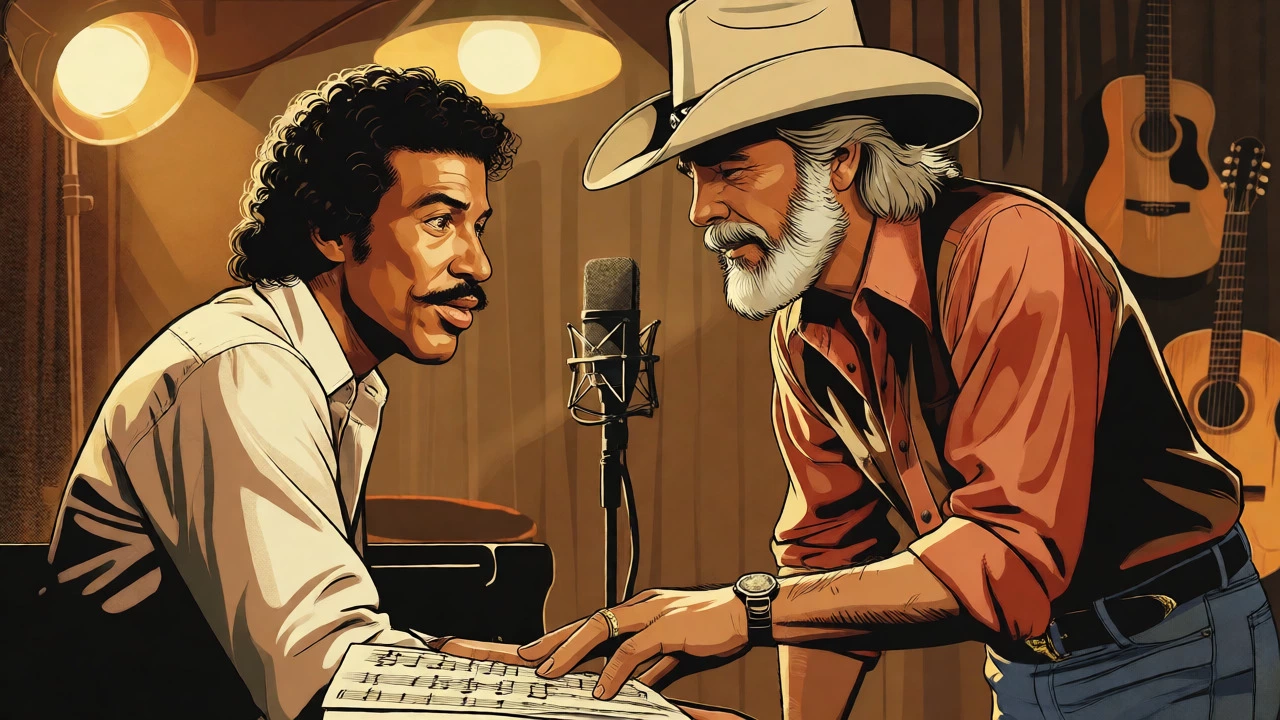

Imagine writing a song that hits number one on the Billboard Hot 100, tops the country charts, and dominates adult contemporary radio all at once. That isn't just luck; it's engineering. In 1980, Lionel Richie, already famous as the frontman of the Commodores, wrote "Lady" for country legend Kenny Rogers. The result? A massive hit that blurred the lines between genres so effectively that few listeners noticed the seams. This wasn't an accident. Throughout the 1980s, Richie executed a masterclass in genre mobility, moving seamlessly between soul, pop, and country without losing his signature sound.
You might think of Lionel Richie primarily as an R&B or pop icon. And you'd be right-his albums like "Can't Slow Down" defined the era's pop soundscape. But his ability to infiltrate the country market reveals something deeper about how music consumption worked in the '80s. It wasn't about rigid categories; it was about melody, storytelling, and production polish. If you've ever wondered how a Motown-trained singer became a fixture in Nashville circles, look no further than his strategic collaborations and carefully crafted ballads.
The Blueprint: Writing "Lady" for Kenny Rogers
The year was 1980. Lionel Richie was still technically part of the Commodores, but his solo potential was obvious. Kenny Rogers, needing a centerpiece for his compilation album "Kenny Rogers' Greatest Hits," reached out to Richie. Why? Because Richie had a gift for melodies that felt familiar yet fresh. "Lady" is a lush, orchestral ballad with conversational lyrics. It doesn't scream "country" with twangy guitars, nor does it shout "R&B" with heavy funk beats. It sits comfortably in the middle.
This track is the perfect example of what critics call "crossover appeal." It reached No. 1 on both the Hot Country Songs chart and the all-genre Hot 100. For a songwriter, this is the holy grail. It proved that a well-written song could transcend format boundaries. Richie didn't change his voice or his fundamental approach to songwriting. He simply tailored the arrangement to fit the context. This success established a pattern: partner with established country stars to gain credibility in that market while retaining your core audience.
| Song Title | Year | Primary Genre Association | Billboard Hot 100 Peak | Country Chart Peak | Notable Collaboration |
|---|---|---|---|---|---|
| Lady | 1980 | Pop/Country Ballad | No. 1 | No. 1 | Kenny Rogers |
| Stuck on You | 1984 | Pop/R&B | No. 3 | Top 30 | None (Solo) |
| Deep River Woman | 1986 | Country-Pop | No. 71 | No. 10 | Alabama |
Embedding Country Sensibilities in Pop Albums
After the success of "Lady," Richie launched his solo career with the self-titled album "Lionel Richie" in 1982, followed by the blockbuster "Can't Slow Down" in 1983. While these albums are often categorized as pop and R&B, they contain subtle nods to country aesthetics. Take "Stuck on You," released in 1984. It’s a smooth, mid-tempo groove that feels laid-back, almost acoustic in its vibe compared to the synth-heavy tracks of the time.
Why did this work? Because country music, especially in the early '80s, valued narrative clarity and melodic simplicity. Richie’s lyrics were direct and emotional, avoiding the complex metaphors found in some rock or avant-garde soul. His vocal delivery was controlled and warm, qualities that resonated with country audiences who preferred sincerity over spectacle. Although "Stuck on You" is primarily remembered as a pop hit, it charted within the Top 30 of the Billboard Hot Country Singles & Tracks chart. This shows that even when he wasn't explicitly marketing to Nashville, his musical DNA appealed to country fans.
Richie understood that his "signature sound"-smooth vocals, strong melodic lines, and optimistic storytelling-was universal. He didn't need to put on a cowboy hat to sing country. He just needed to write a song that made people feel something real. This approach allowed him to maintain his status as a global pop star while quietly building a bridge to the American heartland.

The Direct Hit: "Deep River Woman" and Alabama
If "Lady" was the handshake and "Stuck on You" was the nod, "Deep River Woman" was the full embrace. Released in late 1986 from the album "Dancing on the Ceiling," this track featured harmonies from Alabama, one of the biggest country bands of the decade. This wasn't just a feature; it was a strategic alliance. Alabama brought instant credibility on country radio. Their presence signaled to program directors and fans alike that this song belonged in their playlist.
The results were undeniable. "Deep River Woman" peaked at No. 10 on the Billboard Hot Country Singles chart and No. 28 on the Adult Contemporary chart. It also cracked the Top 10 in Canada’s country charts. Unlike "Stuck on You," which drifted into country territory by accident, "Deep River Woman" was designed for it. The arrangement included acoustic guitars and a structure that mirrored traditional country ballads, yet it retained Richie’s polished production values.
This collaboration highlights a key tactic in Richie’s playbook: leveraging existing infrastructure. Instead of trying to build a new fanbase from scratch in the country market, he partnered with artists who already had those relationships. By singing alongside Alabama, he borrowed their trust and extended his reach. It was efficient, effective, and respectful of the genre’s community dynamics.
Why Did It Work? The Mechanics of Genre Blending
Critics often ask why Lionel Richie succeeded where other pop artists failed in crossing over to country. The answer lies in technical specifics. First, tempo. Many of his crossover tracks sit in the 70-90 beats-per-minute range, a sweet spot for both romantic ballads in R&B and storytelling songs in country. Second, harmony. He frequently used straightforward progressions like I-vi-IV-V in major keys. These chords are comforting and predictable, which appeals to mainstream listeners across demographics.
Third, instrumentation. While his pop hits often featured synthesizers and drum machines, his country-leaning tracks leaned toward live instrumentation, including acoustic guitars and string sections. This shift in texture made the songs feel more organic and less manufactured, aligning with country values of authenticity. Even when he used electronic elements, they were blended subtly so they didn't clash with the acoustic backbone.
Furthermore, Richie’s lyrical themes-love, resilience, unity-are universal. He avoided niche slang or culturally specific references that might alienate listeners outside his core demographic. This accessibility is crucial for crossover success. You can’t connect with a broad audience if you’re speaking only to a small club.
Legacy and Long-Term Impact
Fast forward to 2012, and we see the culmination of this strategy with the album "Tuskegee." Here, Richie re-recorded his greatest hits with country stars like Willie Nelson, Blake Shelton, and Shania Twain. This wasn't a new idea; it was a formalization of what he had been doing informally since 1980. The album debuted at No. 1 on the Billboard 200, proving that his cross-genre appeal had aged well.
Industry analysts now view Richie’s 1980s work not as isolated experiments but as the foundation of a multi-decade career built on adaptability. He showed that an artist doesn't need to abandon their roots to explore new markets. Instead, they can find common ground through melody and emotion. Today, as streaming algorithms blur genre lines even further, Richie’s model seems more relevant than ever. He predicted a world where playlists matter more than labels.
For modern musicians, the lesson is clear: don't fight the genre boundaries. Find the human element that connects them. Whether you're writing for TikTok or radio, focus on the story and the hook. If you do that, you might just find yourself topping charts in three different genres at once.
Did Lionel Richie consider himself a country singer in the 1980s?
No, during the 1980s, Lionel Richie identified primarily as a pop and R&B artist. His engagement with country music was strategic and collaborative rather than identity-based. He viewed his country hits like "Lady" and "Deep River Woman" as extensions of his broader songwriting craft, utilizing partnerships with country stars to reach new audiences without abandoning his core musical identity.
How many of Lionel Richie's solo singles charted on the Billboard Country charts?
Only two of Lionel Richie’s solo singles reached the Top 30 of the Billboard Hot Country Singles & Tracks chart during the 1980s: "Stuck on You" (1984) and "Deep River Woman" (1986). However, his influence extended beyond his own recordings, notably through writing "Lady" for Kenny Rogers, which topped both the country and pop charts.
What role did Kenny Rogers play in Lionel Richie's crossover success?
Kenny Rogers served as a crucial bridge to the country audience. By commissioning Richie to write "Lady" for his 1980 greatest hits album, Rogers validated Richie’s songwriting in the country sphere. The song’s simultaneous success on country and pop charts demonstrated that Richie’s melodies could resonate with country fans, opening doors for future collaborations.
Why did "Deep River Woman" perform better on country charts than "Stuck on You"?
"Deep River Woman" performed better on country charts because it featured explicit collaboration with the band Alabama, who were already dominant in the genre. Their harmonies provided immediate credibility and radio access. Additionally, the song’s arrangement incorporated more traditional country instrumentation compared to the smoother, pop-oriented production of "Stuck on You."
How did Lionel Richie’s 1980s crossover influence modern country-pop?
Richie’s emphasis on polished production, strong melodies, and universal themes helped normalize the blending of pop structures with country narratives. His success paved the way for later artists who mix genres freely. The 2012 album "Tuskegee" further cemented this legacy by showing that classic pop hits could be successfully reimagined with country guests, influencing today’s genre-fluid landscape.