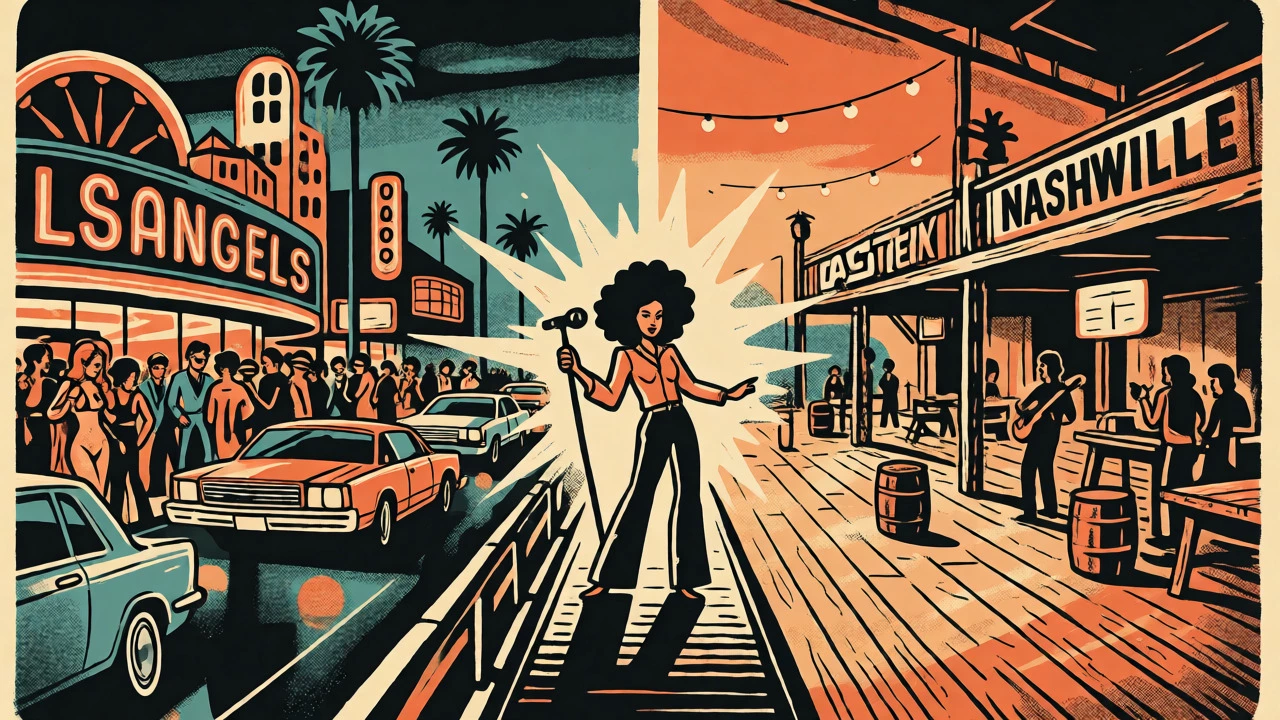

Imagine standing on the edge of two worlds. On one side, you have the polished, radio-ready pop machine of 1970s Los Angeles. On the other, you have the dusty, heartbreak-soaked honky-tonks of Nashville. Most artists pick a side. Linda Ronstadt refused to choose. She didn't just dabble in Linda Ronstadt's country albums; she used her voice as a bridge, dragging mainstream America into the world of Hank Williams and Dolly Parton without asking for permission.
If you think country music in the 1970s was only about rhinestone suits and strict genre rules, you haven't listened closely to Ronstadt's discography. Her work wasn't a polite visit to a foreign land; it was a hostile takeover disguised as a love letter. Born in Tucson, Arizona, Ronstadt grew up surrounded by Mexican ballads, opera, folk, and rock and roll. This chaotic musical diet meant that when she picked up a country song, she didn't hear a genre constraint. She heard a story that needed telling, regardless of whether it fit the "Nashville Sound" or not.
The Early Experiments: Hand Sown and Silk Purse
Ronstadt’s first real attempt at this crossover happened before most people even knew who she was. In 1969, she released Hand Sown … Home Grown. It was a commercial flop, but don't let the sales figures fool you. This album was a declaration of intent. She wanted to sing country, period. But Capitol Records, her label at the time, didn't know what to do with a female rocker singing traditional tunes.
Then came Silk Purse in 1970. This is where things got interesting. Ronstadt actually traveled to Nashville to record it. She wasn't trying to fake it from California; she went to the source. The album featured covers of classics like Hank Williams’s "Lovesick Blues." While it didn't make her a superstar overnight, it established her credibility. She proved she could stand next to the legends of the genre and hold her own vocally. It also gave us "Long Long Time," which became her first major hit, showing that audiences were ready to buy a country-flavored single if the performance was raw enough.
The Breakthrough: Heart Like a Wheel
By 1974, Ronstadt had assembled a band that would change the landscape of American music. Members included Glenn Frey and Don Henley-yes, those guys later formed the Eagles. With producer Peter Asher, she recorded Heart Like a Wheel. This album is the pivot point. It wasn't just a country album; it was a masterclass in interpretation.
Consider the tracklist. You had "You're No Good," a rock-and-roll standard that shot to No. 1 on the Billboard Hot 100. Right next to it was "When Will I Be Loved," a hard-rocking number. And then there was "I Can't Help It (If I'm Still in Love with You)," a Hank Williams cover. That last track won Ronstadt the Grammy for Best Country Vocal Performance, Female, in 1976. Think about that. A woman topping the pop charts with a rock song was simultaneously winning awards for singing traditional country. It shattered the idea that you had to be a niche artist to be taken seriously in country circles.
| Album Title | Release Year | Key Country Element | Commercial Impact |
|---|---|---|---|
| Hand Sown ... Home Grown | 1969 | Traditional folk-country roots | Low sales, critical respect |
| Silk Purse | 1970 | Honky-tonk covers, Nashville recording | First solo hit ("Long Long Time") |
| Heart Like a Wheel | 1974 | Mix of Hank Williams covers and rock standards | Double Platinum, Grammy Winner |
| Simple Dreams | 1977 | Dolly Parton and Roy Orbison covers | No. 1 for 5 weeks, 3M+ sales |
| Trio | 1987 | Collaboration with Dolly Parton & Emmylou Harris | Grammy Winner, Multi-Platinum |
Simple Dreams: The Peak of Crossover Success
If Heart Like a Wheel broke the door down, Simple Dreams kicked it off the hinges. Released in 1977, this album was her biggest commercial statement of the decade. It stayed at No. 1 on the Billboard country-album chart for five consecutive weeks, displacing none other than Elvis Presley.
Why did this work? Because Ronstadt treated country songs with the same reverence she gave rock hits. She covered Dolly Parton’s "I Never Will Marry" and Roy Orbison’s "Blue Bayou." These weren't watered-down pop versions; they were full-throated performances that respected the original emotional weight. Critics noted her ability to sing Warren Zevon alongside the Rolling Stones and Dolly Parton without sounding confused. She created a unified aesthetic out of disparate genres. For many listeners in suburban America, this album was their first real exposure to the depth of country songwriting, filtered through a rock-star lens.
The Interpretive Method: Why She Was Different
Ronstadt wasn't a songwriter in the way Joni Mitchell or Bob Dylan were. She was an interpreter. This is a crucial distinction. Many purists argue that true country artists must write their own pain. Ronstadt argued that if the song is good, it doesn't matter who wrote it. Her method involved selecting obscure gems or forgotten classics and using elite session musicians to polish them for mass consumption.
This approach drew criticism from some quarters. Detractors claimed her production was too slick, lacking the grit of Bakersfield sound or the rough edges of outlaw country. They weren't entirely wrong. Her records sounded expensive. But that polish was part of the strategy. By making country sound accessible and radio-friendly, she introduced millions of people to writers they might never have discovered otherwise. She acted as a curator, elevating the status of country lyrics in the broader pop consciousness.
Trio: Validation from the Legends
Skeptics often asked if Ronstadt was "real" country. In 1987, she answered that question definitively. She joined forces with Dolly Parton and Emmylou Harris for the album Trio.
This wasn't just a marketing gimmick. Parton and Harris are undisputed pillars of country tradition. By inviting Ronstadt into their circle, they validated her place in the lineage. The album won the Grammy for Best Country Performance by a Duo or Group With Vocal. It proved that her vocal technique and emotional delivery could compete directly with the queens of Nashville. When you listen to tracks like "To Know Him Is to Love Him," you hear three distinct voices blending seamlessly. Ronstadt didn't try to mimic Parton’s twang or Harris’s harmony style; she brought her own operatic power to the table, creating a unique sonic texture that honored the past while pushing forward.
Legacy and the Question of Genre
Today, we look back at Ronstadt’s career and see a woman who defied categorization. She has 11 Grammy Awards across different categories, including Country, Pop, and Mexican-American Performance. Yet, despite her massive influence on country-rock and her numerous hits, she remains outside the Country Music Hall of Fame. She is in the Rock and Roll Hall of Fame, however.
This institutional split highlights the tension in her legacy. To the rock establishment, she was a pioneer of country-rock. To the country establishment, she was a pop star who borrowed their clothes. But looking at the data, the impact is undeniable. Her albums sold millions, topped country charts, and preserved traditional songs for new generations. She showed that country traditions aren't static museum pieces; they are living, breathing forms that can adapt to new voices and new arrangements.
Ronstadt retired from performing due to progressive supranuclear palsy, a condition that affected her voice. Her active recording years are behind her, but her catalog remains vibrant. Streaming platforms keep her music alive for younger listeners who might discover her through a TikTok snippet or a movie soundtrack. Her work stands as proof that you don't need to stay in your lane to drive the car. Sometimes, the best way to honor a tradition is to shake it up completely.
Frequently Asked Questions
Was Linda Ronstadt considered a legitimate country artist?
Yes, though with caveats. She won Grammys for country performances and collaborated with icons like Dolly Parton. However, because her production was often pop-oriented and she covered a wide range of genres, some purists viewed her as a crossover artist rather than a traditionalist. Her inclusion in the Rock and Roll Hall of Fame rather than the Country Music Hall of Fame reflects this dual identity.
Which Linda Ronstadt album is most influential for country fans?
"Heart Like a Wheel" (1974) is widely regarded as her most important work. It blended rock, pop, and country seamlessly and included the Grammy-winning country cover of "I Can't Help It (If I'm Still in Love with You)." "Simple Dreams" (1977) is also highly significant for its massive commercial success and high-profile covers of Dolly Parton and Roy Orbison.
Did Linda Ronstadt write her own country songs?
Generally, no. Ronstadt was primarily an interpretive singer. She selected songs from various writers, including Hank Williams, Dolly Parton, and contemporary singer-songwriters like Warren Zevon. Her talent lay in choosing material that suited her voice and delivering it with such conviction that it felt personal, even if she didn't pen the lyrics.
What was the significance of the 'Trio' album?
Released in 1987, "Trio" featured Linda Ronstadt alongside Dolly Parton and Emmylou Harris. It served as a seal of approval from the country music establishment, validating Ronstadt's credentials within the genre. The album won a Grammy and demonstrated that her voice could blend authentically with traditional country harmonies.
Why isn't Linda Ronstadt in the Country Music Hall of Fame?
Her exclusion likely stems from her broad genre versatility. While she had huge country hits, her career spanned rock, pop, Latin, and opera. Institutions often categorize artists strictly, and her primary association with the Los Angeles country-rock scene may have overshadowed her specific contributions to Nashville traditions in the eyes of voters.