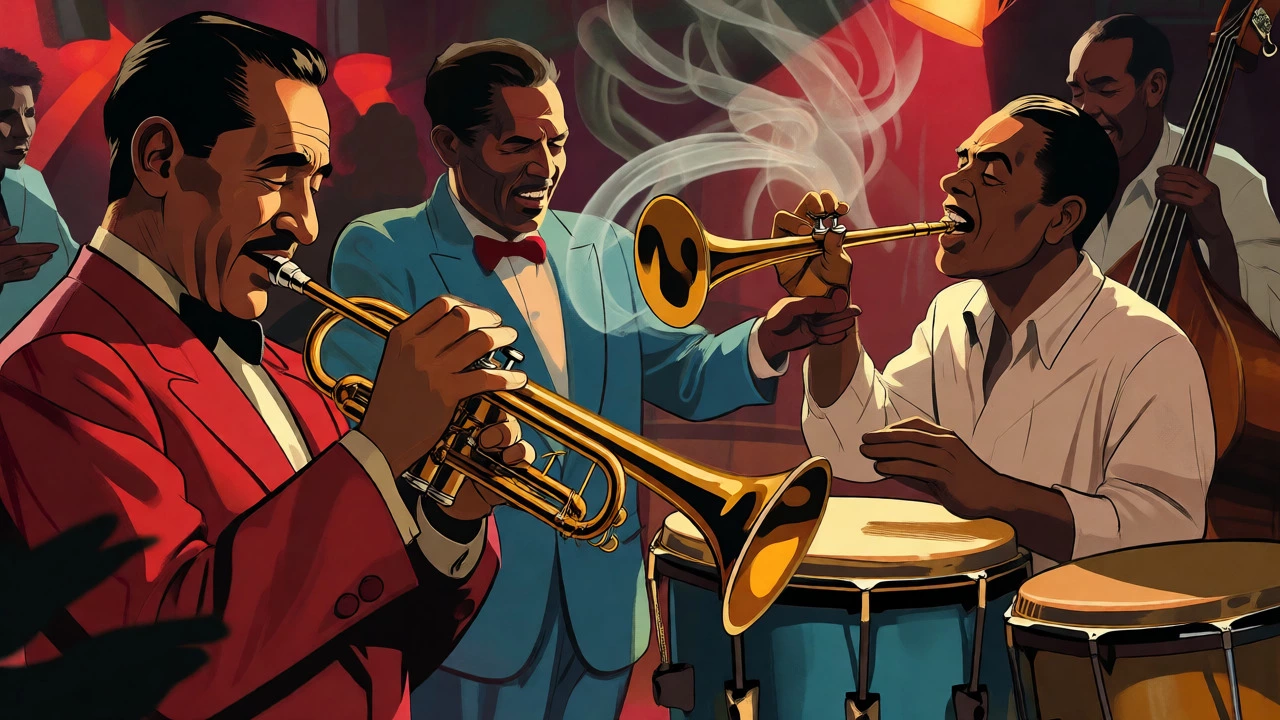

You might think Jazz Fusion was born purely from the collision of rock amplification and jazz improvisation. But if you listen closely to the grooves that defined the 1970s, you’ll hear a different heartbeat. It’s not just a backbeat; it’s a complex, layered pulse rooted in Afro-Cuban and Brazilian traditions. This isn’t just about adding congas to a drum kit for flavor. The integration of Latin rhythms into jazz fusion represented a fundamental reorganization of time, harmony, and ensemble interaction. It transformed how musicians approached the beat, moving away from the swing ride cymbal toward intricate, interlocking cycles that demanded structural understanding rather than mere decoration.
The Pre-Fusion Foundation: Clave and Collaboration
To understand why fusion sounded the way it did, you have to rewind to the 1940s. Before electric keyboards dominated the stage, New York City became a laboratory for rhythmic exchange. In 1941, Cuban trumpeter Mario Bauzá joined forces with singer Frank “Machito” Grillo to form Machito and his Afro-Cubans. This wasn’t an American band trying out exotic instruments; it was a deliberate fusion of jazz arranging techniques with authentic Afro-Cuban music. Their 1943 composition “Tanga,” arranged by Bauzá, is widely recognized as the first major jazz piece organized explicitly around the Clave. Clave is not just a percussion pattern; it is a timeline that dictates where accents fall across two measures, coordinating everything from horn stabs to bass lines.
This foundation was solidified in 1947 when Dizzy Gillespie collaborated with Cuban percussionist Chano Pozo. Together, they created “Manteca,” which brought Afro-Cuban rhythms into the bebop mainstream. The Library of Congress notes that Pozo helped popularize the conga and other percussion instruments in American jazz. By 1950, the “Afro-Cuban Jazz Suite,” arranged by Chico O’Farrill, combined Machito’s orchestra with bebop giants like Charlie Parker. These early collaborations established a crucial precedent: Latin rhythms could support sophisticated harmonic structures and extended improvisation, not just dance steps.
The Brazilian Pathway: Bossa Nova’s Subtle Impact
While Afro-Cuban rhythms provided energy and complexity, Brazil offered a different aesthetic. Bossa Nova, emerging in the late 1950s through artists like Antônio Carlos Jobim and João Gilberto, introduced a quieter, more understated approach to syncopation. Unlike the driving force of mambo or son, bossa nova relied on gentle guitar patterns and sparse accompaniment. Stan Getz’s 1963 album Getz/Gilberto exploded this style onto the international scene, proving that jazz could embrace Brazilian lyricism and restraint.
This influence carried directly into the fusion era. Musicians like Airto Moreira and Flora Purim didn’t just guest on recordings; they were core members of pivotal fusion groups. Airto’s work with Miles Davis and later with Return to Forever brought Brazilian percussion techniques-such as partido-alto and samba-derived subdivisions-into the electric jazz context. This allowed fusion bands to maintain a danceable groove while exploring modal harmonies and abstract improvisation. The result was a sound that felt both grounded in tradition and radically modern.
Miles Davis and the Electric Bridge
No discussion of jazz fusion is complete without Miles Davis. His electric period in the late 1960s served as the critical bridge between acoustic jazz and the high-volume world of fusion. The sessions for Bitches Brew, recorded in August 1969, featured multiple percussionists, electric keyboards, and amplified bass. While often categorized as a rock-jazz hybrid, tracks like “Spanish Key” reveal distinct Latin rhythmic suggestions woven into the fabric of the music.
Davis encouraged spontaneous group improvisation over sketches of chords and rhythms, creating a texture where Latin cycles could coexist with rock intensity. Producer Teo Macero edited nearly nine hours of tape into the final product, highlighting moments where these diverse influences intersected. This approach demonstrated that electric instruments didn’t have to replace traditional rhythmic roles; they could amplify them, allowing a single drummer or percussionist to layer conga patterns, timbale figures, and drum-kit backbeats simultaneously.
Fusion Bands That Embraced the Exchange
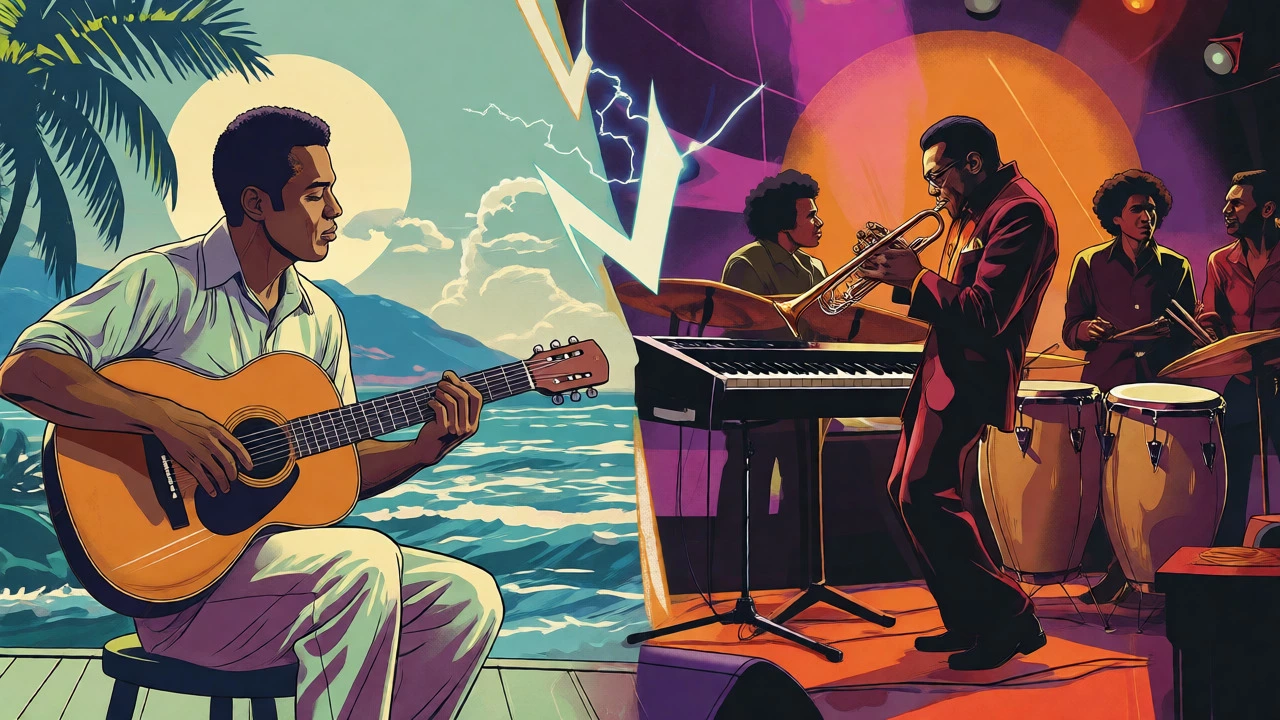
Following Davis’s lead, several key groups made Latin rhythms central to their identity. Weather Report, formed by Joe Zawinul and Wayne Shorter in 1970, drew on African, European, funk, and Latin materials to create a global soundscape. However, it was Return to Forever that most explicitly embraced the Brazilian connection in its early years. Chick Corea’s initial lineup included Airto Moreira and Flora Purim, resulting in albums like Light as a Feather (1973) that blended acoustic warmth with Brazilian-inflected compositions before shifting toward a harder jazz-rock edge.
Meanwhile, Santana carved out a parallel path with Latin Rock. While often distinguished from jazz fusion due to its blues-based harmony, Santana’s use of congas, timbales, and sustained guitar lines over complex percussion grooves demonstrated the mass-market appeal of this cultural exchange. Their 1970 album Abraxas, now part of the National Recording Registry, shows how Afro-Cuban percussion determined the band’s identity, making electric music feel organic and bodily rather than mechanical.
| Feature | Afro-Cuban Influence | Brazilian Influence | Rock/Funk Influence |
|---|---|---|---|
| Rhythmic Core | Clave (3-2 or 2-3), Son Montuno | Samba, Bossa Nova subdivision | Straight 8ths, Backbeat |
| Percussion Role | Structural timeline (Conga, Timbales) | Textural, subtle syncopation | Driving, volume-focused |
| Harmonic Approach | Modal vamps, montuno piano | Extended jazz harmony, lyrical | Power chords, simple progressions |
| Key Artists | Mario Bauzá, Chano Pozo | Jobim, Airto Moreira | Hendrix, Sly Stone |
The Technical Shift: From Swing to Interlocking Cycles
The most significant change Latin influences brought to fusion was technical. Traditional swing relies on a triplet-derived long-short feel driven by the ride cymbal and walking bass. Latin-influenced fusion replaced this with straight eighth notes and independent ostinatos. A fusion drummer might play a rock backbeat on the snare while maintaining a clave pattern on cowbell and a tumbao on the hi-hat. This requires the bassist to lock into specific syncopations rather than simply walking up and down the scale.
Keyboardists adapted by using montuno-like figures-repetitive, syncopated patterns that interlock with the percussion instead of blocking chords. This created a dense, layered groove where every instrument had a specific rhythmic responsibility. The result was music that remained physically engaging for dancers but supported the intellectual demands of jazz improvisation. It wasn’t just “jazz with congas”; it was a new language of time.
Cultural Nuance and Criticism
Despite its success, this exchange faced criticism. The term “Latin” is an imprecise umbrella covering Cuba, Puerto Rico, Brazil, Mexico, and beyond, each with distinct histories. Scholars argue that some fusion narratives minimized the contributions of musicians like Bauzá, Pozo, and Jobim, crediting only U.S. jazz stars. Furthermore, a technically competent conga part can still be culturally shallow if it ignores the social context of genres like rumba or son.
True fusion succeeded when it involved actual collaboration and shared authorship. When “Latin” functioned merely as a commercial label, the results were often generic. But when musicians engaged deeply with the structural logic of clave and tumbao, the music achieved a unique vitality. Today, this legacy continues in contemporary fusion, global jazz, and cross-cultural improvisation, proving that rhythmic exchange remains a powerful tool for innovation.
Frequently Asked Questions
What is the difference between Latin Jazz and Jazz Fusion?
Latin Jazz typically refers to jazz improvisation combined specifically with Afro-Cuban or Brazilian rhythmic systems, often retaining acoustic instrumentation. Jazz Fusion generally describes the late-1960s combination of jazz improvisation with rock, funk, electric instruments, and studio technology. The overlap occurs when fusion bands incorporate Latin rhythmic structures, such as clave or samba, into their electric arrangements.
Why is Clave so important in Latin-influenced fusion?
Clave is a two-measure rhythmic pattern (either 3-2 or 2-3) that serves as the structural timeline for the entire ensemble. It coordinates accents, horn figures, piano patterns, and bass motion. In fusion, understanding clave allows musicians to layer complex electronic and acoustic rhythms without losing coherence, ensuring the groove remains tight and danceable.
How did Bossa Nova influence Jazz Fusion differently than Afro-Cuban music?
Bossa Nova introduced a subtler, more restrained approach to syncopation and harmony, emphasizing lyrical melodies and sparse accompaniment. Afro-Cuban music contributed driving, percussive energy and complex polyrhythms. Both influenced fusion, but Bossa Nova offered a model for integrating Brazilian aesthetics and quiet dynamics into electric settings, while Afro-Cuban rhythms provided the structural backbone for high-energy grooves.
Who are key musicians bridging Latin rhythms and Jazz Fusion?
Key figures include Mario Bauzá and Chano Pozo in the early development phase, followed by Airto Moreira and Flora Purim who actively shaped 1970s fusion groups like Return to Forever. Miles Davis facilitated this bridge during his electric period, and Carlos Santana demonstrated the mass appeal of combining Latin percussion with rock-electric formats.
Is Santana considered Jazz Fusion?
Santana is primarily categorized as Latin Rock rather than pure Jazz Fusion because his harmonic language is rooted in blues and rock. However, he is relevant to this topic because he integrated Afro-Cuban percussion and complex rhythmic cycles into a mainstream electric format, influencing how fusion bands approached groove and audience engagement.