

You probably know the chord shapes. You know how to strum a G or an E minor in standard tuning. But what if you could take those same simple finger positions and suddenly unlock a sound that feels like a cello, a horn section, and a choir all playing at once? That is exactly what Joni Mitchell did. She didn't just use open tunings as a trick; she turned them into a complete compositional language.
In the 1970s, while most folk singers were sticking to safe, familiar keys, Mitchell was busy retuning her guitar until it sounded like nothing else on the radio. She wasn't trying to make things easier for herself. In fact, she made them harder. By abandoning standard tuning, she forced herself to learn where the notes actually lived on the fretboard, rather than relying on muscle memory. The result was a body of work-from *Blue* to *Hejira*-that sounds intimate yet orchestral, simple in technique but dense in harmony.
Why Standard Tuning Was Never Enough
Standard tuning (E-A-D-G-B-E) is designed for convenience. It allows you to move chord shapes up and down the neck easily. But for someone like Mitchell, who came from a background of learning by ear and struggling with conventional fingerpicking patterns, standard tuning felt limiting. She has said in interviews that she couldn't reproduce the alternating bass styles of blues legends like Elizabeth Cotten using standard techniques. So, she started experimenting.
She began with common open tunings used in blues and folk, such as Open D (D-A-D-F#-A-D) and Open G (D-G-D-G-B-D). These tunings allow you to play a major chord by simply barring across all six strings. But Mitchell quickly moved beyond these basics. She wanted sounds that standard tuning couldn't produce without awkward stretches or complex voicings. She wanted dissonance that resolved naturally, drones that hummed beneath melodies, and intervals that felt "modern" rather than traditional.
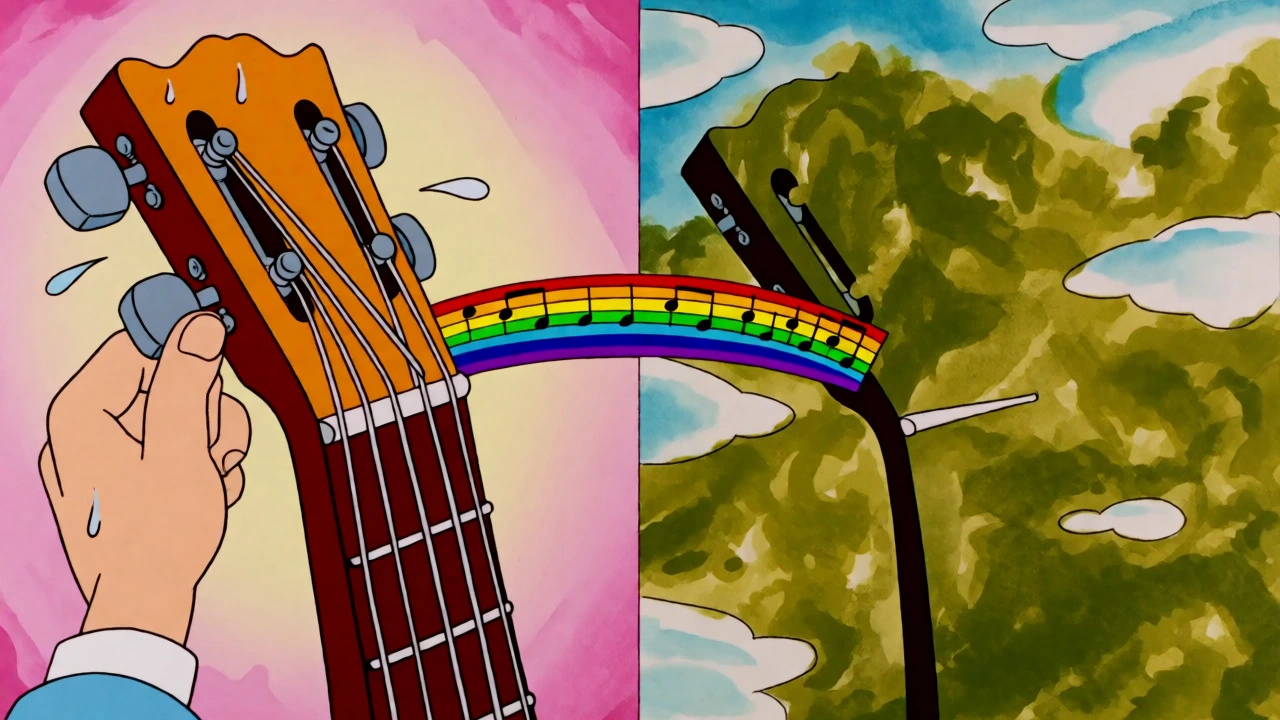
This shift changed her entire approach to songwriting. Instead of picking a key and then finding chords that fit, she would pick a tuning first. The tuning dictated the available colors. If she tuned to something unusual, certain chords became easy, while others disappeared entirely. This constraint sparked creativity. As she put it, changing tunings is like using a typewriter where the letters are rearranged every day. You have to look at the keys before you type, which forces you to think differently about the words-and the music-you're creating.
The Technical Magic: How Open Tunings Work
To understand why this matters, you need to look at the physics of the guitar. In standard tuning, the interval between adjacent strings is mostly four semitones (a major third) or five semitones (a perfect fourth). This regularity makes it easy to transpose. But in many of Mitchell's tunings, the intervals are irregular. For example, in her famous "C-Major" tuning (often cited as C-G-C-E-G-C), the spacing creates a unique resonance.
Mitchell categorized many of her tunings into families based on their interval patterns. Two of the most common were the "7-5" family and the "7-7" family. A 7-5 tuning might have a string spacing pattern that repeats every seven frets, while a 7-7 pattern does so every seven and seven again. These aren't just abstract numbers; they determine which shapes yield consonant chords and which yield strange, beautiful clusters.
Here is a breakdown of some of her key tunings and the songs they defined:
| Tuning Name / Pattern | Pitch Configuration | Representative Song | Sonic Characteristic |
|---|---|---|---|
| Open G | D-G-D-G-B-D | "Marcie", "The Circle Game" | Folk-blues foundation, bright and ringing |
| Open D | D-A-D-F#-A-D | "People's Parties", "Free Man in Paris" | Warm, resonant, ideal for strumming and droning |
| C-Major | C-G-C-E-G-C | "Amelia" | Deep, modal, expansive low end |
| Sisotowbell Lane | C-G-D-F-C-E | "Sisotowbell Lane", "Just Like This Train" | Complex, jazz-influenced, multi-voiced |
| Black Crow | Bb-Bb-Db-F-Ab-Bb | "Black Crow" | Unusual octave bass, haunting and sparse |
Notice that these aren't just random collections of notes. Each tuning offers specific affordances. In the "Sisotowbell Lane" tuning, for instance, the open strings form a chord that includes both a major third and a suspended fourth. This means that even when you aren't fretting anything, the guitar is already suggesting tension. When you add a simple barre shape, you don't get a clean major triad; you get a lush, ambiguous sonority that mirrors the lyrical content of her songs, which often dealt with uncertainty and emotional complexity.

Orchestral Texture on Six Strings
One of the most striking aspects of Mitchell's guitar work is how it sounds bigger than one instrument. She achieved this by treating the guitar not as a single melodic voice, but as a mini-orchestra. She described her concept clearly: the top three strings functioned like a horn section, carrying the melody and counter-melodies, while the bottom three strings acted as the rhythm section-cello, viola, and bass.
This separation is possible because of the way open tunings isolate voices. In standard tuning, if you want to play a bass note and a high melody simultaneously, your hand has to stretch across the neck, often muting the middle strings. In many of Mitchell's tunings, the open strings provide a sustained drone. This drone acts as a pedal point, a constant harmonic anchor. Meanwhile, her fingers can move freely on the higher strings to weave intricate lines above that anchor.
Take the song "Chelsea Morning." The intro features a delicate riff on the upper strings over ringing open basses. Later, a moving bass line emerges below the treble notes. This independence of parts is rare in solo acoustic guitar. Most players strum chords vertically. Mitchell played horizontally, letting each string ring out its own part. The effect is polyphonic. It sounds like there are multiple instruments interacting, even though it's just one person and one guitar.
This technique also allowed her to incorporate dissonance without it sounding harsh. In standard folk music, dissonance usually needs to resolve quickly to a consonant chord. In Mitchell's tunings, the dissonance is often baked into the open strings themselves. Because the open strings are always ringing, the "wrong" notes blend with the "right" ones, creating a wash of sound that is rich and textured rather than clashing. She compared this to painting, saying the drone layer was like an olive-green wash beneath successive colors-it unified the palette without dominating it.
Beyond Jazz: The Debussy Connection
People often label Mitchell's harmonies as "jazz," especially after she started working with jazz musicians like Jaco Pastorius and the L.A. Express. But Mitchell herself rejected that label. She argued that her music was closer to classical impressionists like Debussy. Why? Because her harmonic movement wasn't driven by the functional rules of jazz progression (like ii-V-I resolutions). Instead, it was driven by color and texture.
In jazz, you change chords to create tension and release within a key. In Mitchell's music, you change chords to explore different timbral landscapes. Her use of alternate tunings facilitated this. Because the fretboard layout was unfamiliar, she couldn't fall back on stock jazz licks. She had to listen to what the guitar was telling her. If a certain combination of fretted notes and open strings produced a shimmering, unresolved sound, she kept it. She didn't force it to resolve if it didn't need to.
This approach aligns with the concept of "modal harmony," where music centers around a scale or mode rather than a tonal center. Many of her tunings emphasize modal intervals, such as suspended seconds or fourths, which avoid the strong pull of major thirds. This gives her music a floating, ethereal quality. It feels timeless, neither strictly happy nor sad, but emotionally complex. This complexity was necessary for her lyrics, which explored themes of environmental decay, social alienation, and personal vulnerability. Simple major-minor polarity couldn't capture those nuances. She needed a wider palette.
The Physical Cost of Innovation
While the results were magical, the process was physically demanding. Retuning a guitar repeatedly puts stress on the neck and strings. Mitchell often lowered her bass strings significantly to achieve deeper tones, sometimes down to B or even A. This slackness caused intonation problems. The strings wouldn't stay in tune, and they would buzz against the frets. She noted that her singing voice dropped as she aged, and her guitar tunings followed suit, descending into lower registers.
For a long time, this meant she couldn't switch songs quickly during live performances. Each song required a specific setup. If she forgot to retune, the song wouldn't work. This rigidity frustrated some band members, who expected more flexibility. However, it also forced discipline. Every performance had to be precise. There was no room for improvisational sloppiness because the harmonic structure was so tightly woven into the physical setup of the instrument.
Later in her career, technology offered a solution. The Roland VG-8 virtual-guitar system allowed her to keep her strings in standard tuning while electronically generating the alternate pitches. This freed her from the mechanical constraints of retuning, allowing for greater fluidity in live settings. But for the core 1970s recordings-the era that defines her legacy-the struggle with the physical instrument was part of the art. The imperfections, the buzzing, the slight wavering of pitch, added to the human, organic feel of the music.
Legacy and Influence
Joni Mitchell didn't invent open tunings. Blues players had been using them for decades. But she transformed them from a rhythmic accompaniment tool into a primary engine for composition. Before her, alternate tunings were often seen as a novelty or a shortcut. After her, they became a legitimate path for serious songwriters seeking new sounds.
Her influence extends far beyond folk. Artists like David Crosby experimented with her methods, acknowledging that she pushed the boundaries further than he did. Modern indie and alternative artists continue to study her transcriptions, trying to decode the logic behind her choices. Even today, when you hear a guitarist using a non-standard tuning to create a moody, atmospheric backdrop, you are hearing the echo of Mitchell's innovations.
What makes her work enduring is that it balances accessibility with sophistication. The fingerings are often surprisingly simple-many are just barres or two-finger shapes. But the resulting sound is incredibly complex. This paradox invites listeners in. You can appreciate the beauty without understanding the theory, but if you dig deeper, you find a rigorous system of musical thought. Mitchell proved that limitation breeds creativity. By restricting herself to unconventional tunings, she expanded the possibilities of the guitar forever.
How many open tunings did Joni Mitchell actually use?
Estimates vary depending on how you count them. Mitchell herself stated in a 1996 interview that she had used 51 tunings. However, technical databases identify over 60 apparent tunings when counting exact pitches, and over 80 if capo positions are treated as separate configurations. Approximately 45 essential interval patterns remain when equivalent transpositions are grouped together.
Did Joni Mitchell play standard tuning?
Yes, but rarely for her signature hits. Early works like "Both Sides, Now" use standard tuning with a capo. However, as she developed her style in the early 1970s, she increasingly relied on alternate tunings to access the specific harmonic colors she desired. By albums like *Court and Spark* and *Hejira*, standard tuning was largely abandoned in favor of custom setups.
Why are her tunings considered "harmonic innovations"?
They are innovative because they decouple chord shapes from traditional harmony. In standard tuning, a shape equals a specific chord (e.g., an E-shape is always an E major). In Mitchell's tunings, the same shape produces different intervals, often including suspensions, ninths, or dissonances. This allowed her to write music that defied standard major/minor categorization, leaning instead into modal and impressionistic textures.
Can beginners learn Joni Mitchell's tunings?
Absolutely. While the theory is complex, the fingerings are often simple. Beginners can start with Open G (D-G-D-G-B-D) or Open D (D-A-D-F#-A-D). These tunings allow for easy strumming and basic melody playing. The challenge lies in memorizing the new fretboard geography, but many players find this refreshing compared to the repetitive nature of standard tuning.
Did Joni Mitchell use capos with her open tunings?
Yes, frequently. Capos were essential for adjusting the key without changing the fundamental tuning pattern. For example, "Little Green" uses the same interval pattern as "Marcie" but with a capo at the fifth fret. This allowed her to maintain the comfortable fingering shapes while shifting the tonal center to suit her vocal range.