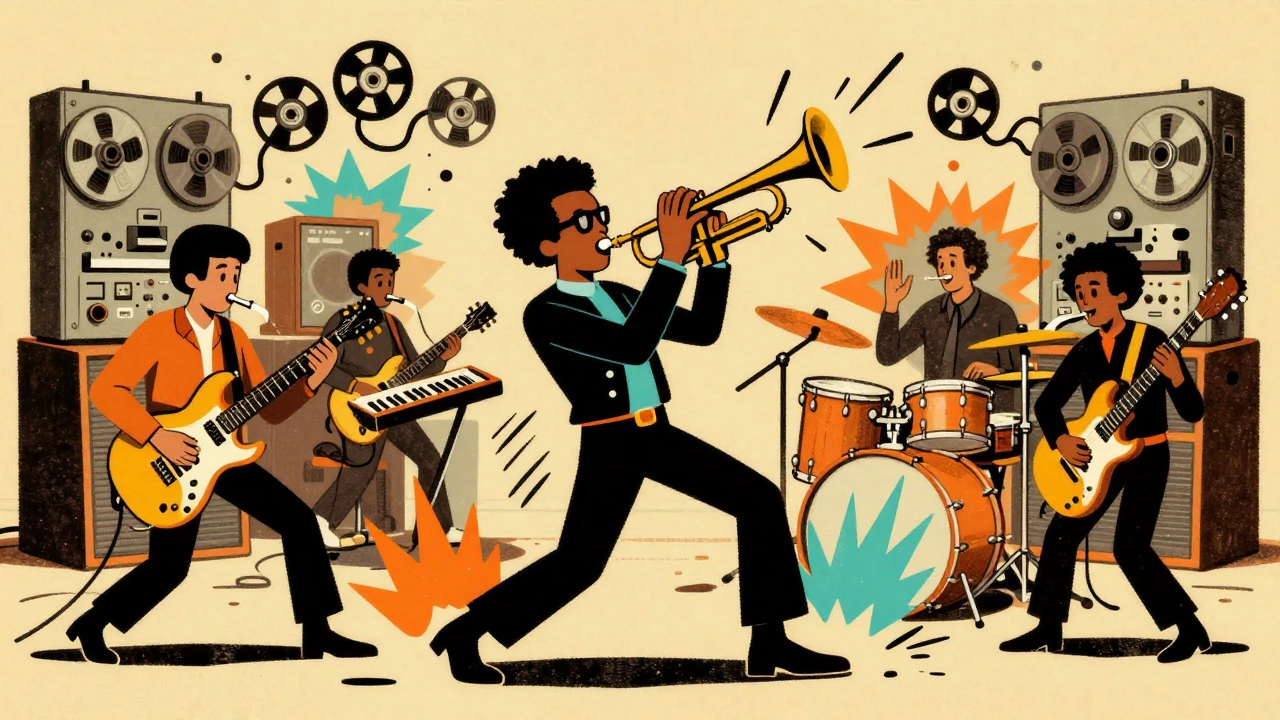

It was 1969. Miles Davis is a legendary American trumpeter and composer who revolutionized jazz by incorporating electric instruments and rock rhythms into his music. Also known as The Prince of Darkness, he recorded In a Silent Way in February of that year, followed shortly by Bitches Brew. These records didn't just change jazz; they broke it open.
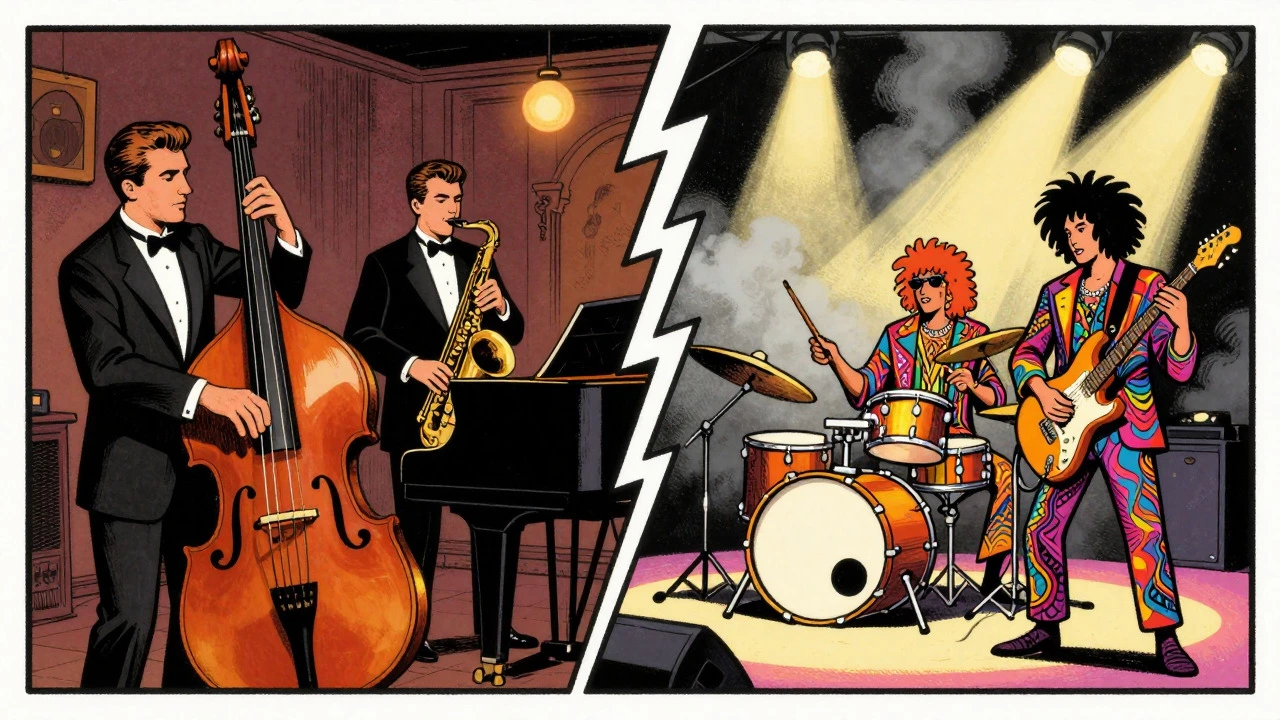
If you grew up thinking jazz was strictly acoustic piano trios or big bands in tuxedos, the sound coming out of those studios would have felt like an alien invasion. Heavy distortion on guitars, thunderous drums, and synthesizers screaming over complex harmonies. This was the birth of Jazz Fusion, a genre defined by its willingness to merge jazz improvisation with the raw power of rock, funk, and R&B. More than fifty years later, that explosion hasn't settled down. It has evolved. Today, we see the direct lineage of those late-60s experiments in everything from hip-hop beats to digital audio workstations (DAWs). The legacy isn't just about old records collecting dust; it’s about a continuing method of experimentation that defines modern jazz.
The Blueprint: What Actually Is Jazz Fusion?
To understand where the genre is going, you have to look at what it actually built. Fusion wasn’t just "jazz with electric guitars." It was a structural overhaul. Traditional jazz relied on swing rhythms-usually between 180 and 220 beats per minute-and standard song forms like the 32-bar AABA structure. Fusion flipped this script.
Musicians started playing straighter grooves, often rooted in funk or rock, sitting comfortably between 90 and 140 BPM. They emphasized the backbeat (beats 2 and 4) instead of the ride cymbal pattern typical of bebop. Harmonically, they moved away from rapid chord changes toward modal vamps-static harmonic areas that could last for 16 to 32 bars, sometimes longer. This gave soloists more room to explore texture and rhythm rather than just navigating chord progressions.
The instrumentation changed drastically too. You couldn't play this music with an upright bass and a clean acoustic piano. You needed volume and sustain. Enter the Fender Rhodes electric piano, the Hammond B-3 organ, and distorted electric guitars. Bands like Weather Report, led by Joe Zawinul and Wayne Shorter, and Mahavishnu Orchestra, led by guitarist John McLaughlin, used these tools to create walls of sound. They weren't afraid of odd time signatures either. Tracks in 7/8 or 9/8 became common, challenging both players and listeners to find the groove in unexpected places.
| Feature | Traditional Jazz (Bebop/Swing) | Jazz Fusion (1970s) |
|---|---|---|
| Rhythm Style | Swing, syncopated ride cymbal | Straight eighths, funk/rock backbeat |
| Tempo Range | Fast (180-220+ BPM) | Moderate to Slow (90-140 BPM) |
| Harmony | Rapid chord changes (ii-V-I) | Modal vamps, static chords |
| Instrumentation | Acoustic bass, upright piano, horns | Electric bass, Rhodes, synths, distorted guitar |
| Volume | Intimate club levels | Arena-level amplification (>100 dB) |
From Tape Splicing to Digital Workstations
One of the most overlooked aspects of fusion’s legacy is its relationship with technology. When Miles Davis recorded Bitches Brew, he wasn't just capturing a live performance. He was using the studio as an instrument. Engineers like Teo Macero spliced tape together, rearranging sections and layering multiple takes to create dense, psychedelic soundscapes. This was avant-garde production for its time.
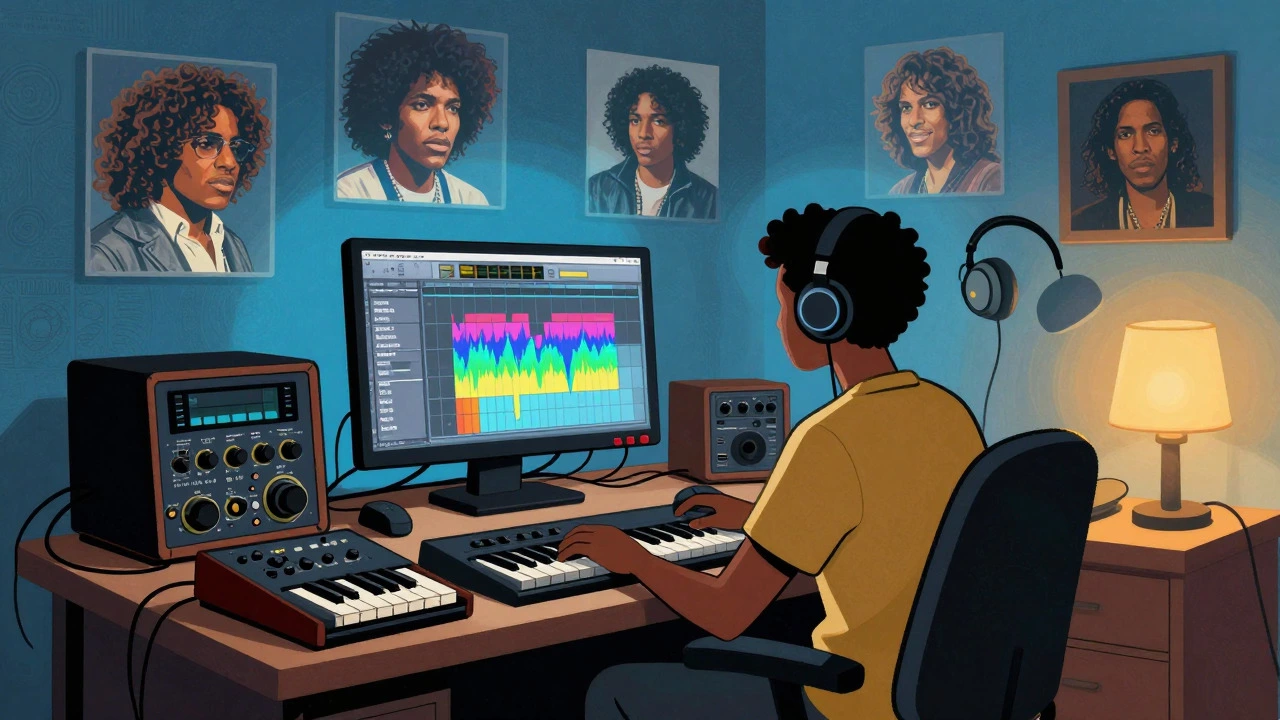
Fast forward to 2026, and that spirit of technological integration is stronger than ever. A recent academic thesis titled The DAWn of a New Fusion argues that today’s pianist-producers are doing exactly what Davis did, but inside Digital Audio Workstations (DAWs) like Ableton Live and Logic Pro. Instead of cutting physical tape, they loop samples, manipulate MIDI data, and blend live improvisation with electronic textures in real-time.
This shift has democratized fusion. In the 1970s, you needed a band, expensive gear, and a major label contract to make a record. Now, a single musician can produce a track that combines jazz harmony, hip-hop beats, and EDM drops entirely from their bedroom. The barrier to entry is lower, but the creative ceiling remains high. Artists like Robert Glasper and Kamasi Washington exemplify this modern approach, blending genres fluidly while maintaining the improvisational core that defines jazz.
The Smooth Jazz Distraction
We can’t talk about fusion’s legacy without addressing the elephant in the room: smooth jazz. By the early 1980s, the commercial success of fusion led some labels to push artists toward a softer, radio-friendly sound. Think Kenny G or Dave Koz. Critics, including scholar Kevin Fellezs, have called this period fusion’s "artistic Waterloo," arguing that the experimental edge was sanded down for mass appeal.
But here’s the thing: smooth jazz didn’t kill fusion; it just went a different way. While one branch focused on easy-listening aesthetics for adult contemporary radio, another branch kept pushing boundaries. Bands like Return to Forever, led by keyboardist Chick Corea, a virtuoso pianist and composer known for his eclectic style spanning classical, jazz, and rock, continued to explore complex structures and world music influences. ECM Records, founded in Munich in 1969, fostered a more ambient, European-flavored fusion that prioritized atmosphere over flashiness.
This divergence shows that fusion was never a monolith. It was a toolkit. Some musicians used it to write pop songs; others used it to deconstruct musical language. The latter group is whose legacy resonates most strongly in today’s "nu-jazz" scene.
Modern Jazz: The Fusion Toolkit in Action
Today, if you walk into a jazz club in Portland, New York, or Tokyo, you’re likely to hear fusion elements even if the band isn’t labeled as "fusion." Why? Because fusion taught modern jazz musicians how to think outside the box.
First, it normalized the use of non-jazz repertoire. In the 1960s, playing Beatles or Jimi Hendrix covers was radical. Today, it’s commonplace. Jazz groups routinely reinterpret songs by Radiohead, Nirvana, and Kendrick Lamar, applying jazz harmony and improvisation to rock and hip-hop structures. This practice, documented by researcher Brian Matthew Felix, keeps jazz relevant to younger audiences who grew up with these genres.
Second, fusion introduced the concept of polystylism-the ability to switch between multiple musical styles within a single performance. Chick Corea, for example, could move from straight-ahead acoustic jazz to electric fusion to classical compositions within a few years. Modern musicians expect this versatility. They aren’t just "jazz players"; they are multi-instrumentalists, producers, and composers who draw from a vast palette of influences.
Finally, fusion changed the business model. As major labels retreated from jazz in the 1990s, independent artists turned to platforms like Bandcamp, SoundCloud, and YouTube. This decentralized approach mirrors the DIY ethos of the early fusion pioneers, who often operated outside traditional jazz institutions. Today’s artists build communities online, releasing music directly to fans and funding projects through Patreon-style patronage.
Why This Matters for Listeners and Musicians
For listeners, understanding fusion’s legacy means appreciating the complexity behind the groove. It’s not just background music. It’s a conversation between tradition and innovation. When you hear a modern jazz track with a heavy bassline and synth pads, you’re hearing the echo of Miles Davis’s 1969 experiments. You’re hearing the influence of Weather Report’s rhythmic precision and Mahavishnu Orchestra’s intensity.
For musicians, fusion offers a roadmap for creativity. It teaches us that genre boundaries are permeable. If you want to innovate, don’t be afraid to borrow from other styles. Use technology as a tool, not a crutch. And always keep improvisation at the center of your practice. That’s the true heart of jazz, whether it’s acoustic or electric.
Who are the key figures in the history of jazz fusion?
The foundational figures include Miles Davis, whose albums In a Silent Way and Bitches Brew launched the genre. Other pivotal artists are guitarist John McLaughlin (Mahavishnu Orchestra), keyboardists Chick Corea (Return to Forever) and Herbie Hancock (Headhunters), saxophonist Wayne Shorter, and drummer Tony Williams. These musicians combined jazz improvisation with rock and funk rhythms, creating a new sonic landscape.
What is the difference between jazz fusion and smooth jazz?
While both genres use electric instruments and accessible melodies, jazz fusion emphasizes complex improvisation, odd time signatures, and high-energy performances. Smooth jazz, which emerged in the 1980s, prioritizes polished production, simple harmonic structures, and radio-friendly formats, often minimizing improvisation. Fusion is seen as more experimental and artist-driven, while smooth jazz is more commercially oriented.
How has technology influenced the evolution of jazz fusion?
Technology has been central to fusion since its inception. In the 1970s, electric guitars, synthesizers (like ARP and Moog), and multitrack recording allowed for new sounds and studio experimentation. Today, Digital Audio Workstations (DAWs) enable artists to blend live improvisation with electronic production, sampling, and looping. This shift has democratized music creation, allowing individual producers to create hybrid genres that continue fusion’s legacy.
Is jazz fusion still popular today?
Yes, though it has evolved. While the term "fusion" may be less commonly used, its influence is pervasive in modern jazz, nu-jazz, and crossover genres. Artists like Robert Glasper, Kamasi Washington, and Snarky Puppy incorporate fusion elements such as electric instrumentation, hip-hop beats, and complex harmonies. The genre thrives in niche communities, university programs, and online platforms, maintaining a dedicated global audience.
What are some essential jazz fusion albums to listen to?
Start with Miles Davis’s Bitches Brew (1970) and In a Silent Way (1969). For guitar-driven energy, check out John McLaughlin’s The Inner Mounting Flame (1971). Herbie Hancock’s Head Hunters (1973) is a landmark funk-fusion album. Weather Report’s Heavy Weather (1977) features the hit "Birdland." Finally, Chick Corea’s Return to Forever (1972) showcases intricate composition and virtuosity. These albums define the genre’s core characteristics.