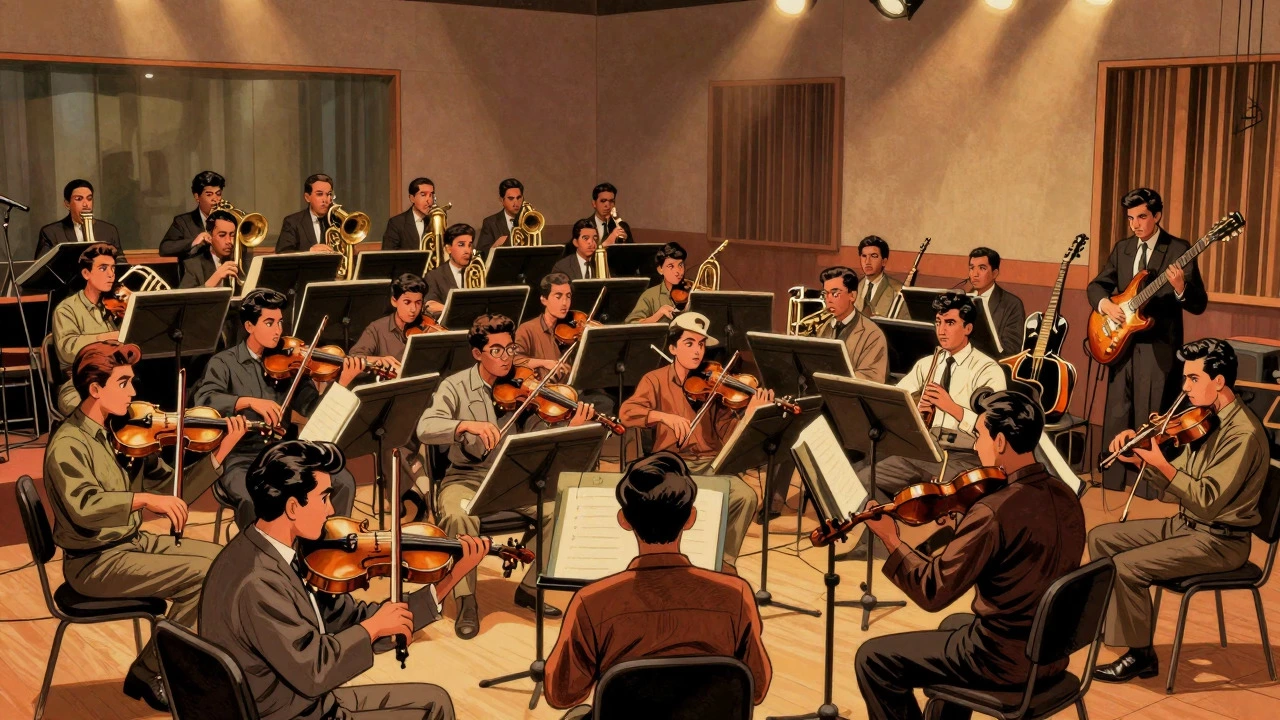

Imagine a studio in Bombay in 1975. One hundred musicians are sitting in rows, violins on their laps, brass instruments gleaming under the lights. In the corner, an electric guitar hums. This wasn't a concert hall; it was a recording session for a movie soundtrack. That specific image captures the essence of Bollywood orchestration during the 1970s, a decade when Hindi cinema soundtracks became massive commercial products that often outsold the films themselves.
The 1970s were not just about big bands. They were a transitional era where traditional melodic structures collided with new global rhythms. You had the heavy, symphonic arrangements rooted in the 1950s meeting the funky, keyboard-driven sounds of Western disco. This mix created a unique sonic landscape that defined Indian popular music for decades to come. It’s a story of how a rigid studio system adapted to changing tastes, driven by visionary composers and technological shifts.
The Scale of 1970s Orchestration
To understand the sound, you have to look at the size. By the mid-1970s, standard practice for major productions involved ensembles ranging from 30 to 100 players. This wasn't just for show; it was necessary to achieve the lush, layered textures that audiences expected. A typical song structure included an instrumental prelude of 20 to 40 seconds, multiple interludes between verses, and a distinct coda. Each section was scored separately, creating a mini-symphonic architecture around the melody.
This approach evolved from the work of earlier pioneers like Shankar-Jaikishan, who introduced systematic Western-style orchestration to Bollywood in the 1950s and 60s. They treated strings, brass, and woodwinds as independent layers rather than mere accompaniment. By the 1970s, this became the baseline. Composers like Laxmikant-Pyarelal took this further, using dense string writing and brass fanfares for action and social dramas. If you listened to scores from films like Muqaddar Ka Sikandar (1978), you’d hear that rich, analog warmth that only a large live orchestra could provide.
The Architects Behind the Sound
Composers wrote the tunes, but arrangers built the buildings. Figures like Anthony Gonsalves played a critical role as intermediaries between the composer's vision and the studio orchestra. Gonsalves didn't just play violin; he determined instrumentation, voicing, and harmony. His influence is so deep that his name was immortalized in the 1977 hit song "My Name Is Anthony Gonsalves." These arrangers translated simple melodies into complex scores that balanced Indian classical ragas with Western harmonic progressions.
R.D. Burman emerged as the most significant innovator of this group. He didn't just follow the rules; he bent them. While maintaining the core melodic frameworks of Indian folk and classical music, Burman integrated "exotic elements" through sophisticated Western orchestration. He used electric guitars, bass, keyboards, and brass sections in ways that felt fresh and urban. His work often featured side rhythms and unconventional percussive textures, pushing the boundaries of what a film song could sound like. For instance, in his scores for Nasir Husain films, he stressed orchestration over pure melody, a shift that aligned perfectly with the emerging disco aesthetic.
From Rock to Disco: The Sonic Shift
Before disco fully arrived, there was rock and funk. Songs like "Dum Maro Dum" from Hare Rama Hare Krishna (1971) featured psychedelic rock grooves and electric bass lines that blazed a trail for Westernized Hindi music. However, these tracks weren't true disco; they were proto-disco experiments. The transition happened gradually. As global trends shifted toward four-on-the-floor beats and synthesizers, Bombay studios began updating their technical stacks. Multitrack tape machines and improved microphones allowed producers to layer more instruments without losing clarity.
By the late 1970s, the hybrid palette was established. Orchestral setups now routinely included drum kits, electric bass, synthesizers, and multiple keyboards alongside the traditional string sections and Indian percussion like tabla and dholak. This blend created a sound that was both familiar and exciting. It was the perfect storm for the arrival of full-blown disco.
The Birth of Bollywood Disco
The definitive moment for disco in Bollywood is often traced to 1979. At age 26, Bappi Lahiri composed the score for the spy thriller Surakksha. The song "Mausam Hai Gaane Ka," picturised on Mithun Chakraborty, is widely cited as one of the first explicit disco motifs in mainstream Hindi cinema. It was a huge hit, paving the way for a surge of disco-influenced numbers. Lahiri's style combined Giorgio Moroder-style arpeggiated synthesizer patterns with traditional Bollywood instrumentation, creating a "brilliant hybrid" that audiences loved.
Another key figure was Biddu, a London-based producer who worked with Pakistani teenager Nazia Hassan. Their collaboration on the 1980 film Qurbani, specifically the song "Aap Jaisa Koi," embedded disco firmly into the mainstream. Shortly after, in 1981, Nazia and her brother Zoheb released the non-film album Disco Deewane. Many consider this the first real Indipop album, proving that the genre could stand independently of cinema. By 1982, with the release of Disco Dancer, the wave reached its commercial peak, earning Bappi Lahiri the moniker "King of Disco."
Comparing the Key Players
Different composers approached this fusion in distinct ways. Here’s how the major figures compared in their orchestral and stylistic choices during this period:
| Composer | Primary Style | Key Innovations | Notable Works |
|---|---|---|---|
| R.D. Burman | Eclectic Hybrid | Side rhythms, electric instruments, noise textures | Muqaddar Ka Sikandar, Hum Kisise Kum Nahin |
| Laxmikant-Pyarelal | Symphonic Drama | Dense strings, brass fanfares, emotional depth | Karz, Safar |
| Kalyanji-Anandji | Rhythm-Forward Pop | Organ, guitar, mixed Indian/Western rhythm sections | Qurbani (production), Sholay (partial) |
| Bappi Lahiri | Disco Fusion | Arpeggiated synths, four-on-the-floor beats | Surakksha, Disco Dancer |
Cultural Impact and Legacy
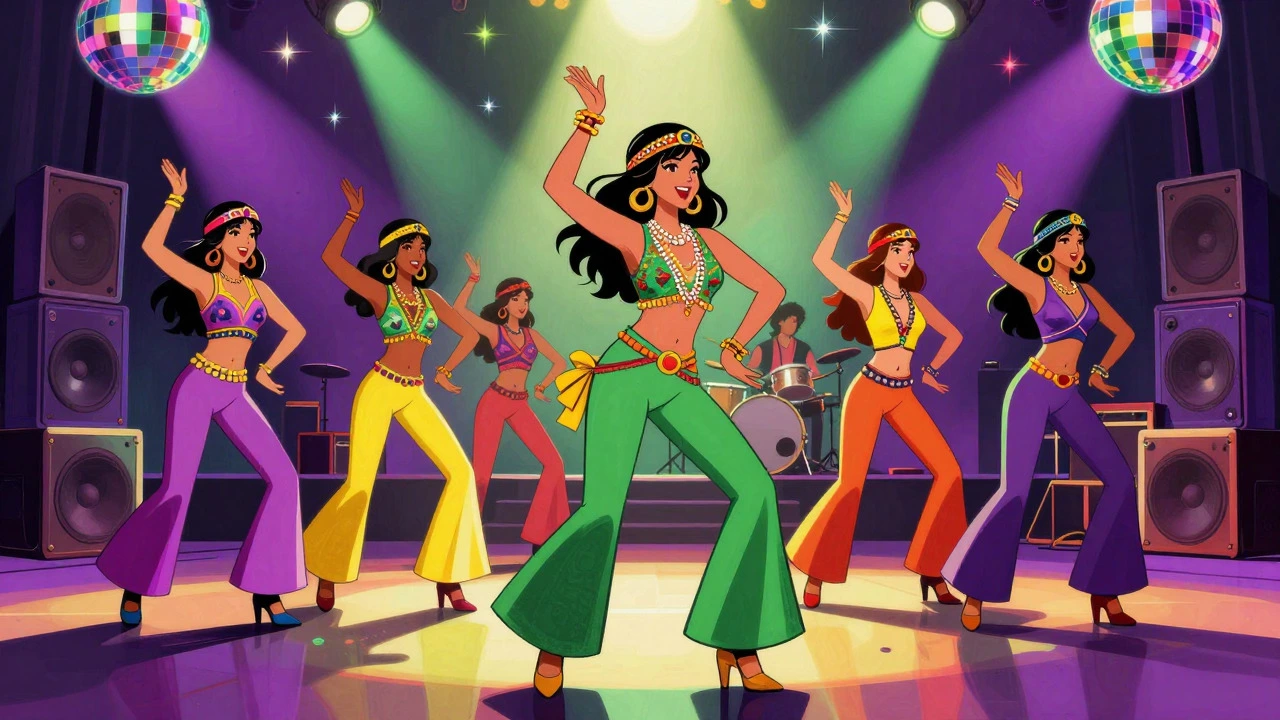
This musical shift wasn't just auditory; it was visual and cultural. Directors like Nasir Husain showcased dance numbers with jazzy floors and dazzling dancers, often clad in flared bell-bottoms and hippie headbands. The music drove the choreography, which in turn influenced fashion and nightlife representation in Indian cinema. The success of these soundtracks, with albums like Sholay selling a million copies in 1975, proved that film music was a standalone economic force. It laid the groundwork for the Indipop industry, which grew into a multi-billion rupee market by the early 2000s.
Today, while digital production has replaced large analog studios, the templates established in the 1970s remain relevant. Modern Bollywood songs still rely on the balance of strong rhythm sections, keyboard-driven arrangements, and spectacular dance sequences pioneered by this generation. Understanding this era helps explain why Indian film music continues to dominate global charts, carrying forward the legacy of those 100-piece orchestras and the first disco beats.
Who started disco in Bollywood?
While influences existed earlier, Bappi Lahiri is widely credited with bringing explicit disco motifs to mainstream Hindi cinema with his 1979 score for Surakksha. Biddu and Nazia Hassan also played crucial roles around 1980-1981 with Qurbani and the album Disco Deewane.
How many musicians were in a typical 1970s Bollywood orchestra?
Ensembles typically ranged from 30 to 100 musicians, depending on the budget and scale of the production. Major hits often featured full 100-piece orchestras for medleys and large-scale numbers.
What was the difference between 1970s Bollywood rock and disco?
Early 1970s tracks like "Dum Maro Dum" featured psychedelic rock grooves and electric guitars but lacked the consistent four-on-the-floor beat and heavy synthesizer use characteristic of disco. Disco became dominant in the late 1970s with more structured rhythmic patterns and keyboard-heavy arrangements.
Why did film soundtracks sell so well in the 1970s?
Soundtracks were standalone commercial products that often outsold the films themselves. With high-quality orchestral production and star playback singers, albums like Sholay sold over a million copies, making music a primary revenue stream for the industry.
Did R.D. Burman compose disco music?
Yes, particularly in the late 1970s and early 1980s. He incorporated disco motifs, such as arpeggiated synthesizer patterns, into his compositions while retaining traditional Bollywood instrumentation, creating a hybrid style that was highly popular.