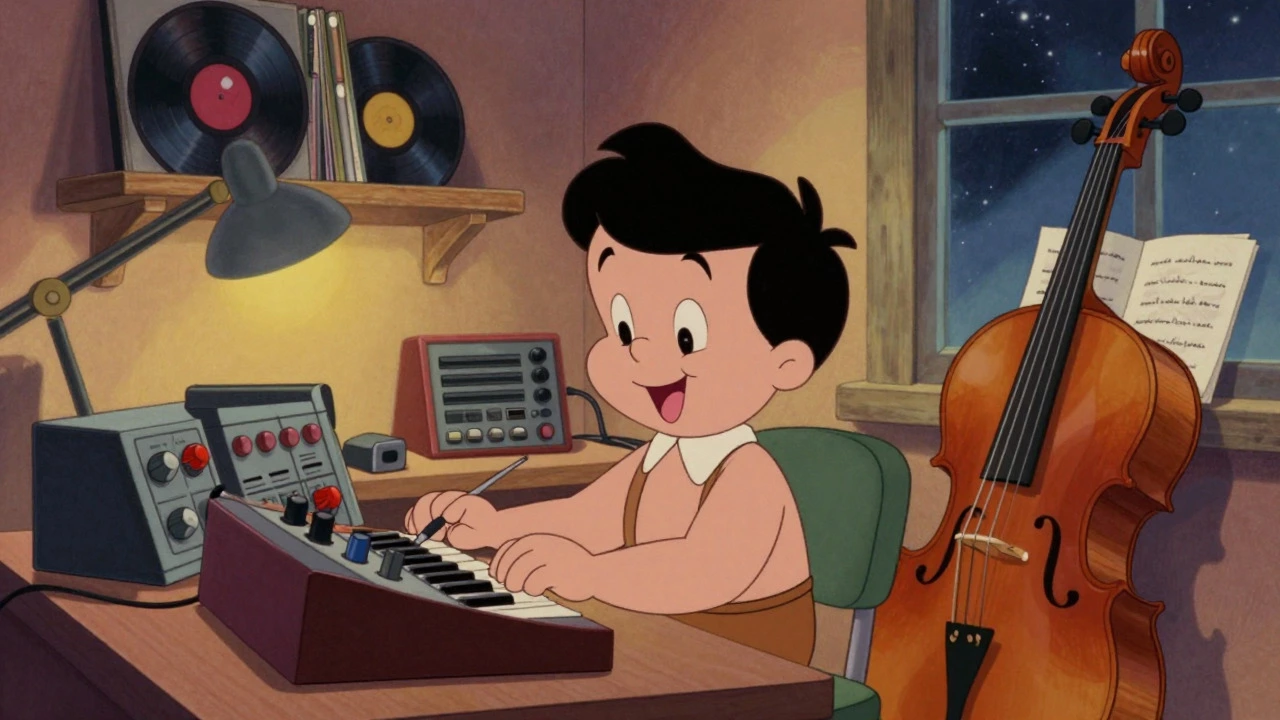

Imagine a scene where the tension is palpable. You hear the deep, rumbling growl of a sub-bass synth that shakes your chest, but right on top of it, a solo cello weeps with raw, acoustic emotion. This isn't a clash of styles; it's the sweet spot of modern composition. For decades, purists argued that electronic instruments had no place in an orchestra. Today, that debate is over. Hybrid orchestral scoring has become the standard for film, television, and video games because it offers something neither world can achieve alone.
You don't need to choose between the warmth of woodwinds and the power of digital synthesis. You need to learn how to make them talk to each other. Whether you are a composer working from a home studio or a pit musician in a theater, understanding the role of synthesizers in orchestral music changes everything about your workflow. It’s not about replacing players; it’s about expanding the palette.
The Evolution: From Noise Machines to Digital Libraries
To understand where we are, look at where we started. The idea of blending electronic sounds with orchestral concepts isn't new. In the early 1910s, Italian futurist Luigi Russolo built the Intonarumori, which were mechanical noise intoners designed to control complex industrial sounds through levers and interfaces. These were essentially the first analog synthesizers used in an "orchestral" setting, creating textures that acoustic instruments simply couldn't produce.
Fast forward to the 1970s and 80s, and you see the rise of analog string synthesizers like the Solina String Ensemble and the Wersi String-Orchestra. Composers didn't use these to perfectly mimic a symphony; they used them to create shimmering, chorus-heavy pads that added a lush, atmospheric layer behind acoustic sections. Thom Holmes, a historian of electronic music, notes that works from this era often combined the Solina, Mellotron, and Moog synthesizers to build massive symphonic effects. These weren't just background noise; they were integral voices in the ensemble.
Today, the technology has shifted from hardware oscillators to software plugins and massive sample libraries. Tools like Roland’s HQ Orchestral plug-in and Brian Transeau’s (BT) Polaris represent the current state of the art. They bridge the gap by offering high-fidelity acoustic samples alongside synthetic textures, allowing composers to switch seamlessly between a realistic violin section and an evolving electronic drone without changing instruments.
Why Use Synths in an Orchestra?
If you have access to a full acoustic orchestra, why add synths? The answer lies in frequency management and texture. Acoustic instruments occupy specific frequency ranges. When you stack strings, brass, and percussion, the mix can get muddy quickly. Synthesizers solve this by providing clean, controlled low-end reinforcement and unique harmonic beds that sit underneath the acoustic chaos.
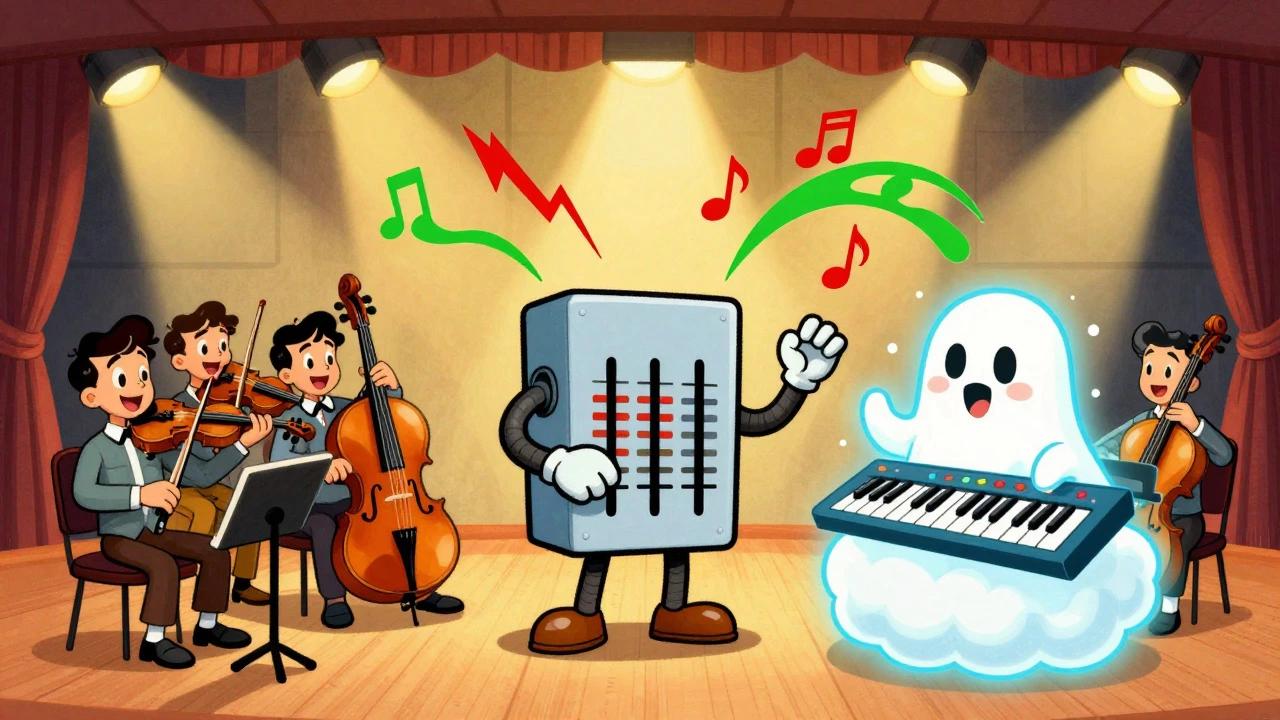
In professional musical theatre, this practice is known as Orchestral Enhancement. This system uses pre-recorded, sampled, or synthesized sounds stored in score-like formats to simulate missing instruments. Because budgets rarely allow for a full 80-piece orchestra in every theater pit, one or two keyboard players use synthesizers to cover entire sections-strings, woodwinds, or even brass. Crucially, these systems support variable tempo control, meaning the live musicians follow the conductor, and the synth tracks adjust speed in real-time. This distinguishes them from static backing tracks.
In film and game scoring, the goal is different. Here, synths are used to create "impossible" sounds. Think of the eerie, pulsating drones in a horror movie or the rhythmic, polyphonic ostinati in an action sequence. As noted in recent hybrid scoring tutorials from 2026, composers are advised not to think in discrete stages ("first I write strings, then I add synths"). Instead, they should choose the instrument that best fulfills a function. If you need a sustained pedal tone, a synth pad might be cleaner than a string section. If you need a sharp, staccato rhythm, a synthetic pluck might cut through better than a pizzicato violin.
Key Tools for Hybrid Scoring
Not all synthesizers are created equal when it comes to orchestral blending. You need tools that offer either extreme realism or distinct character. Here is how the major players compare:
| Tool Name | Primary Function | Technology Type | Best Use Case |
|---|---|---|---|
| Roland HQ Orchestral | Realistic emulation of acoustic sections | Sample-based plugin (VST/DXi) | Film scores requiring authentic string/brass textures without hiring players |
| Polaris | Hybrid textures and creative sound design | Synthesis + Sampling (by BT) | Modern media scores needing evolving pads and unique timbres |
| Spitfire BBC Symphony | High-fidelity acoustic sampling | Kontakt Library | Base layer for realistic orchestral foundation |
| Analog String Synths (e.g., Wersi) | Vintage shimmer and chorus effects | Analog Subtractive Synthesis | Retro vibes or adding width to modern mixes |
Roland HQ Orchestral focuses on premium acoustic samples. It provides solo, part-section, and full-section tones with realistic articulations like vibrato, spiccato, and tremolo. It’s designed for situations where you need the sound of a full orchestra but only have a marching band or a small ensemble available. On the other hand, Polaris, released in 2022, is marketed explicitly as "the orchestral synthesizer." It combines orchestral samples with synthetic layers to create an encyclopedia of hybrid patches. If you want to push boundaries and create sounds that feel futuristic yet organic, Polaris is the tool for that job.

Workflow: How to Layer Synths and Strings
Getting the balance right requires a deliberate mixing strategy. You cannot just turn up the volume until it fits. Follow this step-by-step approach to ensure your hybrid score sounds cohesive:
- Start with the Foundation: Begin with a rich acoustic string section playing a simple chord progression. This establishes the emotional core and harmonic structure.
- Add the Pad: Layer a warm ambient synth pad underneath. Keep the volume lower than the strings. The pad should fill out the mid-range frequencies without overpowering the acoustic attack.
- Clean the Mud: Use EQ to remove muddiness in the 300-400 Hz range on both the synth and the strings. This frequency zone is where acoustic and electronic sounds often clash. Carving out space here makes both elements clearer.
- Glue with Reverb: Send both the acoustic instruments and the synthesizers to the same reverb bus. This places them in the same physical space, preventing the synth from sounding like it was pasted on top.
- Reinforce the Low End: Add a sub-bass synth one octave below your acoustic basses. This provides weight and punch that acoustic double basses sometimes lack in small venues or headphones.
- Layer Percussion: Combine electronic kicks with orchestral timpani. High-pass filter the synth kick to let the acoustic impact shine through, while using the synth for sustained low-frequency energy.
A common mistake is treating synths as decorative afterthoughts. Instead, integrate them at the template level. Pre-assign tracks for electronic percussion, pads, and bass alongside your orchestral sections before you start composing. This encourages you to think functionally from the beginning.
Performance: Making Synths Feel Human
The biggest weakness of synthesized orchestral sounds is their lack of nuance. A MIDI keyboard played with flat velocity will never sound like a live violinist. To fix this, you need expressive control.
Physical modeling engines are gaining traction because they simulate the actual physics of sound production-string bowing, brass airflow, and woodwind resonances-rather than just replaying static recordings. However, even with high-quality samples, performance matters most. Use controllers that map to multiple dimensions of expression. MIDI Polyphonic Expression (MPE) devices, such as those from ROLI or Expressive E’s Touché, allow you to control pitch bend, timbre, and pressure per note. This mimics the micro-variations of a human player.
If you are using a traditional keyboard, map your mod wheel to vibrato depth and aftertouch to volume swells. Practice playing legato phrases slowly, ensuring that the transitions between notes are smooth. In Reddit discussions among composers, users consistently emphasize that mapping controllers to dynamics significantly improves string swells. Without this effort, your orchestral synths will sound robotic and detached.
Pitfalls to Avoid
Even experienced composers stumble when blending these worlds. Here are three common traps:
- Frequency Masking: Don’t let a bright synth lead compete with a flute or piccolo. They occupy the same high-frequency range. Either EQ out the highs on the synth or pan them apart.
- Over-processing: Analog string synths already have heavy chorus and phaser effects. Adding more reverb or delay can wash out the clarity of your acoustic sections. Use them sparingly.
- Ignoring Articulation: A long, sustained synth patch will kill the energy of a staccato string passage. Match the envelope of your synth to the articulation of the acoustic instrument. If the strings are short and plucky, your synth should be too.
The Future of Hybrid Scoring
As we move further into the 2020s, the line between acoustic and electronic continues to blur. Physical modeling technology is becoming more accessible, promising even more realistic simulations of acoustic behavior. Meanwhile, AI-driven tools may soon help generate dynamic orchestral responses based on simple inputs. But the core principle remains unchanged: synthesizers enhance orchestras by filling gaps, adding color, and providing power. They do not replace the soul of acoustic music; they amplify it.
Whether you are scoring a blockbuster film or writing a piece for a local theater pit, embracing hybrid techniques gives you a larger toolbox. Start small. Layer a single pad under your strings. Clean up the mud. Listen closely. You’ll find that the blend of electronic precision and acoustic warmth creates a sound that is uniquely powerful.
What is the difference between a sample library and an orchestral synthesizer?
A sample library plays back recorded audio files of real instruments, aiming for maximum realism. An orchestral synthesizer generates sounds electronically or combines synthesis with sampling to create new, hybrid textures. While sample libraries like Spitfire BBC Symphony strive to mimic a real orchestra, tools like Polaris focus on creative sound design and evolving timbres that don't exist in nature.
Do I need expensive hardware to use orchestral synthesizers?
No. Most modern orchestral tools are software plugins (VST/AU) that run on your computer. You only need a decent audio interface and a MIDI controller. While MPE controllers offer better expressiveness, a standard MIDI keyboard with mapped modulation wheels is sufficient for most hybrid scoring tasks.
How do I prevent synths from sounding fake in an orchestral mix?
Focus on performance and mixing. Use expressive controllers to add human variation to your MIDI data. Share reverb sends between acoustic and electronic tracks to place them in the same space. Finally, use EQ to carve out conflicting frequencies, especially in the low-mid range (300-400 Hz), to ensure clarity.
What is orchestral enhancement in musical theater?
Orchestral enhancement is a system used in theater pits to simulate missing instruments using pre-recorded samples or synthesized sounds. It allows a smaller group of musicians to cover the parts of a full orchestra. Unlike static backing tracks, these systems respond to the conductor's tempo changes, allowing for live interpretation and flexibility.
Which synthesizer is best for beginners wanting to try hybrid scoring?
For beginners, free or low-cost options like Spitfire Audio’s LABS instruments or BBC Symphony Discover provide excellent acoustic foundations. Pair these with a basic subtractive synth for pads and bass. This combination teaches you how to layer sounds without the complexity of advanced physical modeling or expensive libraries.


