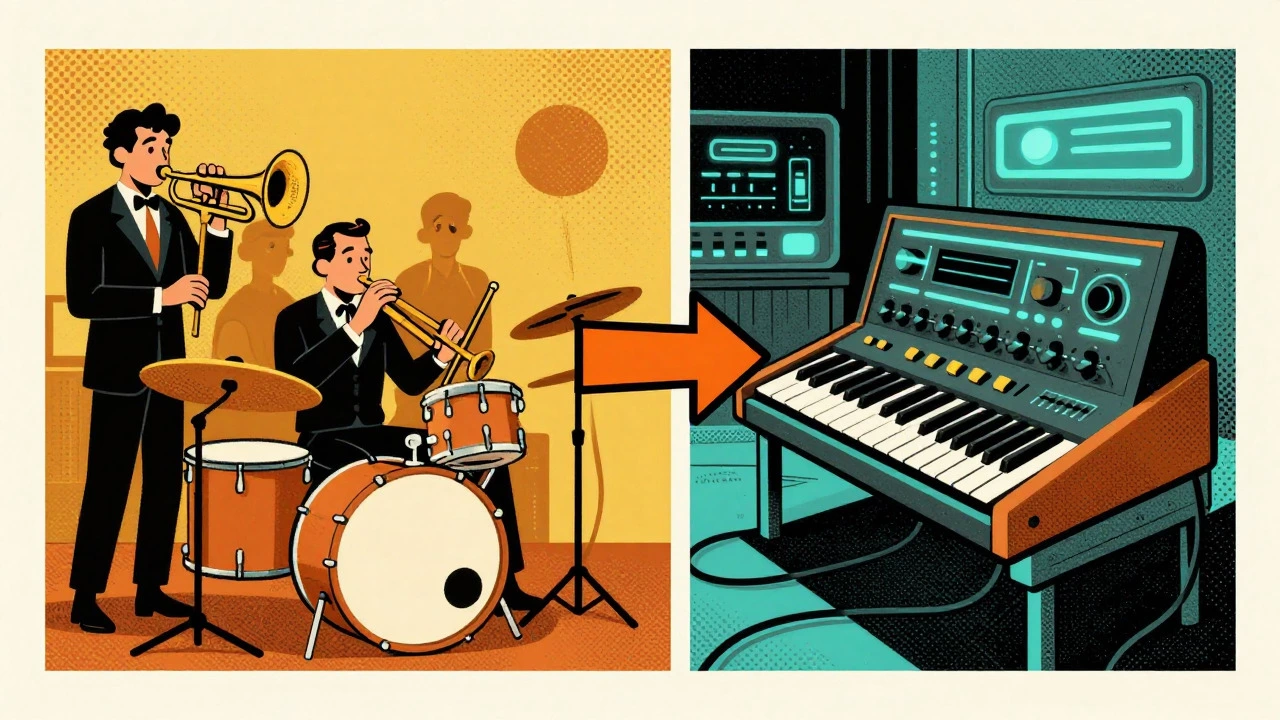

Close your eyes and think of the word "disco." What do you hear? If you picture a massive orchestra with strings and brass, you are thinking of the early 1970s. But if you hear that driving, mechanical bassline or the robotic vocal effect, you are hearing the true heartbeat of the genre's evolution. The shift from live bands to synthesizers in disco is the pivotal moment when electronic instrumentation replaced acoustic sections to create the template for modern dance music. This wasn't just a change in style; it was a technological revolution that happened between 1974 and 1983.
Many people assume disco was always about computers and sequencers. It wasn't. Early disco relied on human musicians playing drums, bass guitars, and clavinet. However, producers soon realized that live instruments had limits. They couldn't hold a perfect tempo for six-minute mixes, and they couldn't create sounds that didn't exist in nature. Enter the synthesizer. This article breaks down how these machines changed everything, which specific models defined the era, and why this history matters for anyone who loves electronic music today.
The Turning Point: From Soul to Silicon
To understand the impact of electronics, we have to look at what came before. In the early 1970s, producers like Tom Moulton in New York were creating extended mixes of soul and funk records. These tracks featured live rhythm sections. The groove came from human feel-the slight push and pull of a drummer or bassist. While this created warmth, it also introduced timing inconsistencies. For a dance floor that needed a relentless, hypnotic pulse, this was a problem.
The solution arrived from two different directions simultaneously. On one side, American funk artists began experimenting with analog synthesis. Lionel Richie played an ARP 2600 is a semi-modular analog synthesizer known for its complex patching capabilities and distinctive lead tones on the Commodores' track "Machine Gun" in 1974. This showed that synths could fit into mainstream R&B. On the other side, European producers were looking at technology differently. They weren't trying to mimic horns or strings; they wanted to build new sonic landscapes entirely.
This divergence created a split in the genre. American disco kept its soul roots, using synths as accents. European disco, particularly in Germany and Italy, embraced full electronic production. This cultural difference set the stage for the explosion of electronic dance music that would follow in the 1980s.
Giorgio Moroder and the Birth of Electronic Disco
If there is one name you need to know in this history, it is Giorgio Moroder is an Italian record producer and composer widely credited as the father of electronic disco and dance music. Working out of Munich in the mid-1970s, Moroder solved the tempo problem. He used sequencers to lock his synthesizers to a rigid grid. This technique, called quantization, eliminated human error. Every beat hit exactly on time, creating a driving force that made listeners want to move.
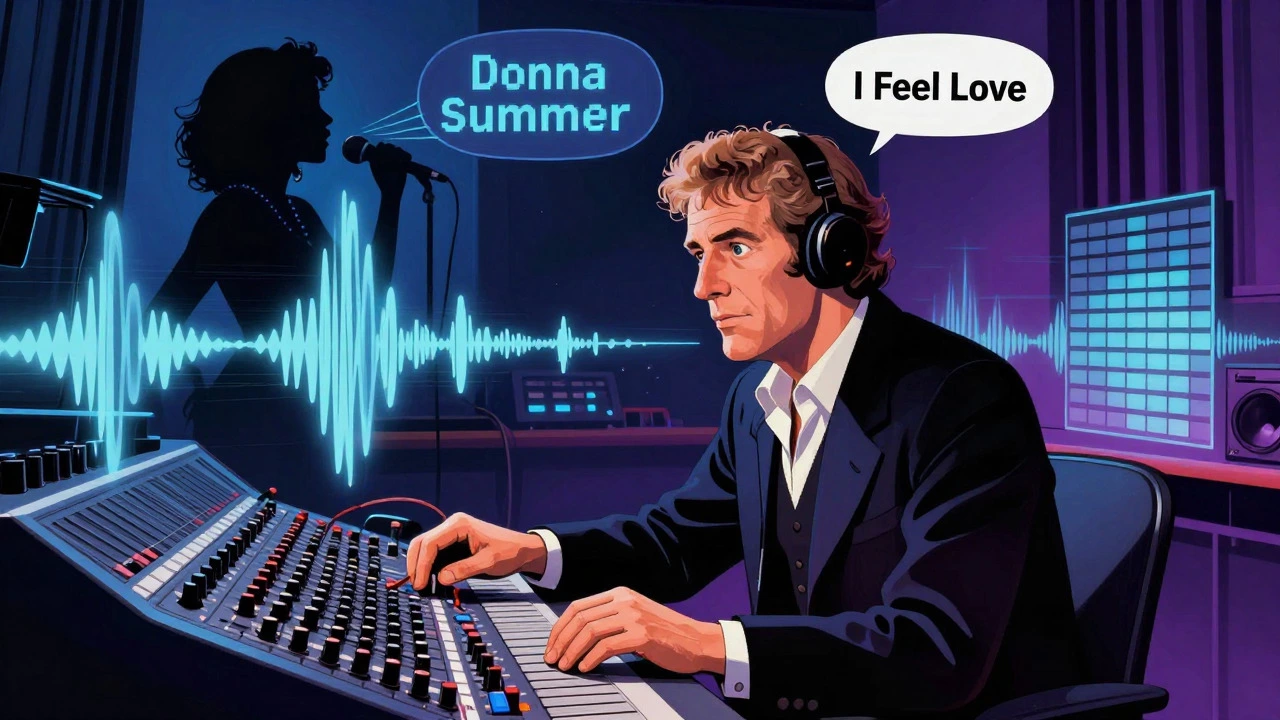
The result was Donna Summer's "I Feel Love," released in 1977. This track is often cited as the blueprint for house, techno, and trance. There were no live drums. There was no bass guitar. Just a sequenced Minimoog Model D is a portable monophonic analog synthesizer famous for its warm basslines and soaring lead sounds and a vocoded vocal. When you listen to "I Feel Love," you are hearing the future of pop music being built in real-time. Moroder proved that you didn't need a band to make a hit; you just needed a computer-like precision and a great melody.
The Essential Instruments of the Era
Not all synthesizers sounded the same. Different manufacturers offered different tools, and each shaped the disco sound in unique ways. Here is a breakdown of the key hardware that defined the late 1970s and early 1980s.
| Instrument | Type | Key Feature | Role in Disco |
|---|---|---|---|
| Minimoog Model D | Analog Mono | Ladder Filter | Basslines and Leads |
| ARP Odyssey | Analog Semi-Mono | Dual Oscillators | Warm Bass and Pads |
| Roland CR-78 | Drum Machine | Programmable Patterns | Electronic Percussion |
| Vocoder | Voice Processor | Spectral Analysis | Robotic Vocals |
The Minimoog Model D is released by Moog Music in 1970, it became the standard for bass sounds due to its stability and rich harmonic content was the workhorse. Its ladder filter gave basslines a fat, rounded tone that cut through loud club systems. Artists like ABBA and Chic used it extensively. Meanwhile, the ARP Odyssey offered a brighter, more nasal tone that worked well for stabs and rhythmic chords.
But keyboards alone weren't enough. You needed rhythm. Early drum machines like the Eko ComputeRhythm is one of the first programmable drum machines released in 1972, featuring a push-button matrix for pattern creation laid the groundwork. By 1978, the Roland CR-78 allowed producers to store custom patterns and control tempo. This meant the drums could stay perfectly locked with the sequenced synth bass. Later, the Linn LM-1 introduced sampled acoustic drums, bridging the gap between synthetic rhythms and realistic sounds.
The Role of Drum Machines and Vocoder Effects
Let's talk about the voice. One of the most recognizable elements of late-70s disco is the "robot voice." This effect comes from the vocoder is an audio signal processor that analyzes the spectral characteristics of speech and imposes them onto another sound source. Originally developed for secure communications, engineers like Harald Bode adapted it for music. In disco, a singer would sing into one microphone while a keyboardist played chords into another. The vocoder analyzed the voice and made the keyboard "sing" with the same formants as the human voice.
This created that eerie, spacey texture heard in many Donna Summer and Kraftwerk tracks. It added a layer of futurism to the music. Combined with the steady thump of a drum machine, the vocoder helped detach the music from traditional song structures. It turned vocals into another instrument, another texture to layer over the beat.
Drum machines evolved rapidly during this period. The transition from purely synthesized sounds (like the CR-78) to sampled sounds (like the Linn LM-1) changed the feel of the music. Sampled drums had more transient punch, which translated better on large PA systems. This technical improvement allowed producers to push volumes higher without losing clarity, fueling the energy of the club scene.
Regional Styles: US vs. Europe
The adoption of synthesizers varied greatly by region. In the United States, disco remained deeply connected to African American musical traditions. Producers in Philadelphia and New York used synths to enhance live arrangements, not replace them. The focus was still on the groove, the horn hits, and the emotional delivery of the vocals.
In Europe, particularly in Italy and Germany, the approach was more experimental. Italo disco is a genre of electronic music that emerged in Italy in the late 1970s, characterized by heavy use of synthesizers, drum machines, and futuristic themes embraced fully electronic production. Tracks often featured simple chord progressions, repetitive basslines, and lyrics about love, robots, and space. This style was cheaper to produce and easier to replicate, leading to a flood of releases that spread across Europe.
This regional divide explains why some people argue that synths weren't central to early disco. They weren't central to *American* soul-disco. But they were absolutely central to the European electronic movement that eventually merged with US styles to create post-disco, hi-NRG, and ultimately house music.
From Analog to Digital: The Early 1980s Shift
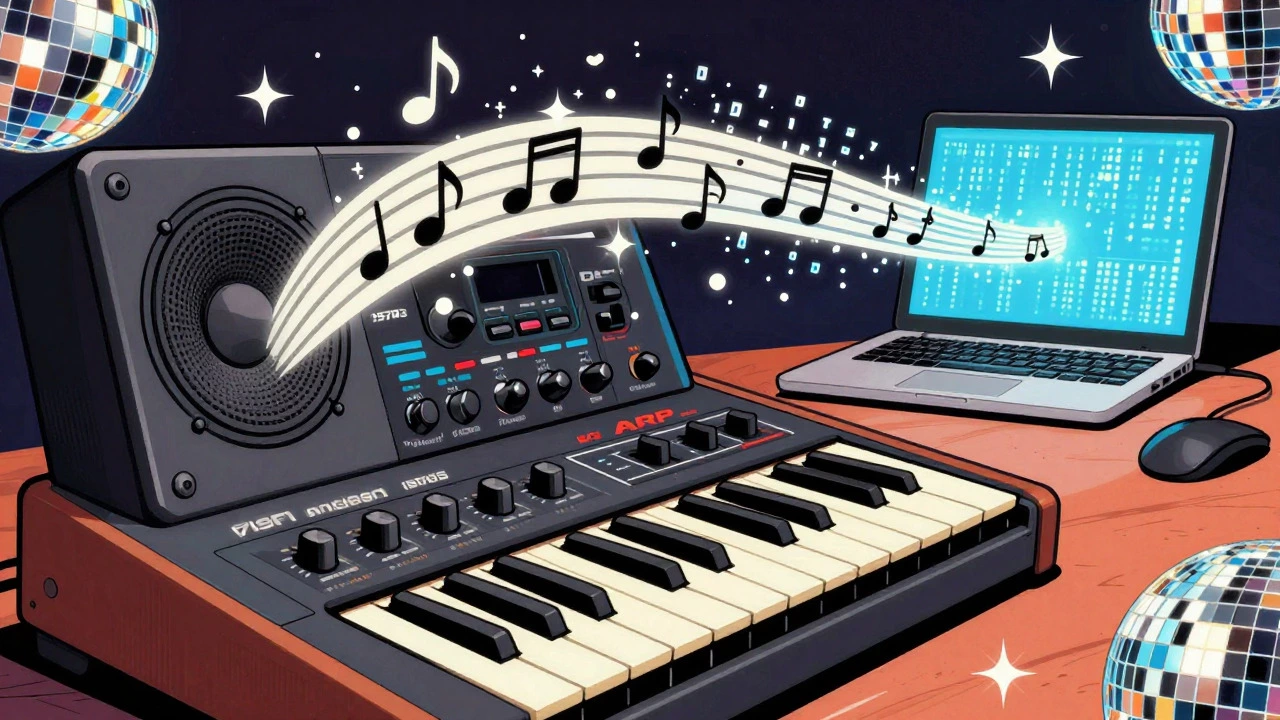
As the decade closed, technology shifted again. Analog synthesizers were expensive and required frequent tuning. Enter digital synthesis. The Yamaha DX7 is a digital synthesizer using FM synthesis technology, released in 1983, known for its bright electric piano and bell-like tones, released in 1983, changed the game. It used Frequency Modulation (FM) synthesis to create crisp, metallic sounds. While it belongs more to the post-disco and synth-pop era, its influence on dance music was immediate.
The DX7's arpeggiator feature allowed producers to create complex rhythmic patterns with a single keystroke. This was perfect for the fast-paced, high-energy tracks of the early 80s. Alongside polyphonic analogs like the Sequential Prophet-5 is a polyphonic analog synthesizer with microprocessor control, offering lush pads and stable tuning and the Roland Jupiter-8, the DX7 provided a new palette of sounds. These instruments allowed smaller studios to create orchestral textures without hiring session musicians.
This democratization of sound production meant that more people could make professional-quality dance music. The barrier to entry dropped. You no longer needed a $50,000 modular system. You needed a few keyboards, a drum machine, and creativity. This accessibility fueled the explosion of independent dance labels in the 1980s.
Legacy and Modern Relevance
So, why does this matter today? Because every EDM subgenre traces its lineage back to these experiments. House music uses the four-on-the-floor kick drum and sequenced basslines pioneered by Moroder. Techno relies on the cold, mechanical aesthetics of German electronic music. Even modern pop production uses the same principles of quantization and layered synthesis.
Today's producers don't need vintage hardware to get these sounds. Software emulations of the Minimoog, ARP 2600, and DX7 are widely available. But understanding the history helps you use them better. Knowing why a certain filter setting works, or how a sequencer can drive a track, gives you deeper control over your productions.
The story of synthesizers in disco is not just about gear. It's about vision. It's about producers seeing potential in technology that others dismissed as gimmicky. It's about finding a way to make people dance using circuits instead of strings. That spirit of innovation is still alive in every electronic track produced today.
What synthesizer was most used in disco?
The Minimoog Model D was the most iconic synthesizer in disco, particularly for basslines and lead melodies. Its warm, stable analog sound made it a favorite among producers like Giorgio Moroder and groups like ABBA. Other notable instruments included the ARP Odyssey and the Sequential Prophet-5 for polyphonic pads.
Who is considered the father of electronic disco?
Giorgio Moroder is widely regarded as the father of electronic disco. His 1977 production of Donna Summer's "I Feel Love" established the template for fully synthesized dance music, using sequencers and drum machines to create a mechanical, hypnotic groove.
Did early disco use drum machines?
Early disco (1973-1976) primarily used live drummers. However, by the late 1970s, drum machines like the Roland CR-78 and Eko ComputeRhythm became common, especially in European productions. By the early 1980s, sampled drum machines like the Linn LM-1 dominated the genre.
What is the difference between American and European disco?
American disco retained strong ties to soul and funk, emphasizing live instruments, horn sections, and vocal emotion. European disco, particularly Italo disco and German electronic music, embraced fully synthetic sounds, sequenced rhythms, and futuristic themes, relying heavily on synthesizers and drum machines.
How did synthesizers change dance music production?
Synthesizers allowed for precise tempo control (quantization), enabling long, repetitive tracks ideal for dancing. They also introduced new timbres impossible with acoustic instruments, such as robotic vocals via vocoders and evolving pad textures. This shifted production from recording bands to programming sequences.


