
Imagine a rock concert in the mid-1960s. You hear distorted guitars, pounding drums, and maybe a Hammond organ. Now imagine that same stage today, layered with pulsing basslines, atmospheric pads, and digital textures that sound like nothing from nature. That shift didn't happen overnight. It was driven by electronic instruments-specifically keyboards and synthesizers-that completely rewrote the rules of what rock music could be.
Rock wasn't always about electric guitars alone. From its earliest days, the genre has absorbed new sounds to push boundaries. But the introduction of voltage-controlled synthesis in the 1960s changed everything. It moved rock from simple chord progressions to complex sonic landscapes. This isn't just about adding a new instrument; it's about how technology altered song structure, live performance, and even the definition of "rock" itself.
The Birth of Voltage-Controlled Sound
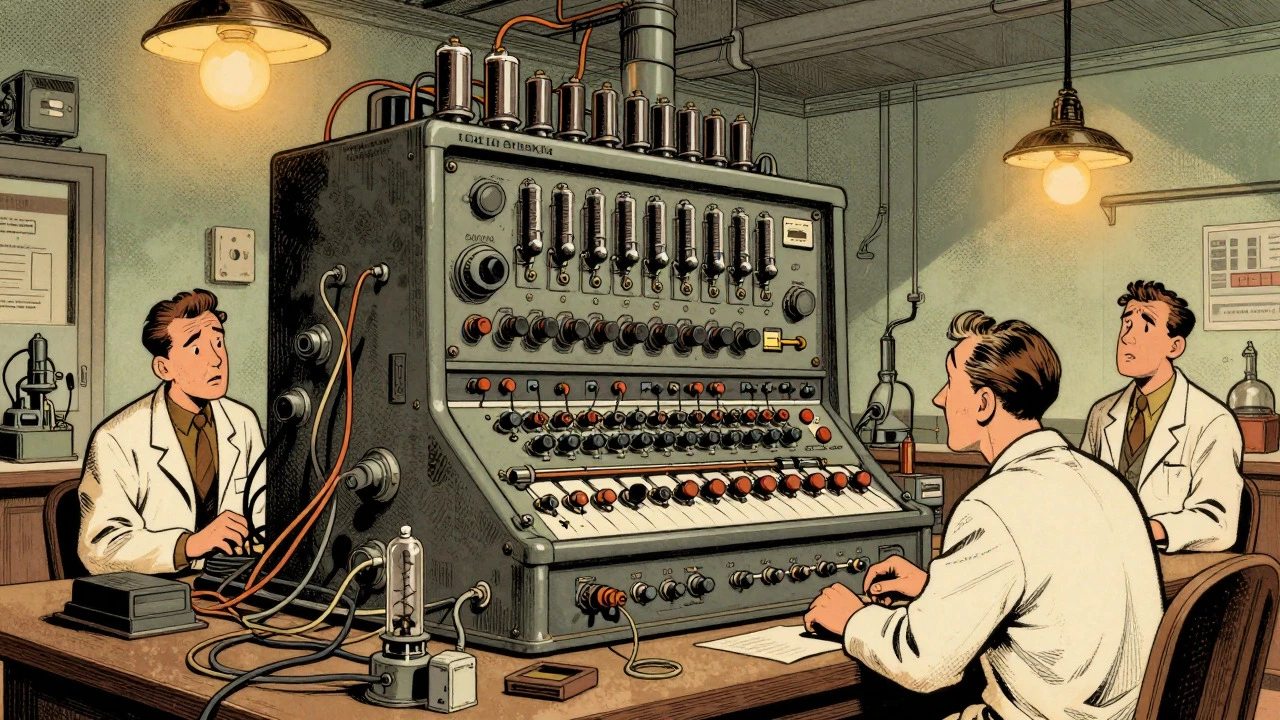
Before bands could use synths on tour, these machines existed only in university labs. The RCA Mark II Sound Synthesizer, operational by 1957, was a room-sized beast developed by Herbert Belar and Harry Olson at RCA. It proved that voltage could control pitch and timbre, but it was too expensive and bulky for any musician to touch.
The real breakthrough came when two engineers built systems musicians could actually play. Don Buchla designed the Buchla 100 Series Modular Electronic Music System around 1963-1965 in California. Around the same time, Robert Moog introduced his modular system commercially in 1964. These weren't just pianos with weird sounds. They used voltage-controlled oscillators (VCOs), filters, and envelope generators. This meant a player could bend notes continuously, shape the brightness of a tone, and control exactly how long a sound lasted.
For the first time, musicians had total control over the waveform itself. Instead of hitting a key and getting a fixed piano note, they could patch cables together to create entirely new timbres. This technical leap turned keyboards from accompaniment tools into lead instruments capable of mimicking strings, brass, or sounds that had no name yet.
First Steps: Synths Enter the Studio
By the late 1960s, these modular systems began leaving universities and entering recording studios. Bands were curious. The Doors recorded "Strange Days" in 1967, using a Moog synth to add eerie textures. The Beatles famously used a Moog on their 1969 album Abbey Road, particularly on tracks like "Here Comes the Sun." George Harrison even released an entire album called Electronic Sound in April 1969, dedicated solely to exploring the instrument.
There is some debate over which rock track was truly the first to feature a prominent Moog. Some sources point to The Monkees' "Daily Nightly," released in November 1967 on the album Pisces, Aquarius, Capricorn & Jones Ltd. Others highlight The Doors. Regardless of who was first, the impact was immediate. Producers realized these machines could add depth and mystery that guitars simply couldn't achieve.
Alongside early synths, tape-based instruments like the Mellotron became popular. The Mellotron worked by playing back short strips of magnetic tape for each key, triggering pre-recorded orchestral strings, choirs, or flutes. While not a synthesizer in the strict sense, it served the same purpose: bringing symphonic richness to rock bands without hiring an orchestra. Bands like The Byrds and later progressive acts relied heavily on this hybrid approach.
The MiniMoog Revolution
Modular synths were great for studios, but terrible for touring. They required racks of equipment, constant tuning, and technicians to manage the cables. Rock bands needed something portable. In response to this demand, Robert Moog released the MiniMoog Model D around 1970.
This was a game-changer. The MiniMoog was compact, monophonic (meaning it played one note at a time), and integrated all the essential components into a single box with a built-in keyboard. It featured three oscillators and a famous 24 dB/octave ladder filter that gave it that warm, "fat" analog sound. Unlike its modular predecessors, it was stable enough to stay in tune during a hot stage show.
| Feature | Moog Modular (1964) | MiniMoog Model D (1970) |
|---|---|---|
| Portability | Rack-mounted, heavy | Compact, stage-ready |
| Polyphony | Monophonic/Polyphonic via patching | Monophonic |
| Primary Use | Studio experimentation | Live performance leads |
| Cost Barrier | Tens of thousands of dollars | Affordable for working musicians |
Because it was affordable and retail-available, the MiniMoog spread quickly through the rock community. Keyboardists like Rick Wakeman of Yes and Richard Wright of Pink Floyd adopted it as a primary lead instrument. It allowed them to cut through the mix with soaring solos that rivaled guitar riffs in intensity.
Progressive Rock and the Keyboard Architect
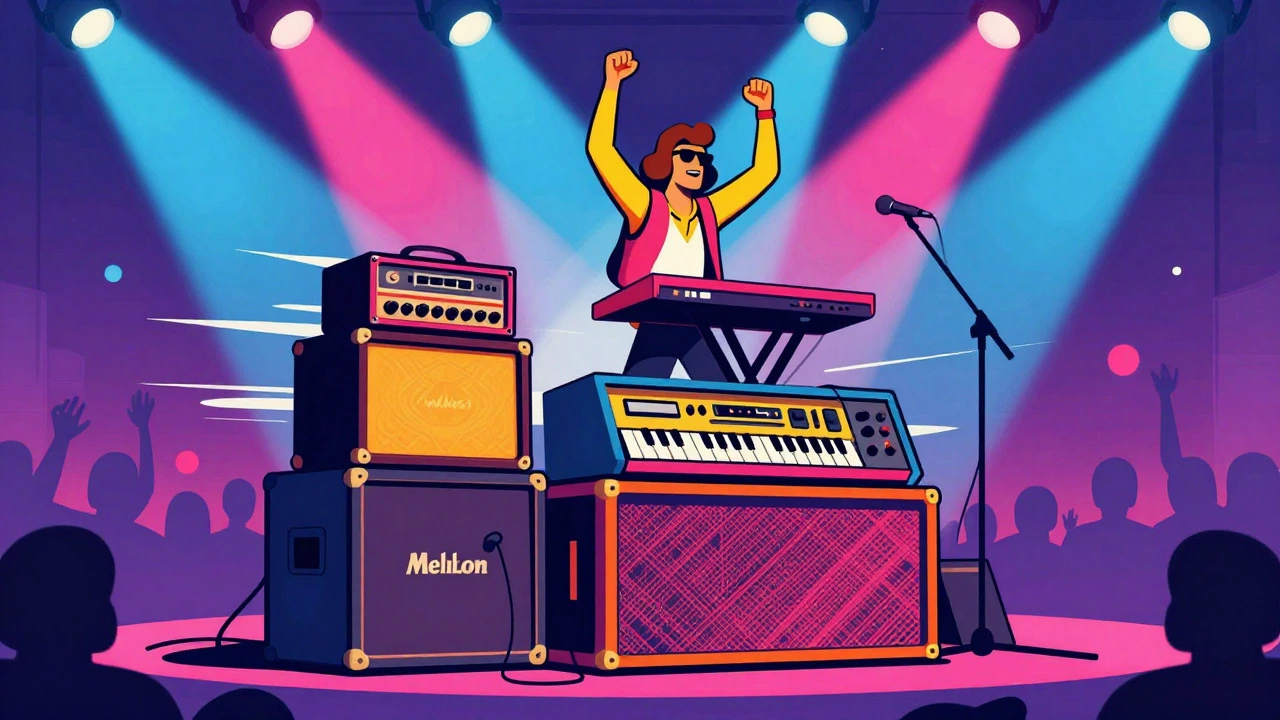
In the 1970s, keyboards stopped being background texture and became structural pillars. Progressive rock bands like Yes, Emerson, Lake & Palmer (ELP), and Tangerine Dream built their entire identity around multi-keyboard rigs. A typical setup might include a Hammond B-3 organ with a Leslie speaker, a Mellotron for strings, a grand piano, and one or more synthesizers.
Keyboardists became "band architects." They handled harmonic complexity, counter-melodies, and rhythmic sequencing simultaneously. Albums like Pink Floyd's The Dark Side of the Moon (released March 1973) showcase this perfectly. The track "On the Run" relies almost entirely on synced sequencers and electronic effects, creating a continuous, driving soundscape that would have been impossible with traditional instrumentation alone.
This era established new expectations for live shows. Rock concerts began featuring massive stacks of keyboards per player. The visual spectacle of a keyboardist managing multiple instruments added to the arena-rock experience. The sound shifted from riff-based guitar songs to multi-layered, texture-driven compositions where the synth pad provided the emotional bedrock.
Digital Shift and the 1980s Explosion
As the decade ended, analog technology hit a limit. Digital synthesis offered new possibilities. Yamaha commercialized frequency-modulation (FM) synthesis in 1983 with the release of the Yamaha DX7. Developed by John Chowning at Stanford University, FM synthesis generated bright, metallic timbres-electric pianos, bells, and plucked strings-that defined the sound of the 1980s.
At the same time, MIDI (Musical Instrument Digital Interface) was standardized in 1983. This protocol allowed different electronic instruments to communicate with each other. A keyboard could trigger a drum machine, or a synthesizer could control another synthesizer's parameters. This connectivity revolutionized production workflows.
While bands like Depeche Mode, Duran Duran, and The Human League pushed synthesizers to the forefront of pop, rock bands adapted. Hard rock and metal groups began using keyboards for cinematic intros, atmospheric pads, and orchestral layering. The Roland Jupiter-8 and other polyphonic synths allowed players to hold full chords while still providing lead lines. This blend of digital clarity and analog grit created a new aesthetic that dominated mainstream charts throughout the decade.
Synths in Heavy Metal and Modern Rock
You might think heavy metal rejects electronic sounds, but that's a misconception. Starting in the 1980s, metal bands began incorporating synths to add horror-inspired atmospheres and symphonic elements. By the 1990s and 2000s, affordable digital workstations made it easy for bands to create wide pads, choirs, and string sections without hiring an orchestra.
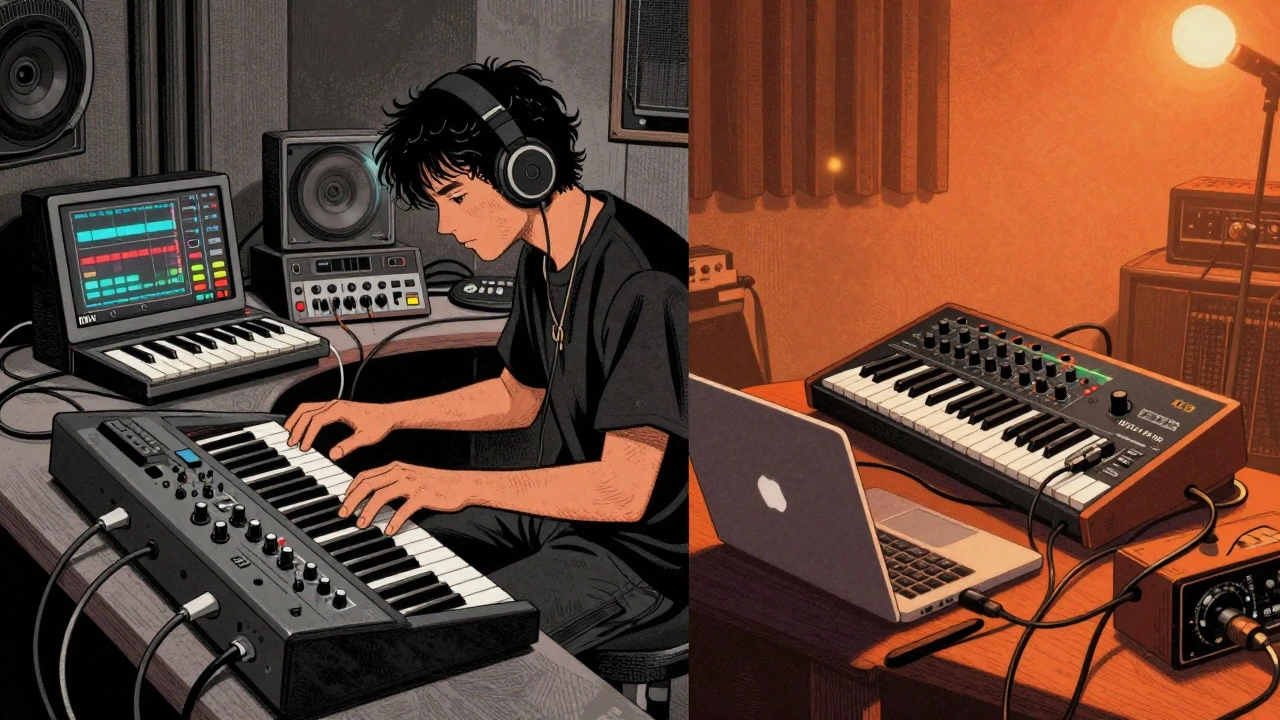
Genres like power metal, symphonic metal, and progressive metal routinely feature keyboard-driven sections. In modern rock-derived genres such as post-hardcore and dance-punk, laptops and MIDI controllers are standard parts of the rig. Guitarists often trigger synth parts alongside their amps, blending distortion with digital sequences.
Today, we see a dual trajectory. On one hand, there is a strong analog revival. Boutique manufacturers produce new versions of classic MiniMoogs, and new Hammond organs are highly sought after. On the other hand, software instruments and controller-heavy rigs dominate modern studios. Musicians can access thousands of vintage sounds from a single laptop, simplifying logistics while expanding creative options.
Why This Transformation Matters
The integration of keyboards and synthesizers did more than add new tones to rock music. It expanded the genre's emotional range and compositional toolkit. Rock moved from a format centered on rhythm and blues structures to one that embraced concept albums, long-form suites, and electronic soundscapes.
For listeners, this means richer, more immersive experiences. For musicians, it means greater flexibility. Whether you're hearing the warm analog swell of a 1970s prog epic or the sharp digital edge of a modern alternative track, you're hearing the legacy of those early experiments with voltage-controlled sound. The keyboard is no longer just an accessory; it is a fundamental voice in the rock conversation.
When did synthesizers first appear in rock music?
Synthesizers began appearing in rock recordings in the late 1960s. Notable early examples include The Doors' "Strange Days" (1967) and The Beatles' use of Moog on "Abbey Road" (1969). The MiniMoog Model D, released around 1970, made widespread adoption possible for touring bands.
What is the difference between a Mellotron and a synthesizer?
A Mellotron is a tape-replay instrument that plays back pre-recorded audio samples (like strings or choirs) when a key is pressed. A synthesizer generates sound electronically using oscillators and filters. While both provide non-guitar textures, synthesizers allow for real-time manipulation of pitch and timbre, whereas Mellotrons reproduce fixed recordings.
Why was the MiniMoog so important to rock history?
The MiniMoog Model D was the first synthesizer designed specifically for live performance. It was compact, stable, and affordable compared to earlier modular systems. Its reliable tuning and powerful analog sound made it accessible to rock keyboardists, leading to its iconic status in progressive and art rock.
How did MIDI change keyboard use in rock?
MIDI (standardized in 1983) allowed electronic instruments to communicate digitally. This enabled keyboardists to control multiple synths, drum machines, and samplers from a single controller. It streamlined live setups and studio production, making complex electronic arrangements easier to manage and replicate.
Are analog synthesizers still used in modern rock?
Yes, there is a significant analog revival in the 2010s and 2020s. Many modern rock and indie bands use boutique analog synthesizers for their warm, organic sound. However, most contemporary rigs also incorporate software instruments and digital workstations for versatility and ease of use.