

There is a specific kind of risk that comes with being a singer-songwriter who decides to abandon the acoustic guitar.
In the early 1970s, if you were an artist known for intimate, confessional lyrics, your audience expected simplicity. They wanted the raw emotion of a folk ballad. But what happens when those same artists start adding complex jazz harmonies, African polyrhythms, or improvisational structures? You don’t just change the sound; you challenge the very definition of your art form.
This shift wasn’t just a trend-it was a revolution in how personal storytelling could be expressed. From Joni Mitchell’s pivot from folk to jazz fusion to Paul Simon’s collaboration with South African musicians, these artists proved that the singer-songwriter genre was not a cage, but a starting point. Here is how they broke the mold, why it mattered, and what it means for music today.
The Blueprint: Joni Mitchell’s Jazz Journey
If we are talking about cross-genre experiments, we have to start with Joni Mitchell. She didn't just dip her toes into jazz; she dove in headfirst, dragging her folk fans along for the ride.
Mitchell’s transition happened in phases. It began subtly on For the Roses (1972), where she introduced woodwind solos by Tom Scott, a key figure in West Coast jazz. Critics noticed the shift immediately. The album featured tracks like "Cold Blue Steel and Sweet Fire," which used jazz timbres to enhance the emotional weight of her lyrics. This was the first crack in the facade of the traditional folk artist.
Then came Court and Spark in 1974. This album became her best-seller, proving that jazz-rock could appeal to a mainstream audience. By inviting the L.A. Express-a fusion band-to play on the record, Mitchell anchored her songwriting in modal harmonies and syncopated rhythms. She wasn't just writing songs anymore; she was constructing musical landscapes.
But the real technical leap happened with her use of alternate tunings. Mitchell composed songs in approximately 50 different open or non-standard tunings. Why? Because standard guitar chords couldn't capture the extended harmonies she heard in modern jazz. These "chords of inquiry" allowed her to create orchestral textures while playing solo, bridging the gap between folk intimacy and jazz complexity.
| Album | Year | Key Jazz Element | Significance |
|---|---|---|---|
| For the Roses | 1972 | Woodwind solos (Tom Scott) | First clear integration of jazz timbres into folk structure |
| Court and Spark | 1974 | L.A. Express fusion band | Mainstream breakthrough for jazz-rock hybrid |
| Hejira | 1976 | Jaco Pastorius fretless bass | Minimalist jazz approach with autobiographical lyrics |
| Mingus | 1979 | Collaboration with Charles Mingus | Direct lyrical adaptation of complex jazz compositions |
By the time she released Hejira in 1976, Mitchell had fully embraced a minimalist jazz aesthetic. Working with Weather Report bassist Jaco Pastorius, she created a sound defined by his fretless, melodic bass lines. Tracks like "Coyote" showed how jazz instrumentation could amplify rather than distract from personal narrative. Later, her collaboration with legendary composer Charles Mingus on the album Mingus (1979) cemented her status as a serious jazz artist, not just a pop star dabbling in new styles.
Beyond Harmony: Integrating World Sounds
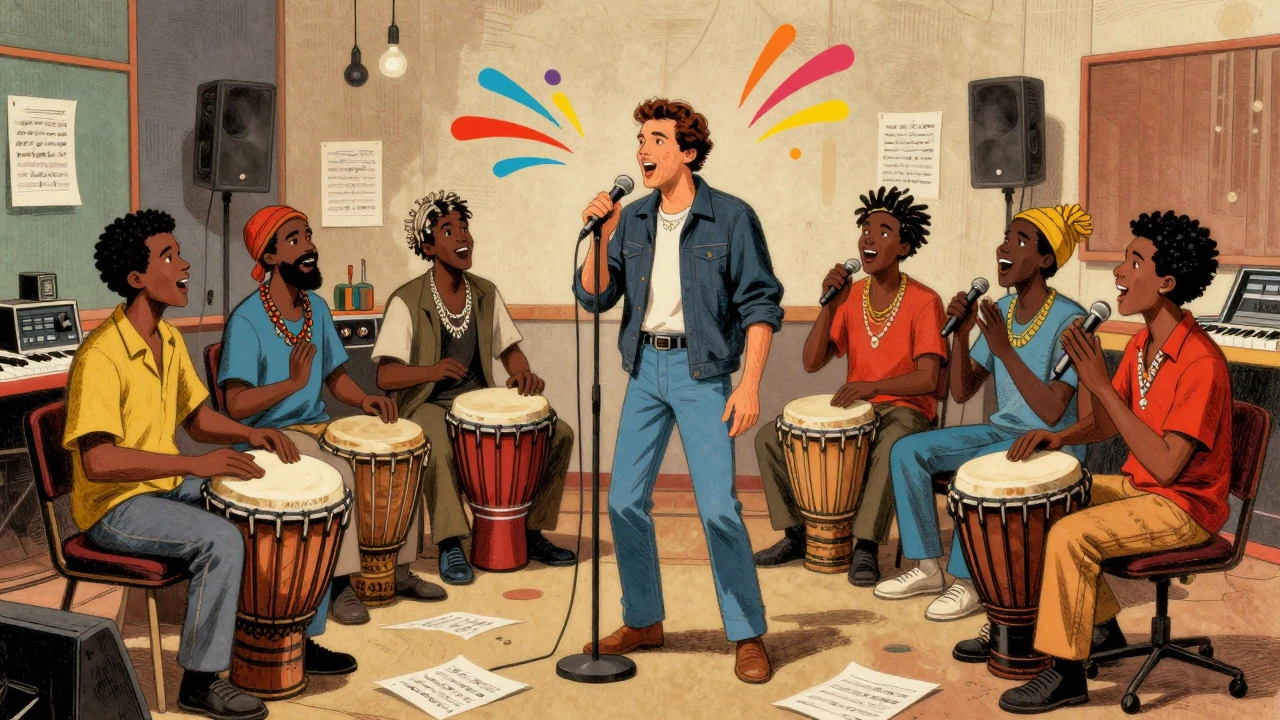
Jazz wasn't the only frontier. Mitchell also experimented with world sounds, particularly African drumming. On The Hissing of Summer Lawns (1975), the track "The Jungle Line" layered field recordings of the Royal Drummers of Burundi beneath electronic keyboards. This collage-like production method anticipated the "world music" movement that would explode in the 1980s.
This approach influenced a generation of artists who saw the studio as a tool for global fusion. It wasn't enough to write a good melody; you needed to build a rhythmically rich sound world that reflected a broader cultural consciousness. Mitchell’s work showed that a singer-songwriter could engage with global cultures without losing their individual voice.
The Global Wave: Simon, Gabriel, and Byrne
Mitchell paved the way, but other major figures followed suit, each bringing their own unique flavor to the mix. In the 1980s, the concept of the "world music" bin emerged in record stores, largely driven by these cross-genre experiments.
Paul Simon took this idea to its commercial peak with Graceland (1986). Released during the height of apartheid in South Africa, the album fused Simon’s narrative songwriting with mbaqanga grooves and township-band instrumentation. He recorded primarily in Johannesburg, working with groups like Ladysmith Black Mambazo. While controversial due to the political context, Graceland introduced millions of listeners to South African music, proving that cross-cultural collaboration could be both artistically vital and massively popular. His follow-up, The Rhythm of the Saints (1990), incorporated Brazilian percussion, further expanding his rhythmic vocabulary.
Meanwhile, Peter Gabriel was integrating African and Middle Eastern rhythms into his solo work long before founding Real World Records in 1989. His albums So (1986) and earlier works used global instruments to create atmospheric, cinematic soundscapes. Gabriel’s label became a hub for artists who wanted to explore similar fusions, positioning the singer-songwriter within a broader ecosystem of global music.
David Byrne, formerly of Talking Heads, moved into heavily Afro-Latin influenced solo work. His album Rei Momo (1989) was built around samba and cumbia, showcasing how art-rock sensibilities could merge with Latin American traditions. Similarly, Kate Bush explored Irish traditional music and gamelan-like textures on albums like Hounds of Love (1985), blending avant-garde pop with ancient musical forms.
Jazz Inflections in Pop: Sting and the New Guard
Not all cross-genre moves involved world music. Some artists focused purely on jazz harmony and improvisation. Sting, after leaving The Police, leaned heavily into jazz-rock arrangements. Albums like The Dream of the Blue Turtles (1985) and Nothing Like the Sun (1987) featured collaborations with jazz luminaries such as Branford Marsalis and Kenny Kirkland. Sting retained his identity as a literate songwriter but elevated the musical sophistication of his backing tracks, appealing to audiences who craved more complexity than standard pop offered.
This trend continued into the 21st century. Contemporary artists like Norah Jones, Laura Mvula, and Bon Iver have adopted jazz harmonies and global rhythmic sources, often citing Mitchell, Simon, and Gabriel as inspirations. Streaming platforms now allow for micro-targeted genre tags like "indie jazz-folk," making it easier for these hybrid artists to find their audience without the marketing barriers faced in the 1970s.
Why It Matters: The Legacy of Hybridity
The impact of these experiments goes beyond chart performance. They changed how we think about the singer-songwriter. No longer confined to the acoustic guitar and simple chord progressions, the genre became a flexible framework capable of absorbing jazz, rock, and world music vocabularies.
Retrospective assessments now view albums like Hejira and Graceland not as risky detours, but as pioneering works that expanded the expressive possibilities of popular music. They demonstrated that personal narrative and musical complexity are not mutually exclusive. In fact, when done right, they enhance each other.
Today, as remote collaboration and digital distribution make transnational recording projects easier, we see a continuation of this legacy. Artists are no longer bound by geography or genre conventions. The path laid out by Mitchell, Simon, Gabriel, and others remains open, inviting new generations to experiment, collaborate, and redefine what it means to be a singer-songwriter.
Who was the first singer-songwriter to successfully blend jazz and folk?
While several artists experimented with jazz elements, Joni Mitchell is widely recognized as the pioneer who systematically integrated jazz harmony and improvisation into the singer-songwriter format, starting with her 1972 album 'For the Roses' and peaking with 'Court and Spark' in 1974.
What is the significance of Paul Simon's 'Graceland'?
Released in 1986, 'Graceland' fused Simon's songwriting with South African mbaqanga music. It was commercially massive and culturally significant, introducing global audiences to township bands like Ladysmith Black Mambazo, though it was controversial due to the cultural boycott of apartheid-era South Africa.
How did Joni Mitchell's use of alternate tunings influence her jazz style?
Mitchell used over 50 non-standard guitar tunings to achieve extended harmonies and complex voicings that are difficult to play in standard tuning. This allowed her to mimic the harmonic richness of jazz piano and orchestration while maintaining the solo guitar format central to her singer-songwriter identity.
Did fans accept these cross-genre experiments initially?
Reactions were mixed. Many fans of Joni Mitchell's early folk work found her mid-70s jazz albums too abstract or alienating. However, retrospective views have re-evaluated these albums as masterpieces, recognizing them as bold artistic risks that expanded the boundaries of popular music.
Which contemporary artists continue this tradition of jazz and world music fusion?
Artists like Norah Jones, Laura Mvula, Lianne La Havas, and Bon Iver draw on jazz harmonies and global rhythms. They benefit from streaming algorithms that categorize niche genres like 'indie jazz-folk,' allowing them to reach audiences interested in these hybrid styles.


