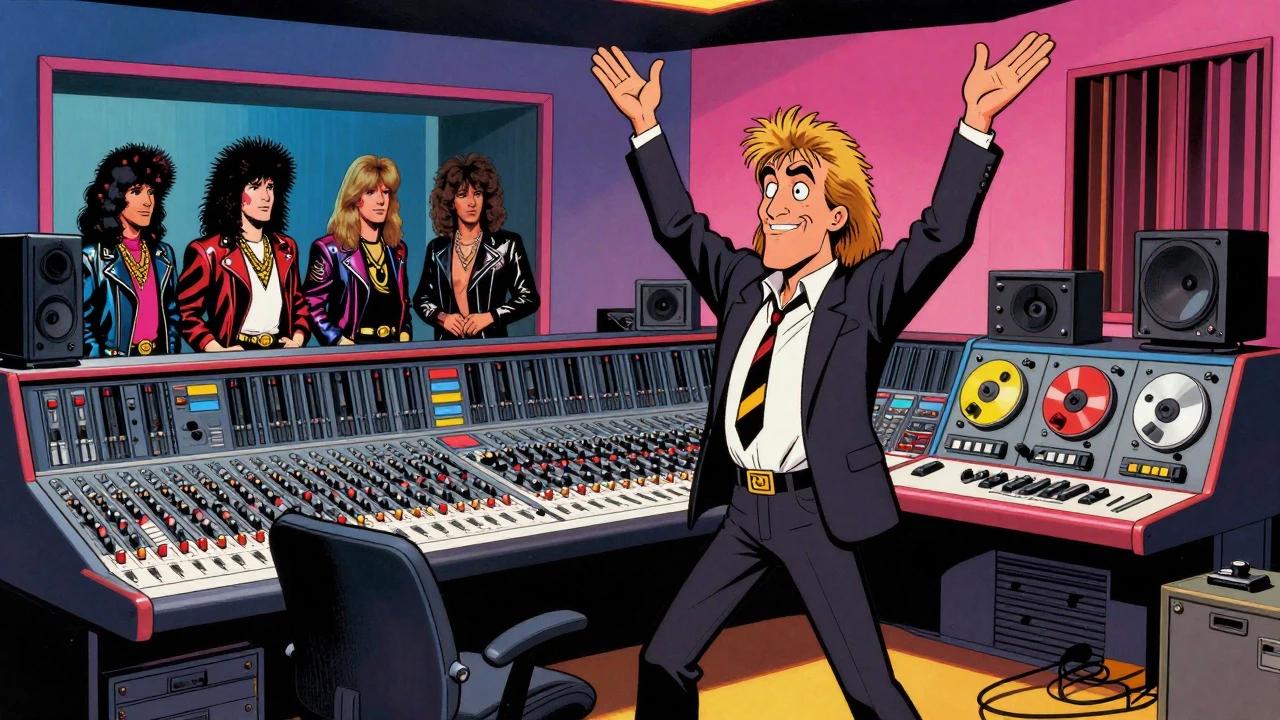

Have you ever listened to "Pour Some Sugar on Me" and wondered how a guitar track sounds so thick, clean, and perfectly synchronized that it feels less like a band playing in a room and more like a machine? That sound wasn’t an accident. It was engineered with obsessive precision by Mutt Lange, the producer behind Def Leppard’s 1980s masterpieces Pyromania and Hysteria. While most rock bands of the early 80s were chasing raw energy and live-room grit, Lange was building pop-perfect anthems note by note, chord by chord.
The result? An album, Hysteria, that sold over 20 million copies worldwide and defined the sonic landscape of glam metal. But to understand why this record still holds up, you have to look past the leather pants and big hair. You have to look at the tape machines, the samplers, and the sheer madness of recording drums last. Here is exactly how they built those mega-hooks.
The Reverse Workflow: Why Drums Came Last
If you’ve ever recorded music, you know the standard rule: drums first, then bass, then guitars, then vocals. The rhythm section sets the foundation. Mutt Lange flipped this script entirely. On both Pyromania (1983) and Hysteria (1987), the band did not play together in a room. Instead, they tracked instruments separately, starting with the guitars.
Lange wanted total control over the arrangement. By recording the guitar riffs and vocal melodies first to a click track from a LinnDrum (a pioneering digital drum machine), he could rearrange songs freely. If a chorus needed to be two bars longer or a verse shorter, he could edit the tape without worrying about re-recording a drummer who had already nailed their performance. This approach turned the studio into a construction site rather than a capture room.
This workflow allowed for microscopic editing. The team would punch in and out of the multi-track tape recorder to replace single beats or entire sections until the feel was mathematically perfect. It wasn’t about capturing a moment; it was about crafting a product where every element served the hook.
Guitar Architecture: The Rockman and Note-by-Note Chords
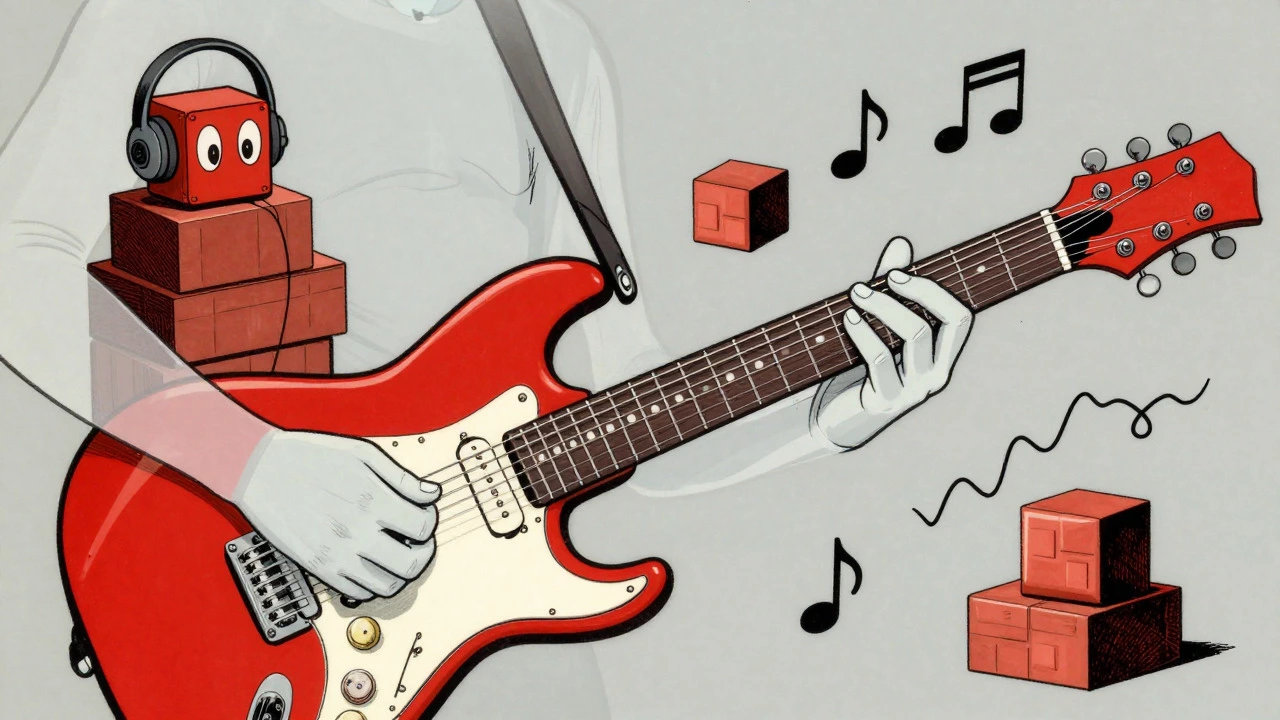
The signature wall-of-sound guitars on these albums didn’t come from massive Marshall stacks blasting in a live room. They came from small, headphone-style amplifiers called Rockman units, designed by Tom Scholz of Boston fame. These devices provided a consistent, compressed tone that stacked cleanly when layered dozens of times. Because the EQ and gain structure never shifted, Lange could layer eleven separate guitar tracks on a song like "Hysteria" without the mix turning into mud.
But the real secret sauce was how those chords were recorded. Phil Collen, one of the band’s lead guitarists, has clarified that the rumor of recording the entire album "one string at a time" is exaggerated. However, for specific sections-like the bridge of "Hysteria"-Lange insisted on building chords note by note. He would record one string, then punch in the next string while the first played back, ensuring every note hit at the exact same millisecond.
Why go to such trouble? To eliminate arpeggiation. When you strum a guitar, the strings don’t all ring out simultaneously; there’s a tiny delay between them. Lange wanted a unified, synthetic block of sound-a single transient that hit the listener’s ear with maximum impact. This technique transformed the electric guitar from a rhythmic instrument into something closer to a synthesizer pad, creating that polished, pop-like texture that dominated radio airwaves.
Drum Sampling and the Fairlight CMI
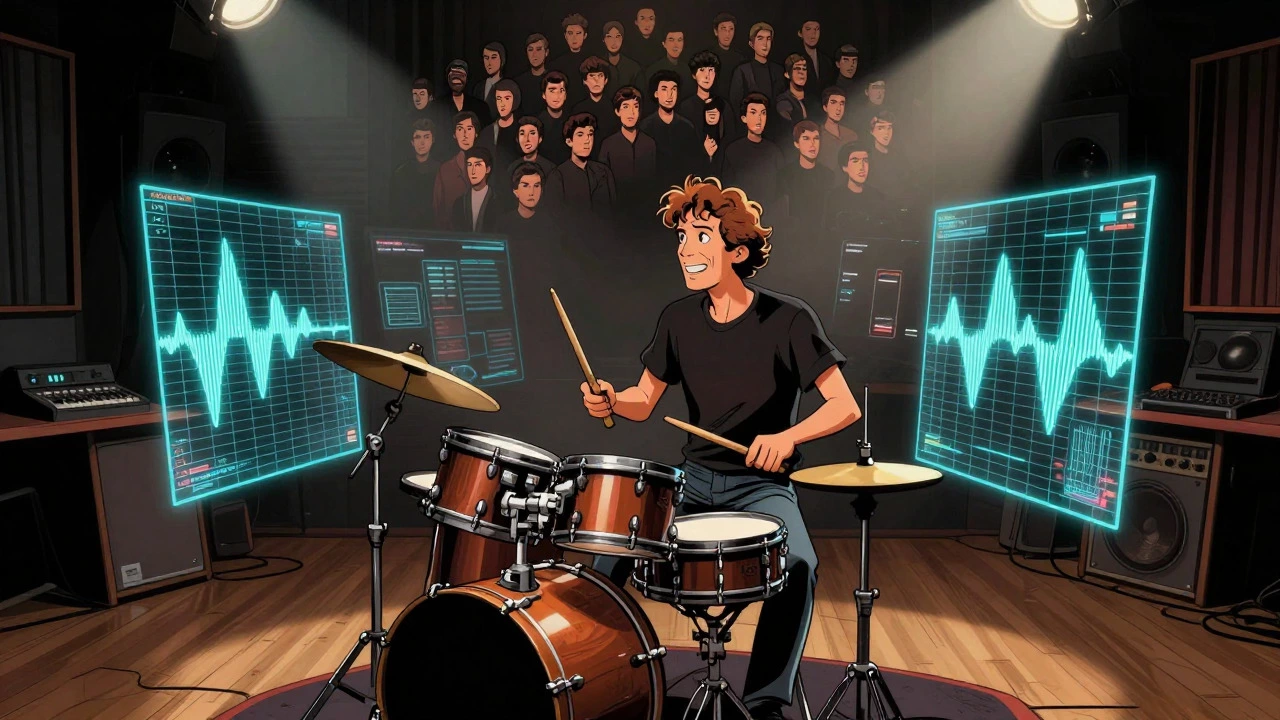
Since the acoustic drums were added near the end of the process, the rhythm section on Hysteria is largely electronic and sampled. Drummer Rick Allen, who lost his left arm in a car accident before the album’s completion, played an electronic kit that was recorded into high-end digital systems. But the true innovation lay in the sampling technology used by engineer Mike Shipley and programmer Philip "Art School" Nicholas.
They utilized the Fairlight CMI, an expensive eight-bit sampler, to create the drum sounds. To get enough harmonic information for convincing playback, they recorded source drum hits at half speed. This trick effectively doubled the resolution of the samples, making them sound richer and more realistic when played back at normal tempo. These samples were then sequenced and quantized using a Synclavier system, another industry-standard digital workstation of the era.
The result was a drum track that was grid-perfect. There were no sloppy fills or timing drifts. The drums operated as a programmable framework designed to support the vocal hooks and guitar layers. Ghost notes, fills, and dynamics were carefully edited for maximum impact, giving the records a mechanical tightness that stood in stark contrast to the loose, human feel of traditional hard rock.
Vocal Stacking and the Mega-Hook Strategy
If the guitars are the body of the song, the vocals are its soul-and Lange treated them with surgical precision. Reports indicate that individual songs on Hysteria feature hundreds of vocal overdubs. Joe Elliott and the backing singers tracked harmonies multiple times, with no two passes sharing the exact same intonation. This created a thick, shifting wall of sound that avoided phase cancellation, resulting in a choir-like density that felt immense yet clear.
Lange’s philosophy was simple: every song must have multiple "drop-dead" choruses. He reshaped song structures around the most memorable lines, often subordinating riffs and drum figures to the vocal melody. On tracks like "Gods of War," they even used reverse vocals achieved by flipping tape reels, recording onto a second reel, and reloading for forward playback. This analog complexity added ethereal textures that digital plugins struggle to replicate authentically today.
The goal was radio dominance. By stacking gang vocals, call-and-response structures, and meticulously pitched harmonies, Lange ensured that the chorus hit like a singular, massive event. This strategy paid off: Hysteria generated seven U.S. Top 40 singles, proving that heavy metal could compete directly with pop artists on FM radio and MTV.
The Cost of Perfection: Studios and Budgets
This level of detail didn’t come cheap. The production of Hysteria spanned three years and involved sessions at Wisseloord Studios in the Netherlands, Windmill Lane Studios in Dublin, and Studio Des Dames in Paris, with final mixing at Battery Studios in London. At the time, it was considered the most expensive record ever produced in the U.K., costing millions of pounds.
The team included specialized personnel like engineers Nigel Green and Ronald Prent, and mastering engineers Bob Ludwig and Howie Weinberg. This large, collaborative effort highlights the shift in the music industry during the 80s, where major labels invested heavily in studio-assembled spectacles. Lange’s willingness to spend years and fortunes to realize a particular sound set a new benchmark for rock production.
| Element | Technique/Tool | Purpose |
|---|---|---|
| Guitars | Rockman amps, note-by-note punching | Clean stacking, unified transients |
| Drums | Fairlight CMI sampling, Synclavier sequencing | Grid-perfect timing, hybrid electronic/acoustic sound |
| Vocals | Hundreds of overdubs, manual pitch adjustment | Choir-like density, mega-hook emphasis |
| Workflow | Guitars/Vocals first, drums last | Flexible arrangement editing |
Legacy: Why It Still Matters
Today, Def Leppard’s 1980s production is studied as a canonical example of multi-tracking and hook-centric arrangement. Modern producers in pop, EDM, and even contemporary rock adopt similar strategies of heavy layering, quantization, and vocal stacking. The techniques pioneered by Lange-using the studio as an instrument, prioritizing the hook above all else, and embracing technology to achieve perfection-remain relevant in an era where digital audio workstations make such editing easier than ever.
While some critics argue that this approach sacrificed the "human" element of rock music, the commercial success and enduring popularity of Pyromania and Hysteria suggest otherwise. Listeners connected with the emotional power of the songs, delivered through a sonic package that was brighter, louder, and more precise than anything before it. Lange didn’t just produce albums; he engineered cultural moments.
Did Def Leppard really record Hysteria one string at a time?
Not the entire album. Phil Collen confirmed that the "one string at a time" technique was used specifically for the bridge of the song "Hysteria." Mutt Lange wanted every note of the chord to hit simultaneously, eliminating the natural arpeggiation of a strummed guitar. This created a unified, synthetic block of sound.
What equipment did Mutt Lange use for guitar tones?
Instead of large amplifier stacks, the band relied heavily on Tom Scholz’s Rockman headphone amplifiers. These units provided a consistent, compressed tone that allowed dozens of guitar tracks to be layered without muddying the mix, contributing to the album's polished, pop-metal sound.
Why were drums recorded last on Hysteria?
Recording drums last gave Mutt Lange the freedom to edit song structures without being locked into a fixed rhythm bed. Since guitars and vocals were tracked first to a click, Lange could extend or shorten sections easily. The final drum parts were often hybrid performances involving electronic kits and sampled sounds from the Fairlight CMI.
How many vocal tracks are on Hysteria?
Reports suggest that individual songs on the album feature hundreds of vocal overdubs. Lange and the band stacked harmonies meticulously, tracking each part multiple times to create a thick, choir-like wall of sound that emphasized the mega-hooks of the choruses.
What role did the Fairlight CMI play in the production?
The Fairlight CMI was used to sample and sequence drum sounds. Engineers recorded acoustic drum hits at half speed to increase harmonic resolution, then played them back at normal speed. This created realistic, high-quality drum samples that were integrated into the electronic kit performances, allowing for precise, quantized rhythms.