
You probably know who directed Se7en. But do you know who directed Scream? For most people, the answer is a blank stare. Yet in the 1990s, the person behind the camera of a three-minute music clip was often just as famous as the singer performing in it. This wasn’t an accident. It was a cultural shift driven by one specific channel and a handful of visionary filmmakers.
The idea that a music video could have an "author"-a single creative voice distinct from the artist-is known as music video auteur theory. While traditional film critics debated this concept for decades regarding movies, the 1990s proved it could work for short-form commercial content. Thanks to MTV, directors like Spike Jonze, Michel Gondry, and Chris Cunningham became household names. Their styles were so recognizable that fans would tune in not just to hear a song, but to see what those specific directors did with it next.
The Credit That Changed Everything
Before the early 1990s, music videos were largely anonymous promotional tools. The label paid for them, the artist starred in them, and the director was essentially a hired gun whose name rarely appeared on screen. That changed in late 1992. After pressure from the Music Video Producers Association, MTV began listing director credits alongside the artist and song title during broadcasts.
This small administrative change had massive consequences. Suddenly, viewers saw names repeatedly. If you liked the visual style of a Beastie Boys video, you could look up who made it. This created a feedback loop: a director’s reputation helped sell their next commission, while the artist borrowed the director’s cool factor. It transformed the video from a disposable ad into a piece of cinema with a signature.
Spike Jonze: The King of Gen-X Irony
No director embodies the 90s auteur more than Spike Jonze. His work wasn’t just visually interesting; it was culturally resonant. He captured the specific mood of Generation X-ironic, nostalgic, and slightly awkward.
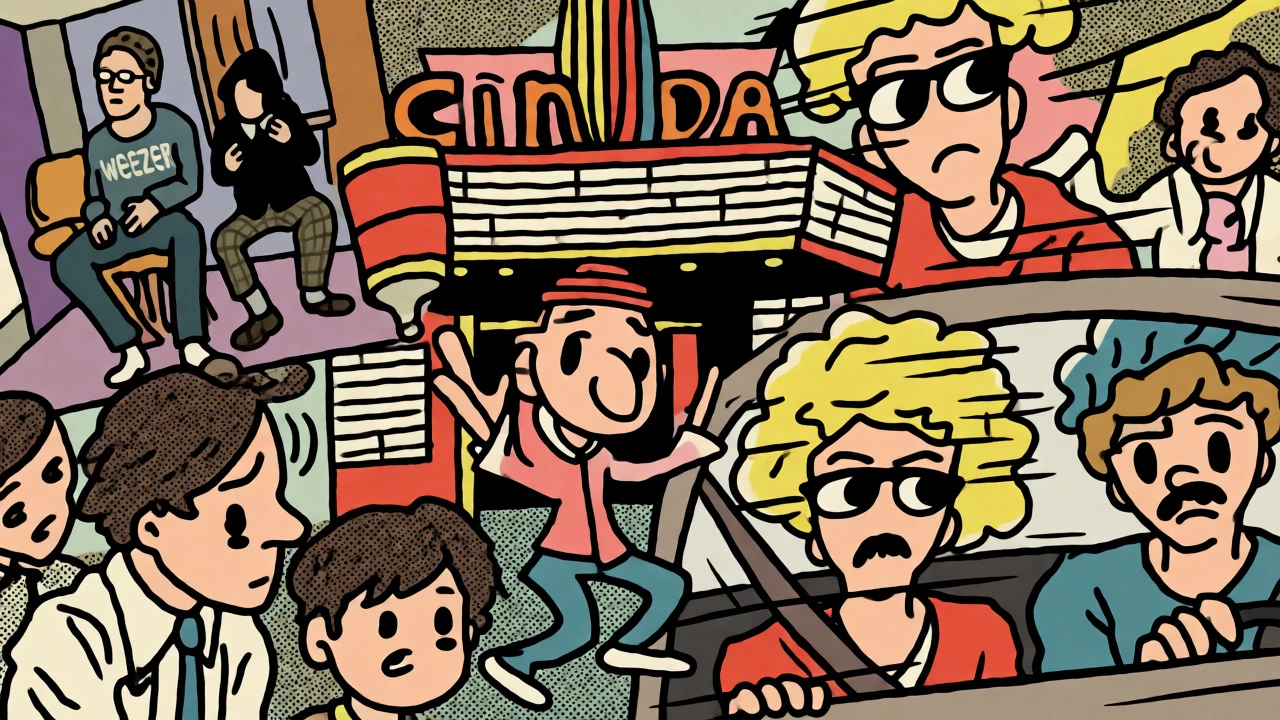
Take his 1994 video for Weezer’s Buddy Holly. Instead of filming the band in a studio, Jonze inserted them into the world of the TV show Happy Days. It was a meta-joke about pop culture that felt effortless. Then there was the Beastie Boys’ Sabotage (1994), where he dressed the rappers in cheap wigs and mustaches, mimicking 1970s cop shows with handheld, shaky cam footage. It looked bad on purpose, which made it brilliant.
By 1999, Jonze had perfected his persona with Fatboy Slim’s Praise You. He disguised himself as a fictional choreographer named Richard Koufey and filmed a seemingly spontaneous dance performance outside a Los Angeles cinema. When the video won three MTV Video Music Awards, including Best Direction, Jonze accepted the trophies while staying in character. This blurring of reality and fiction became his trademark, eventually launching him into feature films like Being John Malkovich.
Michel Gondry: Making Rhythm Visible
If Jonze was about irony, Michel Gondry was about mechanics. The French director treated music videos as laboratories for practical effects. He didn’t rely heavily on CGI; instead, he built physical contraptions, used stop-motion animation, and played with optical illusions to make the beat visible.
His 1997 video for Foo Fighters’ Everlong is a prime example. The narrative shifts between dream logic and reality, using miniaturized spaces and shifting identities to reflect the song’s emotional turbulence. Gondry’s style wasn’t defined by a consistent story theme, but by a consistent method: repetition, elastic scale, and a fascination with how perception works. He turned Björk’s Human Behaviour into a surreal jungle nightmare and Daft Punk’s Around the World into a hypnotic parade of costumes. Like Jonze, Gondry used the medium as a stepping stone to features like Eternal Sunshine of the Spotless Mind, proving that the constraints of a three-minute clip could spark major cinematic ideas.
Chris Cunningham: The Dark Side of the Medium
While Jonze and Gondry were playful, Chris Cunningham was disturbing. A British director, Cunningham brought body horror and digital dystopia to the mainstream. His work for Aphex Twin, particularly Come to Daddy (1997) and Windowlicker (1999), combined grotesque prosthetics with sharp digital compositing.
In Come to Daddy, an old man transforms into a young boy in a bleak urban landscape, mirroring the aggressive, distorted electronic sound of the track. Cunningham didn’t just illustrate the music; he interpreted its texture visually. The harshness of the audio became the ugliness of the visuals. His work highlighted a limitation of auteur theory, though: these effects relied on specialized tech teams and collaborators. Attributing the entire result to one genius erases the craft labor involved, but Cunningham’s vision was undeniably singular.
The Canon and The Critics
Critics quickly formed a canon of 90s video auteurs. Pitchfork and other outlets frequently cited Jonze, Gondry, and Cunningham as the holy trinity, but the list extended further. Mark Romanek brought austere, high-art composition to Nine Inch Nails’ Closer. Hype Williams defined hip-hop aesthetics with fisheye lenses and saturated colors. David Fincher, who started in the 80s, carried a polished, cinematic control into the 90s before moving to Hollywood blockbusters.
| Director | Signature Style | Key Works | Legacy Path |
|---|---|---|---|
| Spike Jonze | Gen-X irony, nostalgia, hidden cameras, fictional personas | Sabotage, Buddy Holly, Praise You | Feature Films (Her, Malkovich) |
| Michel Gondry | Practical effects, stop-motion, dream logic, mechanical whimsy | Everlong, Around the World, Human Behaviour | Feature Films (Eternal Sunshine) |
| Chris Cunningham | Body horror, digital glitch, dystopian aesthetics, uncanny valley | Come to Daddy, Windowlicker, All Is Full of Love | Art Installations & Gallery Work |
| Mark Romanek | Austere composition, art-direction, conceptual clarity | Closer, Free Fallin' | Feature Films (Never Let Me Go) |
| Hype Williams | Fisheye lenses, hyper-saturation, hip-hop spectacle | Mo Money Mo Problems, Rapture | Brand Partnerships & Fashion |
When the Director Became the Product
The ultimate proof that directors had become stars came in 2003. Palm Pictures released The Directors Label, a series of DVDs dedicated entirely to individual creators. The first batch featured Jonze, Cunningham, and Gondry. These weren’t just collections of clips; they included storyboards, interviews, alternate cuts, and documentaries. For the first time, the unit of value wasn’t the song or the album, but the director’s complete body of work.
This shifted the industry perspective. Videos were no longer seen as disposable ads but as collectible art. The DVDs curated a coherent "oeuvre" out of commissions made for different labels and artists, reinforcing the idea that the director was the true author. It validated the 90s experiment: yes, a music video could be a personal artistic statement, even if someone else wrote the check.
Why It Doesn’t Work Quite the Same Way Today
The 90s model relied on concentration. MTV was a gatekeeper. If they played your video, millions saw it. This shared viewing culture allowed a director’s style to become instantly legible. Today, distribution is fragmented across YouTube, Instagram, TikTok, and algorithmic feeds. Discovery is personalized, not centralized.
While we still have talented directors, the path to fame is different. Artists often direct their own videos now, or hire production companies rather than individual auteurs. The economic model has also changed; million-dollar budgets are rare outside of superstar releases. However, the legacy remains. The 90s proved that short-form commercial filmmaking could carry artistic weight. It gave directors a route into critical discussion and feature films, changing how we view the relationship between music and image forever.
What is music video auteur theory?
Music video auteur theory applies the concept of the "director as author" to music videos. It suggests that certain directors imprint such a distinctive visual style and thematic consistency on their work that they become the primary creative force, regardless of the artist they are working with. This theory gained traction in the 1990s when directors like Spike Jonze and Michel Gondry became publicly recognized names.
Did MTV really start crediting directors in the 90s?
Yes. In late 1992, following pressure from the Music Video Producers Association, MTV began displaying director credits on-screen alongside the artist and song title. This was a pivotal moment that transformed directors from anonymous service providers into marketable brands, allowing audiences to associate specific visual styles with specific names.
Who are the most famous music video directors from the 90s?
The most prominent figures include Spike Jonze (known for irony and hidden cameras), Michel Gondry (known for practical effects and dream logic), Chris Cunningham (known for dark, digital body horror), Mark Romanek (known for austere art direction), Hype Williams (known for hip-hop aesthetics), and David Fincher (who transitioned from videos to major feature films).
Why did music video directors become stars?
They became stars due to a combination of MTV's centralized exposure, large record label budgets that allowed for elaborate productions, and the introduction of on-screen credits. This visibility allowed their unique styles to become recognizable to a mass audience, creating a demand for their specific creative vision beyond just the music itself.
Does auteur theory apply to modern music videos?
It applies differently today. With the fragmentation of media platforms like YouTube and social media, there is no single gatekeeper like MTV. Consequently, while individual directors still exist, the broad cultural recognition required for the "star director" phenomenon is harder to achieve. Many modern videos are also directed by the artists themselves, diluting the separation between performer and creator.


