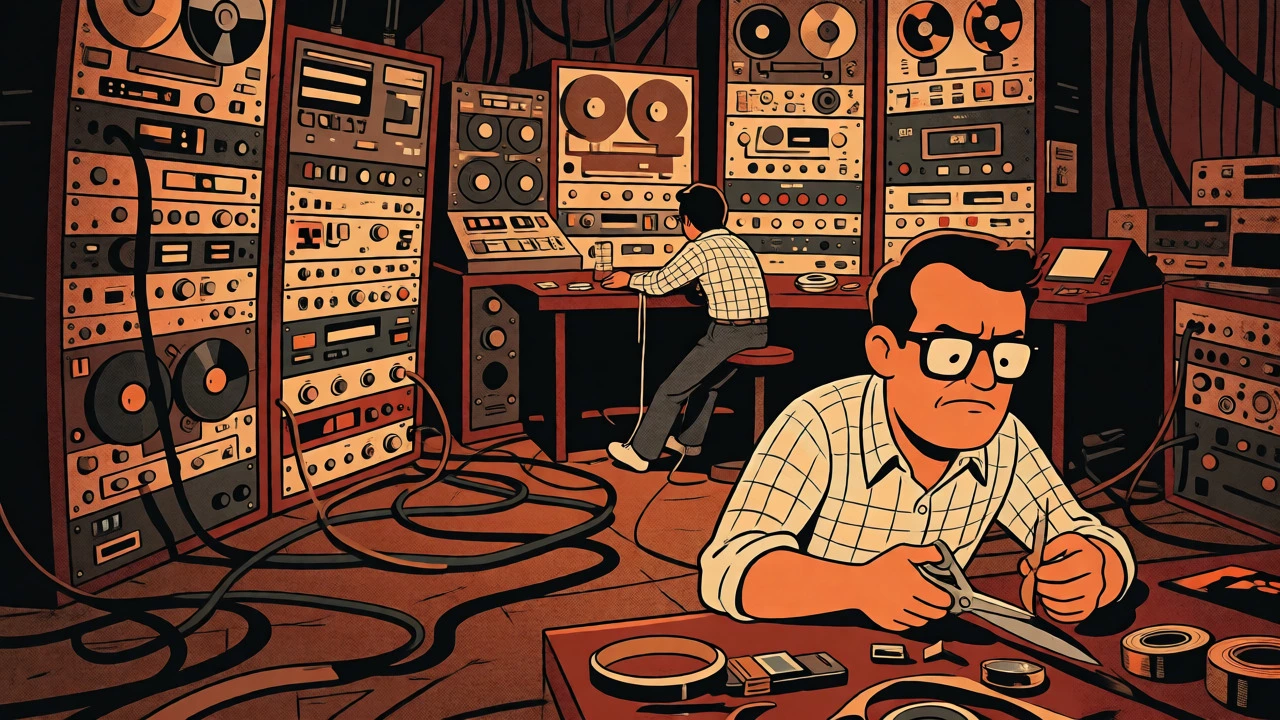

Imagine trying to edit a song’s visual story without being able to jump around the timeline. You have to cut tape physically, or worse, re-record everything after making a single change at the start. That was reality for editors in the early 1980s. Then MTV launched on August 1, 1981, and suddenly, the way we looked at music changed forever. It wasn’t just about hearing the song anymore; it was about seeing it. This shift forced a rapid evolution in video editing techniques within music production, moving from rigid linear tapes to the first glimpses of digital freedom.
| Technology | Function | Impact on Workflow |
|---|---|---|
| U-matic & Betacam | Analog videotape formats | Enabled portable recording but required linear, sequential editing. |
| Edit Controllers (CMX/Sony) | Automated tape machine coordination | Improved precision via Edit Decision Lists (EDLs) but remained linear. |
| Quantel Paintbox | Digital graphics and compositing | Allowed direct drawing over video, creating stylized looks like "Money for Nothing." |
| Quantel Harry | First commercial nonlinear effects system | Offered random access to ~80 seconds of footage, bridging analog and digital. |
The Linear Constraint of Early Tape Editing
Before computers took over, editing was a physical act. Editors worked with 3/4-inch U-matic tapes or the higher-quality Sony Betacam. These were linear systems. If you wanted to move a clip from minute five to minute one, you couldn’t just drag and drop. You had to find the spot, set in and out points, and record it onto a master tape. Every copy degraded the image quality slightly-a phenomenon known as generation loss.
This rigidity shaped the style of early 80s videos. Cuts were often longer because frequent changes were risky and time-consuming. Directors planned meticulously because mistakes were expensive. There was no "undo" button. If you messed up an edit halfway through, you might have to rebuild the entire sequence. This constraint meant that rhythm had to be established during filming, not just in post-production. The editor’s job was assembly, not experimentation.
Computer-Controlled Precision Before Digital Freedom
The first step toward modern editing wasn’t digital storage; it was automation. Companies like CMX and Ampex introduced computer-controlled edit suites. These systems used Timecode to lock multiple VTRs together. An editor could create an Edit Decision List (EDL)-a digital list of cuts-and the machines would execute them automatically.
Did this make editing nonlinear? Not really. It was still linear assembly, but now it was precise and repeatable. You could fine-tune transitions frame-by-frame without manually nudging tape decks. This allowed for tighter synchronization with musical beats. For music videos, where cutting on the snare drum or vocal breath is crucial, this control was revolutionary. It didn’t save time on storage, but it saved sanity during complex sequences.
Quantel and the Birth of Digital Compositing
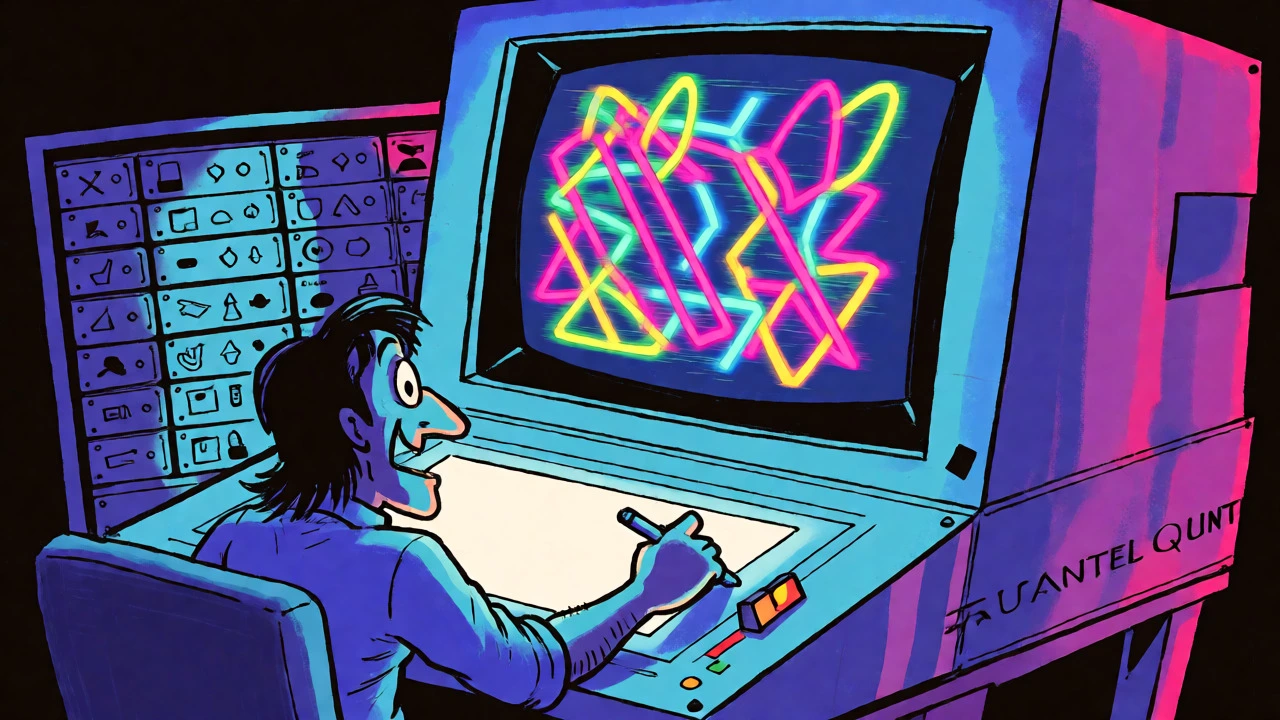
If there’s one name that defines the visual flair of the mid-80s, it’s Quantel. Their Paintbox, released in 1981, let artists draw directly onto video frames using a pressure-sensitive tablet. Think of it as Photoshop before Photoshop existed, but for moving images. This tool defined the look of hits like Dire Straits’ "Money for Nothing," where computer-generated characters interacted with live-action footage.
Then came Harry in 1985. Often cited as the first commercial nonlinear editing (NLE) system, Harry stored video on hard disks. But here’s the catch: it could only hold about 80 seconds of uncompressed broadcast-quality video. That’s less than two minutes. So, while it offered random access-you could jump anywhere in those 80 seconds instantly-it wasn’t a full editing suite. It was an effects box. Editors would use Harry for specific flashy segments and stitch them back into the main linear timeline. It proved that digital manipulation was possible, even if it wasn’t yet practical for whole projects.
Hybrid Workflows: Stop Motion Meets Silicon
Not all innovation happened inside a computer. Peter Gabriel’s "Sledgehammer" (1986) showcased a different path. Created by Aardman Animations and the Brothers Quay, it relied on stop-motion and pixilation. How did they sync this with music? They used frame-stepping capabilities on high-end VTRs. Animators would shoot a few frames, play them back, adjust the clay figure, and shoot again. This painstaking process created a rhythmic, surreal visual language that matched the funk-heavy track.
This hybrid approach was common. Directors mixed film, video, animation, and digital effects. The goal was spectacle. Because music videos were short-usually three to five minutes-studios could justify spending big money on high-end gear for a brief duration. A feature film couldn’t afford 80 seconds of Harry processing for every scene, but a pop star’s promotional clip could. Thus, music videos became the test lab for future television and film technologies.
The Editor as Visual Designer
As tools changed, so did roles. In traditional TV, the editor assembled coverage. In the MTV era, the editor became a co-creator of the artist’s brand. Rapid cuts, strobe effects, and color grading weren’t just technical choices; they were artistic statements. Editors needed to understand music structure deeply. Cutting on the beat wasn’t optional; it was expected.
This collaboration blurred lines between director, editor, and graphic designer. Telecine operators-who transferred film to video-started applying creative looks during transfer. Character generators added animated text. The workflow became a team sport involving specialists who spoke different technical languages. Timecode was the universal translator, allowing these disparate systems to work together.
Why the 80s Were Just the Bridge
It’s tempting to view the 1980s as the start of the digital age, but it was more of a bridge. True desktop nonlinear editing didn’t arrive until the early 1990s with systems like Avid Media Composer. The 80s systems were room-sized, cost hundreds of thousands of dollars, and required dedicated engineers. Storage was the bottleneck. Uncompressed video ate space fast. Compression algorithms were primitive, leading to blocky artifacts if pushed too hard.
Yet, the logic was born here. The idea that media could be indexed, recalled, layered, and revised without linear constraints took root in these expensive suites. When cheaper hardware finally caught up, the software models were already proven. The aesthetic language-fast cuts, digital glitches, vibrant colors-remained dominant long after the tech became obsolete.
What was the biggest limitation of 1980s video editing?
Storage capacity and cost. Early digital systems like Quantel Harry could only store about 80 seconds of high-quality video, forcing editors to mix linear tape workflows with digital effects for short clips.
How did MTV influence editing styles?
MTV’s 24-hour format demanded constant visual stimulation. This led to faster cuts synchronized with music beats, heavy use of special effects, and a focus on stylized imagery to keep viewers engaged between songs.
Was Quantel Harry a true nonlinear editor?
Partially. It offered random access to stored clips, which is a key NLE feature, but its limited memory meant it was primarily used for effects and compositing rather than assembling entire programs.
What is an Edit Decision List (EDL)?
An EDL is a text file containing instructions for editing, such as source timecodes and cut points. Computer-controlled tape decks used EDLs to automate the assembly of video sequences, improving precision and repeatability.
Which music video best demonstrates 1980s digital compositing?
Dire Straits’ "Money for Nothing" (1985) is a prime example. It used Bosch FGS-4000 for 3D animation and Quantel Paintbox for compositing, blending computer graphics with live-action footage seamlessly.