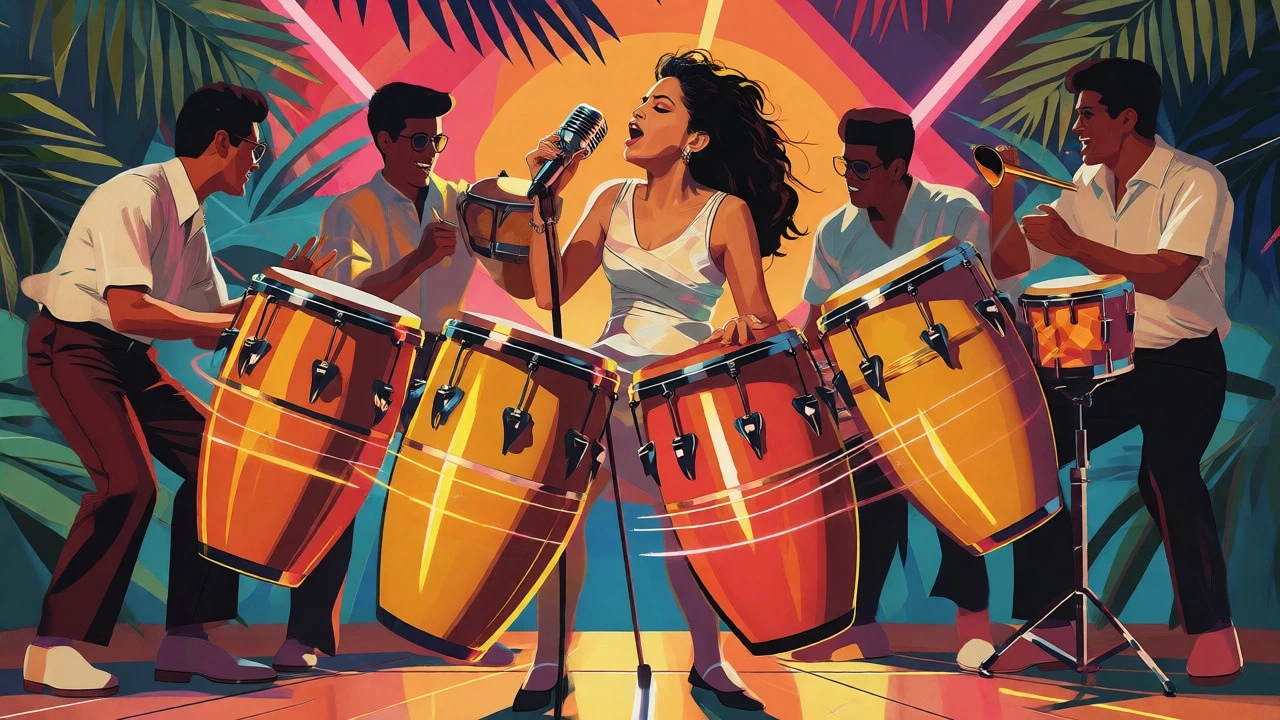

You probably think of the 1980s as the era of synthesizers, big hair, and gated reverb. But listen closely to the biggest hits of that decade, and you’ll hear something else entirely: a heartbeat that isn’t strictly American or British. It’s the Latin percussion layer. From the congas driving Gloria Estefan’s "Conga" to the Brazilian surdos in Peter Gabriel’s studio sessions, Latin rhythms didn’t just visit mainstream pop-they moved in and took over the groove.
This wasn’t just about adding a bongo for flavor. The 1980s marked a pivotal shift where complex Afro-Cuban and Brazilian rhythmic structures were simplified, sampled, and woven into the fabric of Top 40 radio. It was a collision of live musicianship and emerging digital technology that changed how we dance. Let’s look at how this sonic fusion happened, why it worked, and what it left behind.
The Miami Sound Machine Bridge
If there’s one moment that defines this crossover, it’s 1985. That’s when Miami Sound Machine, led by Gloria Estefan and her husband Emilio Estefan, released "Conga". Before this, Latin-influenced rock existed-think Santana in the late 60s-but it rarely dominated the charts with English-language lyrics. "Conga" broke that barrier.
The track reached No. 10 on the Billboard Hot 100 and topped the Dance Singles Sales chart. Why did it work? Emilio Estefan didn’t try to hide the salsa roots; he packaged them. He combined traditional Afro-Cuban percussion instruments like congas, timbales, and bongos with a polished, four-on-the-floor pop structure. Industry insiders initially worried the song had "too much percussion," but they were wrong. The dense horn arrangements and relentless rhythm made the percussion the star, not the background noise.
This approach created what scholars call the "Miami sound." It was a deliberate blend of American Top 40 sensibilities with tropical rhythms. For listeners who had never heard a full salsa arrangement, "Conga" offered a digestible entry point. You didn’t need to understand the clave pattern to feel the urge to move. The band’s subsequent hits, like "Words Get in the Way" and "Bad Boy," proved that this hybrid model had staying power.
Clave, Tumbao, and the Art of Simplification
To understand what was happening musically, you have to look at the core concepts being adapted. Traditional Afro-Cuban music relies on interlocking parts. There’s the clave, which is a repeated asymmetrical timeline (usually 3-2 or 2-3) that holds everything together. Then there’s the tumbao, a specific bass and conga pattern that drives the low end. In a full salsa band, these parts are played by different musicians who listen and react to each other in real-time.
In 1980s pop, this complexity was often flattened. Producers took recognizable fragments-a cowbell accent, a conga roll, a güiro shake-and looped them over a standard drum kit beat. The goal wasn’t authenticity; it was accessibility. The intricate conversation between a timbalero and a bassist got replaced by a sequenced pattern. This allowed producers to keep the "exotic" texture while maintaining the predictable verse-chorus structure required for radio play.
For example, in many new wave tracks, you might hear a synthesized maraca part keeping time instead of a live drummer playing a shuffle. It’s a stylized signifier of "Latin" rather than a functional rhythmic foundation. Yet, because the human ear recognizes these sounds, it still triggers a physical response. The simplification was controversial among purists, but commercially, it was genius.
The Roland TR-727: Putting Salsa in a Box
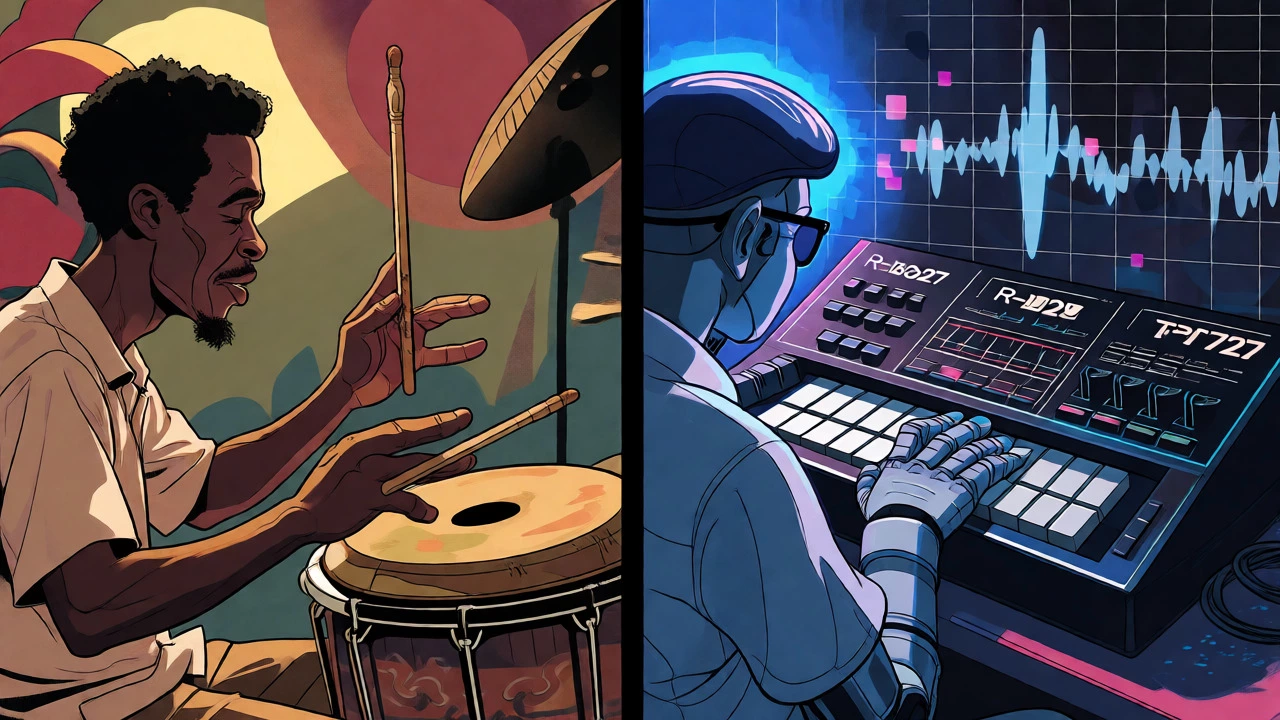
You can’t talk about 1980s production without mentioning the gear. While the Roland TR-808 is famous for hip-hop, its sibling, the Roland TR-727 Rhythm Composer, released in 1985, was the secret weapon for Latin-flavored pop. Unlike the analog synthesis of earlier machines, the TR-727 used PCM samples. It came pre-loaded with 15 original Latin-percussion sounds, including high and low congas, bongos, timbales, claves, and agogô bells.
This machine democratized Latin rhythm. A producer in a small studio could now add a credible conga line without hiring a specialist percussionist. They could program a pattern once and have it repeat perfectly across multiple takes. However, this convenience came with a cost. The TR-727 couldn’t replicate the micro-timing, dynamic swells, or improvisational flair of a live musician like Mongo Santamaría. The patterns were rigid and quantized.
Despite these limitations, the TR-727’s influence was massive. Its sounds seeped into early house music, techno, and acid house. Producers loved the crisp, metallic attack of the electronic cowbell and the dry thud of the synthetic conga. It became a staple color in the global electronic palette, proving that even a flawed imitation of tradition could become a new tradition itself.
| Feature | Live Afro-Cuban Percussion | Roland TR-727 / Sampling |
|---|---|---|
| Dynamics | Natural variation, loud/soft nuances based on emotion. | Static volume levels unless manually automated. |
| Timing | Human swing, slight delays ahead/behind the beat. | Strictly quantized, perfect grid alignment. |
| Cost & Access | High; requires skilled musicians and studio space. | Low; instant access via hardware or software. |
| Complexity | Interlocking polyrhythms, call-and-response. | Simplified loops, repetitive patterns. |
| Cultural Authenticity | Deep connection to genre history and technique. | Stylized "flavor" or sonic signifier. |
World Music and the Global Groove
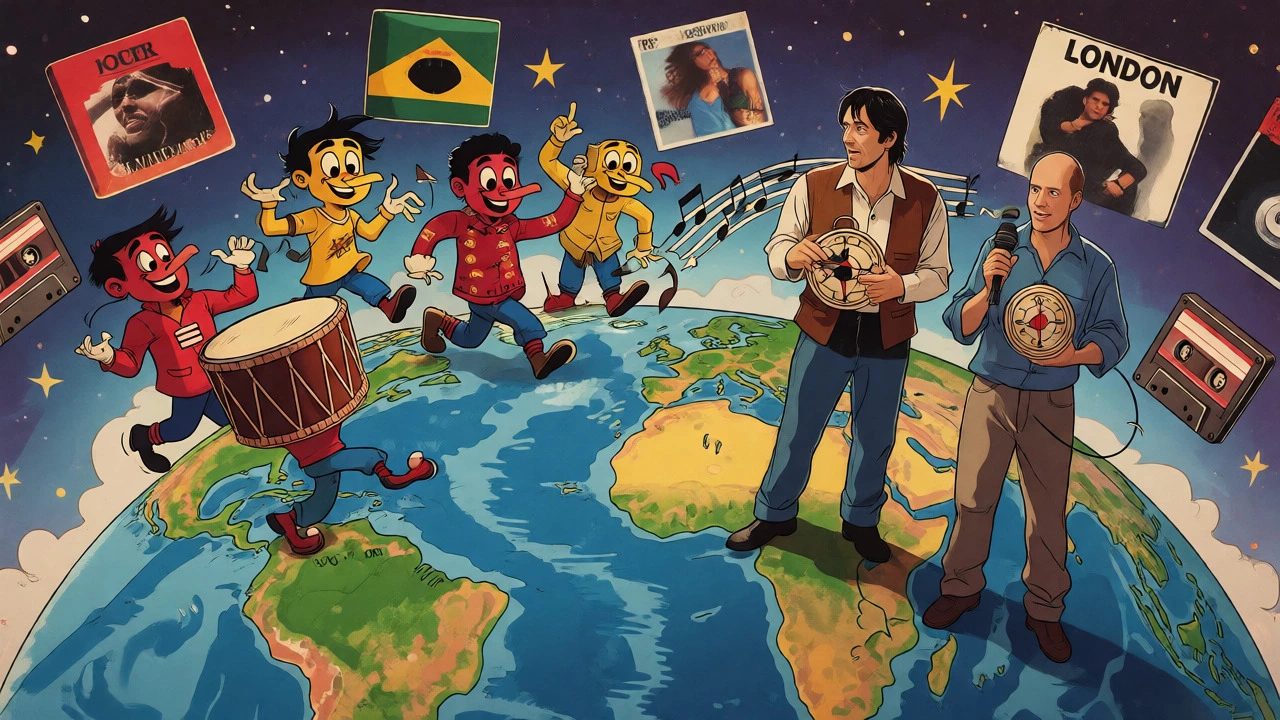
The fascination with non-Western rhythms extended beyond the Caribbean. By the mid-80s, artists like Peter Gabriel and Paul Simon were looking further south. Gabriel’s 1986 album So featured recordings made in Rio de Janeiro. Tracks like "Mercy Street" incorporated Brazilian forró influences and used percussionists like Djalma Corrêa. You can hear the deep, resonant pulse of the surdo (a large bass drum) mixed with triangle and congas.
Similarly, Paul Simon’s Graceland (1986), while primarily South African-focused, opened the door for broader rhythmic exploration. His follow-up, The Rhythm of the Saints (1990), explicitly utilized Brazilian batucada drums. These projects treated regional specialists as central creative partners, not just session players. They showed that a drum kit wasn’t the only way to drive a rock song. A wall of taiko-like drums or a samba ensemble could provide the same energy, if not more.
This trend reflected a wider cultural shift. As air travel and media connectivity improved, Western artists began to view global musical traditions as resources to be mined. Sometimes this felt exploitative, but often it resulted in genuinely innovative hybrids. The key difference from the Miami Sound Machine approach was intent: Gabriel and Simon sought immersion in the source culture, whereas pop producers often sought a quick sonic fix.
Rock en Español and the Underground Scene
While U.S. pop was sampling Latin beats, Spanish-speaking countries were developing their own modern rock identities. The "Rock en tu idioma" movement helped bands like Argentina’s Soda Stereo and Mexico’s Caifanes gain international visibility. These groups didn’t just copy Anglo-American rock; they infused it with local rhythmic sensibilities.
Bands like Enanitos Verdes and Virus blended post-punk and new wave with Caribbean grooves and Andean folk elements. Their success proved that you didn’t need to sing in English to connect with audiences across borders. In the U.S., this influenced the Chicano rock scene, where bands continued the legacy of Santana and Malo. Here, the use of timbales and congas wasn’t a gimmick-it was heritage. When these bands toured internationally, they brought an authentic rhythmic vocabulary that contrasted sharply with the synthesized approximations found in mainstream pop.
Legacy: How the 80s Changed Our Ears
Did the 1980s actually help Latin music, or did it dilute it? Both are true. On one hand, commercial pop extracted easily marketable signs-congas, horns, a Spanish title-while stripping away the social context and improvisational depth of salsa or rumba. On the other hand, it normalized these sounds for millions of listeners who might never have tuned into a Fania Records release.
The lasting impact is audible today. Modern reggaeton, Latin pop, and even hip-hop rely on the production techniques pioneered in the 80s. The idea that a drum machine can carry a culturally specific groove was cemented during this decade. Artists like Shakira and later Bad Bunny stand on the shoulders of Miami Sound Machine and the TR-727. They benefit from a listener base already trained to accept syncopated, Latin-coded rhythms as part of the mainstream soundscape.
Ultimately, the 1980s didn’t just add percussion to pop songs. It transformed Latin rhythmic ideas into a flexible production language. Live musicians provided the soul, electronic machines provided the scale, and crossover artists provided the bridge. The result was a decade where the world danced to a shared, if sometimes simplified, beat.
Frequently Asked Questions
What is the clave rhythm?
The clave is a fundamental rhythmic pattern in Afro-Cuban music, typically played on two wooden sticks called claves. It consists of five notes arranged in a 3-2 or 2-3 pattern over eight beats. This asymmetric timeline serves as the structural backbone for genres like salsa, son, and rumba, guiding all other instruments in the ensemble.
Why was the Roland TR-727 important for 1980s music?
Released in 1985, the Roland TR-727 was the first drum machine dedicated to Latin percussion sounds. Using PCM samples, it provided realistic conga, bongo, and timbale tones that producers could program into sequencers. This allowed non-Latin artists to incorporate authentic-sounding percussion layers into pop and rock tracks without hiring specialized musicians, significantly influencing the sound of the era.
How did Gloria Estefan change pop music?
With the 1985 hit "Conga," Gloria Estefan and Miami Sound Machine successfully fused traditional Afro-Cuban rhythms with English-language pop structures. This crossover brought salsa elements like congas, timbales, and horn sections to the top of the Billboard charts, normalizing Latin percussion in mainstream American radio and paving the way for future Latin pop stars.
What is the difference between tumbao and montuno?
Tumbao refers to the rhythmic pattern played by the bass and congas in Cuban music, providing the foundational groove. Montuno describes the piano section of a salsa song, characterized by repetitive, arpeggiated chords that create a harmonic and rhythmic cycle. While distinct, both are essential components of the layered interlocking textures typical in traditional Latin ensembles.
Did 1980s pop accurately represent Latin music?
It was often a stylized approximation rather than a faithful representation. Mainstream pop frequently simplified complex polyrhythms and removed improvisation to fit radio-friendly formats. However, artists like Miami Sound Machine, who were part of the diaspora, maintained genuine cultural connections, creating a valid hybrid form rather than mere imitation.