
Think about the last time you heard a snare drum that sounded like a cannon firing inside a cathedral. Or a keyboard tone so bright it felt like staring directly into the sun. These aren't just random sounds; they are sonic fingerprints of the 1980s. If you've ever wondered why this decade sounds so distinct from the gritty analog warmth of the '70s or the polished digital sheen of today, the answer lies in the hardware. The instruments available between 1980 and 1989 fundamentally rewired how music was composed, performed, and produced. It wasn't just about new toys; it was about a complete shift in workflow.
The core transformation was the move from acoustic projection to electronic generation. Before the 80s, if you wanted a string section, you hired twelve people. In the 80s, you bought a synthesizer. This didn't just save money; it changed the arrangement. You could layer sounds in ways that were physically impossible with human players. Let's break down exactly which machines did what, and why their limitations actually became their greatest strengths.
The Digital Revolution: Why the DX7 Defined an Era
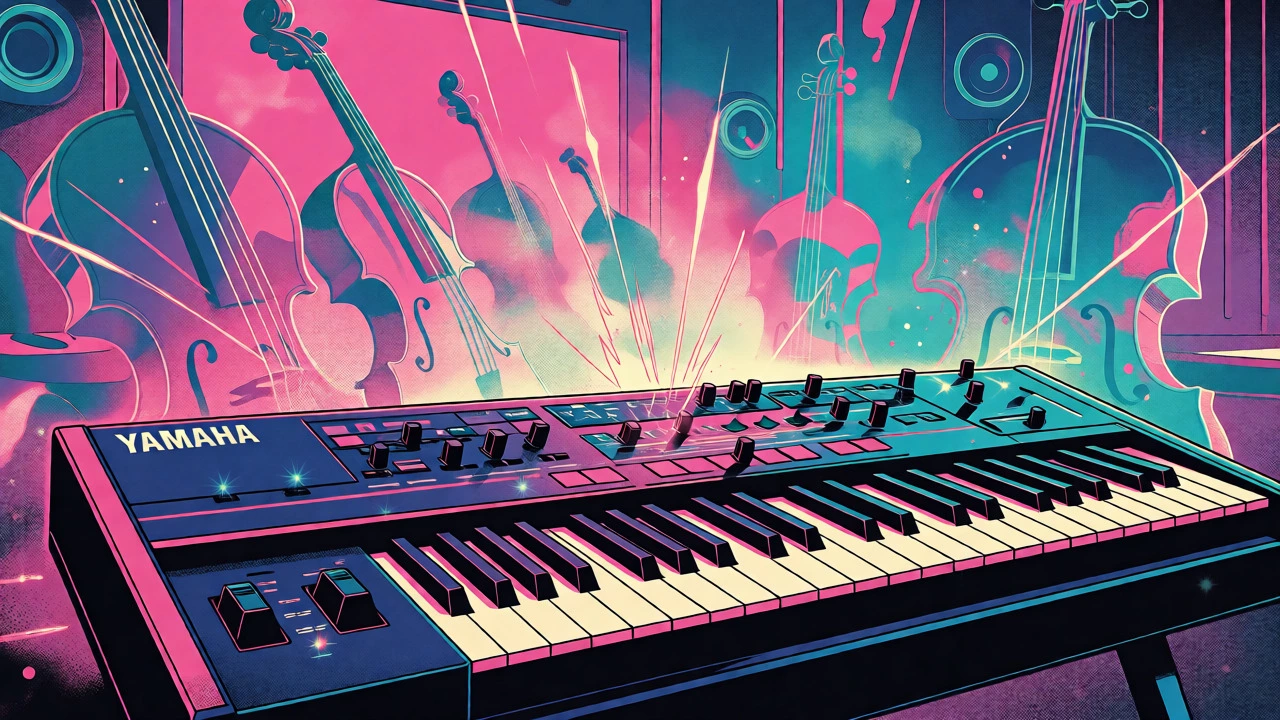
If one instrument defines the mid-80s, it is the Yamaha DX7. Released in 1983, this wasn't just another synth; it was a cultural reset. Unlike the warm, drifting oscillators of earlier analog gear, the DX7 used Frequency Modulation (FM) synthesis. This meant it generated sound by modulating one sine wave with another, creating complex, metallic timbres that cut through mixes like a laser.
Why does this matter? Because FM synthesis was cheap to produce digitally. While analog polysynths were expensive and heavy, the DX7 offered 16-voice polyphony at a price point that made it accessible to everyone from Stevie Wonder to local wedding bands. Its factory presets-specifically the E.Piano 1 and the Bass patches-became ubiquitous. They appeared in ballads, pop hits, and jazz fusion almost simultaneously. The result was a standardized commercial palette. Suddenly, electric pianos sounded glassy and precise rather than woody and imperfect. This precision influenced composition too; composers wrote for the machine’s capabilities, favoring staccato attacks and sustained digital pads over fluid, expressive bends.
| Instrument | Synthesis Type | Key Characteristic | Primary Genre Impact |
|---|---|---|---|
| Yamaha DX7 | FM Digital | Bright, metallic, stable tuning | Pop, Ballads, Jazz Fusion |
| Roland Jupiter-8 | Analog Subtractive | Warm, detuned, rich filters | New Wave, Synth-Pop |
| Korg PolySix | Analog Hybrid | Affordable, built-in chorus | Indie Pop, Early Electronic |
MIDI: The Glue That Held It All Together
You can't talk about 80s gear without talking about MIDI (Musical Instrument Digital Interface). Introduced commercially in 1983, MIDI didn't transmit audio; it transmitted data. Notes, velocity, pitch bend, and tempo. Before MIDI, if your drummer played slightly off-beat, you had to re-record the whole track. With MIDI, you could sync a drum machine, a bass synth, and a sequencer to the same clock.
This created the "machine-tight" aesthetic. Rhythm sections no longer needed to breathe together; they just needed to be programmed correctly. The first devices to support this were the Sequential Circuits Prophet-600 and the Roland Jupiter-6. Once instruments could talk to each other, production workflows exploded. Producers could record a melody on one keyboard, transpose it instantly, and loop it across multiple tracks. It encouraged a grid-based approach to music-making. Quantization-the process of snapping notes to the nearest beat-became standard practice. While some purists argued this killed the human feel, it allowed for complex, interlocking rhythmic patterns that defined genres like New Jack Swing and early House music.
Drum Machines: The Heartbeat of Hip-Hop and Dance
If synths provided the texture, drum machines provided the pulse. Two Roland units stand out here, though for very different reasons. First, the Roland TR-808. Launched in 1980, it was a commercial failure initially because its sounds were deemed "too artificial." It used analog circuits to simulate drums, resulting in a kick drum with a deep, resonant boom and snares that sounded like white noise bursts.
But those "flaws" became features. Arthur Baker used the 808 on Afrika Bambaataa’s "Planet Rock," proving that unrealistic drums could drive a dance floor. The 808’s long decay tail filled low frequencies in a way real drums couldn't, making it essential for hip-hop and Miami Bass. Then came the TR-909 in 1983. It combined analog synthesis for kicks and snares with digital samples for hi-hats. It was tighter, sharper, and more aggressive. While the 808 ruled hip-hop, the 909 became the backbone of house and techno. Its four-on-the-floor kick pattern established the blueprint for modern electronic dance music.
- TR-808: Deep sub-bass, elastic snare, handclaps. Best for hip-hop and electro.
- TR-909: Punchy kick, crisp hats, rigid timing. Best for house and techno.
- Linn LM-1: Sampled acoustic drums. Used by Prince and Human League for a realistic but processed groove.
Sampling: Turning History Into Instruments
While drum machines synthesized sound, samplers recorded it. The Fairlight CMI, introduced in the late 70s but popularized in the 80s, was the Ferrari of samplers. Costing upwards of £15,000, it allowed artists like Peter Gabriel and Kate Bush to sample orchestral hits or vocal snippets and play them like piano keys.
But the real revolution came when sampling got cheaper. The E-mu Emulator II and later the Akai S-series brought sampling to the masses. This changed compositional logic entirely. Instead of writing a riff, producers chopped up existing records. A James Brown drum break could be pitched down, looped, and layered under a synthesizer pad. This technique, central to hip-hop, treated the turntable and sampler as primary instruments. The limitation of early samplers-low bit depth and short memory-actually contributed to the lo-fi crunch that many producers loved. It wasn't about perfect fidelity; it was about creative reuse.
Guitars and Effects: The Loud, Wide Wall of Sound
Did guitars die in the 80s? Absolutely not. They just changed jobs. In rock and metal, the guitar moved from a lead voice to a textural wall. High-gain amplifiers like the Marshall JCM800 allowed for sustain and distortion that could compete with synth leads. But the bigger change was in effects processing.
Two techniques dominated: Chorus and Gated Reverb. Chorus pedals doubled the guitar signal, detuning it slightly to create a shimmering, wide stereo image. This was crucial for clean tones in New Wave and Pop, allowing guitars to sit alongside synths without clashing. Meanwhile, gated reverb transformed drums. Pioneered by Hugh Padgham on Peter Gabriel’s recordings, this effect used a noise gate to abruptly cut off the reverb tail. The result was a huge, explosive snare hit that stopped dead, leaving space for the next beat. You hear this on Phil Collins’ "In the Air Tonight" and countless Duran Duran tracks. It made drums sound larger than life while keeping the mix tight and punchy.
The Legacy: Why It Still Matters
The 80s weren't just a period of excess; they were a laboratory for hybrid workflows. We learned that live musicians, programmed rhythms, sampled loops, and digital effects could coexist. Modern productions still rely on these foundations. When you use a software plugin to emulate a TR-808 kick or a DX7 bell, you're tapping into the specific engineering decisions made forty years ago. The constraints of early MIDI, the character of 12-bit sampling, and the brightness of FM synthesis didn't disappear; they became stylistic choices.
Understanding these instruments helps you understand the music. The stiffness of a quantized beat isn't a mistake; it's a feature of MIDI. The coldness of a digital piano isn't a flaw; it's the nature of FM synthesis. By recognizing the tools, you hear the intent behind the sound.
Why do 1980s drums sound so big?
The "big" sound is primarily due to gated reverb and high-gain compression. Producers would send drum signals through large reverbs and then use a noise gate to cut the tail off quickly. This created a massive initial impact without muddying the mix with long decay tails. Additionally, drum machines like the TR-808 had boosted low-end frequencies that stood out on small speakers and radio broadcasts.
What was the most important invention for 1980s music?
MIDI (Musical Instrument Digital Interface) was arguably the most critical innovation. Introduced in 1983, it allowed different brands of synthesizers, drum machines, and computers to communicate. This enabled sequencing, synchronization, and editing of performances, fundamentally changing how music was arranged and produced.
Why did the Yamaha DX7 become so popular?
The DX7 offered professional-grade polyphony and unique FM synthesis sounds at a much lower price point than previous digital synthesizers. Its bright, cutting tones fit perfectly with the polished production style of the mid-80s, and its reliability made it a staple for touring musicians and studio producers alike.
Did synthesizers replace real instruments in the 80s?
They didn't fully replace them, but they supplemented them heavily. Synthesizers took over roles previously held by string sections, brass, and rhythm guitars. However, live drums and vocals remained common. The trend was toward hybrid arrangements where electronic textures supported or replaced specific acoustic layers to achieve a cleaner, more controlled mix.
What is FM synthesis?
Frequency Modulation (FM) synthesis generates sound by modulating the frequency of one sine wave (the carrier) with another (the modulator). This creates complex harmonic structures that are often metallic, bright, or bell-like. It differs from subtractive synthesis, which starts with a rich waveform and filters out frequencies to shape the tone.