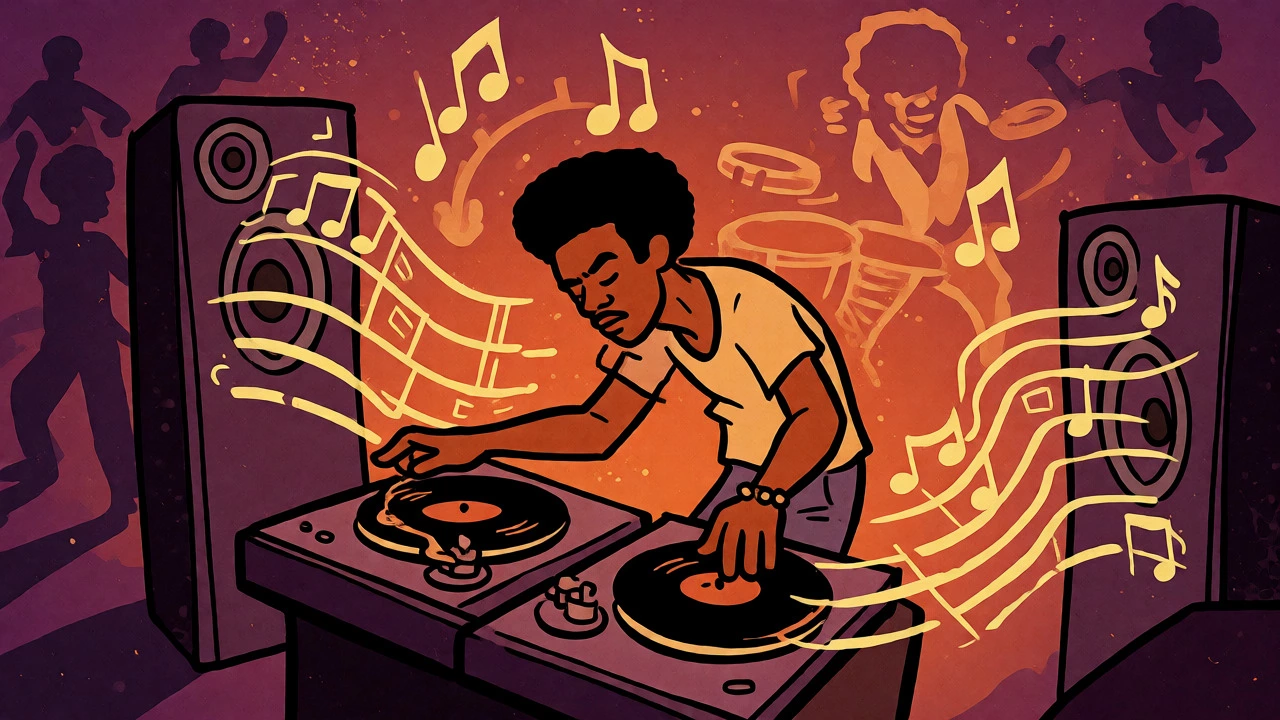

Walk into any club today and you might hear a beat that feels familiar. It has a deep, thumping kick drum, a snare that cracks like a whip, and a bass line that locks your body in place. You might think this is just modern electronic music. But if you peel back the layers, you will find the ghost of James Brown or George Clinton hiding underneath. The rhythmic DNA of funk a genre characterized by a strong rhythmic groove of a bassline or drum pattern often played with syncopation did not just survive into the 1980s; it became the architectural blueprint for hip-hop.
This wasn't an accident. It was a direct lineage from the dance floors of the 1970s to the block parties of the Bronx. When DJs started isolating specific parts of funk records, they weren't just playing songs. They were creating a new language. This article breaks down exactly how funk supplied the raw materials, the performance models, and even the technological direction for 1980s hip-hop production. We are talking about real gear, specific tracks, and the shift from vinyl manipulation to digital sampling.
The Breakbeat: From Vinyl Loop to Digital Foundation
At the heart of early hip-hop was a technique called the "break." In funk and soul records, there was often a section where the melody dropped out, leaving only the drums and bass. This was the part dancers loved most because it had the most rhythm and the least distraction. Kool Herc, widely credited as a founding father of hip-hop, realized he could extend this moment indefinitely. He used two copies of the same record on two turntables. As one copy reached the end of the break, he would switch to the second copy, starting it at the exact same spot. This created a continuous loop.
This method transformed a fixed recording into a modular performance tool. The most famous example is James Brown's "Funky Drummer". Released in 1970, its drum solo, played by Clyde Stubblefield, became arguably the most sampled piece of audio in history. Why? Because it had a perfect balance of syncopation and space. It wasn't too busy, but it had enough complexity to keep dancers moving. Other tracks like The Winstons' "Amen, Brother" served similar purposes. These breaks provided a stable rhythmic platform. Without them, early MCs would have had nowhere to anchor their rhymes.
The transition from DJing to producing happened when producers started treating these breaks as building blocks rather than just background noise. Instead of just looping the whole break, producers began to isolate individual drum hits. This was the first step toward the sample-based production that would dominate the late 1980s. The idea was simple: take the most danceable part of a pre-existing recording, repeat it, and build everything else around it.
Electro-Funk and the Rise of the Roland TR-808
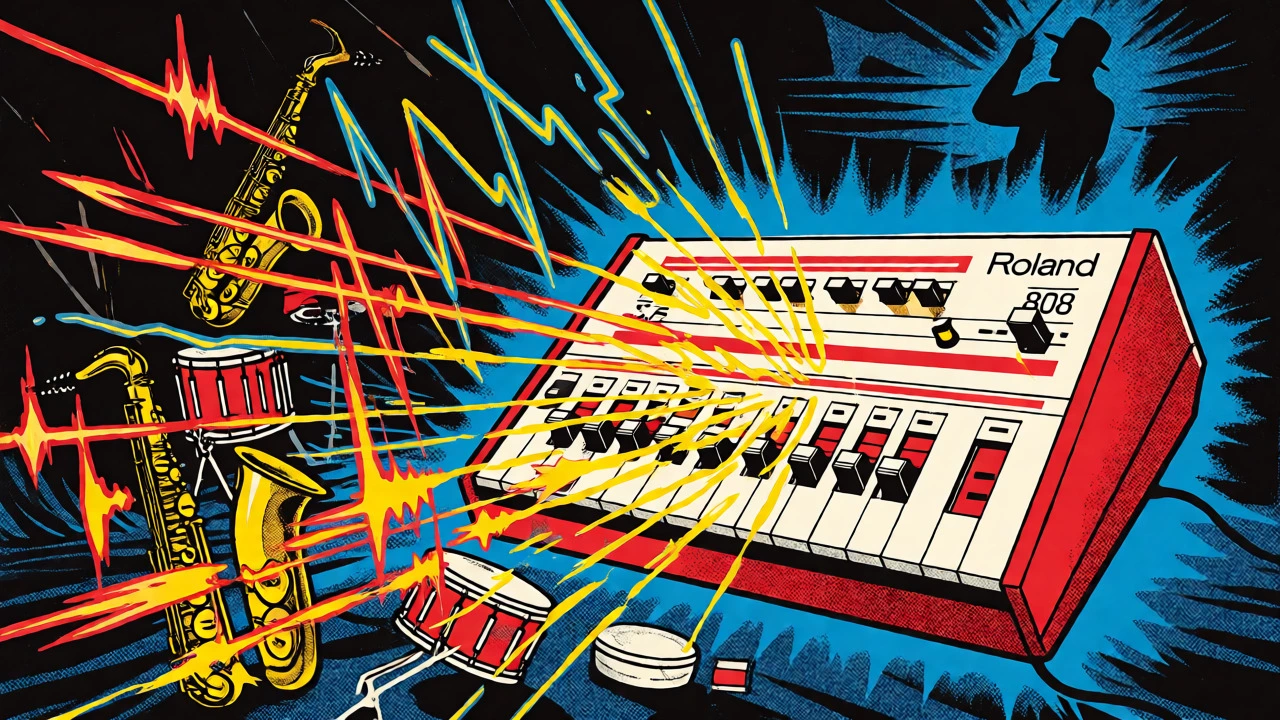
By the early 1980s, technology started to change the game. Enter the Roland TR-808 an analog drum machine introduced in 1980 known for its distinctive synthetic sounds and programmability. Initially, many musicians rejected the 808 because its sounds didn't mimic real drums perfectly. The kick drum was long and boomy, and the snare sounded like static electricity. But hip-hop producers saw potential in those flaws.
Afrika Bambaataa and producer Arthur Baker combined forces for the track "Planet Rock" in 1982. They took the heavy, physical impact of funk basslines and translated it into synthesized sub-bass using the 808. They also incorporated electronic textures inspired by German band Kraftwerk. This created a new subgenre: electro-funk. The 808 allowed producers to program rhythms that were impossible for human drummers to play consistently. You could stack sounds, layer claps over snares, and create patterns that felt mechanical yet deeply groovy.
| Feature | Turntables (DJ Technique) | Roland TR-808 (Drum Machine) | E-mu SP-1200 (Sampler) |
|---|---|---|---|
| Source Material | Original Vinyl Records | Synthesized Analog Sounds | Digital Samples from Vinyl |
| Primary Output | Extended Breakbeats | Programmed Electro Beats | Chopped & Rearranged Loops |
| Key Limitation | Requires Physical Skill & Two Copies | No Melodic Sampling Capability | Limited Memory (10 Seconds Total) |
| Impact on Sound | Raw, Live Feel | Deep Bass, Synthetic Texture | Gritty, Lo-Fi Aesthetic |
The 808 didn't replace funk; it amplified its core principle. Funk emphasized the "one"-the first beat of the measure-and the interplay between kick and snare. The 808 let producers exaggerate this interplay. The long decay of the 808 kick filled the low-end frequencies in clubs and car stereos, making the music feel physically heavier. This was crucial for genres like Miami Bass and early West Coast rap, which relied on that visceral low-end response.
Sampling Technology: Chopping the Groove
If the 808 brought synthesis, samplers brought reconstruction. In the mid-1980s, equipment like the E-mu SP-1200 and the Akai MPC60 changed how producers interacted with funk records. Before these machines, you either played the record or you didn't. With a sampler, you could take a single drum hit from a funk song, save it to memory, and trigger it whenever you wanted.
Marley Marl is often cited as a pioneer here. In 1986, for MC Shan's "The Bridge," he took the drum break from "Impeach the President" by The Honey Drippers. Instead of just looping it, he separated the kick and snare hits and reprogrammed them. He essentially rebuilt the drum kit from scratch using samples. This shifted the role of the producer from selector to composer. You weren't just finding a good break; you were editing it.
The limitations of these early samplers actually defined the sound. The SP-1200, released in 1987, had only 10 seconds of total sample time. That’s not much. To fit more music into that tiny memory, producers would sample a record playing at 45 RPM instead of 33 RPM. Then, during playback, they would slow it down. This trick increased the duration of the sample but lowered the pitch and added a distinct grainy texture. This "lo-fi" quality became a stylistic choice. It gave 1980s hip-hop a dusty, warm character that clean digital recordings couldn't replicate.
George Clinton and the Parliament-Funkadelic Legacy
No discussion of funk's influence is complete without mentioning George Clinton the bandleader behind Parliament and Funkadelic, known for his theatrical stage presence and complex bass-heavy arrangements. His work with Parliament-Funkadelic provided a massive library of sonic fragments for hip-hop producers. Unlike tighter funk bands, P-Funk’s music was sprawling, experimental, and rich with weird noises, vocal shouts, and futuristic synthesizer lines.
Hip-hop producers loved this because it offered variety. You could grab a horn stab from one track, a vocal scream from another, and a bass riff from a third, and stitch them together. The collage nature of P-Funk’s music matched the collage nature of hip-hop production. Artists like Dr. Dre, who later dominated the West Coast scene, built entire careers on interpolating and sampling Clinton’s grooves. The emphasis on a repeating, hypnotic pocket in P-Funk tracks made them ideal for rapping over. The music didn't demand attention; it supported it.
The Bomb Squad and Dense Political Montage
While some producers focused on clean loops, others went for chaos. The Bomb Squad the production team behind Public Enemy, known for their dense, layered, and politically charged soundscapes, led by Hank Shocklee, took funk sampling to an extreme. Their work with Public Enemy, particularly on albums like "It Takes a Nation of Millions to Hold Us Back," was less about a single groove and more about a wall of sound.
They layered multiple funk breaks, sirens, radio snippets, and guitar scratches on top of each other. It was aggressive and information-dense. This approach showed that sampling could be a form of political commentary. By cluttering the mix with references to black music history, they asserted cultural authority. The funk elements were still there-the driving rhythms and bass-but they were buried under layers of noise and urgency. This demonstrated that funk wasn't just a background beat; it was a foundational text that could be deconstructed and reassembled to convey complex messages.
Live Interpolation vs. Direct Sampling
Not all 1980s hip-hop relied on digital samplers. Many tracks used live studio musicians to replay funk ideas. This practice, known as interpolation, kept the spirit of funk alive through performance rather than technology. Kurtis Blow’s "Christmas Rappin’" is a prime example. It blended James Brown-style funk with Chic’s disco polish. Session musicians played the parts, capturing the swing and human error that machines sometimes lacked.
This parallel existence is important. It shows that the influence of funk wasn't limited to people with expensive gear. If you had a band, you could capture the funk vibe directly. This ensured that the rhythmic grammar of funk-syncopation, call-and-response, and emphasis on the downbeat-remained central to hip-hop, regardless of whether the source was a vinyl record or a session player.
Legal Tensions and the End of the Wild West
As hip-hop grew commercially, the easy access to funk archives started to dry up. Copyright owners began to notice their work being reused without permission. In the 1980s, clearance laws were murky. Producers often sampled without asking. But as lawsuits mounted, the cost of sampling rose. This forced a creative adaptation. Producers started chopping samples into smaller pieces to avoid recognition or simply replayed the parts themselves.
This legal pressure accelerated the shift toward original composition within a funk-inspired framework. It pushed producers to master their tools better. The restriction became a catalyst for innovation. The gritty, chopped-up sound of the late 80s wasn't just aesthetic; it was partly economic. You had to do more with less.
Key Takeaways
- Rhythmic Foundation: Funk provided the breakbeat structure that became the backbone of hip-hop beats.
- Technological Bridge: The Roland TR-808 translated funk’s physical bass impact into electronic synthesis.
- Sampling Evolution: Gear like the SP-1200 turned funk records into editable libraries of sonic components.
- Cultural Continuity: Both live interpolation and digital sampling maintained funk’s syncopated groove as hip-hop’s core identity.
- Aesthetic Constraints: Technical limits of early samplers created the signature lo-fi, gritty sound of 1980s hip-hop.
Why was the breakbeat so important for early hip-hop?
The breakbeat isolated the most rhythmic, percussive section of a funk song, stripping away melodies and vocals. This provided a consistent, repetitive loop that allowed dancers to move freely and MCs to rhyme over a steady, predictable pulse. It turned a full song into a focused rhythmic tool.
Did the Roland TR-808 replace funk drums in hip-hop?
No, it complemented and evolved them. The TR-808 allowed producers to synthesize the deep, resonant bass and sharp snare characteristics found in funk records. It enabled precise programming and layering that mimicked the intensity of live funk drumming while adding a unique electronic texture that became iconic in electro and Miami bass.
What role did George Clinton play in hip-hop production?
George Clinton’s Parliament-Funkadelic catalog served as a primary source of samples for hip-hop producers. His music offered diverse elements like bass lines, horn stabs, and vocal exclamations that could be easily chopped and rearranged. His futuristic and theatrical style also influenced the aesthetic direction of many hip-hop artists.
How did sampler limitations shape the sound of 1980s hip-hop?
Early samplers like the SP-1200 had very little memory and low fidelity. Producers had to chop samples into short segments and often pitched them down to fit longer phrases into memory. This process introduced noise, distortion, and a darker tone, creating the gritty, lo-fi aesthetic that defines the era’s classic records.
Was all 1980s hip-hop based on sampling?
No. While sampling became dominant, many tracks used live studio musicians to replay funk-inspired parts. This interpolation allowed for greater musical flexibility and avoided copyright issues. Both methods shared the same goal: capturing the syncopated groove and rhythmic energy of funk.

