
You probably think you know what a "pop song" sounds like. You expect a verse, a chorus, maybe a bridge. But have you ever stopped to wonder why those sections feel so tight, so perfectly timed, and so incredibly loud? The blueprint for modern pop wasn't drawn by a songwriter with a guitar. It was coded into machines in the 1990s.
Before this decade, arrangement meant writing parts for humans to play together. If you wanted a string section, you hired twenty people. If you wanted a specific drum sound, you tuned a kit or found a room that sounded right. The 1990s changed the game entirely. It shifted pop from a performance-based craft to an edit-based architecture. Suddenly, producers weren't just capturing music; they were constructing it out of digital blocks, loops, and processed audio fragments. This wasn't just about new toys. It fundamentally altered how songs were built, mixed, and perceived.
The Shift From Tape to Code
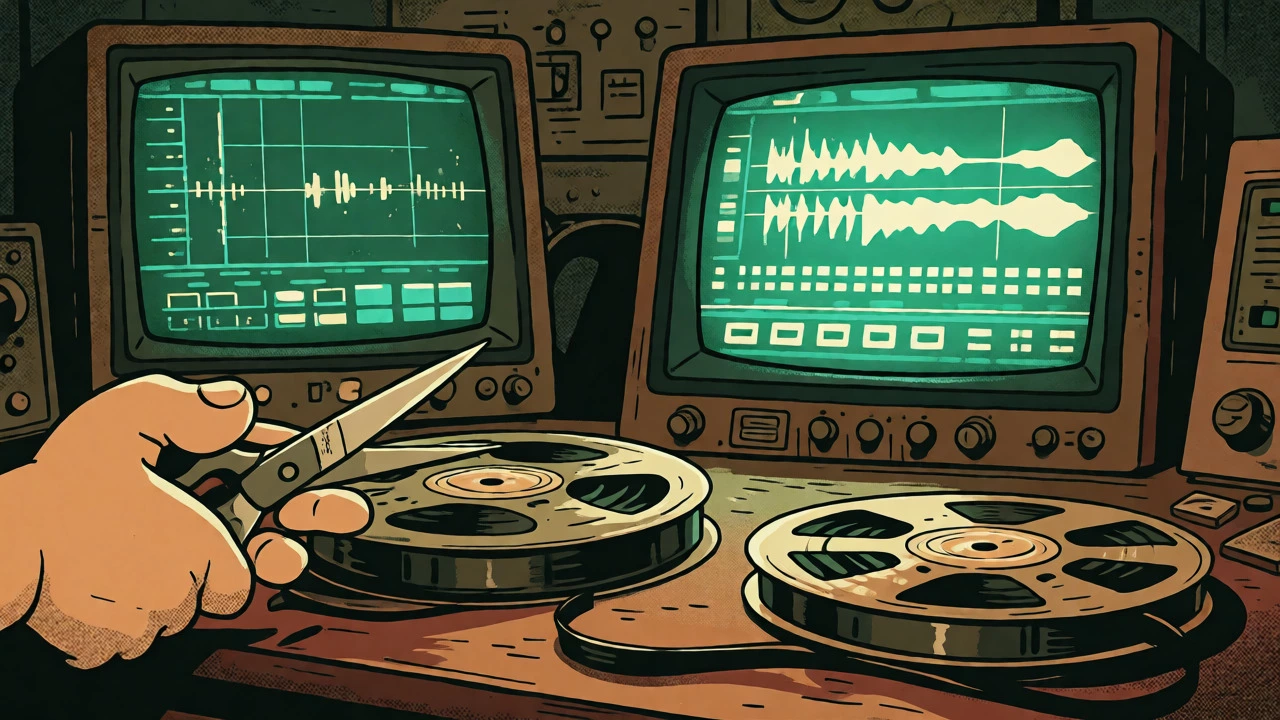
The biggest change started with infrastructure. In the late 80s and early 90s, Digidesign’s Pro Tools began migrating from a niche two-track editor to a four-track powerhouse. Before this, editing tape was physical work-cutting and splicing magnetic ribbon. With digital audio workstations (DAWs), moving a vocal phrase three milliseconds earlier became a mouse click. This tiny shift had massive aesthetic consequences.
Why does this matter for arrangement? Because when editing is easy, you stop committing to a single take. You can copy a perfect chorus line and paste it everywhere. You can mute the bass during the second verse to create space without rewriting the part. Arrangements became modular. Instead of a linear progression of musical ideas, songs turned into stacks of interchangeable layers. A producer could build a track by starting with a four-bar loop, adding a sampled hook, and then subtracting elements to create tension. The song wasn't written; it was assembled.
Sampling as Composition
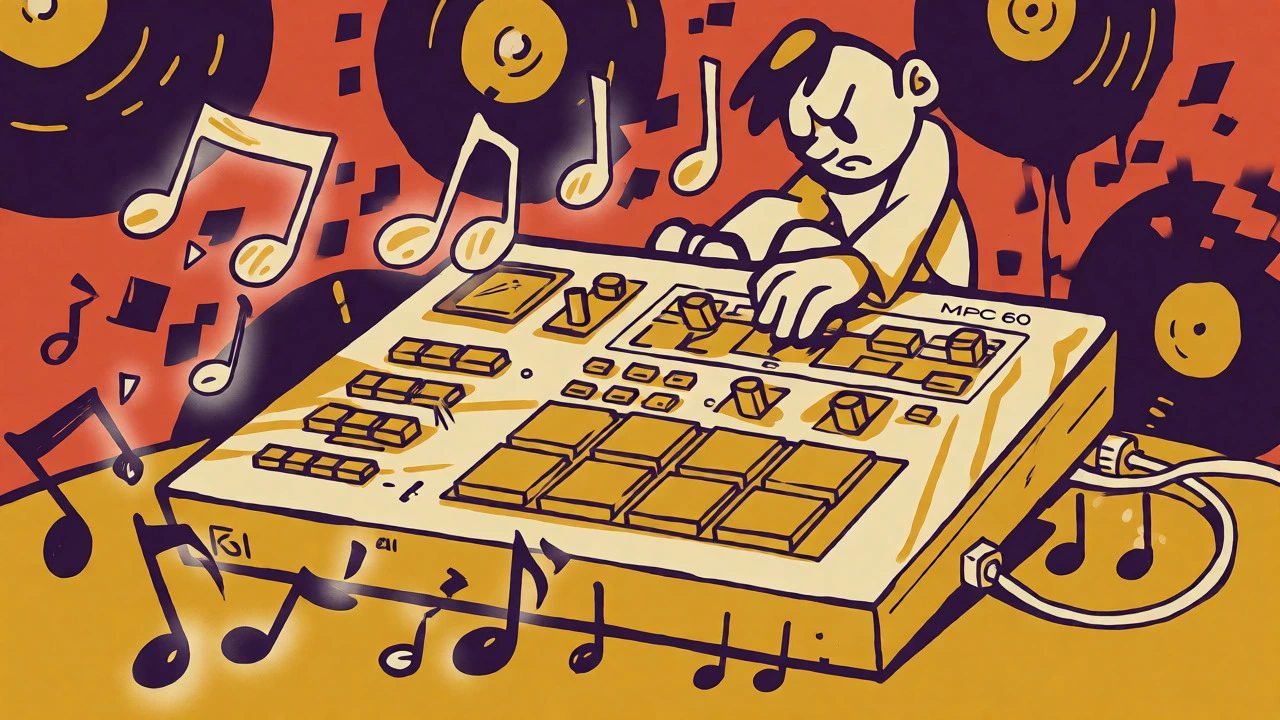
If DAWs provided the canvas, samplers provided the paint. Devices like the Akai MPC60, released in 1991, allowed producers to chop up existing records and rearrange them into new rhythmic patterns. This wasn't just copying; it was recontextualizing. A breakbeat from a 1970s funk record could become the backbone of a 1990s dance-pop hit.
This introduced a new type of compositional logic: sample clearance and texture selection replaced chord progressions as primary creative decisions. Consider the impact of Grand Upright Music Ltd. v. Warner Bros. Records in 1991. When the court ruled that Biz Markie’s unauthorized sample of Gilbert O’Sullivan constituted copyright infringement, it didn't just change legal codes; it changed aesthetics. Producers couldn't just grab any cool snippet. They had to clear samples, replay parts, or synthesize original textures. This pushed pop toward cleaner, more synthetic sounds because creating your own timbre was safer than borrowing someone else's.
| Feature | Pre-1990s Standard | 1990s Innovation |
|---|---|---|
| Rhythm Source | Live drummers or basic drum machines | Sampled breaks, quantized programming, MPC sequencing |
| Editability | Tape splicing (destructive, time-consuming) | Digital non-destructive editing (copy/paste, looping) |
| Vocal Processing | Pitch correction was rare or manual | Auto-Tune used as an audible effect (Cher’s “Believe”) |
| Arrangement Logic | Instrumental orchestration and harmonic movement | Layer stacking, frequency carving, and drop/breakdown structures |
The Vocal Becomes an Instrument
Perhaps no single tool illustrates the 1990s shift better than Auto-Tune. Released by Antares in 1997, it was originally designed to subtly correct pitch errors. But producers Mark Taylor and Brian Rawling set the retune speed to zero for Cher’s 1998 hit "Believe." The result wasn't natural; it was robotic, snapping instantly between notes without the human glide of vibrato.
This changed the role of the voice in an arrangement. Previously, the vocal was the lead instrument, supported by others. Post-1998, the voice became another synthesizable layer. It could be distorted, vocoded, or pitched down to function as a bassline or a rhythmic stab. Imperfections weren't just fixed; they were stylized. The "T-Pain" era of the 2000s and the current dominance of pitch-perfect pop stems directly from this decision to make technology audible rather than invisible.
Loudness, Density, and the Wall of Sound
As digital tools made it easier to add layers, producers faced a new problem: mixing them all without mud. The solution was aggressive compression and spectral layering. Digital limiters allowed tracks to get louder without clipping, leading to the "loudness war." But beyond volume, compression changed the dynamic shape of songs.
In older arrangements, quiet verses contrasted with loud choruses. In the 1990s, constant density became the norm. Kick drums, basslines, and vocals occupied specific frequency slots, carved out by EQ and sidechain compression. This created a "vertical" arrangement where every moment of the track was packed with information. Breakdowns became essential structural markers because they offered the only true silence in a dense mix. The arrangement relied on subtraction-removing the kick or bass-to create impact, rather than addition.
Genre Fragmentation and Hybridization
It’s tempting to say there was one "90s sound," but the reality was fragmentation driven by accessible tech. Eurodance utilized bright, preset-heavy synthesizers and rigid four-on-the-floor beats. Meanwhile, trip-hop and jungle used chopped breaks and atmospheric samples to create darker, moodier textures. Rock bands adopted digital editing to tighten performances, blending live instruments with programmed percussion.
This democratization meant small teams could produce radio-ready hits. You didn't need a studio orchestra; you needed a sampler, a sequencer, and a good ear for texture. This lowered the barrier to entry but also raised the bar for sonic distinctiveness. Since everyone had access to the same presets and samples, success depended on how creatively you manipulated them. A snare drum wasn't just a snare; it was a processed, layered, gated-reverb-laden event designed to cut through a compressed mix.
Legacy: The Edit-Based Songwriter
Today, we rarely talk about "sound design" as separate from "songwriting." That merger happened in the 90s. When you listen to a modern pop track, notice how the structure often revolves around drops, builds, and textural shifts rather than complex harmonic changes. This is the direct descendant of 1990s workflow.
The arrangement is no longer just a plan for musicians to follow. It is a detailed map of automated parameters, sample triggers, and processing chains. The tools evolved-from hardware samplers to software plugins-but the philosophy remains: construct the song from discrete sonic objects. Understanding this history helps you hear the mechanics behind the melody. It reveals that the polish you enjoy isn't accidental; it's engineered.
Did the 1990s invent electronic pop?
No. Electronic instruments like the Fairlight CMI and MIDI existed in the 1980s. However, the 1990s moved these tools from niche genres into mainstream pop production, making them standard practice rather than experimental novelties.
How did sampling laws affect pop music?
The 1991 Grand Upright ruling against Biz Markie established that unlicensed sampling was copyright infringement. This forced producers to clear samples or create original synthesized textures, pushing pop toward more original, synthetic soundscapes rather than relying heavily on recognizable snippets from other records.
What is the difference between tape editing and digital editing?
Tape editing required physically cutting and splicing magnetic tape, which was destructive and time-consuming. Digital editing allows for non-destructive copying, pasting, and moving of audio clips with precision, enabling producers to experiment freely with arrangement structures without losing the original recording.
Why did pop songs get louder in the 1990s?
Digital limiters and compressors allowed producers to increase average volume without distortion. Combined with the competitive nature of radio and CD playback, this led to denser mixes with less dynamic range, prioritizing constant impact over quiet-loud contrasts.
Is Auto-Tune still considered an effect?
Yes. While often used for subtle correction, its extreme application, popularized by Cher in 1998, treats the voice as a synthetic instrument. Modern pop continues to use pitch correction not just to fix errors, but to define the timbral character of the vocal.