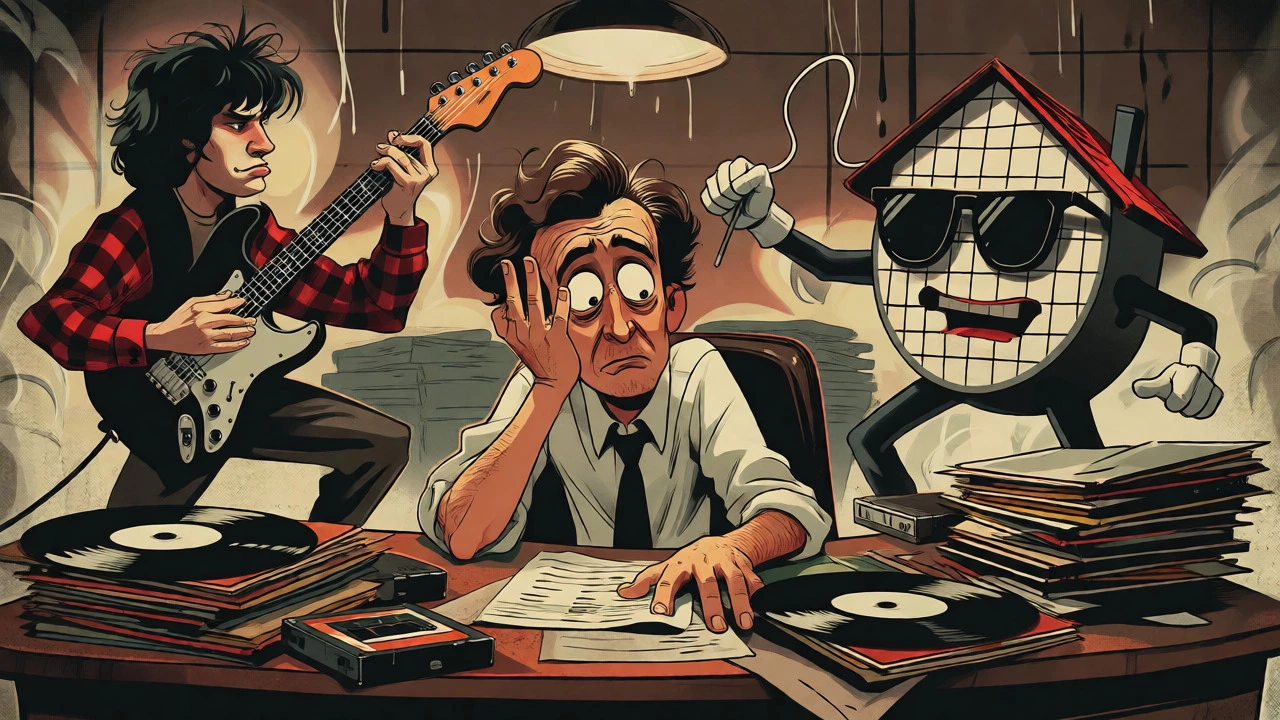

Imagine you’re a music journalist in 1993. A band just dropped an album that mixes grunge guitars with house beats. Do you call it a masterpiece or a mess? The answer wasn’t obvious. In the 1990s, critics faced a crisis of categorization as genre hybrids exploded across rock, hip-hop, and electronic scenes. They weren’t just reviewing songs; they were policing borders between cultures, races, and commercial motives. This decade didn’t just accept mixing genres-it fought over who had the right to mix them.
The Crisis of Purity in a Mixed-Up World
Before the 1990s, rock criticism relied on a strict value system. Authenticity meant live performance, organic instruments, and resistance to pop formulas. Then came the hybrids. When Primal Scream released Screamadelica in 1991, blending acid house with psychedelic rock, indie purists initially called them sellouts. Yet, by the mid-decade, the same critics branded them "dance traitors" for returning to rock. This flip-flopping reveals the core tension: critics celebrated innovation but clung to tribal loyalty. They used terms like "postmodern" to praise boundary-breaking sounds while simultaneously accusing artists of "selling out" if the mixture felt too calculated.
This instability forced critics to invent new labels. "Alternative dance," "big beat," and "electronica" became catch-all categories for sounds that defied traditional radio formats. These weren’t neutral descriptions. They were tools to decide whether a record belonged to a respected subculture or the mass market. For instance, Electronic’s 1991 self-titled album was praised not just for its sound, but because Johnny Marr’s guitar provided a familiar anchor for skeptical rock fans. The fusion worked only when it remained legible through established icons.
Hip-Hop’s Crossover Battle
If rock critics struggled with identity, hip-hop journalists waged war over ownership. The early 1990s saw rap explode into the mainstream, triggering intense debates about "crossover." Was MC Hammer authentic? Many argued no. His polished videos and pop hooks signaled capitulation to white audiences. EPMD’s 1992 track "Crossover" crystallized this fear, framing commercial success as a betrayal of Black cultural expression.
| Aspect | Early 1990s View | Late 1990s View |
|---|---|---|
| Authenticity Source | Purity from pop influence | Aggressive refusal of boundaries |
| Commercial Success | Sign of selling out | Evidence of cultural dominance |
| Fusion Direction | Rap softening for white listeners | Mainstream crossing into Black urban styles |
By the late decade, the logic inverted. Scholars like Mark Anthony Neal noted that mainstream listeners began crossing over toward hip-hop’s "raw" aesthetics rather than rap diluting itself for them. Yet, the policing continued. Critics scrutinized whether samples respected their origins. When white acts sampled Black funk or jazz, the question wasn’t just musical harmony-it was ethical entitlement. Who owned the groove?
Trip-Hop and the Power of Naming
Nowhere was the struggle for control clearer than in Bristol, England. Artists like Portishead and Massive Attack created dark, cinematic blends of hip-hop beats and ambient textures. Journalists labeled this "trip-hop," a term the artists often rejected. Why? Because the label sanitized complex, politically charged Black British music for white, middle-class consumption.
Critics used "trip-hop" to make the unfamiliar digestible. It turned revolutionary sonic experiments into a lifestyle brand for coffee shops and fashion magazines. This naming practice highlighted a broader issue: classification is power. By creating a genre, critics could claim expertise and curate taste, even if the artists themselves resisted the box. The label also obscured the racial dynamics of UK jungle and drum and bass, sometimes misclassifying them as inferior versions of American hip-hop rather than distinct innovations.
World Music and Imperialist Nostalgia
Globalization brought sounds from Africa, Latin America, and Asia into Western pop. Paul Simon’s Graceland era set the stage, but the 1990s intensified scrutiny. Critics began questioning the ethics of borrowing. Terms like "worldbeat" and "ethnic techno" emerged, but so did accusations of "imperialist nostalgia." Did Western artists extract "authentic" sounds from marginalized communities while ignoring the political realities those communities faced?
Paul Oldfield and Simon Reynolds criticized world-music journalism for treating non-Western cultures as repositories of rural purity lost to the industrial West. Collaborations involving Peter Gabriel or David Byrne were often viewed through this lens. Were these partnerships mutual exchanges or thinly veiled musical imperialism? The critique wasn’t anti-fusion; it was pro-context. Critics demanded that reviewers acknowledge labor conditions, copyright issues, and the historical asymmetry of global markets.
The Legacy of Ambivalence
So, how did 1990s critics ultimately handle these hybrids? They didn’t resolve the tension-they institutionalized it. On one hand, they expanded the canon. Robert Christgau’s consumer guides reviewed techno, Afropop, and boy bands alongside classic rock. On the other, they maintained hierarchies. A hybrid was "good" if it felt organic, respectful, and artistically motivated. It was "bad" if it seemed opportunistic, shallow, or exploitative.
This dual approach shaped modern music discourse. Today’s streaming playlists are built on the vocabulary invented then. We still use terms like "indie-dance" or "neo-soul" because 1990s critics needed ways to describe fluid identities. But we also inherited their suspicion. Every time a pop star incorporates trap beats or folk samples, the old questions resurface: Is this homage or appropriation? Is it innovation or calculation?
The 1990s taught us that genre isn’t just a musical category-it’s a social contract. Critics acted as enforcers, deciding who got to play, who got paid, and who got remembered. Their reviews weren’t just opinions; they were negotiations over cultural value in a rapidly fragmenting world. Understanding this history helps us navigate today’s genre-less landscape, where boundaries are thinner but the stakes of ownership remain high.
Why did 1990s critics obsess over "authenticity" in hybrid music?
Critics used authenticity to police cultural boundaries during a time of rapid globalization and commercial expansion. As genres mixed, writers feared losing the distinct identities of subcultures like punk, hip-hop, or jazz. Authenticity served as a shield against perceived commercial dilution, ensuring that music retained its social and historical context rather than becoming mere background noise.
What is "trip-hop" and why did artists reject the label?
Trip-hop refers to a genre emerging from Bristol, UK, in the early 1990s, characterized by slow tempos, heavy bass, and atmospheric samples. Artists like Portishead and Massive Attack rejected the term because they felt it trivialized their work, reducing complex artistic expressions to a trendy marketing buzzword aimed at white, suburban consumers rather than acknowledging the Black musical roots of the sound.
How did hip-hop critics view "crossover" success differently than rock critics?
Hip-hop critics viewed crossover with deep suspicion, interpreting it as potential betrayal of Black cultural ownership and working-class solidarity. While rock critics might see crossover as artistic growth, hip-hop journalists often analyzed it through the lens of race and economics, asking if the artist changed their sound to appeal to white Top 40 markets, thereby sacrificing authenticity for profit.
Did 1990s criticism eventually embrace genre hybrids?
Yes, but conditionally. By the late 1990s, aggressive genre-bending became a sign of creativity and postmodern awareness. However, acceptance depended on perceived intent. Hybrids were embraced if they felt culturally informed and innovative, but rejected if they appeared to be lazy pastiches or exploitative appropriations lacking respect for the source traditions.
What role did technology play in 1990s genre fusion?
Sampling technology and digital production enabled unprecedented fusion. Producers could isolate breaks from funk records, layer them with rock guitars, or embed African rhythms into electronic tracks. This technological shift forced critics to develop new vocabularies like "electronica" and "big beat" to describe sounds that couldn't be categorized by traditional instrumentation alone.