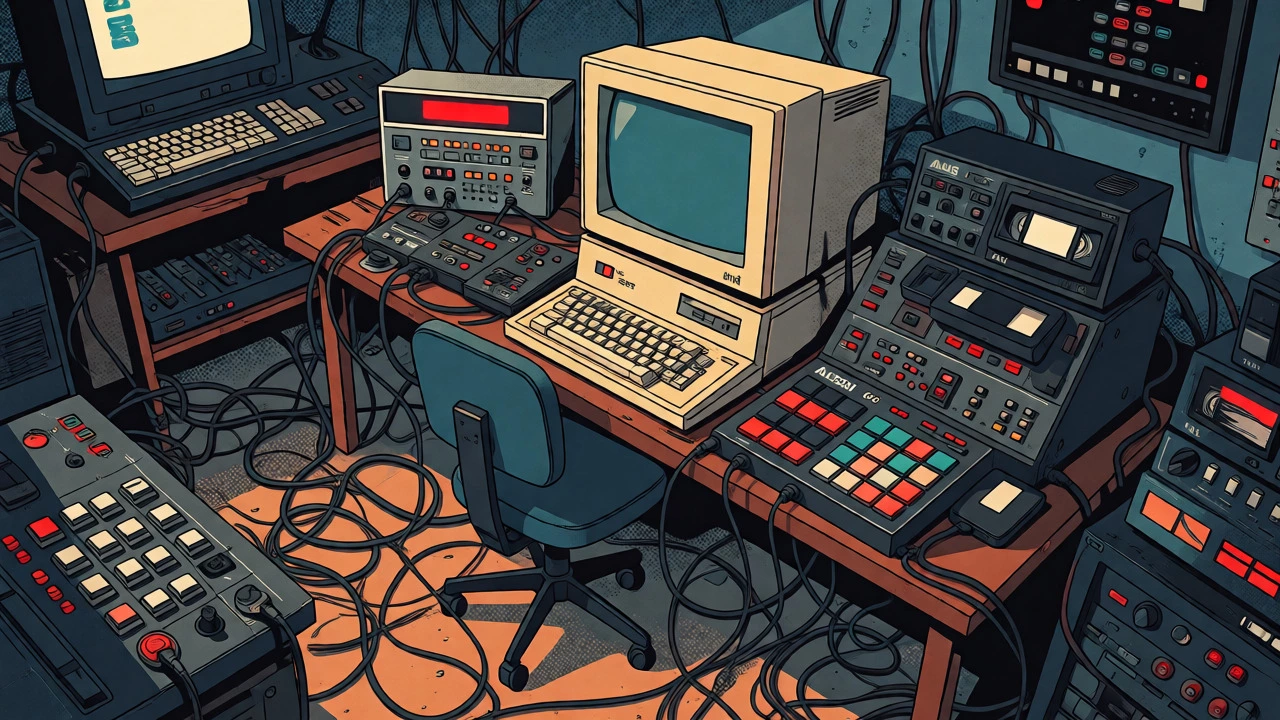

You probably think of a "bedroom producer" as someone with a laptop, headphones, and maybe a MIDI controller sitting on a desk. But in the 1990s, that image would have been laughable. There were no laptops. No cloud storage. No one-click plugins. The rise of bedroom producers was a messy, cable-tangled revolution driven by hardware that cost thousands of dollars but fit in a spare room. It wasn't just about convenience; it was about breaking the monopoly of million-dollar recording studios.
This shift didn't happen overnight. It was a convergence of cheaper samplers, digital recorders, and personal computers that allowed artists to make professional-sounding records without ever stepping into a commercial facility. From the dusty basements of Detroit to the cramped apartments of Paris, this movement reshaped how we hear music today. Let's look at how it actually happened, who did it, and why their gear choices still echo in modern tracks.
The Myth vs. The Reality of the "Bedroom"
First, let's clear up a common misconception. When people say "bedroom producer," they don't always mean literally working next to the bed. In many cases, it meant a basement, a garage, or a corner of a parent's house. The term became shorthand for independent, low-budget production. A famous example is White Town's 1997 hit "Your Woman." Many articles claimed Jyoti Mishra recorded it in his bedroom. In reality, he used a Tascam 688 eight-track recorder, an Atari ST computer, and an E-mu sampler in a dedicated home setup. It wasn't a literal bed scenario, but it was definitely not a professional studio either.
The key difference between a hobbyist and a serious bedroom producer in the '90s was workflow. You weren't just recording demos. You were composing, sequencing, sampling, and mixing entirely on your own. This required a specific set of skills that didn't exist in the mainstream music industry before. You had to be the engineer, the arranger, and the performer all at once.
The Gear That Built the Beat
If you want to understand the sound of the 90s, you have to understand the limitations of the gear. Modern producers have infinite tracks and unlimited memory. Back then, every megabyte counted. Two pieces of hardware stand out as the engines of this revolution: the Akai MPC and the Alesis ADAT.
The Akai MPC2000, released in 1997, was the holy grail for hip-hop heads. Priced around $1,495, it offered 16 pressure-sensitive pads and built-in sampling. Before this, samplers like the Akai S900 were expensive and clunky. The MPC allowed producers to chop samples and program drums in real-time, creating the swing and human feel that defined the era. Producers like J Dilla pushed this machine to its limits, placing kick drums slightly off-grid to create a unique rhythmic bounce.
On the other side, the Alesis ADAT changed recording forever. Introduced in the early 90s, it recorded eight digital tracks onto standard VHS cassettes. While $3,995 was still a lot of money for an individual, it was a fraction of the cost of renting a professional studio. Better yet, you could sync multiple ADAT units together to get 16, 24, or even 64 tracks. Suddenly, a kid in Portland could record a full band or layer dozens of synth parts without paying hourly rates.
| Feature | Commercial Studio (Early 90s) | Bedroom/Home Studio (Mid-Late 90s) |
|---|---|---|
| Cost | $100-$500+ per hour | $3,000-$5,000 upfront equipment |
| Recording Medium | 2-inch Analog Tape | S-VHS Cassette (ADAT) or DAT |
| Sequencing | Large Format Console + Mainframe | Atari ST / PC + Cubase/Cakewalk |
| Flexibility | High (Engineer assisted) | Unlimited experimentation (Self-driven) |
Hip-Hop’s Underground Engine
In hip-hop, the bedroom was the laboratory. The genre relied heavily on sampling-taking snippets of old funk, soul, and jazz records and twisting them into something new. Commercial studios often frowned upon this because of copyright issues and the technical difficulty of syncing samples to tape. Home setups made it easy to experiment without judgment.
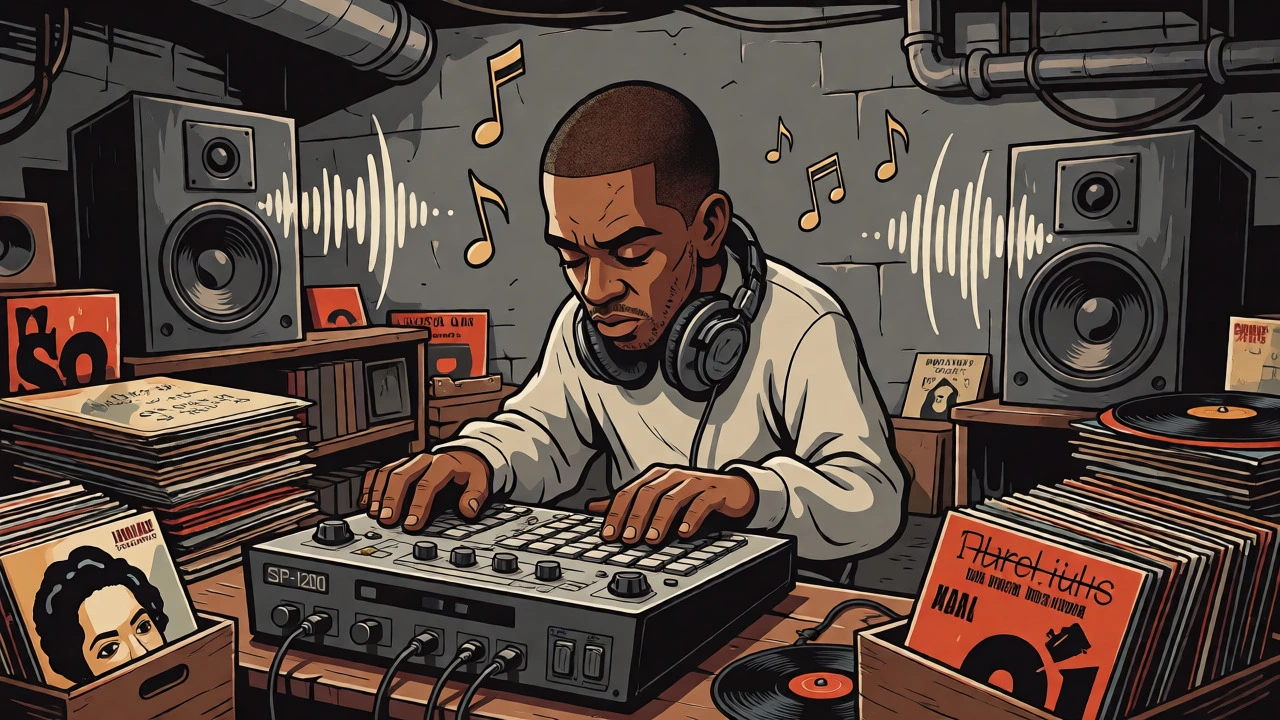
Take J Dilla from Detroit. He worked out of his mother’s basement, using an SP-1200 and later an MPC3000. His style wasn't polished in the traditional sense; it was raw, unquantized, and deeply human. Because he controlled every aspect of the beat, he could leave in the "mistakes" that gave his music character. This approach influenced a generation of producers who valued vibe over perfection.
Similarly, Madlib demonstrated how portable this movement had become. By the late 90s and early 2000s, he was making beats in hotel rooms using a portable turntable and a small sampler. The barrier to entry had dropped so significantly that geography no longer mattered. You didn't need to be in New York or Los Angeles to make a classic album. You just needed good ears and access to crates of vinyl.
Electronica’s Digital Frontier
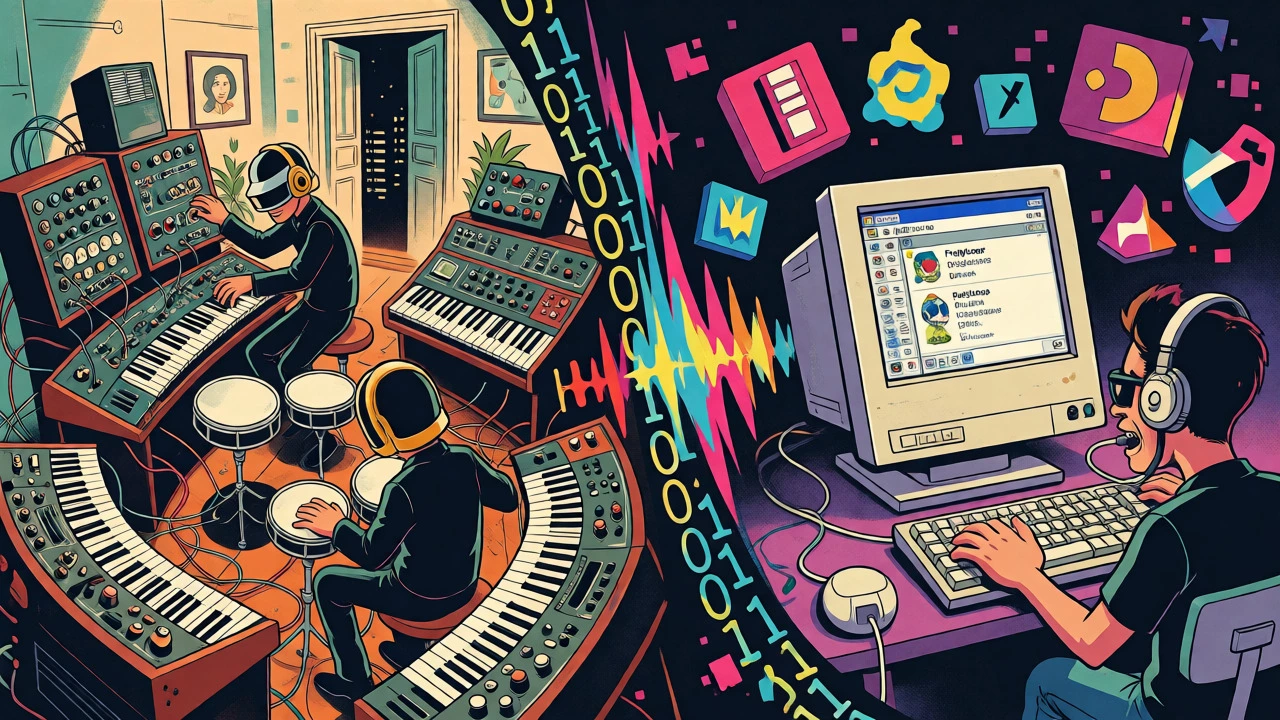
While hip-hop focused on sampling, electronica embraced synthesis and programming. Artists like Daft Punk started in bedrooms in Paris, surrounded by drum machines, synthesizers, and effects pedals. They described themselves as part of the "pre-laptop" generation. Their early hits weren't made with complex software suites but with hardware sequencers and analog synths patched together with cables.
The transition from hardware to software began in earnest in the mid-90s. Steinberg introduced the VST plugin standard in 1996, allowing effects to run inside a computer. Then, in 1997, Image-Line released FruityLoops, a simple step sequencer that ran on Windows. It was cheap, intuitive, and perfect for beginners. By 1999, VST instruments arrived, letting producers simulate synthesizers inside their computers. This was the beginning of the end for the rack-heavy bedroom, though hardware remained king for many purists.
Groups like The Prodigy in the UK also leveraged this tech. Their use of Atari computers and Akai samplers allowed them to create dense, chaotic electronic tracks that broke into the mainstream. They proved that electronic music didn't need a live band to be exciting. It just needed a compelling loop and a strong rhythm.
The Economic Shift and Its Limits
Did this democratize music? Yes, but with caveats. The rise of home studios hurt the business model of large commercial facilities. Studios in cities like San Francisco saw bookings drop as artists opted to record at home. However, calling it a complete leveling of the playing field ignores the reality of class and race.
A full home setup still cost several thousand dollars. In 1995, that was a significant investment. Not everyone had disposable income, space, or the technical knowledge to troubleshoot MIDI synchronization issues. Furthermore, studies suggest that women remained underrepresented in these spaces due to social barriers, not just financial ones. So while the door opened wider, it didn't swing open for everyone equally.
Another hurdle was copyright. Sampling was cheap to do but expensive to clear. A bedroom producer could make a great track in an afternoon, but if it used a sample from a major label artist, releasing it legally could cost more than the equipment itself. This forced many indie labels to operate in a legal gray area until the sample culture was eventually regulated more strictly.
Why This Era Still Matters
The legacy of the 1990s bedroom producer isn't just nostalgic. It redefined the role of the producer. Before this, a producer was often a manager or an engineer hired by a label. After the 90s, the producer became the artist. Think of Flume, Skrillex, or Metro Boomin today. They work alone, often in small rooms, controlling every sonic detail. That autonomy was born in the cluttered bedrooms of the 90s.
The aesthetic of that era-the crackle of vinyl samples, the slight drift of analog synths, the imperfect timing of drum machines-is now emulated by plugins because we miss the humanity of those constraints. We traded convenience for character, and many artists are trying to get that character back.
Frequently Asked Questions
What was the most popular computer for bedroom producers in the 90s?
The Atari ST was hugely popular, especially in Europe, because it had built-in MIDI ports and ran affordable sequencing software like Cubase. In the US, Macintosh computers were common for audio editing, while PCs gained traction later in the decade with Windows-based sequencers.
Did bedroom producers really save money compared to studios?
Yes, over time. While the initial equipment cost ($3,000-$5,000) was high, it eliminated hourly studio fees. For an artist producing multiple albums or experimenting constantly, the home studio paid for itself quickly. It also allowed for unlimited rehearsal time without the pressure of a ticking clock.
How did sampling affect copyright laws?
The explosion of sample-based music led to stricter enforcement of copyright laws. Major lawsuits in the late 90s established that almost any recognizable sample required clearance. This increased costs for indie producers and shifted some genres away from heavy sampling toward original composition or royalty-free libraries.
What is the difference between a demo and a finished track in this context?
In the 90s, the line blurred. Many "demos" made on ADAT or DAT tapes were released as final products because the quality was sufficient for radio and clubs. Artists like J Dilla and Madlib often released tracks directly from their home setups, proving that high fidelity wasn't the only metric for success.
Are there modern equivalents to 90s bedroom producers?
Absolutely. Today's producers use laptops and DAWs like Ableton Live or FL Studio (the successor to FruityLoops). The spirit is the same: total creative control, low overhead, and the ability to release music independently via platforms like SoundCloud or Bandcamp. The tools are cleaner, but the DIY ethos remains.