
You hear it before you see the album cover. That sharp, digital snare crack. The shimmering, metallic electric piano that cuts through the mix like a laser. It’s not just nostalgia; it’s the DNA of synth-pop from the 1980s, and it’s running the show in today’s biggest hits. If you’ve ever wondered why Dua Lipa or The Weeknd sound so familiar yet so fresh, the answer lies in how producers are actively repurposing the technology of 1983 to make music for 2026.
This isn’t about copying old songs. It’s about inheriting a specific way of thinking about sound. In the 1980s, recording studios shifted from capturing acoustic reality to constructing artificial perfection. Tools like the Fairlight CMI, invented in 1979 by Peter Vogel and Kim Ryrie, taught us that any sound could be sampled, edited, and looped. This wasn’t just a technical upgrade; it was a philosophical shift. Today’s producers use this same logic. They don’t just record drums; they build rhythmic architectures using samples that have been stripped of their natural room tone, leaving only the raw, punchy transient.
The Drum Machine Revolution: From LM-1 to DAW Racks
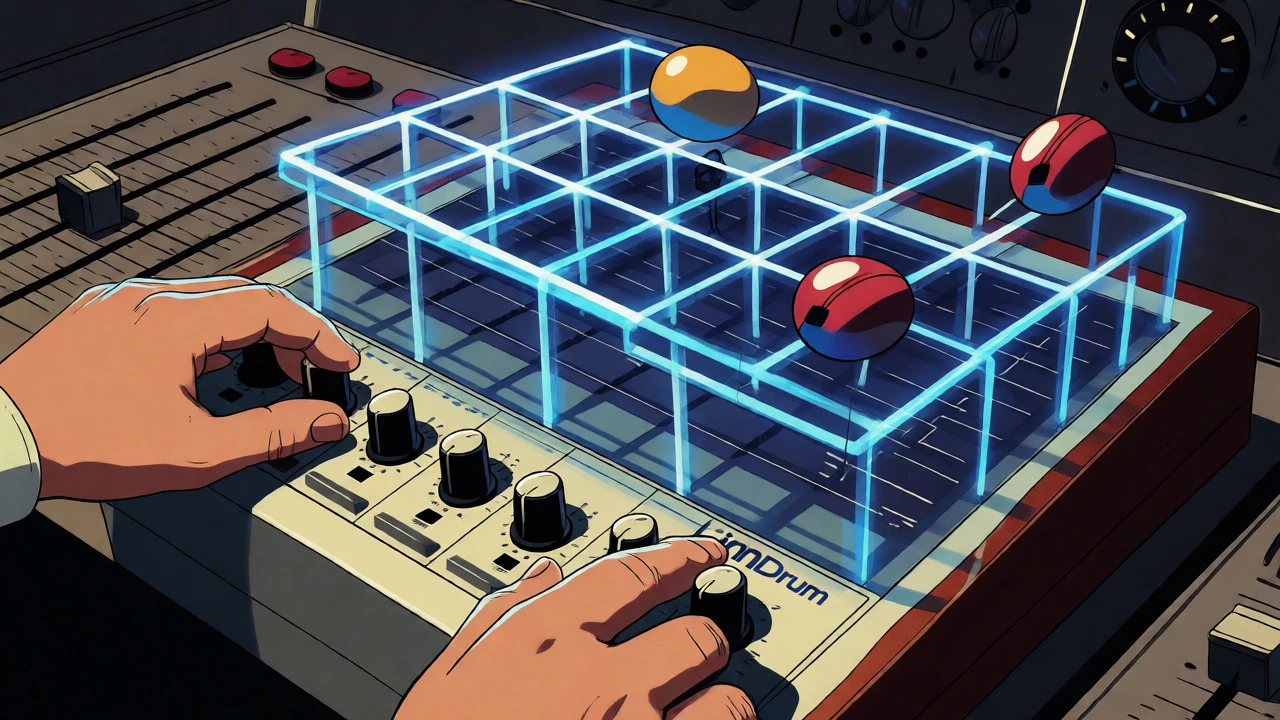
Think about the drum sounds on a current top-40 track. They’re dry, tight, and unnaturally perfect. You can thank Roger Linn’s LM-1, released in 1980, for that aesthetic. It was the first drum machine to use real-world samples rather than synthesized tones. But here’s the twist: the LM-1’s low-fidelity limitations-storing sounds at just 28 kHz with 8-bit depth-created a specific sonic character that engineers loved. Because the samples were so dry, producers had to add reverb and compression artificially. This created a separation between the "source" (the drum hit) and the "space" (the effect).
Modern production workflows mirror this exactly. When you open a Digital Audio Workstation (DAW), you’re likely loading one-shot samples into a sampler rack. These samples are often chosen specifically because they lack ambient noise, allowing you to place them in any virtual space you want. The quantization feature on the LM-1, which corrected timing errors, is now standard in every MIDI editor. We still chase that grid-perfect precision, but we also know that a little human error makes it feel alive. The difference? We have infinite undo options. The LM-1 producer committed to the groove; we tweak it until it feels right.
MIDI: The Invisible Backbone of Modern Pop
If the LM-1 gave us the rhythm, MIDI (Musical Instrument Digital Interface), standardized in 1983, gave us the flexibility. Before MIDI, if you wanted to change a synth patch mid-song, you had to stop the tape and reset your knobs. MIDI separated the performance data (which notes, when, and how hard) from the sound source. This means a melody played on a piano keyboard in 1985 could be reassigned to a flute or a bass synthesizer without re-recording the performance.
This concept is the bedrock of modern pop production. A producer might program a chord progression using a generic MIDI controller, then audition fifty different virtual instruments until one fits the vibe. Did you write a great hook on a Yamaha DX7? Great. You can export that MIDI file and play it on a modern software emulator that mimics the DX7’s FM synthesis architecture. The timbre remains iconic-that bright, glassy bell sound-but the workflow is entirely digital and non-destructive. MIDI turned composition into modular design, allowing for the rapid experimentation that defines streaming-era pop.
Gated Reverb: Turning an Accident into a Signature
No sound screams "1980s" louder than the gated reverb snare. You know the sound: a huge, explosive crash that suddenly cuts off, leaving silence instead of a natural decay. It originated accidentally in 1980 when engineer Hugh Padgham discovered that compressing the talkback microphone of an SSL console while Phil Collins played drums created this dramatic effect. He used it on Peter Gabriel’s Intruder and later on Collins’s In the Air Tonight.
Technically, it’s simple: send a snare to a large hall reverb, then put a noise gate after the reverb return. The gate opens when the snare hits and closes quickly, chopping off the tail. Why does this matter today? Because it creates drama. In a dense modern mix, where every frequency is fighting for space, a long reverb tail can muddy the vocals. Gated reverb provides impact without clutter. Producers today use plugins to recreate this, often automating the gate threshold to make the effect appear only during choruses. It’s a tool for dynamic contrast, proving that artificial space can be more expressive than natural acoustics.
| 1980s Technology | Key Feature | Modern Equivalent | Impact on Current Pop |
|---|---|---|---|
| Fairlight CMI | Digital Sampling & Waveform Editing | Native DAW Samplers (Ableton Simpler, Kontakt) | Treats any audio clip as a playable instrument. |
| LM-1 | Sampled Drums & Quantization | Drum Racks & One-Shot Libraries | Creates dry, punchy rhythms that accept external FX. |
| Yamaha DX7 | FM Synthesis (Bright, Metallic Tones) | Software FM Synths (Dexed, FM8) | Provides instant melodic hooks with high-frequency clarity. |
| SSL 4000 Console | Channel Strip Dynamics & Bus Compression | Plugin Emulations (Waves SSL, FabFilter) | Adds cohesion and "glue" to digital mixes. |
Timbre as Hook: The DX7 Legacy
In the 1970s, the guitar solo was often the hook. In the 1980s, the synthesizer took over. The Yamaha DX7 didn’t just provide accompaniment; its presets became the main character. Think of the bright, percussive electric piano in countless ballads or the icy bells in dance tracks. These sounds were designed to cut through the mix, occupying frequencies that guitars couldn’t reach without masking vocals.
Today’s producers understand that timbre is a compositional element. When The Weeknd releases a track like "Blinding Lights," the driving synth arpeggio isn’t just background noise; it’s the primary melodic identity. Producers achieve this by using FM synthesis techniques-modulating one sine wave with another-to create complex, harmonically rich tones that feel both retro and futuristic. They might layer a DX7-style pad with a modern sub-bass, bridging the gap between 1983’s clarity and 2026’s demand for low-end weight.
Practical Workflow: How to Build the Sound
If you want to capture this aesthetic, don’t just load a preset. Here’s how to apply these historical principles:
- Start Dry: Use sample-based drums that have no built-in reverb. Process them separately to maintain control.
- Quantize Intentionally: Lock your hi-hats and snares to the grid for machine precision, but slightly offset the kick or add velocity variation to keep it human.
- Gate Your Space: Don’t let reverbs run wild. Use gates to truncate tails, creating rhythmic punctuation rather than wash.
- Layer Timbres: Combine a digital FM lead with an analog-modeled pad. The contrast between the sharp attack of the FM and the warm sustain of the analog adds depth.
The goal isn’t to fake a vintage recording. It’s to use the constraints of the past as creative boundaries. The 1980s forced producers to make bold choices because technology was limited. Today, we have unlimited options, which can lead to decision paralysis. By adopting the 1980s mindset-where the sound design is part of the songwriting-you can cut through the noise.
Why do modern pop songs sound "retro" even though they are new?
They utilize the sonic grammar established in the 1980s, such as gated reverb, FM synthesis timbres, and sample-based drum programming. These elements trigger nostalgic associations while being delivered with modern clarity and loudness standards.
What is gated reverb and why is it popular?
Gated reverb is an effect where a reverb tail is abruptly cut off by a noise gate. It creates a sense of massive scale without muddying the mix, making it ideal for dense pop productions where vocal clarity is paramount.
How did MIDI change music production?
MIDI allowed electronic instruments to communicate with each other and computers. It separated musical performance data from the sound source, enabling producers to edit notes, timing, and instrumentation non-destructively after recording.
Is the Yamaha DX7 still relevant today?
Yes, primarily through software emulations. Its FM synthesis engine produces bright, cutting tones that remain effective for melodic hooks in modern pop, hip-hop, and electronic music.
What is the difference between sampling and synthesis?
Sampling records existing audio (like a drum hit) and plays it back, while synthesis generates sound electronically from scratch. 1980s pop blended both, using samples for realism and synthesis for abstract, stylized textures.