
You press a key on your laptop or tap a pad on a controller, and a sound emerges. It might be a deep bassline for a techno track, a shimmering pad for a film score, or a lead melody that sounds like it belongs in a 1970s sci-fi movie. We often think of electronic music as a digital phenomenon, born from computers and software. But if you strip away the code and look at the bones of modern production, you find something else entirely: a debt to a handful of engineers and musicians working in garages and labs during the 1970s.
This isn't just nostalgia. The way we make music today-how we structure songs, how we control timbre, even how we connect devices together-is a direct result of decisions made by people like Robert Moog, Don Buchla, and Peter Zinovieff. They didn't just build machines; they invented the language of electronic sound. Before them, electronic music was a niche academic pursuit, locked in university tape studios where making a single note could take hours of splicing magnetic tape. After them, it became a performable, portable, and commercially viable art form. Let's look at who actually paid this debt and what they left behind.
The Great Divide: East Coast vs. West Coast Philosophy
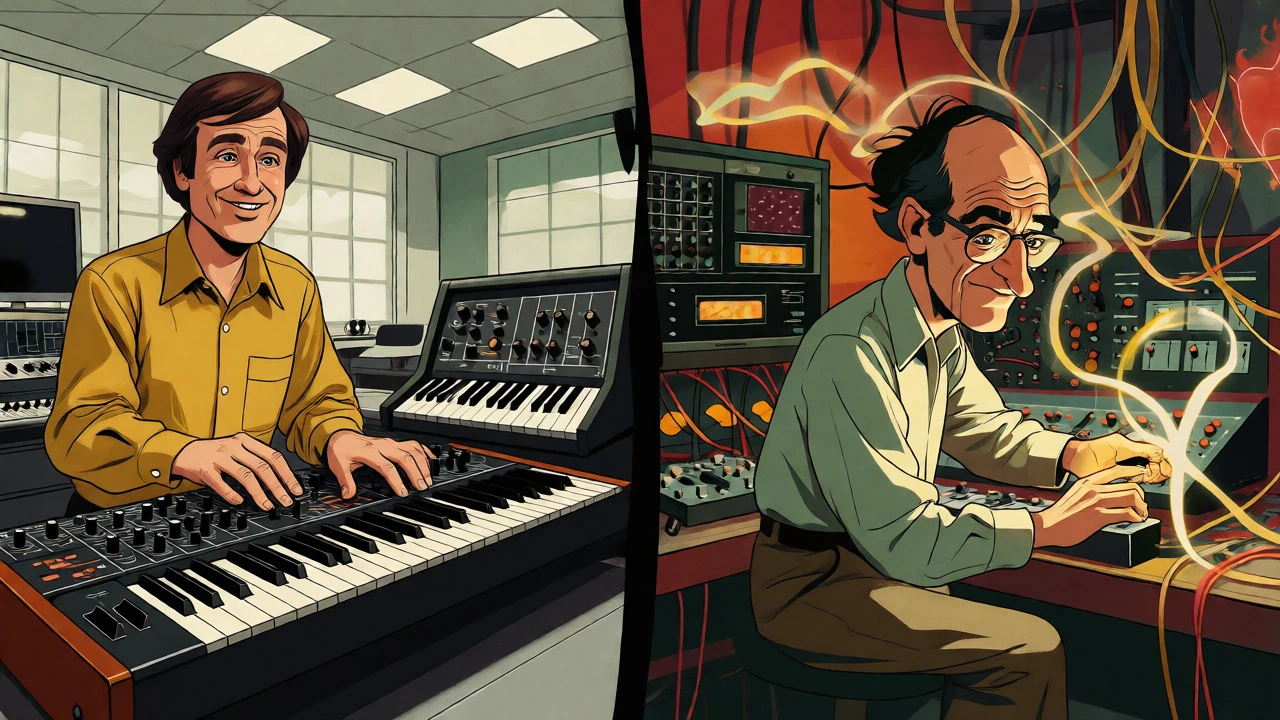
To understand why your synth sounds the way it does, you have to look at the two competing visions that emerged in the 1960s and matured in the '70s. On one side, you had Robert Moog, who believed a synthesizer should be an extension of the piano. His Moog synthesizers used voltage-controlled oscillators and filters to create subtractive synthesis, allowing musicians to sculpt sound with familiar keyboard interfaces. This approach prioritized immediate playability. You hit a key, a note plays. It’s intuitive, stable, and perfect for rock bands needing a reliable bass or lead line.
On the other side was Don Buchla, who rejected the piano entirely. Working out of San Francisco, Buchla designed touch-plate interfaces and complex control voltage systems that encouraged experimentation over traditional melody. His instruments didn’t ask "what note do you want?" but rather "what texture do you want to explore?" This West Coast philosophy valued unpredictability and evolving textures, laying the groundwork for ambient music and generative composition. While Moog gave us the tools to write pop songs, Buchla gave us the tools to break them.
| Instrument | Creator | Interface | Primary Use Case | Legacy Impact |
|---|---|---|---|---|
| Minimoog Model D | Robert Moog | Keyboard | Live performance, bass, leads | Standardized the keyboard synth format |
| Buchla 100 Series | Don Buchla | Touch Plates / Sequencers | Experimental textures, academic music | Influenced modular and generative workflows |
| EMS VCS3 | Peter Zinovieff | Matrix Pin Patching | Sound effects, portability | Enabled mobile electronic performance |
| ARP 2600 | Alan R. Pearlman | Semi-Modular Keyboard | Studio work, education | Bridged modular complexity and ease of use |
Making It Portable: The EMS VCS3 and ARP 2600
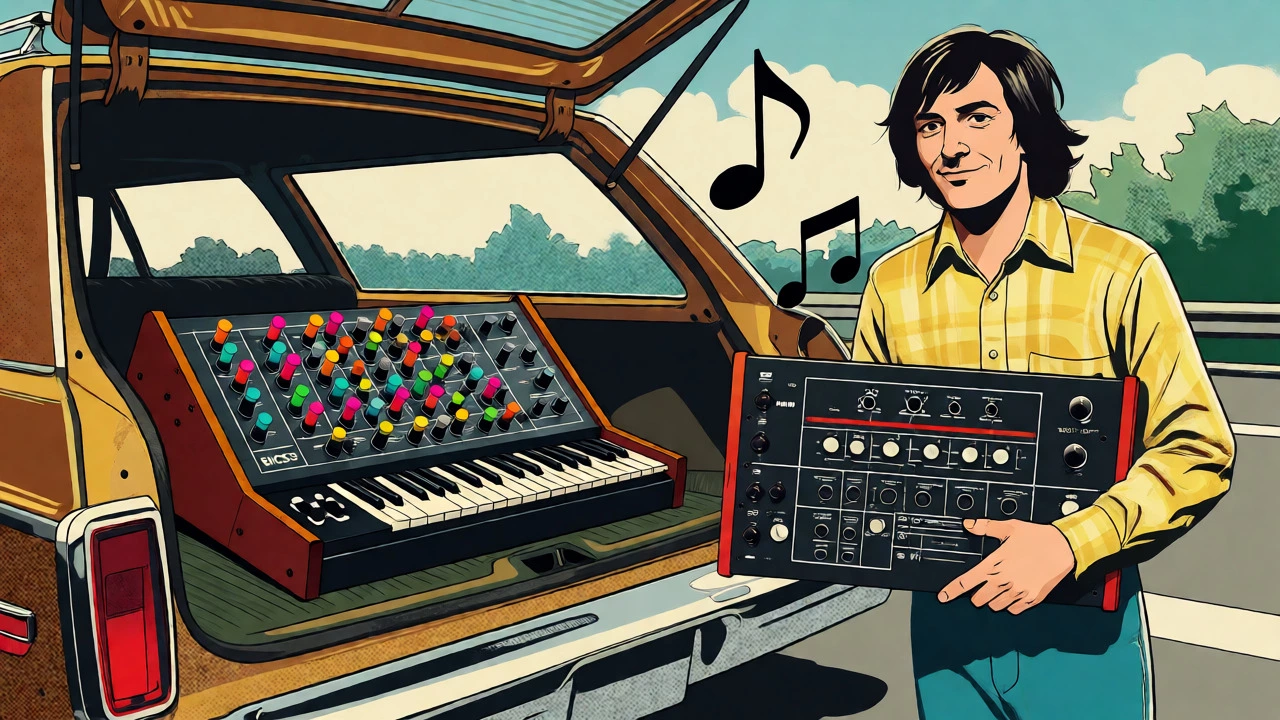
If Moog and Buchla were building engines, others were figuring out how to put them in cars. In the UK, Peter Zinovieff, along with engineers David Cockerell and Tristram Cary, created the EMS VCS3, Europe’s first commercially produced portable synthesizer, featuring a unique matrix pin-patching system instead of traditional cables. Released in late 1969, the VCS3 was small enough to fit in a car trunk. Pink Floyd used it to create the swirling, unstable sounds on *Wish You Were Here* and *The Dark Side of the Moon*. It wasn't about playing clean notes; it was about manipulating noise and feedback in real-time.
Across the Atlantic, Alan R. Pearlman developed the ARP 2600, the world’s first semi-modular synthesizer, which allowed users to play without patch cords while retaining the ability to rewire signal paths for deeper sound design. Introduced in 1971, the 2600 struck a crucial balance. It was robust enough for touring musicians yet flexible enough for studio composers. Its architecture influenced countless later designs because it proved you didn't need a room full of gear to get professional results. This shift from massive modular walls to integrated boxes is the reason you can carry a whole studio in a backpack today.
The Human Element: Turning Machines into Instruments
Hardware alone doesn't change culture. Musicians did. In 1968, Wendy Carlos released Switched-On Bach, an album that demonstrated the Moog synthesizer could perform complex classical repertoire with precision and emotional depth. Before this, the public viewed synthesizers as novelty toys that made