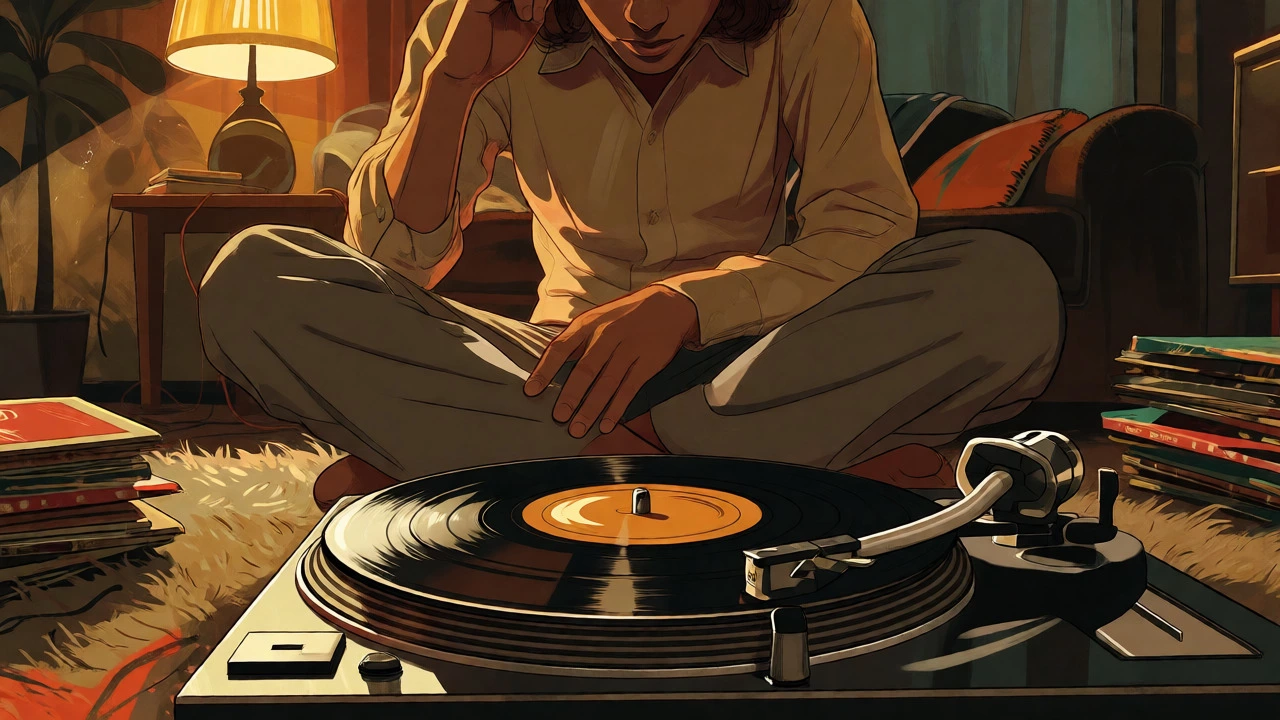

Imagine you’re sitting on the floor of your living room in 1974. You’ve just placed a needle on a black disc. There is no skip button. No shuffle mode. No algorithm deciding what plays next. For the next twenty minutes, you are locked into a specific journey chosen by the artist. If they wanted to tell you a story, you had to listen to it exactly as they built it. This physical constraint turned album sequencing into one of the most powerful storytelling tools in music history.
We often talk about the lyrics or the melodies of the 1970s, but we rarely give enough credit to the order of the tracks. In that decade, particularly within progressive rock and R&B, the sequence wasn't just a list; it was the plot. The way a song ended and the next one began could change the meaning of both. It was an era where the medium dictated the message, and the two-sided nature of the LP record forced artists to think like novelists or playwrights, dividing their narratives into acts.
The Physical Limits That Shaped the Story
You might wonder why this mattered so much then compared to now. The answer lies in physics. A standard 12-inch vinyl record spinning at 33⅓ RPM has a hard limit on how much audio fits on one side before the sound quality drops off a cliff. Engineers back then knew that if you pushed past 18 to 20 minutes per side, the grooves got too close together. The result? Weak bass, distorted highs, and a general loss of dynamic punch.
This technical ceiling created a natural narrative structure. Artists couldn’t just dump ten songs onto Side A and call it a day. They had to break their stories into chunks that fit within those 15-20 minute windows. This meant every side needed its own mini-arc: a beginning, a middle, and a resolution-or at least a compelling cliffhanger to make you flip the record. Think of it like chapters in a book. If you cut a chapter in the wrong place, the reader loses interest. If you cut it right, they have to turn the page immediately.
For double albums like Genesis’s The Lamb Lies Down on Broadway, this became even more critical. With four sides (A, B, C, D), the band mapped out a surreal journey for the protagonist, Rael. Each side represented a distinct stage of his psychological transformation. The physical act of flipping the record became part of the ritual, a pause for breath before diving deeper into the chaos. Modern digital albums don’t force this engagement, which is why many feel less cohesive today.
Narrative Arcs: From Overture to Collapse
How did these artists actually build the flow? They borrowed heavily from classical music and theater. Many 1970s story albums opened with an "overture" or an introductory theme. This wasn’t just a pretty song; it was a musical map. It introduced motifs-short melodic phrases-that would return later to signal character development or plot twists.
Pink Floyd mastered this technique. On The Wall, released in 1979, the track "In the Flesh?" sets up the aggressive, authoritarian persona of the main character, Pink. Later, the reprise "In the Flesh" shows the same theme twisted by madness and isolation. The sequence tells you how the character has changed without needing a single word of exposition. The transition between tracks was often seamless, using crossfades or continuous instrumental passages to blur the lines between songs. This made the album feel like one long piece of music rather than a collection of singles.
| Album | Artist | Narrative Type | Sequencing Strategy | Side Break Function |
|---|---|---|---|---|
| The Dark Side of the Moon | Pink Floyd | Thematic/Quasi-Narrative | Continuous segueing; recurring motifs (clocks, heartbeats) | Shift from external conflict to internal introspection |
| Tommy | The Who | Linear Rock Opera | Chronological progression of protagonist's life | Transition from childhood trauma to spiritual awakening |
| Ziggy Stardust | David Bowie | Biographical Fiction | Rise and fall arc; introduction to climax to collapse | Movement from fame/ascent to alienation/disaster |
| I Remember Yesterday | Donna Summer | Temporal Journey | Chronological march through music eras | Culmination in futuristic sound ("I Feel Love") |
Beyond Rock: Disco and R&B Storytelling
It’s easy to assume this was just a white, male, progressive rock phenomenon. But look closer at the R&B and disco scenes. These genres used sequencing to tackle social issues and personal histories with equal sophistication. Donna Summer, working with producers Giorgio Moroder and Pete Bellotte, didn’t just make dance hits. Her 1977 album I Remember Yesterday is a time machine. The tracks move chronologically from 1940s swing styles through 1950s doo-wop and 1960s pop, ending with the electronic pioneer track "I Feel Love." The sequence isn’t random; it’s a history lesson delivered on the dance floor. The final track feels like a breakthrough because of everything that came before it.
Similarly, Parliament’s Mothership Connection (1975) used funk rhythms to tell a space-travel mythos. The ordering of tracks established the premise, developed the lore, and provided thematic payoffs. In the Black community, these albums weren’t just entertainment; they were cultural statements. The gatefold sleeves often contained artwork that complemented the narrative, creating a multimedia experience that required attention to detail. You had to read the lyrics, look at the pictures, and listen to the order. It demanded effort, and the reward was a richer understanding of the artist’s vision.
The Lost Art of Front-to-Back Listening
Why does this matter today? Because we’ve lost the habit of linear listening. Streaming platforms encourage skipping. Playlists chop up albums into mood-based fragments. When you put a track from The Lamb Lies Down on Broadway into a "Classic Rock Hits" playlist, you strip away the context. You hear the notes, but you miss the story.
Reddit communities dedicated to music theory and production often debate this. One common observation is that concept albums almost always feel better sequenced than non-concept albums. Why? Because the musicians remembered they were telling a story. In a standard album, track order might be determined by which song sounds best first, or which one has radio potential. In a story album, the order is dictated by plot logic. If a scene happens after another scene, the song must follow. This discipline creates a cohesion that is rare in modern releases.
There’s also the issue of emotional pacing. Good sequencing builds tension and releases it. It knows when to let the listener rest and when to hit them hard. If you shuffle a story album, you ruin this rhythm. You might get a quiet, introspective moment followed immediately by a chaotic explosion, not because the artist intended it, but because the algorithm didn’t care. The 1970s LP forced a contract between artist and listener: trust me, I’ll take you somewhere interesting, but you have to stay on the ride.
Practical Lessons for Modern Creators
If you’re a songwriter or producer today, you can still use these principles. You don’t need to press vinyl to benefit from LP thinking. Start by asking yourself: What is the job of each track in the overall narrative? Does Track 3 prepare the listener for the shift in Track 4? Are you relying on transitions to bridge gaps?
- Plan the Arc First: Don’t write ten songs and try to stitch them together. Decide on the story beats first. Treat your tracks like chapters.
- Respect the Pause: Even in digital formats, consider where you want the listener to breathe. Use silence or ambient noise to mark transitions between major plot points.
- Use Recurring Motifs: Bring back a melody or lyrical phrase in different contexts. This helps listeners connect the dots across the entire project.
- Think in Sides: Divide your project into two or three distinct parts. Give each part a clear identity and purpose.
The 1970s proved that constraints breed creativity. The limitation of the vinyl groove forced artists to be precise, intentional, and thoughtful about their storytelling. While we no longer have to worry about inner-groove distortion, we should keep the spirit of that intentionality alive. An album is more than a folder of files. It’s a journey. And like any good journey, the path matters as much as the destination.
What defines a narrative concept album?
A narrative concept album is a collection of songs unified by a specific storyline, where the track order is essential to understanding the plot. Unlike thematic albums, which explore a broad idea, narrative albums feature characters and events that progress chronologically or logically from the first track to the last.
Why did 1970s LPs have strict time limits per side?
Physical limitations of the vinyl format restricted audio quality based on groove density. Exceeding approximately 18-20 minutes per side caused sound degradation, such as reduced bass response and increased distortion, forcing artists to structure their narratives into shorter, manageable segments.
How did side breaks affect storytelling in 1970s albums?
Side breaks acted as natural chapter divisions or act endings. Artists used these pauses to create suspense, resolve subplots, or shift the tone of the narrative, requiring the listener to physically engage with the medium to continue the story.
Are there examples of narrative sequencing outside of rock music?
Yes, artists in R&B and disco utilized similar techniques. Donna Summer’s 'I Remember Yesterday' sequences tracks chronologically through music history, while Parliament’s 'Mothership Connection' uses funk structures to advance a sci-fi mythology, proving narrative flow transcended genre boundaries.
Does album sequencing matter in the streaming era?
While shuffle play disrupts traditional sequencing, many contemporary artists still prioritize track order for artistic integrity. Listeners who value deep engagement often disable shuffle to experience albums as intended, preserving the narrative arcs designed by the creators.