
You know that feeling when a song starts soft, almost whisper-quiet, and then suddenly explodes into a wall of sound that hits you right in the chest? That’s not just good production; it’s a specific architectural trick invented by hard rock ballads of the 1970s. Before this decade, love songs were often gentle affairs with acoustic guitars or orchestral swells. But bands like Led Zeppelin and Aerosmith realized they could keep their loud, aggressive edge while still making people cry. They created a hybrid: the power ballad. This wasn't just about being sad; it was about using volume as an instrument of emotion. If you’ve ever wondered why "Stairway to Heaven" feels so epic or why "Free Bird" makes you want to scream along at the end, you’re looking at the blueprint laid down between 1970 and 1979.
The Blueprint: From Soul Roots to Rock Amplification
To understand where these songs came from, you have to look outside of rock for a second. Music sociologist Simon Frith points out that the DNA of the hard rock ballad actually comes from soul artists like Ray Charles. These singers used intense, raw vocal delivery to convey pain and longing. Rock vocalists like Eric Burdon and Joe Cocker borrowed that emotional intensity but applied it to slower tempos. Then, guitar-driven bands took those vulnerable lyrics and backed them up with full drum kits and distorted electric guitars. It was a strategic move. In the mid-70s, male rock stars needed to show vulnerability without losing their "macho" stage persona. The solution? Start quiet and vulnerable, then let the instruments do the screaming for you. This shift turned sentimental pop material into something theatrical. You weren’t just hearing a story about heartbreak; you were experiencing a sonic climax. By 1976, FM radio programmers were pushing these long-form tracks, giving new life to songs that might have been too slow for AM radio. This era marked the moment when rock bands realized that silence and noise could work together to manipulate your heartbeat.
Dynamics: The Art of the Slow Burn
The defining feature of a 1970s hard rock ballad isn’t the melody-it’s the dynamic curve. Most of these songs follow a strict rule: start small, end huge. Think of Aerosmith’s "Dream On," released in 1973. Steven Tyler begins singing over a simple piano line, his voice restrained and intimate. As the song progresses, the drums enter, the bass thickens, and the guitars begin to swell. By the time he hits that famous high note, the entire band is crashing around him. This technique creates a physical sensation of escalation. Your body reacts to the increase in volume and intensity as if you’re climbing a mountain.
Scholars call this "dynamic intensification." It’s different from the steady energy of a standard rock track. Here, the contrast is everything. A song like Lynyrd Skynyrd’s "Free Bird" uses this to extreme effect. The first half is a reflective, blues-rock shuffle. The second half? It’s a multi-minute instrumental explosion that allows guitarist Allen Collins to stretch out. This structure gave listeners time to connect with the lyrics before overwhelming them with sound. It’s a calculated emotional journey, designed to make the final release feel earned rather than forced.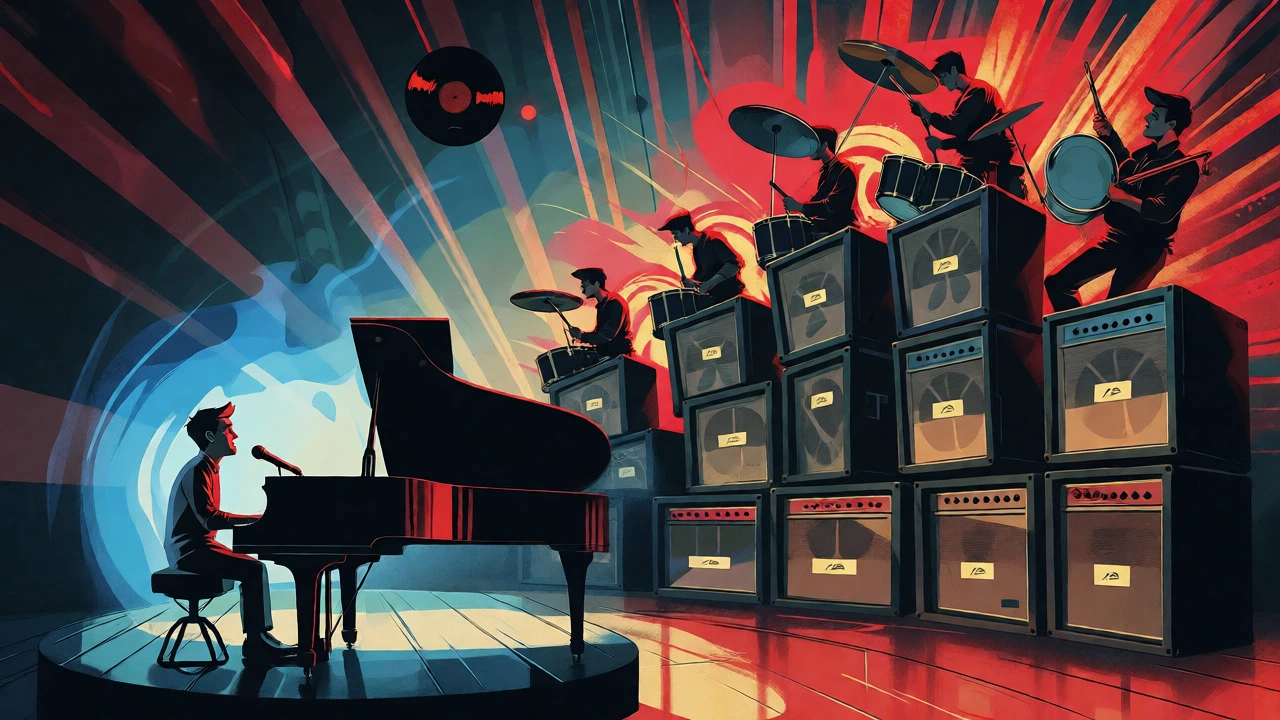
Arrangements: Mixing Intimacy with Arena-Scale Power
How did engineers capture this mix of intimacy and power? The arrangements relied on a specific layering strategy. Typically, the verses would feature clean tones-acoustic strumming, clean electric arpeggios, or a mellow organ. This kept the texture light and allowed the vocals to sit upfront. As the song moved toward the chorus, producers would introduce distortion. Not just any distortion, but heavy, sustained fuzz or overdrive that filled the stereo field. Take The Carpenters’ "Goodbye to Love" (1972). While not a hard rock band, their guitarist Tony Peluso inserted a heavily distorted, sustained lead break into an otherwise soft, orchestrated pop song. Critics see this as a prototype because it smashed two worlds together: delicate orchestration and raw rock aggression. Hard rock bands adopted this quickly. Styx’s "Lady" (1973) is another prime example. Dennis DeYoung wrote it with a dramatic vocal arc supported by organ and guitar. Metro Times later called DeYoung the "father of the power ballad" because he perfected the blend of keyboard warmth and guitar bite.
| Song Title | Artist | Year | Key Instrumental Feature | Dynamic Arc |
|---|---|---|---|---|
| Stairway to Heaven | Led Zeppelin | 1971 | Acoustic to Electric Transition | Folk intro → Heavy Rock Climax |
| Dream On | Aerosmith | 1973 | Piano & High-Register Vocals | Intimate Verse → Explosive Chorus |
| Free Bird | Lynyrd Skynyrd | 1974 | Extended Guitar Solo Coda | Blues Shuffle → Double-Time Jam |
| Without You | Badfinger | 1970 | Piano-Led Melody | Gentle Build → Dramatic Vocal Peak |
| Lady | Styx | 1973 | Organ & Guitar Harmony | Melodic Verse → Anthemic Chorus |
Emotional Hooks: Why Simple Lyrics Hit Harder
You might think complex poetry drives these songs, but it’s actually the opposite. The most effective hard rock ballads use direct, sometimes cliché lyrics. Nazareth’s "Love Hurts" (1975) doesn’t try to be clever. It states plainly that love hurts. Dan McCafferty’s raspy voice sells the pain more than any metaphor could. Journalist Charles Aaron argues that the hook lies in moving from narrative description to "wordless intensity." Once the words run out, the guitar solo takes over the emotional load. This is crucial. In a standard pop song, the bridge might offer a lyrical twist. In a 70s hard rock ballad, the bridge often leads to a solo that acts as an exclamation point. The listener stops analyzing the meaning and starts feeling the vibration. Songs like Kansas’s "Dust in the Wind" (1977) use simple imagery about mortality, paired with a fingerpicked acoustic riff that evolves into a full band arrangement. The simplicity allows the listener to project their own feelings onto the song, making the experience personal and cathartic.
Production Techniques: Creating Space and Grandeur
The sound of these ballads is inseparable from how they were recorded. Producers in the 70s favored wide stereo panning. Rhythm guitars were placed hard left and right, creating a sense of width. Lead guitars and vocals stayed central, cutting through the mix. Drums were often drenched in reverb to mimic the acoustics of large arenas. This wasn’t just aesthetic; it was functional. These songs were written for live performance in venues holding thousands of people. The production had to translate the feeling of being in a crowd to someone listening on a home hi-fi system. Bass lines played a subtle but vital role. Instead of driving the rhythm aggressively, bassists in ballads often held down long, sustaining notes that grounded the soaring guitars. This created a foundation that felt massive but didn’t clutter the mid-range frequencies where the vocals lived. When the climax hit, the combination of layered guitars, prominent cymbals, and powerful bass created a "wall of sound" that defined the era’s sonic identity.
Legacy: Setting the Stage for the 80s
By 1979, the formula was proven. Styx’s "Babe" reached Number 1, and Journey’s "Lovin’, Touchin’, Squeezin’" cracked the Top 20. These songs signaled a transition. The rougher edges of the early 70s were smoothing out, leading directly into the polished, synthesized power ballads of the 1980s. Bands like Bon Jovi and Poison would later take the structural rules established by Zeppelin and Aerosmith and apply them to a more commercial, radio-friendly format. But the 70s originals retain a unique charm. They display greater structural variety than their 80s successors. You get folk-influenced suites like "Stairway," blues hybrids like "Free Bird," and concise piano pieces like "Lady." This diversity proves that the genre wasn’t just a marketing gimmick; it was a genuine artistic exploration of how amplified instruments could express human vulnerability. Today, streaming playlists continue to rotate these tracks, proving that the emotional hooks crafted fifty years ago still resonate with new generations.
What defines a hard rock ballad?
A hard rock ballad is characterized by a dynamic structure that begins with low-volume, intimate instrumentation (like acoustic guitar or piano) and builds to a high-volume, distorted guitar-heavy climax. Lyrically, it focuses on themes of love, loss, or longing, often transitioning into wordless vocal intensity or extended guitar solos.
Why are 1970s hard rock ballads considered prototypes for power ballads?
They established the core formula of combining sentimental pop songwriting with rock amplification. Unlike earlier love songs, these tracks used loudness and distortion as tools for emotional expression, creating a template that 1980s glam metal bands later standardized into the modern "power ballad."
Which songs best exemplify the 1970s hard rock ballad style?
Key examples include Led Zeppelin's "Stairway to Heaven" (1971), Aerosmith's "Dream On" (1973), Lynyrd Skynyrd's "Free Bird" (1974), Badfinger's "Without You" (1970), and Styx's "Lady" (1973). These songs showcase the typical build-from-quiet-to-loud structure and emotional vocal delivery.
How did FM radio influence the popularity of these ballads?
In the mid-1970s, FM radio stations began favoring album-oriented rock, allowing longer tracks to receive airplay. This enabled complex, multi-minute ballads like "Stairway to Heaven" to become mainstream hits despite their length, which would have been too long for single-focused AM radio.
What role does the guitar solo play in these songs?
The guitar solo serves as an emotional exclamation point. After the lyrics reach their peak, the solo provides a section of "wordless intensity," allowing the musician to express feelings that words cannot capture, often using sustained bends and high-register notes to maintain the emotional tension.
