

You might think MTV was a global phenomenon from day one. But if you were watching television in Tokyo or Mumbai in 1985, you probably didn’t have an MTV button on your remote. The channel launched in New York on August 1, 1981, but its international footprint took years to build. This wasn’t just about exporting American rock songs; it was about selling a new way of consuming music. Before MTV, you heard music on the radio or saw it at a concert. After Music Television, you watched it as a visual product, packaged with fashion, narrative, and celebrity branding.
The spread of this format changed how we understand pop culture. It created a shared language for youth across borders, even when that language was heavily accented by American corporate interests. Let’s look at how this visual revolution actually happened in Europe and Asia during the pivotal decade of the 1980s.
The American Blueprint That Shook the World
Warner-Amex Satellite Entertainment launched MTV with a simple premise: fill airtime with cheap, prerecorded videos supplied by record labels. The first video played was "Video Killed the Radio Star" by The Buggles. It was ironic, given that the channel would soon kill radio’s monopoly on music discovery. Initially, the channel had only about 250 videos in rotation and fewer than a million viewers. But the demographic sweet spot-ages 12 to 34-was lucrative for advertisers.
A critical factor in MTV’s early success was its reliance on British acts. Labels like Virgin and EMI had already invested in high-quality promotional videos, unlike many American artists who were still focused on live performance. This led to the "Second British Invasion," where bands like Duran Duran and The Police dominated US airwaves because they looked good on screen. However, this focus exposed a blind spot. Early executives doubted Black artists would resonate with their core audience, delaying the rotation of Michael Jackson’s "Billie Jean". When they finally caved, the massive commercial success proved that visual appeal transcended racial boundaries, forcing a structural change in the channel’s programming.
Europe’s Precursors and the Launch of MTV Europe
Before MTV arrived in Europe, the continent wasn’t sitting idle waiting for American content. A service called Music Box started broadcasting in March 1984. Backed by Virgin-associated interests, it used satellite technology to reach potential viewers across Europe and the Middle East. While technical barriers like expensive satellite dishes limited actual reach, Music Box proved that pan-European music television was viable. It operated until January 1987, just months before MTV made its own move.
Meanwhile, the United Kingdom developed its own localized approach. Channel 4 launched The Chart Show in April 1986. Unlike MTV’s personality-driven VJ format, The Chart Show was presenter-less, focusing purely on the videos themselves within the context of national charts. It showed that European audiences wanted video culture, but not necessarily the specific American packaging.
| Service | Launch Date | Format Style | Geographic Reach |
|---|---|---|---|
| Music Box | March 1984 | Satellite/Cable, mixed language | Potential 60M+ viewers in Europe/Middle East |
| The Chart Show | April 1986 | Presenter-less, chart-focused | United Kingdom (Channel 4/ITV) |
| MTV Europe | August 1987 | VJ-led, continuous rotation | Pan-European via satellite/cable |
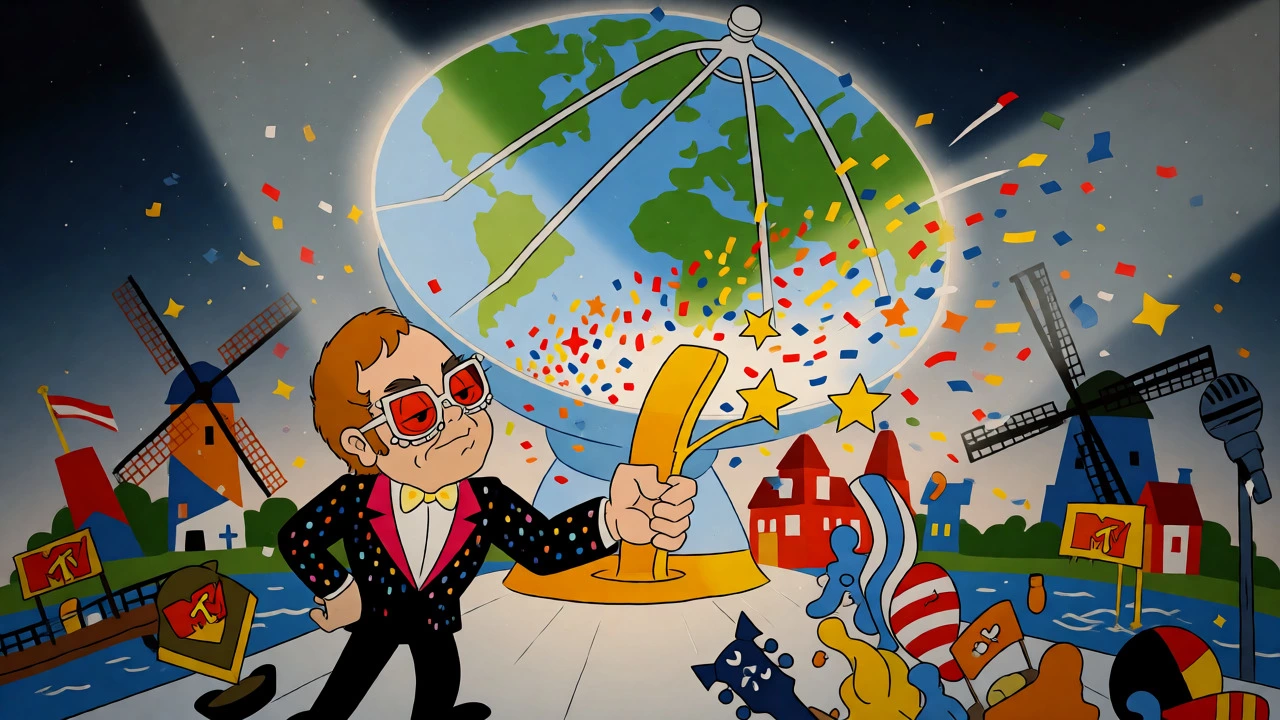
MTV Europe officially launched on August 1, 1987, from Amsterdam. The opening night featured Elton John flipping a switch and Dire Straits’ "Money for Nothing" playing first. The choice of Amsterdam was symbolic-it represented a supranational identity, distinct from London or New York. However, the channel faced immediate criticism for being too Anglo-American. Its English-language dominance felt imperialistic to some local audiences, and its playlist often ignored non-English hits. Over time, MTV Europe adjusted, moving production to London in 1989 and slowly incorporating more diverse content, but the initial tension between global branding and local relevance defined its first few years.
Regulatory Walls and Cultural Resistance
The spread of American video culture wasn’t happening in a legal vacuum. European regulators watched the influx of US media with growing concern. By the late 1980s, there was a significant audiovisual trade deficit between Europe and the United States. In response, the European Commission adopted Directive 89/552/EEC, known as "Television Without Frontiers," in October 1989. This regulation aimed to facilitate the free circulation of TV services while mandating quotas for European-produced content.
This directive didn’t stop MTV, but it forced a shift. Broadcasters had to balance the popularity of imported American videos with the requirement to support local industry. It normalized the idea that transnational channels could operate across borders, provided they respected certain cultural protections. For MTV, this meant navigating a complex landscape where regulatory compliance became part of the business model, ensuring that the "global" brand had to at least acknowledge local laws and sensibilities.
Asia: Influence Before Arrival
Here is a common misconception: MTV did not broadcast in Asia during the 1980s. The first branded MTV Asia channel didn’t launch until September 15, 1991, through a partnership with STAR TV. So, what were Asian audiences watching? They were experiencing the *logic* of MTV without the brand.
In India, state broadcaster Doordarshan dominated the landscape. It introduced color TV and regional languages throughout the 1980s. Programs like Hot Tracks aired imported music videos, giving Indian youth their first taste of Western visual pop. Suketu Mehta, an Indian writer, recalls seeing Michael Jackson’s "Beat It" on Doordarshan as a generational shock, comparable to the impact of "Video Killed the Radio Star" in the US. This exposure laid the groundwork for the Indipop movement and the eventual acceptance of satellite channels in the 1990s.
Japan presents a different case. The country already had a robust entertainment infrastructure, including karaoke bars and dense commercial TV networks. Research by Chelsea Morgen Ward highlights how Japanese karaoke businesses integrated video screens into leisure spaces, creating a unique form of interactive video culture. Japanese producers also engaged in "cultural flows," repackaging Western styles for regional markets in places like Taiwan and Singapore. Koichi Iwabuchi’s work on Japanese transnationalism shows that Asia wasn’t just passively receiving American culture; it was actively remixing it. When MTV finally arrived in 1991, it entered a market that already understood and produced sophisticated visual music content.

The Human Element: VJs and Visual Identity
One of MTV’s most powerful exports was the role of the Video Jockey, or VJ. These hosts weren’t just announcers; they were style icons and gatekeepers. In the US, figures like Nina Blackwood and Mark Goodman became celebrities. As the format spread, the concept of the VJ adapted locally. In Europe, the lack of strong local VJs initially hurt MTV Europe’s connection with audiences. People trusted local presenters more than distant American ones.
The visual grammar of the videos themselves also shifted stardom. Artists like Madonna and Cyndi Lauper didn’t just sing songs; they performed characters. Fashion, dance moves, and narrative arcs became essential components of the musical product. Ann Kaplan, in her seminal analysis Rocking Around the Clock, described these videos as resembling advertisements, categorized into types like romantic, socially conscious, or nihilistic. This classification helped analysts understand how MTV shaped consumer desires. You weren’t just buying a song; you were buying into an aesthetic lifestyle.
Legacy of the Decade
The 1980s established the template for modern music consumption. It moved the center of gravity from audio to audiovisual. Record companies realized that investing in high-production-value videos was no longer optional-it was necessary for international sales. Satellites broke down national barriers, allowing a teenager in Berlin to watch the same clip as someone in Los Angeles almost simultaneously.
However, the story isn’t one of total Americanization. Europe maintained strong national broadcasters that competed with MTV. Asia developed its own vibrant video cultures, influenced by Japanese and Indian domestic productions. The legacy of Global MTV in the 1980s is a hybrid one: a global standard for promotion, filtered through local tastes, regulations, and creative traditions. It taught the world that music could be seen, not just heard, setting the stage for the internet age where visuals dominate everything from TikTok to YouTube.
When did MTV launch in Europe?
MTV Europe launched on August 1, 1987, exactly six years after the US debut. It began broadcasting from Amsterdam, symbolizing its pan-European ambitions.
Was MTV available in Asia during the 1980s?
No, the branded MTV channel did not launch in Asia until September 1991. However, Asian audiences were exposed to music videos through local programs on state broadcasters like Doordarshan in India and various commercial networks in Japan.
What was Music Box?
Music Box was a pioneering pan-European music video channel that operated from 1984 to 1987. It preceded MTV Europe and demonstrated the feasibility of satellite-distributed music television in the region.
Why did MTV initially struggle with diversity?
Early MTV executives believed their core demographic of white suburban teens wouldn't respond to Black artists. This led to the underrepresentation of urban music until the massive success of Michael Jackson's videos forced a change in policy.
How did regulations affect MTV in Europe?
The European Union's "Television Without Frontiers" directive in 1989 encouraged the circulation of TV services while promoting European content. This pressured channels like MTV to include more local and European material alongside American imports.