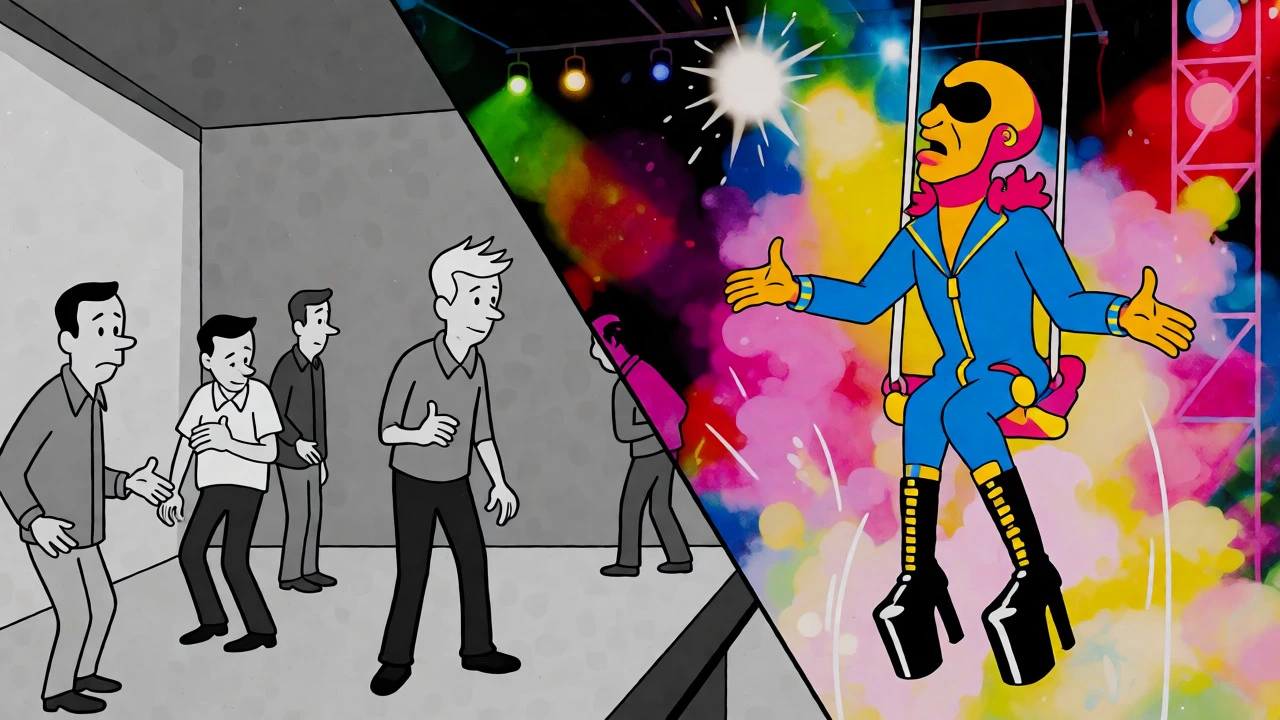

Imagine walking into a venue in 1970. You see a band on a bare stage, maybe a couple of colored lights, and the musicians looking like they just rolled out of bed. Fast forward to 1973, and you’re watching a human alien descend from the ceiling, wearing platform boots that could crush a car, while fog machines hiss and spotlights chase him through a haze of theatrical smoke. This wasn’t magic; it was Glam Rock, a movement that fundamentally rewired how we experience live music.
If you’ve ever wondered why modern concerts feel like blockbuster movies rather than just gigs, you can thank the glam era. Between 1971 and 1976, artists like David Bowie and KISS didn’t just play songs; they engineered visual events. They turned the stage into a canvas where costume, lighting, sound, and choreography had to work together perfectly. This article breaks down exactly how they did it, what technical hurdles they faced, and why their approach still dictates the rules of stagecraft today.
The Shift from Authenticity to Theatricality
Before glam, rock culture was obsessed with "authenticity." If you wore makeup or used props, you were seen as fake. Bands wanted to look like regular guys playing instruments. Glam shattered this rule. Philip Auslander, a professor of performance studies, argues that glam challenged this ideology by openly admitting that the performer is acting a role. It wasn’t about revealing your true self; it was about constructing a character.
This shift changed the job description for everyone involved. A singer wasn’t just a vocalist anymore; they were a lead actor. A guitarist wasn’t just strumming chords; they were part of a visual ensemble. This required a new level of coordination. You couldn’t just show up and improvise the visuals. Every entrance, every costume change, and every light cue needed to be rehearsed like a Broadway show. The concert became a piece of theater, and the audience knew it.
Bowie’s Ziggy Stardust: Engineering an Alien
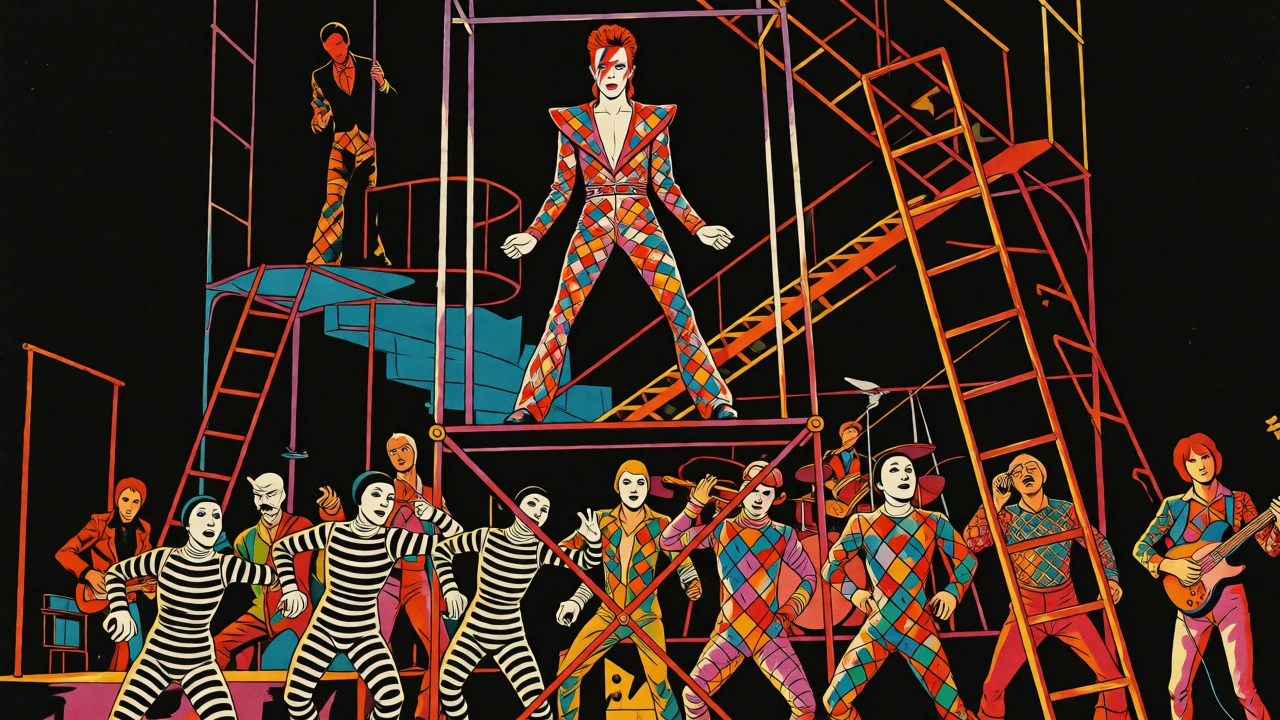
No case study illustrates this better than Ziggy Stardust. In July 1972, David Bowie appeared on Top of the Pops wearing a bright blue zip-up jacket and tight trousers designed by Freddie Burretti. That single image changed pop culture overnight. But the TV appearance was just the tip of the iceberg. The real innovation happened at the Rainbow Theatre in London later that year.
Bowie didn’t just hire a band; he hired a mime troupe led by Lindsay Kemp. Why? Because he wanted precise physical control over his movements. He studied mime to learn how to communicate emotion without words, which translated directly to stage presence. The stage itself was built from scaffolding, platforms, and ladders, creating multiple levels. This allowed Bowie to appear above the band, isolating him as the star while the Spiders from Mars provided the musical foundation.
The costumes were also technical tools. Burretti sourced fabrics from Liberty and street markets in Cyprus to create quilted suits that caught the light dramatically. These outfits weren’t just pretty; they made Bowie legible from the back row of a large venue. When the lights hit him, the texture and color popped, ensuring he remained the focal point even in a dark hall. This attention to detail meant that fashion design, lighting, and staging were no longer separate departments-they were one integrated system.
KISS and the Industrialization of Spectacle
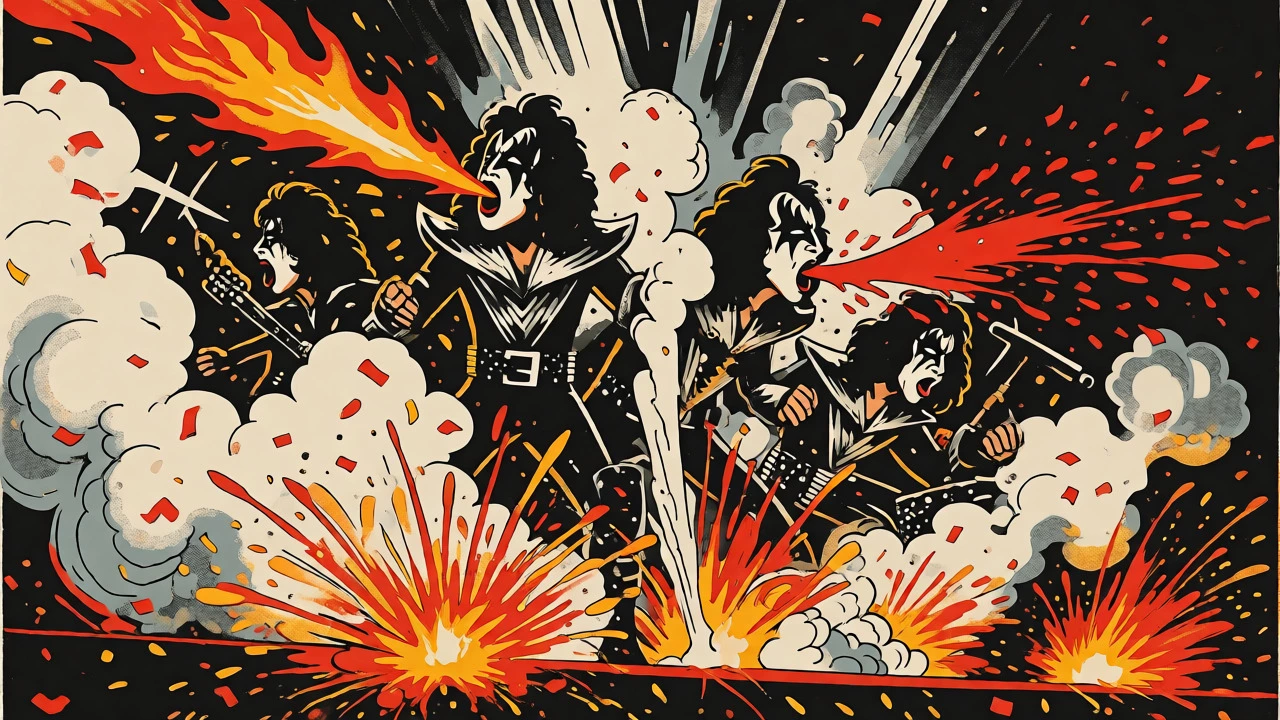
While Bowie refined the art of character, American bands like KISS industrialized the spectacle. By the mid-1970s, KISS took the glam aesthetic and cranked the volume up-literally and visually. They combined face paint (their version of makeup) with pyrotechnics, fire-breathing, and blood-spitting effects.
Consider their 1976 Destroyer tour. Reports from the Washington Post noted that within the first 40 seconds, the stage filled with thick smoke, Gene Simmons breathed fire, and torches exploded. KISS didn’t invent fire effects or smoke machines; psychedelic bands in the 1960s already used them. What KISS did was synchronize these elements into a dense, repeatable brand identity. They proved that a concert could be a product you buy, not just a memory you make.
This required serious logistical planning. Managing fire on stage involves fuel delivery, ignition timing, and safety protocols that didn’t exist in standardized form yet. Early fire effects relied on manual ignition and crude fuel systems, meaning one mistake could burn down a venue. KISS’s success forced the industry to develop safer, more reliable special effects technologies, paving the way for the massive pyro shows we see today.
The Technical Ecosystem Behind the Glitter
You can’t have a glam show without the right gear. In the early 1970s, touring bands often relied on whatever equipment the venue provided. This usually meant basic amplification and a few static lights. As glam acts grew in popularity, they started carrying their own production packages. This included specific lighting fixtures, custom cabling, dimmers, and followspots.
Companies like Showco, founded in Dallas in 1970, began renting out large-scale sound and lighting systems. This allowed bands to reproduce their designed look in different cities, regardless of the local venue’s capabilities. By the end of the decade, top-tier tours moved from using dozens of lights to hundreds, sometimes reaching 1,000 fixtures per show. This expansion created a new business model: the rental house. Instead of owning every cable and lamp, bands rented specialized gear, making high-production values accessible to more artists.
| Production Element | Pre-Glam Standard (Early 1970s) | Glam-Influenced Standard (Late 1970s) |
|---|---|---|
| Lighting | Venue-provided washes, basic followspots | Portable rigs, moving heads, synchronized cues |
| Costume | Casual wear, denim, leather | Custom designs, character-specific, durable for touring |
| Stage Design | Minimal scenery, risers | Scaffolding, multi-level platforms, props |
| Special Effects | Rare, ad-hoc | Integrated smoke, fire, confetti, lasers |
| Crew Role | Sound engineer only | Lighting director, stage manager, effects operator |
Safety and Logistics: The Hidden Costs
All this glitter came with significant risks. Multi-level scaffolding introduced fall hazards. Fog machines, while great for atmosphere, could obscure emergency exits and confuse cameras. Pyrotechnics posed ignition risks that varied wildly depending on the crew’s experience. There was no universal safety code for stage effects yet, so each band developed its own protocols.
Financially, this was expensive. Building a set like Bowie’s "Hunger City" for the Diamond Dogs tour reportedly took 36 hours of labor. Transporting all this gear required trucks, insurance, and permits. Smaller acts couldn’t afford this level of production, leading to a divide between major label spectacles and independent club gigs. However, the *aesthetic* of glam was cheap to imitate. Makeup and attitude cost little, allowing fans to participate in the trend even if they couldn’t afford the full technical package.
Legacy: From Arena Rock to LED Walls
The techniques pioneered during the glam era didn’t disappear when the fad faded. They evolved. The integration of persona and production seen in Bowie’s work influenced everything from Madonna’s tours to Lady Gaga’s meat dress. The synchronization of music and visuals laid the groundwork for the music video era and modern arena tours.
Today, when you see a concert with automated lighting, LED screens, and coordinated pyro, you are seeing the direct descendants of glam rock innovations. The expectation that a major concert should be a reproducible, branded environment is a result of the standards set between 1971 and 1976. Glam proved that stagecraft isn’t just support infrastructure; it’s a primary artistic medium.
Frequently Asked Questions
Did glam rock invent stage lighting?
No, stage lighting existed long before glam rock. Psychedelic bands in the 1960s used light shows, and theaters had sophisticated lighting rigs for decades. However, glam rock normalized the use of dramatic, synchronized lighting as a core component of rock concerts, moving away from simple venue-provided washes to custom-designed lighting plots that traveled with the band.
Why was makeup important in glam rock performances?
Makeup served two purposes: artistic expression and practical visibility. Artistically, it helped performers adopt fictional personas like Ziggy Stardust or the KISS characters, challenging traditional gender norms. Practically, heavy makeup and bright colors ensured performers remained visible and expressive under harsh stage lights and from distant seats in large arenas.
How did glam rock affect concert logistics?
It increased complexity significantly. Bands had to carry more equipment, including custom lighting, props, and special effects gear. This led to the rise of professional touring crews, including dedicated stage managers and lighting technicians. It also spurred the growth of equipment rental companies like Showco, which supplied the necessary hardware for large-scale tours.
Was glam rock just about fashion?
Fashion was a key element, but it was part of a broader theatrical strategy. Glam rock integrated costume with choreography, set design, and narrative structure. The goal was to create a cohesive visual world around the music, turning the concert into a multimedia event rather than just a musical recital.
Which band best represents the transition from glam to stadium rock?
KISS is often cited as the bridge. They retained the glam emphasis on persona and visual spectacle but scaled it up for larger venues using pyrotechnics and elaborate stage setups. Their approach influenced subsequent arena rock acts like Queen and Alice Cooper, who further refined the balance between musical performance and visual production.
