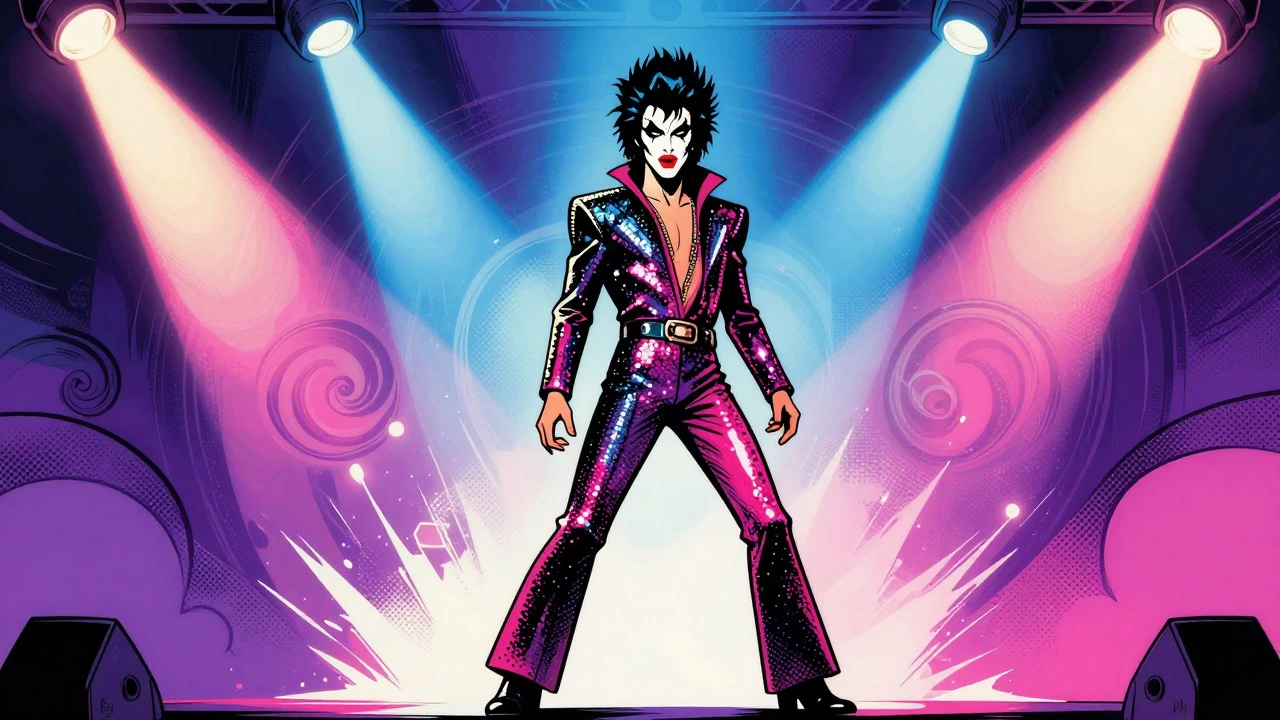

Imagine stepping onto a stage in 1972. The lights are blinding, the heat is intense, and you need your face to read as clearly from the back row as it does up close. This was the reality for Glam Rock, a musical movement that turned concerts into high-stakes performance art between roughly 1970 and 1975. It wasn't just about loud guitars; it was about visual shock. Artists like David Bowie and Marc Bolan didn't just wear makeup; they used it to construct entirely new identities, blurring gender lines and challenging norms with pale foundations, glittering accents, and geometric symbols.
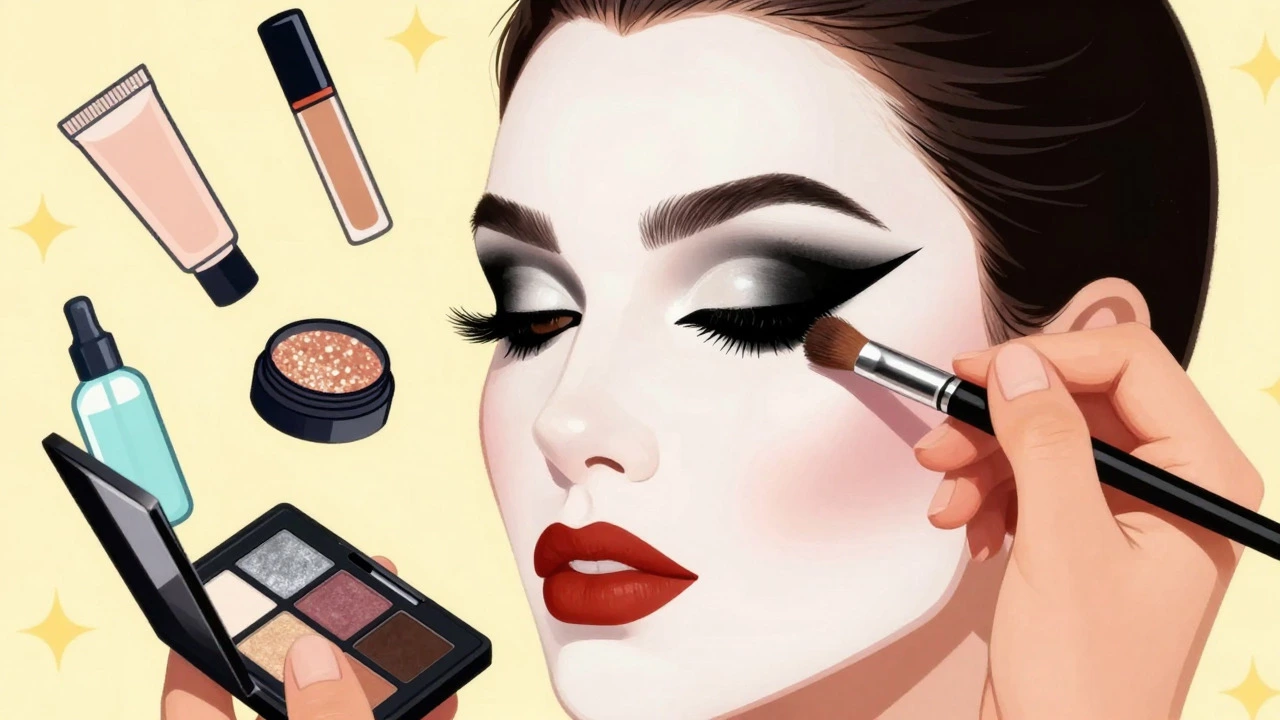
If you want to recreate these iconic looks today-whether for a tribute band, a costume party, or just to experiment with your own style-you need more than just heavy eyeliner. You need to understand the specific techniques and product choices that made these looks survive under hot stage lights without melting or cracking. Here is how to master the art of glam rock makeup.
The Foundation of Glam: Pale Bases and Androgyny
The most defining characteristic of classic glam rock makeup is the base. Forget natural skin tones. The goal was an otherworldly pallor that contrasted sharply with the dark clothing and bright stage lighting. This aesthetic allowed performers to create fluid identities on stage, separating their personal selves from their artistic personas.
- Choose the right shade: Look for a foundation that is significantly lighter than your natural skin tone. In the 1970s, artists often used white rice powder purchased from discount stores to achieve this stark canvas. Today, color-correcting concealers mixed with light foundation can help you reach that porcelain finish without looking cakey.
- Cover the eyebrows: One of the first steps in any Ziggy Stardust tutorial is hiding the brows. Use a thick concealer or a specialized brow cover-up to completely erase your natural arches. This creates a blank slate for the dramatic eye shapes that follow.
- Set it heavily: Because stage lights generate immense heat, sweat is your enemy. Set your pale base with a translucent powder. In modern recreations, setting sprays applied both before and after makeup application are essential to lock everything in place for long sets.
Bold Eyes: Kohl, Liner, and Dimension
While the face provided a blank canvas, the eyes were where the drama lived. Glam rock makeup relied on heavy definition to ensure visibility from a distance. David Bowie, for instance, famously lined his eyes with Indian black kohl, smudging it along the lash line for a soft yet intense effect.
- Apply black liner generously: Use a waterproof black pencil or liquid liner to draw thick lines around the upper and lower lash lines. Don't be afraid to go beyond the natural eye shape.
- Add metallic shadows: Layer silver, blue, or gold eyeshadows over the liner. The key is dimension. Mix matte and shimmer finishes to catch the light differently as you move.
- Smudge for texture: Unlike precise editorial beauty, glam rock often embraced a slightly messy, "runny" aesthetic. Smudging the liner slightly gives it that raw, rock-and-roll energy while still maintaining structure.
Contouring and Cheekbones: Sculpting the Face
Contouring in glam rock wasn't about subtle enhancement; it was about exaggeration. Artists used strong reds and browns to sculpt exaggerated cheekbones that popped under colored stage lights. This technique helped define the facial structure against the flat, pale base.
When applying contour, focus on the hollows of your cheeks and blend upwards towards the temples. Use a mix of cool-toned bronzers and warm blushes. As noted in historical accounts, Bowie’s contour often read as "rather pinky," suggesting a vibrant, almost bruised look rather than a neutral shadow. This added depth and character to the face, making expressions readable even when the rest of the face was masked in white.
Graphic Symbols: Circles, Bolts, and Glitter
The true signature of glam rock makeup lies in its graphic elements. These weren't random decorations; they were symbolic markers of the persona. The most famous examples include the astral circle on Ziggy Stardust's forehead and the lightning bolt across Aladdin Sane's face.
| Symbol | Associated Persona | Application Technique | Product Type |
|---|---|---|---|
| Astral Circle / Gold Sphere | Ziggy Stardust | Painted center of forehead, sometimes outlined with rhinestones | Metallic gold eyeshadow or cake paint |
| Lightning Bolt | Aladdin Sane | Splitting the face diagonally, half black/red, half white | High-contrast cream paints |
| Black Smears | Alice Cooper (Shock Rock) | Heavy, uneven application around eyes | Kohl pencils and charcoal powders |
To create these symbols yourself, precision is key. Use fine-tipped brushes for outlines. For the gold circle, apply a metallic gold base and then press tiny rhinestones or glitter onto wet adhesive like eyelash glue for added dimension. Remember, symmetry matters less than impact. If the symbol feels off-center, lean into it-it adds to the chaotic energy of the genre.
Stage-Ready Products: What Actually Works?
One common mistake people make when trying glam rock makeup is using too much loose glitter. While it looks great in photos, loose glitter falls into your eyes under hot lights and lacks the "soft" quality needed for professional wear. Historical records show that Bowie avoided excessive loose glitter because it irritated his eyes and didn't hold up well during performances.
Instead, opt for these product types:
- Cream-based glitters: These adhere better to the skin and don't shed as easily. They provide a smooth, reflective surface that catches light beautifully.
- Long-wear mascaras: Use waterproof formulas to prevent running. In the 1970s, "old-fashioned" mascaras were common, but today’s tubing mascaras offer superior longevity.
- Lip glosses and creams: Products like Elizabeth Arden Eight-Hour Cream were staples for adding a glossy, hydrated finish to lips and eyelids. This kept the skin flexible and prevented cracking during long shows.

Modern Adaptations: From Euphoria to Everyday Glam
Glam rock makeup isn't stuck in the past. Its influence is visible everywhere, from the dimensional glitter looks on HBO’s *Euphoria* to the gender-fluid aesthetics of modern pop stars like Lady Gaga. Makeup artist Doniella Davy has cited 1970s glam as a major inspiration for her work, noting that teenagers today use makeup similarly to how Bowie did-to portray "who they want to be that day."
For those wanting to adapt these techniques for everyday wear, start small. Instead of a full white face, try a pale highlighter on the cheekbones. Swap the massive lightning bolt for a single winged liner in a metallic shade. The core principle remains the same: use makeup as a tool for self-expression and identity construction, not just correction.
Troubleshooting Common Issues
Recreating these looks can be tricky. Here are solutions to frequent problems:
- Makeup melting: If your foundation slides off, you’re likely skipping the prep step. Always start with a primer designed for oily skin, and finish with a strong holding spray.
- Cracking paint: Graphic designs crack if the skin underneath is dry. Moisturize thoroughly before applying makeup, and use cream products rather than dry powders for large areas.
- Asymmetry: Drawing a perfect circle or bolt is hard. Take your time, use stencils if necessary, and remember that slight imperfections add character. Real stage makeup is never perfectly symmetrical due to movement and lighting angles.
What is the most important product for achieving a classic glam rock look?
A pale, full-coverage foundation is the cornerstone. Without the stark contrast of a white or very light base, the bold contours and graphic symbols lose their impact. Pair this with a high-quality setting powder to ensure it stays put under lights.
Did David Bowie use loose glitter in his makeup?
Surprisingly, no. Historical accounts indicate he disliked loose glitter because it fell into his eyes and lacked a soft texture. He preferred metallic creams and cakes that adhered smoothly to the skin, ensuring comfort during long performances.
How long did it take to apply full glam rock stage makeup?
In the early 1970s, artists like Bowie spent at least two hours before each concert getting their makeup done. This included intricate contouring, painting symbols, and sealing the look. Modern tutorials condense this to 20-40 minutes for home users.
Can I recreate these looks with drugstore products?
Absolutely. Many modern tutorials demonstrate that standard consumer products like L’Oréal liners, affordable foundations, and basic eyeshadows can achieve authentic results. The technique matters more than the price tag.
What is the difference between glam rock and shock rock makeup?
Glam rock focuses on androgynous beauty, metallic finishes, and geometric symbols (like Bowie’s circles). Shock rock, exemplified by Alice Cooper, leans towards horror themes with smeared black eyes, fake blood, and aggressive imagery. Glam is about glamour; shock is about fear.


