
When you think of 1970s jazz, what comes to mind? Probably Miles Davis’s electric experiments or Herbie Hancock’s funk grooves. But if that’s all you hear, you’re missing half the story. The decade wasn’t just a male-dominated playground for fusion; it was a fertile ground for female innovators who reshaped the genre’s boundaries. From spiritual jazz pioneers to avant-garde composers, these women didn’t just participate in the scene-they defined its most adventurous edges.
This article digs into the specific contributions of vocalists and instrumentalists who broke barriers during this pivotal era. We’ll look at how artists like Alice Coltrane expanded instrumentation, how Bobbi Humphrey brought the flute into the mainstream, and why figures like Carla Bley deserve more than a footnote in standard histories. If you’ve ever felt that the classic jazz canon feels incomplete, this is where we start filling in the gaps.
The Electric Revolution and Gender Barriers
The 1970s are often described as an "electric revolution" in jazz. Textbooks on the subject highlight the two-way connection between jazz and rock, citing groups like Weather Report and Chick Corea’s Return to Forever. Yet, within this narrative of technological shift, women faced entrenched gender barriers. While men were encouraged to lead bands and experiment with synthesizers, women were frequently pushed toward vocal roles or behind-the-scenes arranging.
Despite this, a cohort of musicians refused to stay in the background. They navigated a music industry that often sidelined them, creating spaces for themselves through sheer artistic force. The establishment of events like the Kansas City Women’s Jazz Festival in 1977 marked a turning point. It provided a dedicated stage for women improvisers when mainstream festivals remained overwhelmingly male. This structural support allowed artists to showcase their talents not as novelties, but as central figures in the evolving sound of jazz.
Alice Coltrane and the Spiritual Expansion
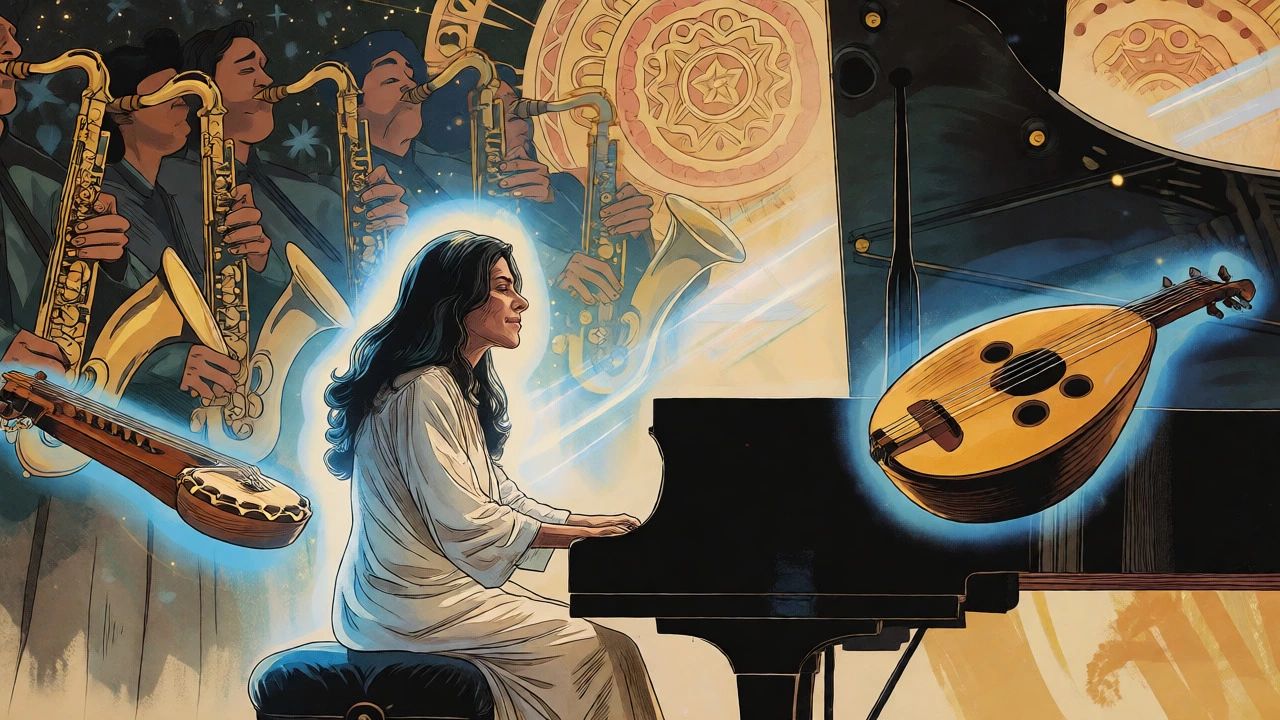
No discussion of 1970s innovation is complete without Alice Coltrane. She stands out as one of the decade’s most influential spiritual jazz bandleaders. On her landmark album Journey in Satchidananda (Impulse!, 1971), she expanded the traditional jazz palette significantly. She incorporated instruments like the oud and tamboura, creating a sitar-like drone that underpinned modal improvisations.
| Attribute | Details |
|---|---|
| Primary Instruments | Harp, Piano, Organ |
| Musical Style | Spiritual Jazz, Avant-Garde, Modal |
| Key Album | Journey in Satchidananda (1971) |
| Collaborators | Pharoah Sanders, Cecil McBee |
Coltrane’s work reframed jazz improvisation through the lens of Eastern spirituality. Critics now rank Journey in Satchidananda as the defining spiritual jazz record of the era. Her use of harp and piano over Pharoah Sanders’s soprano saxophone created a texture that was both meditative and intense. By leading large ensembles in this style, she challenged the notion that such complex orchestration was exclusively a male domain.
Bobbi Humphrey and Dorothy Ashby: Breaking Instrument Stereotypes
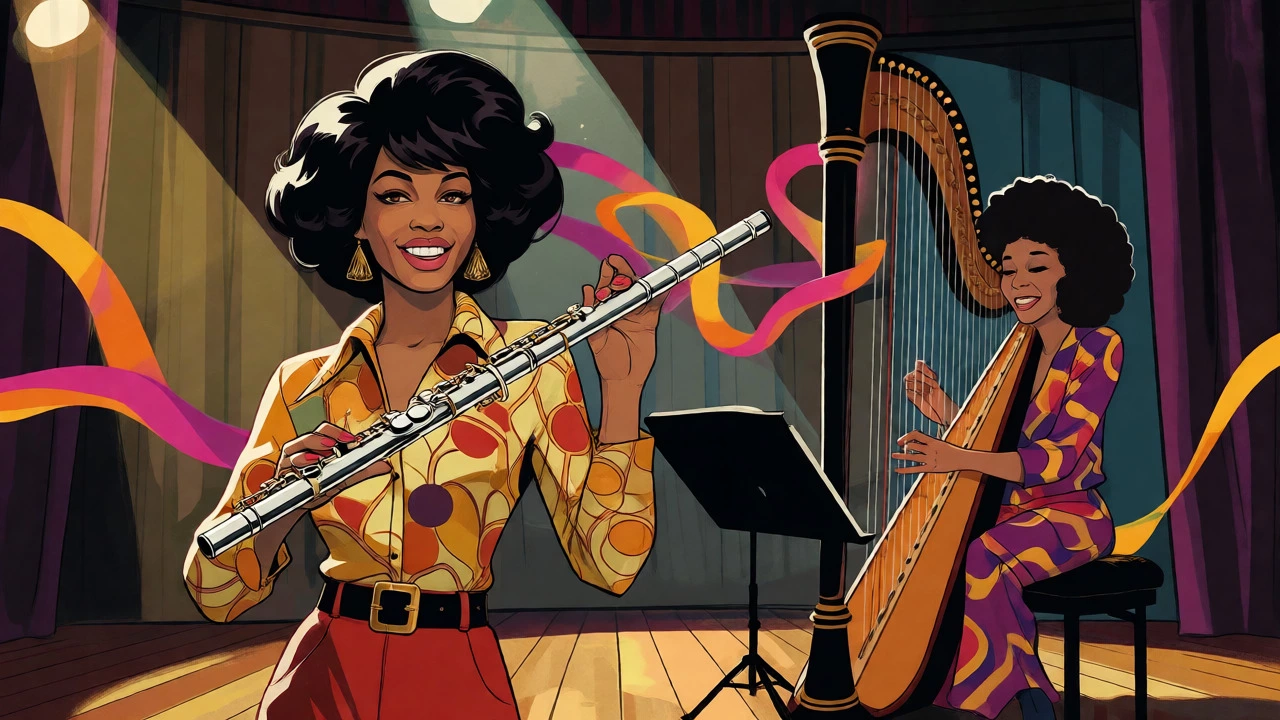
If Coltrane expanded the spiritual dimension, flautist Bobbi Humphrey shattered commercial ceilings. In 1971, she became the first female instrumentalist signed by Blue Note Records. This was a massive deal. Blue Note was a powerhouse label, known for hard bop and later, fusion. Signing Humphrey signaled that a woman could hold her own in the groove-inflected jams of 1970s funk and R&B.
Her albums, such as Blacks and Blues (1974) and Fancy Dancer (1976), placed her alongside male peers like Grover Washington Jr. Her music swirled with the energy of the time, proving that the flute could be a lead voice in jazz-funk. Meanwhile, harpist Dorothy Ashby proved that the concert harp could swing. While her breakthroughs began earlier, her early 1970s work aligned with the period’s exploration of non-traditional timbres. Albums like The Rubaiyat of Dorothy Ashby blended bebop lines with soul and pop textures, showing that the harp was not just for classical recitals but a viable jazz instrument.
Carla Bley: The Architect of Large Ensembles
While some innovators focused on performance, Carla Bley revolutionized composition and arrangement. As a pianist, composer, and bandleader, she tackled politically engaged large-ensemble works. Her role as arranger on Charlie Haden’s Liberation Music Orchestra (released 1970) is often cited as one of the few successful attempts to fuse jazz with explicit political content.
Bley’s multi-year project Escalator Over the Hill further illustrates the era’s experimentation. It fused jazz, rock, and theatrical forms into a long-form structure that defied easy categorization. Unlike the smaller-group electric experiments of Miles Davis, Bley’s innovations lay in complex forms and mixed meters. Her work demonstrates that female composers were driving the avant-garde forward, even if standard histories often overlooked their contributions in favor of louder, more commercially visible male figures.
Flora Purim and the Vocal Fusion Frontier
Innovation wasn’t limited to instruments. Vocalist Flora Purim integrated Brazilian rhythmic phrasing and extended vocal techniques into acoustic and electric fusion contexts. Her work with Chick Corea’s group Return to Forever, particularly on the album Light as a Feather, showcased a new kind of singing.
Purim’s soaring, rhythmically flexible vocals paired with electric keyboards and Latin percussion helped redefine jazz singing. She moved beyond the standard ballad format, using her voice as another instrument in the ensemble. This approach opened space for other non-American, non-English-language voices in the fusion mainstream. Her influence can be heard in the way modern jazz vocalists approach rhythm and texture, treating the voice with the same flexibility as a saxophone or keyboard.
Vocal Continuity and the Next Generation
The 1970s also saw veterans carrying forward mid-century techniques into new contexts. Singers like Betty Carter treated the voice as a pure bebop horn, avoiding vibrato for a harder, more rhythmic sound. This technique blurred the lines between vocal and instrumental improvisation. Younger vocalists began experimenting with repertoire and band formats that would come to fruition in the 1980s.
Figures like Shirley Horn, though nationally prominent later, had established followings in the 1970s. These artists stood on the shoulders of giants like Ella Fitzgerald and Sarah Vaughan while pushing against recording bias. Their persistence ensured that the vocal tradition remained vibrant, even as the instrumental landscape shifted toward electronics and fusion.
Why Recognition Matters Now
For decades, the work of these women occupied a parallel but less publicized position. Standard histories emphasized male innovators, leaving women like Coltrane, Bley, and Humphrey in the margins. However, recent re-evaluations have begun to correct this. Curated lists and documentaries now place their recordings among the top of the decade.
The disparity between creative influence and commercial recognition was stark. Many female instrumentalists moved into roles as composers and arrangers instead of fighting for bandstand visibility. Today, reissue campaigns and academic interest are bringing their stories to light. Understanding their contributions isn’t just about historical accuracy; it’s about recognizing the full scope of jazz innovation.
Who was the first female instrumentalist signed by Blue Note?
Bobbi Humphrey was the first female instrumentalist signed by Blue Note Records in 1971. She was a flautist whose work in fusion and smooth jazz challenged gender norms in the industry.
What makes Alice Coltrane's 'Journey in Satchidananda' significant?
Released in 1971, the album is considered a cornerstone of spiritual jazz. It expanded the jazz palette by incorporating Eastern instruments like the oud and tamboura, and featured innovative collaborations with Pharoah Sanders.
How did Flora Purim change jazz vocals?
Purim integrated Brazilian rhythmic phrasing and extended vocal techniques into fusion music. Her work with Return to Forever demonstrated that the human voice could function flexibly as an instrument within electric jazz ensembles.
Was there a festival for women in jazz in the 1970s?
Yes, the Kansas City Women’s Jazz Festival began in the late 1970s. It provided a crucial platform for female improvisers and composers who struggled to find spots on mainstream, male-dominated festival bills.
Did Dorothy Ashby play only classical music?
No, Dorothy Ashby was a pioneering jazz harpist. She proved that the harp could swing and blend with bebop, soul, and pop textures, challenging the idea that it was strictly a classical instrument.