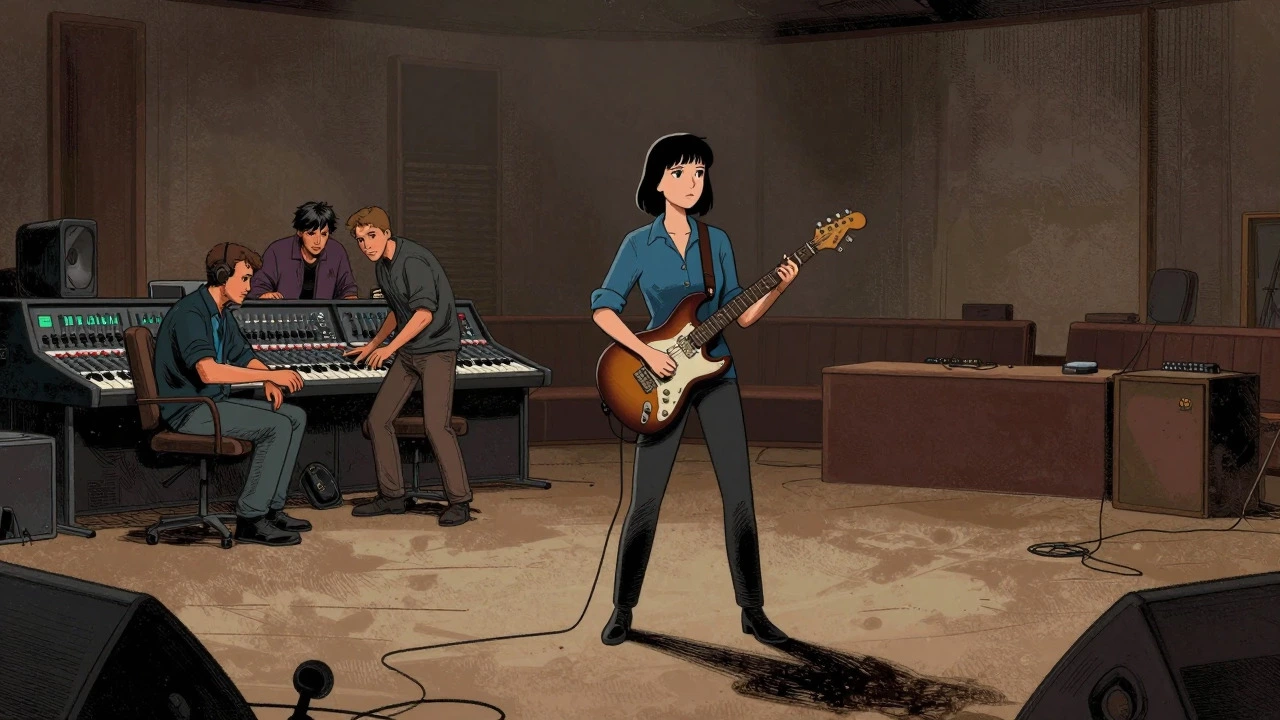

Imagine walking into a rehearsal room where you are the only woman. The guitars are tuned to drop D, the amps are cranked, and the conversation is thick with technical jargon that feels like it was written by someone else. For decades, this has been the standard reality for female band members who join predominantly male groups in genres like rock, metal, and punk. It is not just about playing an instrument; it is about navigating a space where your presence is often treated as an anomaly rather than a norm.
The numbers tell a stark story. A comprehensive study from Northwestern University analyzed releases between 1960 and 2000, finding that while women made up roughly 20% of commercially active artists in 1960, that number only climbed to about 25% by the year 2000. In the broader landscape of popular music, a 2019 report from the USC Annenberg Inclusion Initiative revealed that across the top 600 songs from 2012 to 2017, women accounted for just 22.4% of credited artists, 12.3% of songwriters, and a mere 2.1% of producers. These figures highlight a persistent imbalance that female musicians must contend with every time they strap on their gear and step onto a stage.
The Historical Context: From Vocalists to Instrumentalists
In the early days of rock and roll during the 1950s and 1960s, the role for women in bands was narrowly defined. If a woman was in a group, she was almost certainly the singer. Think of the girl groups associated with New York’s Brill Building or acts like The Ronettes, formed in 1957. Veronica "Ronnie" Bennett led the vocals, but the men controlled the instruments, the songwriting, and the business decisions. This dynamic set a precedent that lingered for decades: men played the serious instruments, while women provided the voice.
Even when women did break into mixed-gender rock bands in the late 1960s, their visibility was tied to their frontperson status rather than their musical control. Grace Slick joined Jefferson Airplane in 1966, and Janis Joplin fronted Big Brother and the Holding Company starting in the same year. Both were iconic figures, yet their power came primarily from their vocal presence. They were not typically seen as the architects of the band's sound or its commercial strategy. Professional women instrumentalists remained "initially uncommon," making any deviation from the vocalist role a rare and noteworthy event.
Pioneers Who Changed the Game
The tide began to turn in the early 1970s with the emergence of all-female bands and multi-instrumentalist women who refused to be confined to a single role. Fanny, signed to Warner Bros. Records in 1969 by Mo Ostin, is often cited as the first all-female rock band to achieve significant commercial success. Led by sisters June and Jean Millington, Fanny proved that women could handle the full spectrum of rock instrumentation. Their visibility helped make it "cool and accepted" for other women to pick up electric guitars and drums, challenging the notion that these instruments were exclusively male territory.
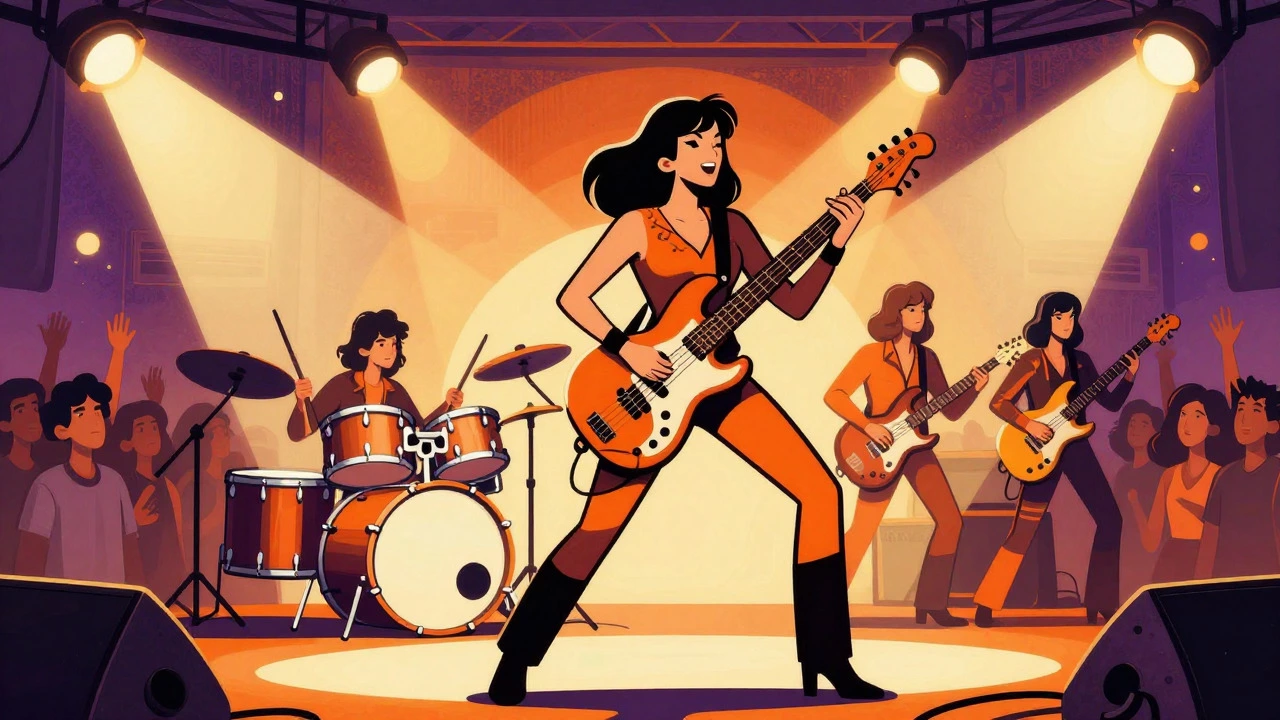
Suzi Quatro emerged in 1973 as a singular force in the genre. Music scholar Philip Auslander noted that at her debut, no other prominent female musician was simultaneously working as a singer, instrumentalist, songwriter, and bandleader in mainstream rock. Quatro played bass, wrote hits, and led her own band, effectively dismantling the idea that a woman needed a male counterpart to run a rock operation. Similarly, the hard-rock band Heart, founded by sisters Ann and Nancy Wilson, became a paradigm of female leadership within a mixed-gender context. By placing female guitar work at the center of their sound, they sold millions of records and showed that women could be the primary creative drivers of a major rock act.
Navigating the Modern Landscape
Fast forward to the 1980s, 1990s, and beyond, and the scene diversified, but the structural imbalance remained. Debbie Harry fronted Blondie, Kim Deal played bass in Pixies, and Dolores O’Riordan led The Cranberries. Each of these women held significant influence, yet they operated in an industry where the majority of festival bills and label rosters were still dominated by male bands. In heavy metal, a genre historically resistant to change, women like Lita Ford (of The Runaways) and Janet Gardner (of Vixen) carved out spaces in a touring circuit that was overwhelmingly male-coded.
Today, the situation shows incremental progress but far from parity. A 2022 analysis highlighted that there is literally only one American top-tier rock band led by a woman instrumentalist: Halestorm, fronted by Lzzy Hale. While artists like Amy Lee of Evanescence have achieved massive success, the perception that a woman leading a rock band is exceptional rather than normal persists. This scarcity affects how media covers these bands, often focusing on the novelty of the female leader rather than the quality of the music.
| Aspect | Typical Experience for Male Members | Typical Experience for Female Members |
|---|---|---|
| Perception of Skill | Assumed competent based on experience | Frequently questioned; must prove technical ability repeatedly |
| Media Coverage | Focus on music, lyrics, and production | Focus on appearance, gender, and "tokenism" |
| Industry Networks | Integrated into informal decision-making circles | Often excluded from backstage socializing and networking |
| Role Definition | Instrumentalist, songwriter, producer | Often restricted to vocals or specific "feminine" instruments |
The Unique Challenges Inside the Group
Being the lone woman in a male-dominated band creates a specific set of dynamics that differ from both solo careers and all-female groups. On one hand, joining a recognized male-coded band can provide immediate access to established fan bases and professional networks. On the other hand, it often means isolation. You might be the only woman on the tour bus, in the studio, or at the after-party. This isolation can make you more vulnerable to harassment or tokenization, where your presence is valued for marketing purposes rather than musical contribution.
Technical skepticism is another constant hurdle. Women instrumentalists, particularly those playing drums or lead guitar, often face doubts about their competence that their male peers do not encounter. Press coverage frequently uses labels like "girl drummer" or "female bass player," marking them as deviations from a presumed male norm. Behind the scenes, women report being mistaken for girlfriends, merch sellers, or fans when arriving at venues. Sound engineers and promoters often direct technical questions to the male bandmates, even when the woman is the bandleader or primary songwriter.
Strategic Navigation and Career Longevity
Surviving and thriving in this environment requires more than just musical talent; it demands strategic navigation of industry structures. Many successful female band members adopt a multi-role model, training on multiple instruments and mastering songwriting to secure positions that are less easily replaced. This mirrors the approach of pioneers like Suzi Quatro and the Wilson sisters of Heart. By controlling more aspects of the creative process, women reduce their dependence on male counterparts for validation and credit.
Touring presents its own unique challenges. The demands of long hours, late nights, and extended travel intersect with gendered expectations around safety and caregiving. Some women describe implementing stricter personal security practices on the road, such as arranging separate accommodations or working only with trusted crews. Support resources, including women-focused music collectives and mentorship programs, have grown since the 1990s, but the core mainstream rock and metal circuits remain heavily male. This limits the number of visible role models for young women considering a career in bands.
Looking Ahead: Structural Change
Changing the culture of male-dominated bands requires more than just adding more women to existing lineups. It involves shifting the underlying structures that govern hiring, promotion, and recognition. Experts argue that increasing the number of women in leadership positions and on instruments historically coded as male is critical. Visible female instrumentalists expand the imaginative possibilities for younger listeners, challenging stereotypes about who belongs in a band.
Educational institutions play a key role here. By spotlighting women musicians from diverse eras and styles, schools can counter the overwhelmingly male canons that shape band formation. However, real change also depends on label signing practices, producer hiring, and festival booking policies. Until these structural elements shift, the underrepresentation of women in bands will continue to impact genre identity and audience demographics. The goal is not just to have women in bands, but to ensure they are heard, credited, and respected as equal musical collaborators.
What is the most common instrument played by female band members?
Historically, vocals have been the most common role for women in male-dominated bands. However, in recent decades, there has been a significant rise in women playing bass and keyboards. Lead guitar and drums remain less common but are increasingly represented by high-profile artists like Lzzy Hale and Kim Deal.
Why are female band members often perceived as 'tokens'?
Tokenism occurs when a woman is added to a band primarily for marketing purposes rather than musical necessity. Because women are underrepresented in genres like rock and metal, their presence can be viewed as a novelty. This leads to media coverage that emphasizes their gender over their skill, reinforcing the idea that they are exceptions rather than standard members.
How does the experience differ between all-female bands and mixed-gender bands?
In all-female bands, members operate free of male colleagues and can distribute roles among themselves without external gender bias. In mixed-gender bands, the sole female member may gain access to larger networks but faces isolation and heightened scrutiny. She must constantly negotiate power dynamics and authorship within a group where the default assumption is male dominance.
Who are some pioneering female bandleaders in rock history?
Key figures include Suzi Quatro, who combined singing, bass playing, and songwriting in the 1970s; Ann and Nancy Wilson of Heart, who led a hard-rock band as primary songwriters; and Lzzy Hale of Halestorm, who is currently one of the few top-tier rock leaders who is both a vocalist and instrumentalist.
What steps can aspiring female musicians take to succeed in male-dominated genres?
Aspiring musicians should focus on developing multi-instrumental skills and strong songwriting abilities to increase their value and independence. Building a network through women-focused collectives and seeking mentors who have navigated similar challenges can also provide crucial support. Additionally, maintaining clear communication about credits and roles within the band helps prevent issues with tokenization and unequal distribution of labor.


