
Imagine paying $25,000 in 1979-roughly the price of a new car-for a keyboard that sounded like it was recorded through a tin can. That was the reality for early adopters of the Fairlight CMI, or Computer Musical Instrument. It wasn't just an expensive toy; it was the machine that taught the world how to sample. Before the Fairlight, if you wanted to use a real drum hit in a pop song, you had to cut tape and splice it by hand. After the Fairlight, you could record a sound, chop it up on a screen with a lightpen, and play it back across a keyboard. This Australian invention didn't just change the gear list in studios; it rewired the DNA of modern music production.
The Australian Roots of Digital Sound
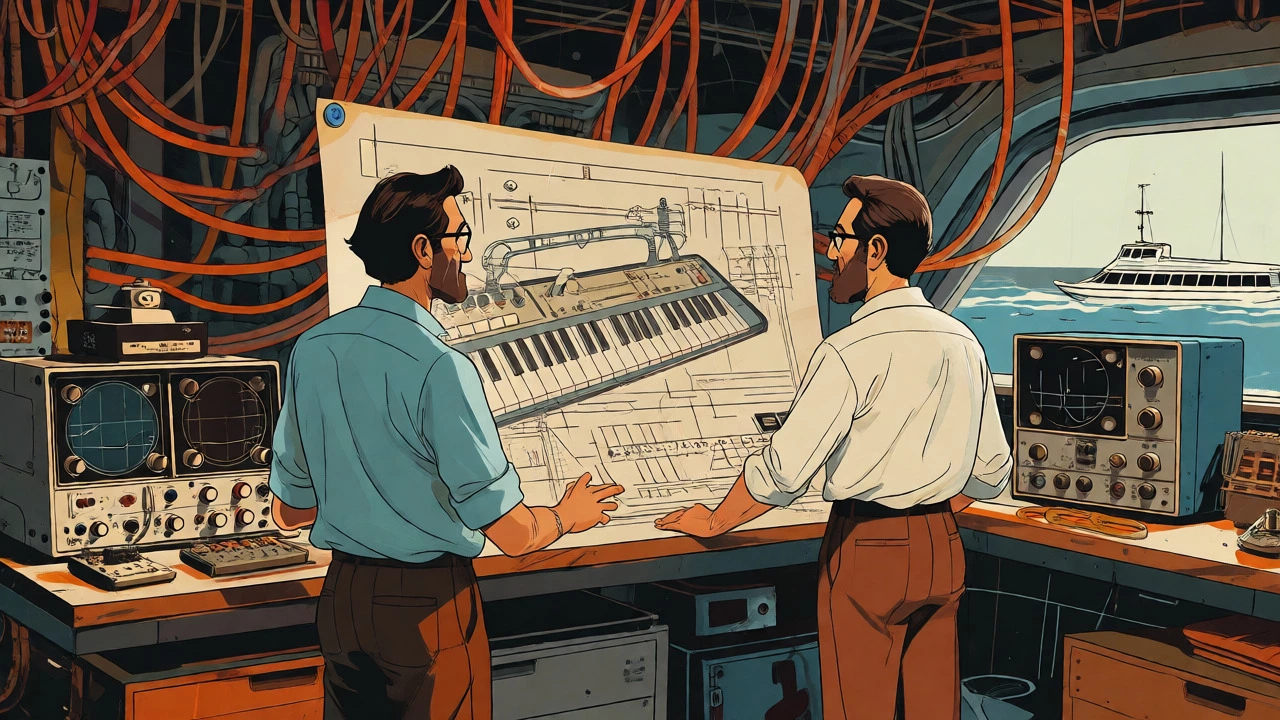
The story starts not in Silicon Valley, but in Sydney, Australia. In the mid-1970s, two engineers, Peter Vogel and Kim Ryrie, were tinkering with ideas that most people thought were science fiction. They wanted to build a synthesizer that didn't rely on unstable analog oscillators. Their inspiration came from the Qasar M8, a massive dual-microprocessor synth built by Tony Furse for the Canberra School of Electronic Music. The Qasar was too big and too expensive to sell, but it proved one thing: computers could model sound.
Vogel and Ryrie realized they could skip the complex math of physical modeling. Instead, they could just record a sound, store it in memory, and play it back. This concept-sampling-was revolutionary because it allowed musicians to use any sound as an instrument. A dog bark, a breaking glass, or a snippet of a opera singer's voice could become a playable note. They founded Fairlight Instruments Pty Ltd in December 1975, naming it after a hydrofoil ferry Ryrie saw passing his grandmother’s house. By 1979, their prototype became the commercial Series I, launching the era of digital sampling.
How the Fairlight CMI Actually Worked
Calling the Fairlight a "keyboard" is like calling a spaceship a "car." It was a full workstation system. You couldn't just plug it into a wall outlet and start playing. The setup required four main components: the central processing unit with disk drives, a 73-note keyboard, a monochrome CRT monitor, and a lightpen. The brain of the operation was powered by two Motorola 6800 microprocessors running at about 1 MHz. For context, your smartwatch today has processors thousands of times faster.
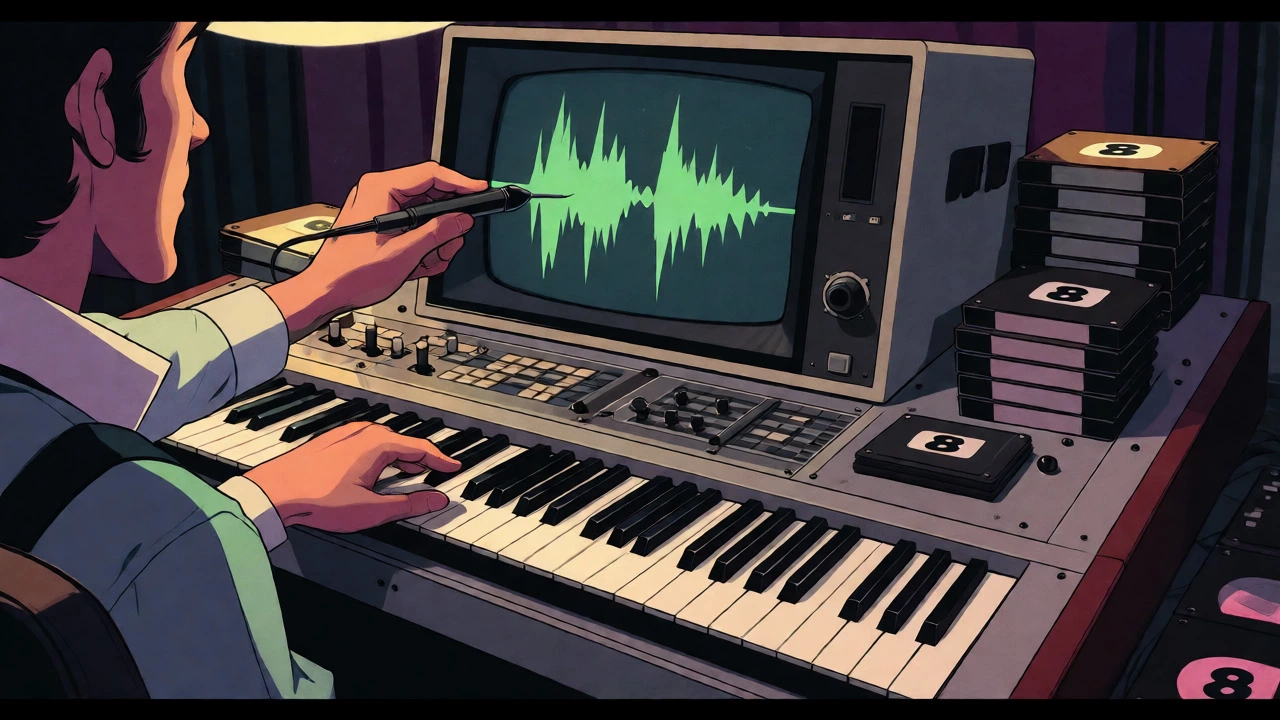
The magic happened on the screen. Using the lightpen, users could draw waveforms directly onto the monitor. This visual editing approach was unheard of in 1979. Most synthesizers used knobs and sliders; the Fairlight used graphics. The operating system, called QDOS, organized tasks into "pages." One page handled sampling, another handled synthesis, and another handled sequencing. This modular interface laid the groundwork for every software plugin and DAW (Digital Audio Workstation) we use today.
| Feature | Series I (1979) | Series IIx (1983) | Series III (Mid-80s) |
|---|---|---|---|
| Processor | 2x Motorola 6800 @ 1MHz | Motorola 6809 | Custom High-Speed CPU |
| Sampling Quality | 8-bit, ~10kHz bandwidth | 8-bit, 32kHz rate | 16-bit, 44.1kHz (CD Quality) |
| Storage | Two 8-inch floppies (512KB each) | Two 8-inch floppies + Optional Hard Disk | Hard Disk Drives |
| Connectivity | Proprietary | MIDI & SMPTE Time Code | Advanced MIDI & Digital Audio |
The Crude Charm of Early Sampling
Let's be honest: the first Fairlights sounded bad. The Series I sampled at 8-bit resolution with a low bandwidth. If you sampled a piano, it sounded grainy, metallic, and distant. Critics called it "crude." But this limitation became its greatest asset. Because the samples were so short and noisy, producers started using them differently. They didn't try to mimic real instruments perfectly. Instead, they embraced the glitchiness.
This aesthetic defined the early 1980s. Artists like Kate Bush and Peter Gabriel used these gritty textures to create atmospheric, otherworldly sounds. The famous "Orch5" patch-a lush orchestral swell-became ubiquitous in pop music, appearing everywhere from Duran Duran hits to horror movie trailers. The Fairlight didn't just provide sounds; it provided a vibe. The noise floor was part of the signature.
Page R: The Birth of Visual Sequencing
If there is one feature that changed workflow forever, it was Page R. Introduced with the Series II, Page R was a graphical rhythm sequencer. Before this, programming drums meant entering notes step-by-step or recording live performances. Page R let you draw patterns on a grid. You could see the kick, snare, and hi-hats visually arranged over time.
This might seem basic now, but in 1983, it was mind-bending. It allowed producers to experiment with timing and arrangement instantly. You could copy a bar, paste it, and shift the beat without re-recording anything. This non-linear approach to composition is exactly how we work in Ableton Live or Logic Pro today. The Fairlight proved that music creation could be visual and interactive, not just auditory.
Competing with the Synclavier
The Fairlight didn't rule the high-end market alone. Its main rival was the Synclavier from New England Digital. Both machines cost upwards of $20,000 to $50,000, putting them out of reach for all but the biggest studios and superstar artists. While the Synclavier focused heavily on FM synthesis and hard-disk recording, the Fairlight leaned into sampling and ease of use via its graphical interface.
The competition drove innovation. When the MIDI standard emerged in 1983, both companies rushed to integrate it. The Fairlight Series IIx added MIDI and SMPTE time code support, allowing it to sync with other digital gear. This interoperability was crucial. It meant the Fairlight could control a bank of synthesizers or lock to a tape machine, making it a central hub rather than an isolated island.
Why It Disappeared
By the late 1980s, the landscape shifted. General-purpose computers became cheaper and more powerful. Companies like Apple began offering music software that ran on standard PCs. Simultaneously, Japanese manufacturers released affordable samplers like the Ensoniq Mirage and the Akai S900. These devices offered decent sampling quality for a fraction of the Fairlight's price.
Fairlight Instruments struggled to compete in this new mass market. The company pivoted away from musical instruments in 1989, shifting focus to video post-production technologies. The CMI line ended, but its legacy remained. Every modern DAW owes a debt to the Fairlight’s integration of sampling, sequencing, and visual editing into a single workflow.
Legacy in Modern Production
You can still hear the Fairlight today. Not just in archival recordings, but in the techniques it pioneered. Hip-hop producers in the late 80s and 90s relied on samplers to flip old records, a technique directly descended from the Fairlight’s ability to manipulate audio snippets. Electronic genres like techno and house built entire tracks around looped samples, a concept Page R made intuitive.
Institutions like the National Science and Media Museum call the Fairlight "the secret composer of the music you love." It democratized sound design before it was cool to do so. It showed that technology could serve creativity, not just replicate tradition. If you've ever dragged an audio file into a timeline and chopped it up, you're using a workflow invented in Sydney forty years ago.
Was the Fairlight CMI the first sampler?
No, it wasn't the absolute first device capable of recording digital samples. The Publison DHM 89 B2 sampling delay processor appeared in 1978. However, the Fairlight CMI was the first commercially available polyphonic digital sampling synthesizer that integrated sampling, sequencing, and waveform editing into a user-friendly keyboard workstation. This distinction makes it the progenitor of the modern digital audio workstation.
Why did the Fairlight CMI sound "grainy"?
Early models, specifically the Series I and II, used 8-bit sampling with limited bandwidth (around 10-16 kHz). This low resolution introduced quantization noise and aliasing, resulting in a characteristic metallic or grainy texture. Unlike later 16-bit CD-quality samplers, the Fairlight's early fidelity was intentionally rough, which many producers embraced as a creative effect rather than a flaw.
How much did a Fairlight CMI cost in the 1980s?
The Fairlight CMI was an elite studio instrument with a price tag ranging from $25,000 to over $50,000 depending on the configuration and options like hard disks. Adjusted for inflation, this would be equivalent to well over $100,000 today. This high cost limited ownership to major professional studios and wealthy artists, creating an exclusive club of users who shaped the sound of the decade.
What is Page R on the Fairlight CMI?
Page R was the Fairlight's graphical rhythm sequencer. It allowed users to compose and edit drum patterns and sequences visually on the CRT monitor using a lightpen. This feature was groundbreaking because it replaced traditional step-time entry with a drag-and-drop, visual interface, laying the conceptual foundation for the piano-roll and grid editors found in modern software DAWs.
Who are famous artists that used the Fairlight CMI?
Numerous high-profile artists adopted the Fairlight CMI in the early 1980s, including Kate Bush, Peter Gabriel, Stevie Wonder, Herbie Hancock, Thomas Dolby, and Nick Rhodes of Duran Duran. Its distinctive sounds, particularly the "Orch5" string patch, appear on countless hit records from that era, cementing its status as a defining tool of 1980s pop and rock production.