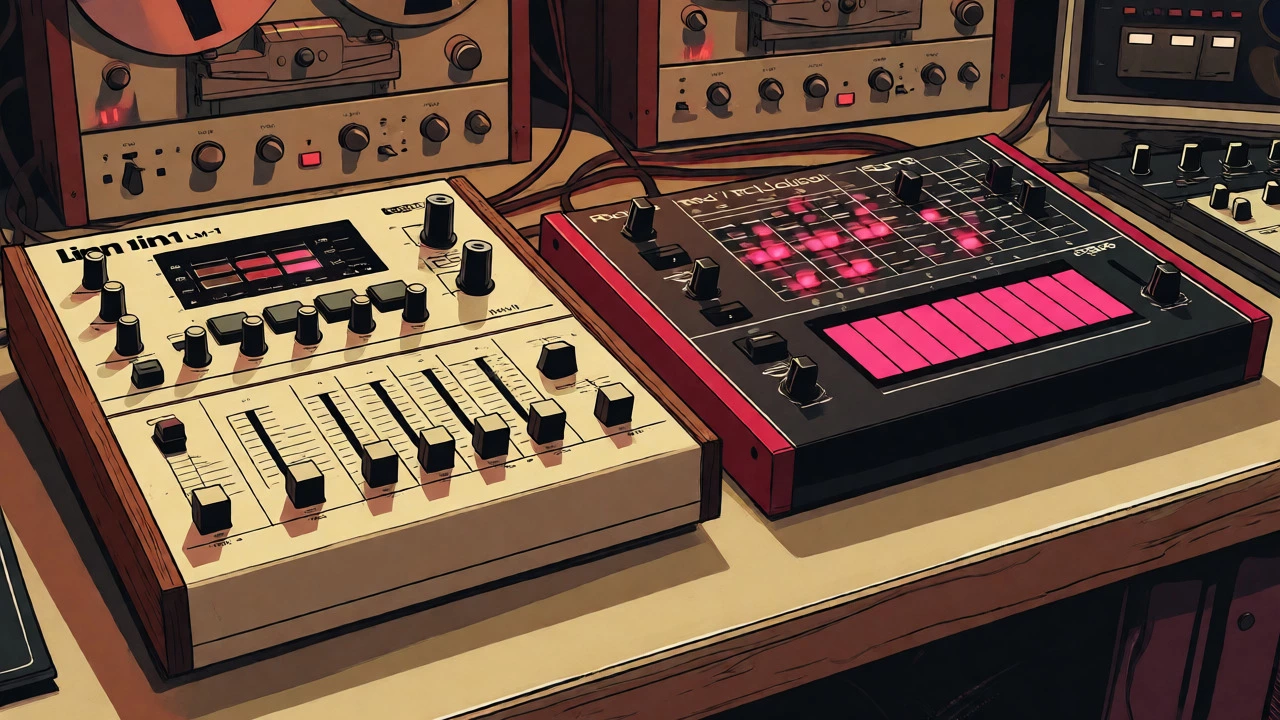

Think about the biggest hits of the 1980s. Now try to tell which ones used a real drummer and which ones relied on a drum machine. You probably can’t. That ambiguity wasn’t an accident; it was the result of a deliberate engineering choice. Producers in that decade didn’t just choose between robots and humans-they blended them. They treated rhythm as a modular system, assigning specific jobs to digital precision and others to human feel. This approach created the sonic signature we still hear today.
The Hardware That Changed Everything
In 1980, two machines landed in studios and shattered the traditional role of the drummer. The first was the Linn LM-1, the first drum machine to use digitally sampled sounds instead of synthesizing them from scratch. Priced at roughly $4,995, it offered 12 sampled instruments like kick, snare, and hi-hats, stored in EPROM memory. It allowed producers to tune individual sounds and route them to separate mixing channels. The second was Roland’s TR-808, which generated sounds electronically. While the LM-1 sounded more realistic, both machines offered something acoustic kits couldn’t: perfect repeatability. A producer could program a pattern once, recall it instantly, and tweak timing without asking a musician to play it again.
Oberheim followed up in late 1981 with the DMX, expanding the palette with 24 selectable sounds across eight voice groups. These machines weren’t just toys; they were architectural tools. They let producers build a rhythmic skeleton before a single microphone was set up. But they had limits. The samples were short, the dynamic range was narrow, and the repetition could become sterile. That’s where the live kit came back into play-not as a replacement, but as a partner.
Why Blend? The Case for Hybrid Rhythm
If you’re wondering why anyone would bother mixing these two worlds, consider what each side lacked. Drum machines provided stability and exact tempo, but they struggled with nuance. They couldn’t replicate the subtle push-and-pull of a human drummer, the ghost notes on a snare, or the wash of a cymbal decaying in a room. Conversely, live kits offered emotional depth and dynamic variation, but they required tuning, isolation, and multiple takes to get right. In a studio environment where time is money, that inefficiency hurt.
Hybrid techniques solved both problems. By layering a programmed kick and snare under a live performance, producers got the punch and consistency of the machine with the energy and fills of the drummer. This wasn’t about cheating; it was about optimization. Academic analysis suggests that this shift changed how music was arranged. Dense, tightly layered rhythms became possible because the machine handled the grid while the human handled the expression. It turned rhythm production into a compositional method rather than just a performance capture.
Technique 1: Machine Skeleton, Human Skin
One common workflow involved programming the core beat-the kick and snare-on a machine like the LM-1 or DMX. These elements formed the unshakeable foundation of the track. Then, engineers recorded live hi-hats, cymbals, or percussion over that grid. Why? Because cymbals have complex decay patterns and high-frequency content that early 8-bit samplers couldn’t reproduce convincingly. A real hi-hat adds air and movement that a digital tick simply lacks.
This technique also helped with arrangement. If a song needed a sudden tom fill or a crash to mark a section change, a live drummer could execute it with physical force. The machine kept the verse tight and repetitive, while the drummer added drama during transitions. Prince was a master of this. He often looped a simple LM-1 pattern, then muted the snare in certain sections and played finger-drummed fills or claps over the top. He processed these additions through effects pedals, blurring the line between programmed and performed until the listener couldn’t distinguish the source.
Technique 2: Reinforcing the Real Thing
The reverse approach was equally popular. A band would record a full acoustic drum performance, capturing the natural interplay of the kit. Then, if certain hits felt weak or inconsistent, the engineer would reinforce them with machine sounds. Maybe the kick drum lacked low-end punch, so they triggered an LM-1 kick sample every time the acoustic kick hit. Or perhaps the snare needed more snap, so they layered a sharp digital snare underneath the real one.
This reinforcement wasn’t always audible as a separate element. Often, it just made the live drums sound bigger and more controlled. However, it introduced technical challenges. Phase cancellation was a constant threat. If the machine trigger fired milliseconds after the acoustic hit, the two sounds could interfere, creating a hollow or flammed effect. Engineers had to meticulously align the timing, sometimes nudging samples by tiny fractions of a second to ensure they locked in perfectly with the performance.
Technique 3: The Gated Reverb Illusion
You can’t talk about 1980s drums without mentioning gated reverb. This effect, famously associated with Phil Collins’ “In the Air Tonight,” made acoustic drums sound massive yet abrupt. The technique involved recording a highly live room sound, compressing it heavily, and then using a noise gate to cut off the reverb tail suddenly. The result was a cannon-like impact that stopped dead in its tracks.
| Feature | Drum Machine (e.g., LM-1) | Live Kit | Hybrid Approach |
|---|---|---|---|
| Timing Precision | Perfect (Quantized) | Variable (Human Feel) | Stable Grid + Organic Fluctuation |
| Dynamic Range | Limited (Fixed Velocity) | Broad (Expressive) | Controlled Punch + Dynamic Fills |
| Setup Time | Fast (Programming) | Slow (Tuning/Mics) | Moderate (Layering) |
| Sonic Character | Dry, Synthetic, Compact | Ambient, Resonant, Natural | Aggressive, Processed, Textured |
While originally developed for acoustic kits, this effect worked wonders on hybrid setups. Applying gated reverb to a machine snare gave it a larger-than-life presence that mimicked a huge room, despite being a dry digital sample. Conversely, applying it to a live kit made the acoustic drums sound almost synthetic in their precision. Peter Gabriel’s albums utilized this to create a sense of architectural space, proving that technology could reshape the perception of physical instruments.
The Synchronization Struggle
None of this was easy. Before modern DAWs, syncing a drum machine to tape was a nightmare. Studios used SMPTE timecode, an audio signal encoded on one track of the tape that carried hours, minutes, seconds, and frames. A synchronizer box read this code and sent clock signals to the drum machine to keep it in time with the rest of the band.
This setup consumed valuable tape tracks and introduced risks. Clock drift could cause the machine to slowly fall out of sync, ruining takes. Routing errors could introduce noise. And if the synchronization failed mid-take, the entire performance might be unusable. Despite these hurdles, producers persisted because the creative payoff was worth it. The ability to lock a sequenced synth bassline to a precise drum grid opened up new musical possibilities that pure analog methods couldn’t match.
Legacy of the Hybrid Era
By the end of the 1980s, the distinction between “real” and “machine” drums had blurred beyond recognition. Drummers started using triggers to fire samples during live performances, effectively turning their kits into hybrid controllers. Producers continued to layer sources, leading to the dense, polished productions of the 1990s.
The key takeaway isn’t that one method was better than the other. It’s that combining them created a third option that was superior to either alone. The drum machine provided the canvas and the structure; the live kit provided the paint and the texture. Today, when you listen to those classic tracks, you’re hearing a collaboration between silicon and skin, engineered to perfection.
What was the main difference between the Linn LM-1 and the Roland TR-808?
The primary difference lies in sound generation. The Linn LM-1 used digitally sampled recordings of actual acoustic drums, making it sound more realistic. The Roland TR-808 generated its sounds using analog synthesis circuits, resulting in a more electronic, distinctive character that became iconic in hip-hop and dance music.
Why did producers mix drum machines with live drums?
Producers mixed them to combine the strengths of both. Drum machines offered perfect timing, repeatability, and consistent tone, while live drums provided dynamic variation, human feel, and complex cymbal work. Blending them allowed for tighter arrangements without sacrificing musicality.
What is gated reverb?
Gated reverb is an audio processing technique where a heavy reverb effect is applied to a sound, usually drums, and then abruptly cut off by a noise gate. This creates a large, explosive sound that stops suddenly, giving drums a powerful, artificial presence characteristic of 1980s pop and rock.
How difficult was it to synchronize drum machines with tape in the 1980s?
It was quite difficult and expensive. It required SMPTE timecode synchronization, which consumed a tape track and needed specialized hardware. Issues like clock drift, routing noise, and setup complexity made it a technically demanding process compared to modern software-based syncing.
Did famous artists like Prince use drum machines exclusively?
No, Prince rarely used drum machines exclusively. He frequently combined LM-1 loops with live drumming, finger-drummed fills, and extensive effects processing. His approach was highly hybrid, using machines for structure and live performance for expression and spontaneity.