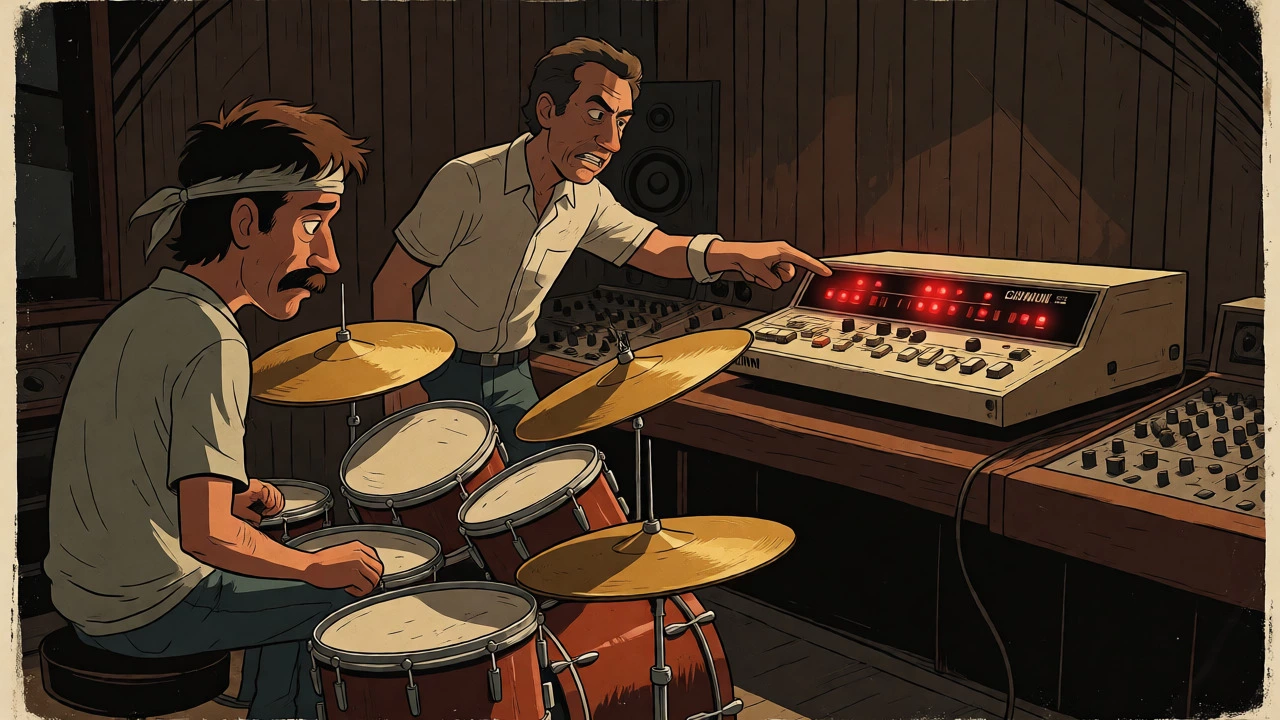

Imagine walking into a studio in 1983. You’re a session drummer, and the producer hands you a click track that’s tighter than your heartbeat. Then he points to a blinking box on the console and says, "We don't need you for the verse." This wasn't just a joke; it was a genuine professional crisis. The 1980s drum machine debate was a cultural and economic clash between traditional acoustic performance and emerging electronic precision. It wasn't merely about which sound was "better." It was about who got paid, what counted as authentic music, and whether a human touch was still necessary when a computer could hit every beat perfectly.
The Rise of the Machine
Before we look at the conflict, we have to understand the technology that started it all. In 1980, Roger Linn introduced the Linn LM-1 Drum Computer a groundbreaking instrument that used digitally sampled recordings of real drums rather than synthesized tones. At $5,000, it cost more than most cars did back then, so it wasn't exactly a toy for the bedroom producer. It was a luxury item for stars like Prince and Michael Jackson. But it changed the game because it didn't just beep; it played sounds recorded from a real kit, specifically by session drummer Art Wood. Suddenly, a producer could program a perfect groove without hiring a band.
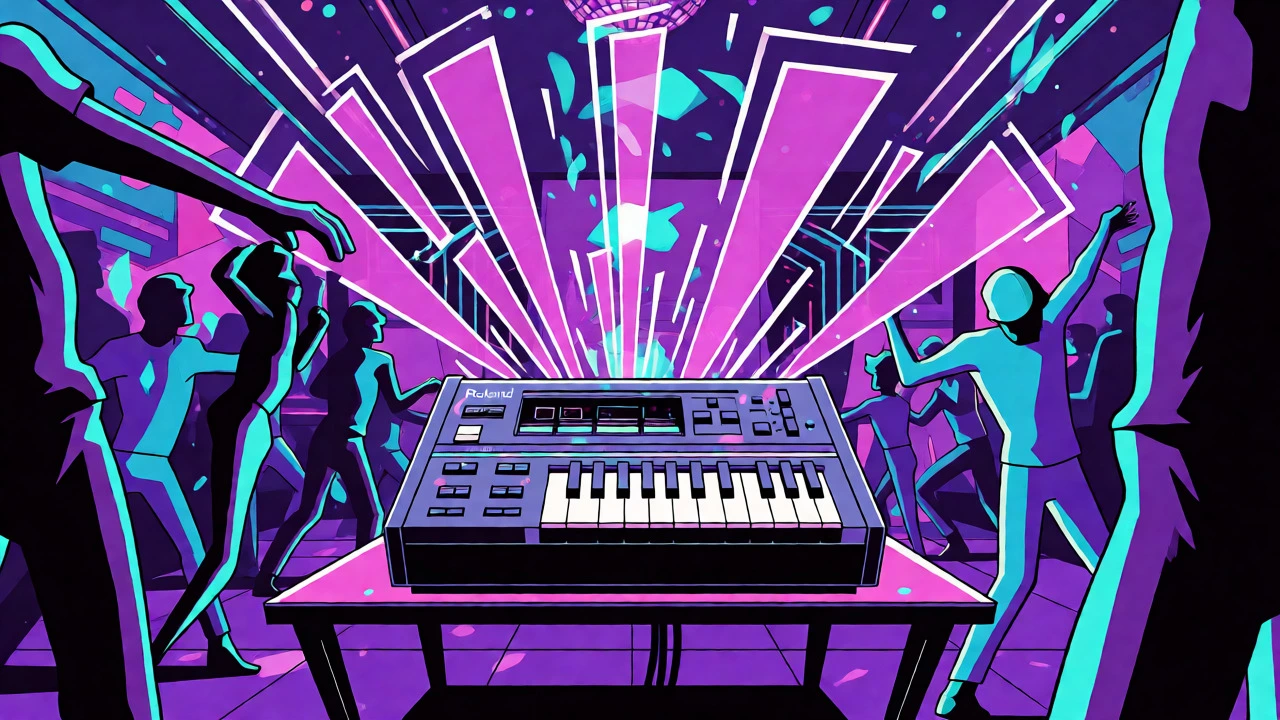
Then came the Roland TR-808 Rhythm Composer an analog drum machine known for its distinctive synthetic kick drum and cowbell sounds. Unlike the LM-1, the 808 didn't try to fake reality. Its sounds were obviously artificial-deep, booming kicks and sharp, metallic snares. Critics hated it initially. They said it sounded cheap. But musicians loved it because those "cheap" sounds cut through loud club systems better than any acoustic kit ever could. By the mid-80s, hip-hop pioneers like Afrika Bambaataa and later Public Enemy were using the 808 not as a substitute for a drummer, but as an instrument in itself. The machine wasn't trying to be human anymore; it was being something new.
The Acoustic Defense: Why Humans Still Mattered
If machines were so convenient, why didn't drummers disappear? Because they offered something the boxes couldn't: nuance. An acoustic kit is a physical environment. The sound depends on how hard you hit, where you hit, the room you're in, and even the humidity. A skilled drummer can play slightly behind the beat to create a lazy, soulful feel, or rush ahead to build tension. Early drum machines struggled with this. They quantized everything, meaning every note landed exactly on the grid. To ears trained on jazz, funk, or rock, this felt sterile. It was "robotic," a word thrown around constantly in industry magazines.
Moreover, live interaction was impossible for early machines. If the singer slowed down for emotional effect, a programmed loop kept marching forward, clashing with the performance. Drummers could listen, react, and adjust in real-time. This dynamic responsiveness was crucial for genres like rock and soul, where the energy of the crowd and the interplay between band members drove the song. Producers might want the consistency of a machine for a pop hook, but they still needed humans for the bridge, the solo, or the live show. The acoustic kit remained the gold standard for expressive power.
The Middle Ground: Electronic Drums and Hybrids
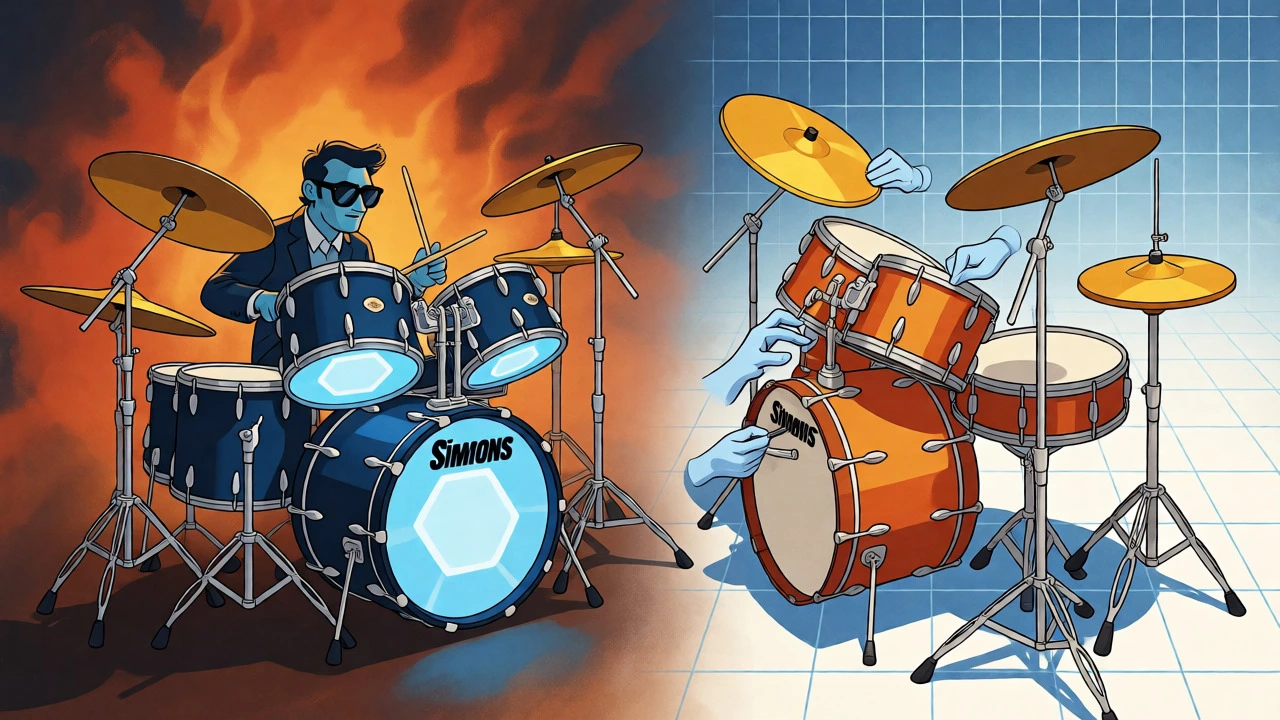
Not everyone wanted to choose one side. Some artists wanted the visual spectacle of a drummer plus the futuristic sound of electronics. Enter the Simmons SDS-V an electronic drum kit featuring hexagonal pads and a rack-mounted sound module. Released in 1981, the Simmons kit looked like something from a sci-fi movie. Bands like Duran Duran and Phil Collins made these glowing hexagons iconic. The Simmons didn't try to sound like wood and skin; it had long, synthetic tom rolls that became a signature of 80s pop. It allowed drummers to keep their physical performance skills while delivering sounds no acoustic kit could produce.
This hybrid approach blurred the lines. Drummers began triggering samples from their acoustic kits. Engineers started gating acoustic drums to make them sound tighter and more mechanical, mimicking the clean separation of a sequencer. The boundary between "real" and "electronic" dissolved. A record might feature a programmed bass line, a gated snare, and a live hi-hat. The debate shifted from "which is better?" to "how do we combine them?"
Economic Reality: Cost vs. Control
Let's talk money. Hiring a drummer costs money. Renting a studio with a good drum room costs money. Setting up microphones takes time. If you're a songwriter in a small apartment, you can't afford to book a studio every time you have an idea. A drum machine, once purchased, was free to use. You could tweak a pattern for hours without paying anyone. For new wave bands and indie producers, this democratization was huge. You didn't need a rhythm section to make a danceable track; you just needed a sequencer and a keyboard.
| Feature | Acoustic Kit | Drum Machine (e.g., TR-808) | Electronic Kit (e.g., Simmons) |
|---|---|---|---|
| Sound Source | Vibrating wood/metal | Analog synthesis or digital samples | Triggered electronic modules |
| Consistency | Variable (human error) | Perfect (quantized) | High (trigger-based) |
| Cost | High (instrument + space + player) | Medium (one-time purchase) | High (complex setup) |
| Live Interaction | Excellent | Poor (pre-programmed) | Good (visual + responsive) |
| Editing | Difficult (re-record) | Easy (copy/paste/edit) | Moderate |
Artistic Impact: Who Won?
Did the machines win? In terms of ubiquity, yes. By the late 80s, almost every major pop hit featured some form of electronic percussion. Madonna’s "Lucky Star" and George Michael’s "Faith" relied on the crisp, unyielding timing of machines like the LinnDrum the commercial successor to the LM-1, offering more sounds and lower price. Hip-hop exploded because samplers and drum machines allowed producers to isolate and loop breakbeats, creating entirely new musical textures.
But acoustic drums didn't die. They evolved. Rock bands continued to rely on them for raw energy. Jazz and funk purists rejected the sterility of quantization. And eventually, the two worlds merged. Modern production often uses a machine for the backbone and a human for the feel. The 1980s debate taught us that "perfect" isn't always desirable. Sometimes, the slight drag of a human snare is what makes a song breathe. Conversely, sometimes the relentless drive of a 909 hi-hat is exactly what a dance floor needs.
Key Takeaways
- Technology drove change: The affordability and editing capabilities of drum machines shifted power from session players to producers.
- Authenticity was redefined: Listeners stopped equating "real" with "acoustic" and started accepting synthetic sounds as artistic choices.
- Hybrid workflows emerged: The strict division between acoustic and electronic collapsed, leading to modern techniques like triggering and sampling.
- Genre specialization: Machines dominated pop, hip-hop, and dance, while acoustic kits retained dominance in rock, jazz, and live performance contexts.
Why was the Roland TR-808 controversial in the 1980s?
Critics initially dismissed the TR-808 because its sounds were clearly synthetic and didn't resemble real drums. However, musicians embraced it because its deep kick and sharp snare cut through club systems effectively, becoming foundational to hip-hop and electro.
Did drum machines replace human drummers completely?
No. While machines took over many studio roles, especially in pop and dance, human drummers remained essential for live performances, genres requiring improvisation (like jazz and rock), and adding nuanced human feel to recordings.
What was the main advantage of the Linn LM-1?
The Linn LM-1 was the first drum machine to use digital samples of real acoustic drums, allowing for more realistic-sounding patterns compared to the purely synthesized sounds of earlier machines.
How did the Simmons SDS-V differ from drum machines?
The Simmons SDS-V was an electronic drum kit played physically by a drummer using pads, whereas drum machines are typically programmed electronically. The Simmons allowed for live performance dynamics while producing synthetic sounds.
Why were drum machines cheaper for producers?
Machines eliminated recurring costs such as paying session musicians, renting large studios with isolation booths, and spending hours setting up microphones. Once bought, they offered unlimited usage with precise editing capabilities.


