
Imagine being seventeen years old. Most people are worrying about driver's licenses or prom dates. Debbie Gibson was worrying about whether her drum machine programming sounded right for radio play. In 1988, she didn't just sing a hit song; she wrote it, produced it, played on it, and took it to No. 1 on the Billboard Hot 100. That record? It still stands today as the youngest woman to achieve that specific trifecta of creative control.
We often look back at the late 1980s teen-pop explosion-think Tiffany, New Kids on the Block-as a moment when labels manufactured idols from scratch. But Debbie Gibson broke that mold completely. She wasn't a puppet with a vocal track added later. She was the architect. Her journey from a Brooklyn garage studio to the top of the charts reshaped what we expect from young artists. Let's look at how she did it, why it mattered, and where the myths end.
The Garage Studio Origins
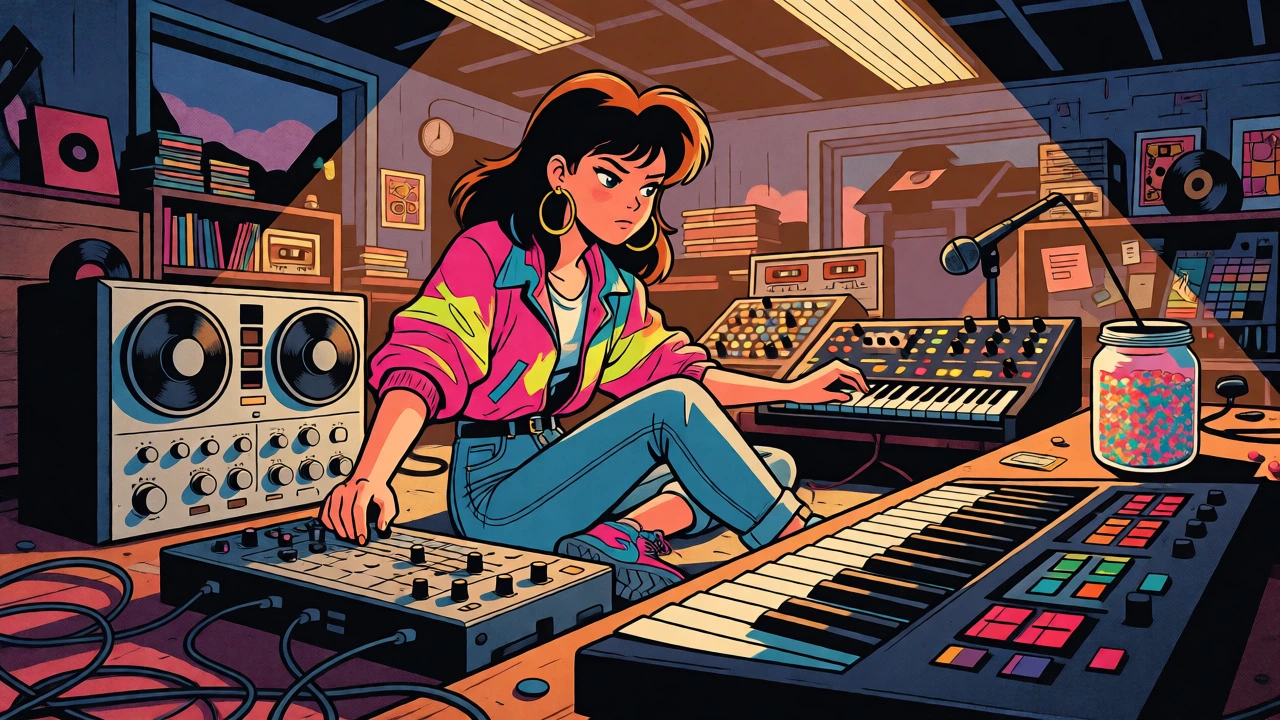
Before Atlantic Records signed her, Deborah Ann Gibson was already a prolific songwriter. Born in 1970 in Brooklyn, she started composing as a child. By her mid-teens, she had written over 100 songs. But writing isn't the same as producing. To get her demos heard, she built a home studio in her family's garage. This wasn't some high-end facility with analog consoles. It was a keyboard, a sequencer, a drum machine, and a four-track recorder.
American Songwriter reports that she spent three years refining her craft in this setup. The label listened to her tapes for over a year before signing her, largely because they could hear her improving. She moved from a four-track to a twelve-track system, showing technical growth alongside musical maturity. One famous anecdote involves the demo for "Shake Your Love." Lacking proper percussion instruments, Gibson used Carvel ice cream sprinkles in a jar as improvised shakers. It sounds cute, but it shows her resourcefulness. She wasn't waiting for a producer to tell her what to do; she was solving problems with what she had.
This DIY approach meant that when she finally walked into a professional studio, she knew exactly what she wanted. She had programmed the rhythms, laid down the harmonies, and established the emotional tone. She wasn't handing over blank sheets of paper to an arranger. She was handing over a blueprint.
Collaboration with Fred Zarr
It’s easy to fall into the trap of thinking Gibson did everything alone. That’s not quite accurate, and ignoring the collaboration misses half the story. Atlantic paired her with Fred Zarr, a veteran Brooklyn producer known for his work with Madonna and Arthur Baker. Zarr didn't write the songs. He didn't come up with the melodies. But he took Gibson's garage demos and elevated them to radio-ready quality.
Gibson has credited Zarr with taking her raw material and fine-tuning it. On her debut album, Out of the Blue, she wrote all ten tracks. She produced or co-produced four of them with Zarr. His role was crucial for sonic polish. He handled the arrangement refinement and instrumental programming that gave the records their sleek, synthesized sheen. This partnership highlights a key industry reality: even if you write the song, you need a team to make it sound expensive enough for MTV rotation.
Gibson herself said, "If the production is wrong, you can ruin a good song." She understood that authorship didn't mean isolation. It meant having a vision strong enough to guide a collaborator. She kept creative direction while leveraging Zarr's technical expertise. This balance allowed her to maintain artistic integrity while achieving commercial viability.
Chart Dominance with Out of the Blue
Released in August 1987, Out of the Blue became a juggernaut. It peaked at No. 7 on the Billboard 200 and went triple-platinum. But the real story is the singles. Four of them cracked the Top 10 on the Billboard Hot 100:
- "Only in My Dreams" (No. 4)
- "Shake Your Love" (No. 4)
- "Out of the Blue" (No. 3)
- "Foolish Beat" (No. 1)
Having four top-ten hits from one album by a teenage writer is rare. It proved that her songwriting wasn't a fluke. Each single showcased a different facet of her style. "Only in My Dreams" was bright and rhythm-forward. "Shake Your Love" leaned into dance-pop energy. "Foolish Beat" showed she could handle a sweeping ballad. The lyrics were distinctly adolescent-romance, longing, self-definition-but the structures were tight, hook-heavy, and designed for mass appeal.
Critics at the time sometimes dismissed the music as "bubbly confections," a phrase used by the Los Angeles Times. While true in a sense, it underestimates the craftsmanship. These weren't throwaway tunes. They were carefully constructed pop artifacts with clear verse-to-chorus movements and polished textures. The success wasn't just luck; it was the result of disciplined songwriting paired with effective marketing.
The Record-Breaking 'Foolish Beat'
On June 25, 1988, "Foolish Beat" hit No. 1 on the Billboard Hot 100. Gibson was 17. This made her the youngest woman to write, produce, and perform a chart-topper. Billboard confirmed in 2024 that this record still stands. Why does this matter?
In the music industry, credit lines are often murky. Many "teen idols" have songs written by teams of adult professionals. The singer often just sings. Gibson was the sole writer and producer of "Foolish Beat." She didn't share those credits. She didn't have a ghostwriter. She didn't have a heavy-handed executive producer overriding her choices. This level of control was unprecedented for someone so young, especially a female artist.
Billboard noted that this achievement silenced critics who thought she needed more experienced hands behind the boards. Even within her own camp, there were doubts. Some believed an older producer should have handled the final mix. Gibson proved them wrong. The song's success validated her instincts. It demonstrated that a teenager could understand market trends and execute them technically without losing authenticity.
Electric Youth and Peak Control
If Out of the Blue was the breakthrough, Electric Youth (1989) was the consolidation of power. Released in January 1989, it debuted at No. 1 on the Billboard 200 and stayed there for five weeks. Again, Gibson wrote every song. But her production role expanded significantly. She produced six of the eleven tracks herself. She also contributed keyboards, drum programming, backing vocals, and piano.
The lead single, "Lost in Your Eyes," was another solo effort. It reached No. 1 on the Hot 100 for three weeks. On March 11, 1989, Gibson became the first teenage female artist to hold the No. 1 spot on both the album and singles charts simultaneously. This dual dominance signaled that her influence wasn't fading after one hit. She had sustained momentum.
Electric Youth generated four Hot 100 hits, including "Electric Youth" (No. 11) and "No More Rhyme" (No. 17). The album's sound was slightly more mature, reflecting Gibson's growing confidence in the studio. She wasn't just replicating the formula; she was evolving it. The production values were higher, the arrangements more complex, and her vocal delivery more assured.
Gibson vs. Tiffany: Different Models of Teen Pop
You can't talk about 1980s teen pop without mentioning Tiffany. Both artists dominated the airwaves and retail shelves between 1987 and 1989. However, their industrial roles differed sharply. The Washington Post noted in 1989 that while both acts were teen-oriented, Gibson's work was less dependent on external machinery.
| Feature | Debbie Gibson | Tiffany |
|---|---|---|
| Songwriting Role | Sole or principal writer on major hits | Interpreted material selected by others |
| Production Credit | Producer/Co-producer on key tracks | Primarily performer; limited production input |
| Origin Story | Home-recording demos led to deal | Vocal talent discovered via competitions/auditions |
| Industry Narrative | Teenage auteur/singer-songwriter | Teen idol/vocalist |
Tiffany reportedly spent two years searching for suitable material for her debut. Gibson supplied her own. This distinction matters. It means Gibson's brand was built on authorship. Tiffany's was built on interpretation and image. Neither approach is inherently better, but Gibson's model offered more long-term artistic leverage. She owned her catalog and her creative voice in a way that many contemporaries did not.
Legacy and Industry Impact
Debbie Gibson's impact goes beyond nostalgia. She normalized the idea that a teenage girl could be a serious musician. Before her, the industry often treated young female singers as commodities to be packaged. Gibson showed that they could be creators. Her success helped pave the way for future singer-songwriters like Britney Spears (who had more input than often cited), Taylor Swift, and Olivia Rodrigo.
She won the ASCAP Songwriter of the Year Award in 1989, a significant recognition from the publishing side of the business. This award highlighted that her value wasn't just in her face or voice, but in her intellectual property. Record companies realized that investing in writers pays off longer than investing in fleeting images.
Today, Gibson remains active in theater and recording. But her 1980s run remains her defining historical contribution. She proved that technical skill and youthful perspective aren't mutually exclusive. You don't have to wait until you're thirty to know how to build a hit record. Sometimes, the best ideas come from a kid with a four-track recorder and a jar of sprinkles.
Did Debbie Gibson really write all her hits?
Yes, for her biggest early hits. She wrote every song on her debut album Out of the Blue and her second album Electric Youth. This includes massive singles like "Only in My Dreams," "Shake Your Love," "Foolish Beat," and "Lost in Your Eyes."
Was Debbie Gibson the youngest person to number one?
Not the youngest person overall, but she holds the record for the youngest woman to write, produce, and perform a Billboard Hot 100 No. 1 hit. She achieved this with "Foolish Beat" at age 17 in 1988. Stevie Wonder and others hit No. 1 younger, but typically without the full trio of writing, producing, and performing credits.
Who produced Debbie Gibson's music?
Her primary collaborator was Fred Zarr, a veteran producer. However, Gibson produced or co-produced several key tracks herself, including "Foolish Beat" and "Lost in Your Eyes." She often provided the initial demos and creative direction, which Zarr then refined for radio release.
How did Debbie Gibson differ from other teen idols like Tiffany?
Gibson was promoted as a singer-songwriter-producer, emphasizing her authorship and technical skills. Tiffany was marketed primarily as a vocalist and teen idol, interpreting songs written by others. Gibson's home-studio background and self-penned material set her apart as an "auteur" figure in the teen-pop genre.
What equipment did Debbie Gibson use to make demos?
She started with a four-track recorder, a keyboard, a sequencer, and a drum machine in her family's garage. She later upgraded to a twelve-track system. She famously used improvised items, like ice cream sprinkles in a jar, for percussion effects on early demos.
