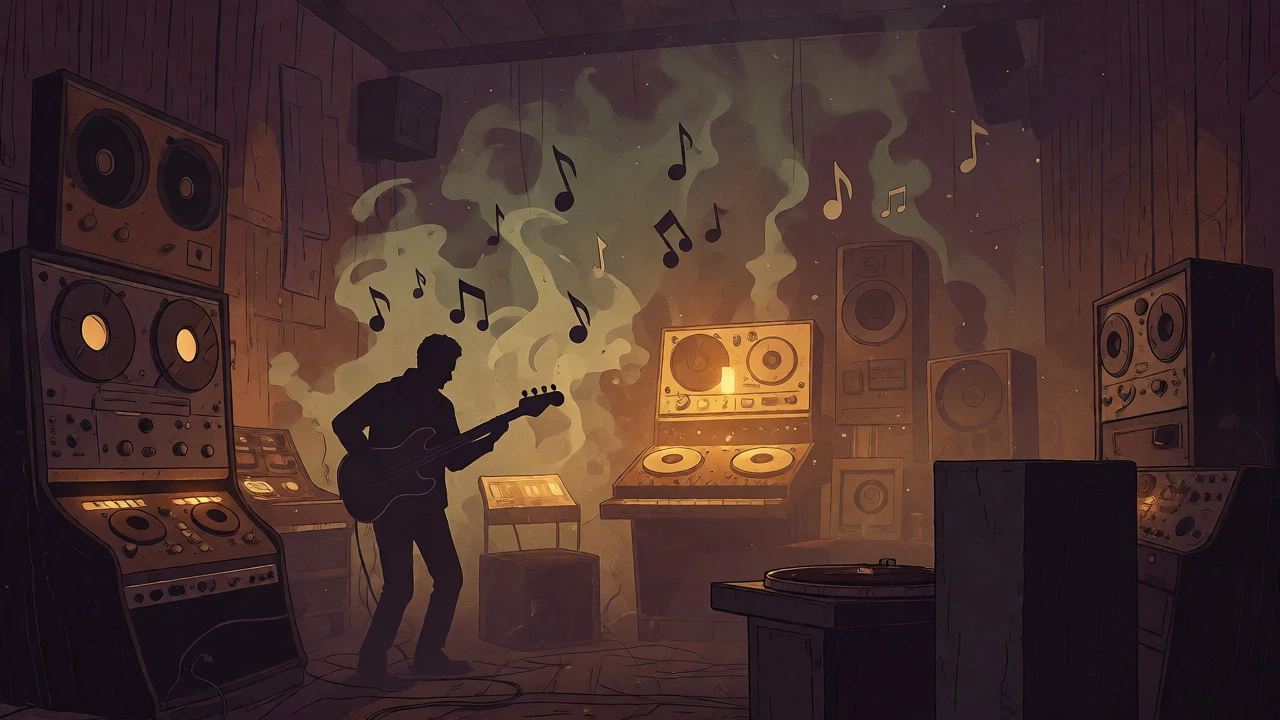

Imagine walking into a room where the air is thick with humidity and the smell of old wood. There are no click tracks, no grid-quantized beats snapping to a digital clock, and no Auto-Tune smoothing out the rough edges. Instead, there is a band playing live, sweating through their shirts, trying to catch lightning in a bottle. This wasn’t just a vibe; it was a deliberate artistic rebellion. When D’Angelo released Voodoo, he didn’t just drop an R&B album. He dismantled the polished machinery of late-90s pop and rebuilt it from the ground up using mud, funk, and jazz.
Most people remember Voodoo for one reason: the video for "Untitled (How Does It Feel)." But that shirtless, gyrating performance is actually a trap. It hides the fact that this record is one of the most complex, meticulously crafted musical documents of the 20th century. Released in January 2000 but forged in the fires of 1999, Voodoo represents the absolute peak of the neo-soul movement. It’s the moment when the genre stopped being a marketing label and started being a serious art form. If you think you know this album because you heard the single, you haven’t really heard it yet. You need to understand the craft behind the chaos.
The Studio as an Instrument
To understand why Voodoo sounds different, you have to look at where it was made. D’Angelo and his team holed up in Electric Lady Studios in New York City. This isn’t just any studio; it’s the place Jimi Hendrix built. The walls literally absorbed decades of psychedelic rock and soul history. D’Angelo wanted to tap into that lineage, but he didn’t want to copy it. He wanted to evolve it.
The approach was radical for its time. In an era when producers like Timbaland and Dr. Dre were perfecting the art of digital precision, D’Angelo chose analog imperfection. He worked closely with engineer Russell “The Dragon” Elevado, who later revealed that about 85 percent of the recording was done live. That means the mistakes, the breaths, and the slight timing drifts weren’t fixed in post-production. They were kept. Why? Because they felt human.
- Analog Warmth: The album was recorded on tape, not hard drives. This gave the instruments a rounder, thicker sound that digital formats often strip away.
- Live Interaction: Musicians played face-to-face in the same room. You can hear them listening to each other. If the drummer leaned back, the bassist followed. It wasn’t isolated tracking; it was conversation.
- Minimal Editing: Only three songs required significant Pro Tools intervention, mostly to shorten takes. Everything else remained raw.
This method created a sonic texture that feels murky to some listeners but immersive to others. It forces you to lean in. You aren’t being hit over the head with a bright, shiny hook. You’re being invited into a smoky jam session that happened to be captured on tape.
The Soulquarians and the Human Element
You can’t talk about Voodoo without talking about the people in the room. D’Angelo didn’t hire session musicians who could play anything perfectly but feel nothing. He assembled a collective known as the Soulquarians. This group included Ahmir “Questlove” Thompson from The Roots, keyboardist James Poyser, and producer J Dilla. These weren’t just backing players; they were co-conspirators in a mission to bring hip-hop’s rhythmic complexity into the world of soul music.
Questlove’s drumming is the heartbeat of this record. Listen closely to "Devil's Pie" or "Playa Playa." His drums don’t sit squarely on the beat. They drag slightly behind it, creating a lazy, hypnotic groove that makes your body move before your brain realizes why. This technique, often called "playing behind the beat," is a hallmark of great funk and soul, but it had largely been abandoned by mainstream R&B in favor of robotic precision. Questlove brought it back with authority.
Then there’s Pino Palladino on bass. A Welsh musician with deep roots in Motown and jazz, Palladino provided the melodic counterpoint to D’Angelo’s vocals. His lines are conversational. They respond to the drums, they tease the guitar, and they leave space for silence. On tracks like "Chicken Grease," the interplay between Questlove and Palladino is so tight it feels telepathic. It’s a masterclass in restraint. They prove that what you *don’t* play is just as important as what you do.
| Collaborator | Role | Contribution to Sound |
|---|---|---|
| Ahmir “Questlove” Thompson | Drums & Production | Introduced hip-hop swing and live improvisation to R&B structures. |
| Pino Palladino | Bass | Bridged jazz harmony with funk rhythms; used melodic, non-repetitive lines. |
| Russell Elevado | Engineer/Mixer | Captured analog warmth; prioritized live room tone over digital cleanliness. |
| Charlie Hunter | Guitar/Bass | Used a custom 8-string instrument to layer harmonic and rhythmic textures simultaneously. |
| J Dilla | Production/Collaboration | Influenced the off-kilter, sample-based aesthetic within a live-band context. |
Deconstructing the Groove
If you listen to standard R&B from 1999-think TLC or Destiny’s Child-the structure is predictable. Verse, chorus, bridge, repeat. The production is glossy, the vocals are upfront, and the beat is locked in. Voodoo throws that rulebook out the window. The songs are long, winding, and often lack traditional choruses. Take "Left and Right," featuring Method Man and Redman. It’s a seven-minute funk odyssey that builds slowly, layer by layer, rather than hitting you with a catchy refrain.
D’Angelo’s vocal delivery is part of this deconstruction. He doesn’t belt. He murmurs, whispers, and distorts his voice, treating it like another instrument. On "The Root," his vocals are buried deep in the mix, swirling around the guitars and keyboards. This choice frustrates some listeners who want clarity, but it serves the mood. The voice isn’t there to tell you a story directly; it’s there to evoke a feeling. It’s sensual, mysterious, and deeply personal.
The track "Spanish Joint" is perhaps the best example of this fusion. It features Charlie Hunter on his custom eight-string guitar, which allows him to play bass lines and chords at the same time. The result is a dense, polyrhythmic tapestry that feels both ancient and futuristic. It’s psychedelic soul meets modern hip-hop. There’s no obvious hook here, just a groove that pulls you under and keeps you there. This is the craft of neo-soul at its finest: complexity disguised as ease.
The Paradox of "Untitled (How Does It Feel)"
We have to address the elephant in the room. "Untitled (How Does It Feel)" became a massive hit, but it also complicated the legacy of Voodoo. The music video, directed by Paul Hunter, showed D’Angelo nearly nude, moving sensually against a black background. It was erotic, vulnerable, and undeniably effective. It sold millions of copies and pushed the album to number one on the Billboard 200.
But did it help or hurt the album’s reputation? For many critics, the video reduced a serious musical achievement to a sex symbol moment. Questlove later noted that during tours, audiences would demand D’Angelo perform the song exactly as seen in the video, ignoring the intricate musicianship that supported it. D’Angelo himself reportedly struggled with this reduction, feeling his identity as a composer and bandleader was overshadowed by his body.
Yet, musically, the song is a masterpiece. It’s a slow-burning Prince-influenced ballad that stretches over seven minutes. It proves that you don’t need a fast tempo or a loud chorus to create tension. The falsetto is delicate, the harmonies are rich, and the arrangement breathes. It’s a testament to D’Angelo’s ability to write accessible pop without sacrificing artistic integrity. The paradox remains: the very thing that made the album commercially successful also obscured its deeper innovations for casual listeners.
Why 1999 Was the Peak
The term "neo-soul" was coined by manager Kedar Massenburg in the late 90s to describe artists like D’Angelo, Erykah Badu, Lauryn Hill, and Maxwell. By 1999, these artists had moved beyond novelty. They weren’t just reviving the past; they were reinterpreting it for a new generation raised on hip-hop.
Before 1999, neo-soul was often criticized for being too retro or too quiet. But albums like Voodoo, Mama’s Gun by Erykah Badu, and Negro Swan by Common changed the conversation. They showed that soul music could be gritty, experimental, and relevant. They integrated the sampling aesthetics of hip-hop with the live instrumentation of jazz and funk. This synthesis reached its highest point with Voodoo.
After 2000, the landscape shifted. Digital production took over completely. Autotune became ubiquitous. The focus moved from musical proficiency to sonic spectacle. While other genres evolved, the specific blend of analog warmth, live ensemble playing, and hip-hop rhythm found in Voodoo became rare. It stands as a monument to a brief window of time when technology served humanity, rather than replacing it.
Legacy and Lasting Influence
Today, Voodoo is consistently ranked among the greatest albums of all time. Rolling Stone placed it at number 28 on its revised list of the 500 Greatest Albums, a dramatic rise from its previous position. This reassessment isn’t just nostalgia; it’s recognition of the album’s enduring influence.
Artists like Anderson .Paak, Thundercat, and Frank Ocean cite Voodoo as a primary inspiration. They borrow its loose grooves, its layered vocals, and its refusal to conform to radio formulas. The album proved that you could achieve commercial success without compromising your artistic vision. It showed that a seven-minute instrumental break could work on MTV if the groove was strong enough.
D’Angelo passed away in October 2025, leaving behind a small but potent discography. Voodoo remains his defining work. It’s not just an album; it’s a lesson in craftsmanship. It teaches us that perfection isn’t about being flawless. It’s about being real. In a world increasingly dominated by AI-generated content and algorithm-driven playlists, Voodoo reminds us of the power of human error, human touch, and human connection.
When was D’Angelo’s Voodoo actually released?
While the creative peak and much of the buzz occurred in 1999, the album was officially released on January 25, 2000, by Virgin Records. The singles, however, began rolling out in late 1999, which is why it is culturally associated with that year.
Who played drums on Voodoo?
Ahmir “Questlove” Thompson, the drummer for The Roots, handled the majority of the drumming. His distinctive style, characterized by playing slightly behind the beat, is central to the album’s laid-back, funky feel.
Did D’Angelo produce Voodoo himself?
Yes, D’Angelo produced the album primarily himself, working closely with engineer Russell Elevado. He also collaborated with members of the Soulquarians collective, including J Dilla and Raphael Saadiq, who contributed to the production and instrumentation.
What is the significance of Electric Lady Studios?
Electric Lady Studios was founded by Jimi Hendrix. Recording there allowed D’Angelo to connect with the history of psychedelic soul and rock. The studio’s analog equipment and acoustic properties contributed significantly to the warm, organic sound of the album.
Why is the album considered neo-soul?
Neo-soul blends traditional soul music with elements of hip-hop, jazz, and funk. Voodoo exemplifies this through its use of live instrumentation, jazz harmonies, hip-hop rhythms, and socially conscious or introspective lyrics, distinguishing it from more polished, electronic-driven contemporary R&B.
