
You know that feeling when a song is so catchy you want to sing along, but the guitars are loud enough to make your ears ring? That specific tension-where sweetness meets aggression-is the signature sound of Buzzcocks. They didn't just play punk; they rewired it. While their contemporaries in London were spitting venom and three-chord nihilism, two guys from Manchester figured out how to smuggle Beatles-esque melodies into high-speed noise. If you've ever wondered where Green Day or Blink-182 got their blueprint, look no further than this band's late-70s catalog.
From Manchester Tech College to DIY Revolution
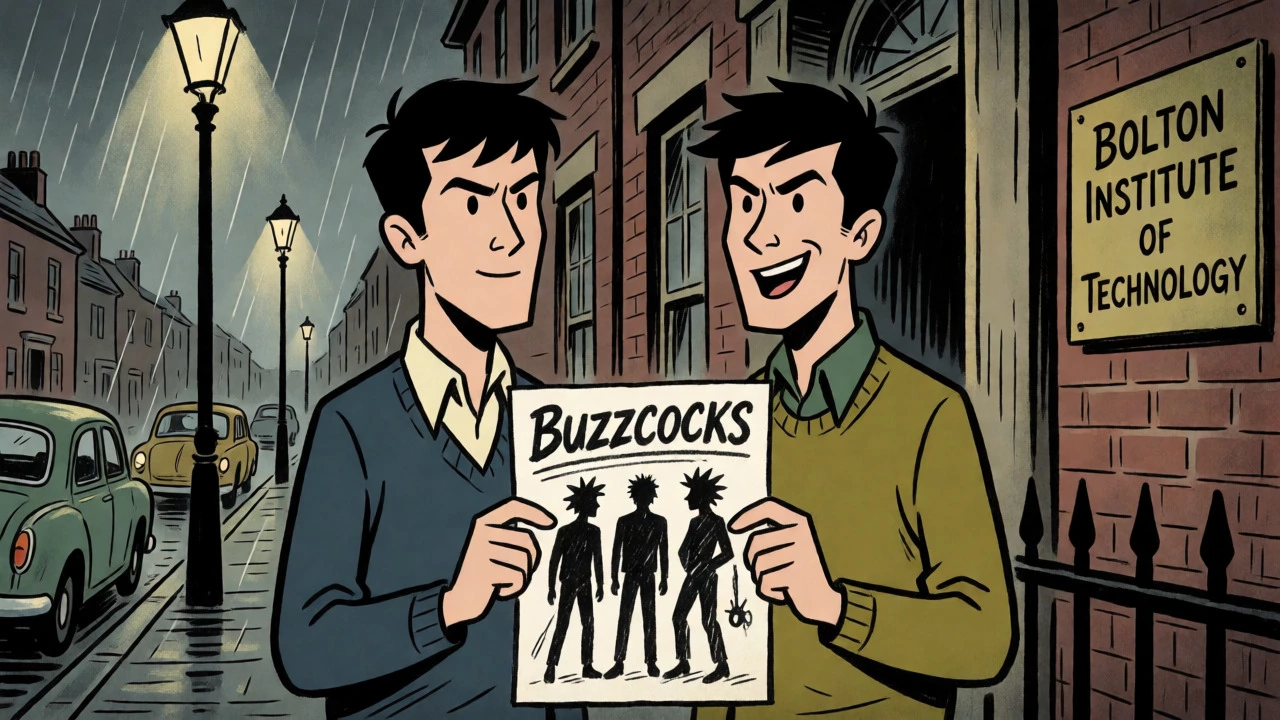
It started in February 1976 at the Bolton Institute of Technology. Two students, Pete Shelley and Howard Devoto, bonded over a magazine article about the Sex Pistols. They weren't just fans; they were organizers. They booked the Sex Pistols' first Manchester gig at the Lesser Free Trade Hall in June 1976. Only about forty people showed up, but those attendees included future legends like Ian Curtis of Joy Division and Morrissey. This event sparked a local scene, but Shelley and Devoto wanted more control.
Their solution was radical for the time: do it yourself. In December 1976, they recorded four songs in one day at Indigo Sound Studio. The result was the EP Spiral Scratch. Released on their own label, New Hormones, it cost them £500 to press. It sold around 16,000 copies and hit the UK independent charts. This proved that unsigned bands didn't need major label backing to reach an audience. It was the economic proof that fueled the entire independent music infrastructure of the 1980s.
Codifying the Pop-Punk Template
After Devoto left to form Magazine, Shelley took the reins as primary songwriter. He shifted the focus from pure anger to something more complex: romantic anxiety set to blistering speed. Between 1978 and 1979, Buzzcocks released three albums that defined their aesthetic: Another Music in a Different Kitchen, Love Bites, and A Different Kind of Tension.
These records weren't just fast; they were meticulously composed. Critics often note that while the Sex Pistols opened the door for hardcore punk, Buzzcocks walked through it carrying a guitar case full of pop hooks. As Mark Deming of AllMusic put it, they brought "crisp melodies" and "driving guitars" to the three-minute pop song. They took the structural simplicity of punk-verse, chorus, verse-and injected it with the harmonic sophistication of British Invasion bands like The Kinks and The Who.
| Album Title | Release Year | UK Chart Peak | Defining Characteristic |
|---|---|---|---|
| Another Music in a Different Kitchen | 1978 | #15 | Dense layering of distorted yet tuneful guitars; established the core sound. |
| Love Bites | 1978 | #13 | Home to "Ever Fallen in Love"; perfect balance of hook and heartbreak. |
| A Different Kind of Tension | 1979 | #26 | More experimental structures; featured the proto-indie track "Why Can't I Touch It?". |
The Anatomy of a Hook: "Ever Fallen in Love"
To understand how they balanced edge and melody, look at the single "Ever Fallen in Love (With Someone You Shouldn’t’ve?)". Released in 1978, it reached number 29 in the UK. On the surface, it’s a breakup song. But dig deeper, and you find a gender-neutral queer love story written during an era of hyper-masculine punk posturing.
Musically, the song is a masterclass in tension. The verses ride a nervous, churning minor-key riff with drums sprinting at a metronomic pace. It feels anxious, urgent. Then the chorus blooms. Shelley stacks vocal harmonies reminiscent of girl-group records, but plays them at double speed. It’s joyful and destructive simultaneously. This isn't just noise; it's emotional precision. The lyrics turn personal frustration into a communal singalong, proving that punk could be vulnerable without losing its teeth.
Singles Going Steady: The Ultimate Case Study
If you only listen to one Buzzcocks record, make it the compilation Singles Going Steady. Released in 1979 for the US market, it places eight A-sides on one side and eight B-sides on the other. The A-side runs through hits like "Orgasm Addict," "What Do I Get?," and "Harmony in My Head." These tracks showcase the progression from sexually charged comedy to sophisticated examinations of romantic failure.
The B-side is where the experimentation lives. Tracks like "Noise Annoys" and "Something’s Gone Wrong Again" feature dissonant lead lines and dub-like bass figures. Rolling Stone noted in 1980 that the album captures Shelley’s attempt to reconcile unwavering romanticism with explosive energy. This duality is key. The band never sacrificed the hook for the sake of aggression, nor did they polish away the rough edges for radio play. They kept both, creating a sonic identity that felt raw yet refined.
Legacy and Modern Relevance
Buzzcocks’ influence stretches far beyond the 1970s. By proving that pop-punk was viable, they laid the groundwork for Nirvana, Green Day, The Offspring, and Blink-182. PopMatters has argued that early albums by these later giants show more obvious Buzzcocks influence than that of The Clash or The Damned. Their impact wasn't just musical; it was structural. The success of Spiral Scratch inspired Rough Trade founder Geoff Travis and others to build the independent distribution networks that allowed Factory Records and countless other labels to thrive.
Even today, the band remains active. Following Pete Shelley’s death in 2018, guitarist Steve Diggle continued leading the group. Their 2026 release, Attitude Adjustment, received positive reviews for maintaining that classic balance. Clash Magazine called it a "triumphant return," noting that despite five decades passing, the combination of raw energy and melodic smarts still works. Fans on forums like Reddit continue to debate their best singles, with "Everybody’s Happy Nowadays" and "Ever Fallen in Love" consistently topping polls.
So, why does this matter now? Because we live in an era where genre boundaries are blurred. Buzzcocks were doing it before it was cool. They showed that you can be smart and loud, emotional and aggressive, indie and mainstream. If you're starting a band and want to write songs that stick in people's heads without sounding generic, study Buzzcocks. Keep the tempos high, keep the chords simple, but let the melodies breathe.
Did Buzzcocks invent pop-punk?
While they may not have been the absolute first to mix pop and punk, critics and historians widely credit Buzzcocks with crystallizing pop-punk as a distinct subgenre. They pioneered the template of playing melodic pop tunes at punk velocity with emotionally direct lyrics, influencing later acts like Green Day and Blink-182.
Why is the 'Spiral Scratch' EP significant?
Released in 1977 on their own label New Hormones, 'Spiral Scratch' demonstrated that unsigned bands could finance, record, and distribute music independently. Its commercial success proved the viability of the DIY model, inspiring the rise of independent labels across the UK.
Who wrote most of the Buzzcocks songs?
After founding member Howard Devoto left in 1977, Pete Shelley became the primary songwriter and frontman. Guitarist Steve Diggle also contributed significantly to the band's melodic direction and co-wrote many hits.
Are Buzzcocks still touring?
Yes, as of 2026, Buzzcocks remain active. Led by original member Steve Diggle following Pete Shelley's passing in 2018, the band continues to tour and has released new material, including the album 'Attitude Adjustment'.
What is the best starting point for new listeners?
The compilation 'Singles Going Steady' is widely considered the definitive introduction. It collects their essential A-sides and B-sides from 1977-1979, showcasing their ability to balance catchy hooks with punk energy in concise packages.


